Quotes for Nephew From Aunt and Uncle: 12 Lines From Real Letters and Books
Words My Family Quotes Editors

In August 1785, Thomas Jefferson was in Paris as the American minister to France when a letter arrived from his fifteen-year-old nephew, Peter Carr. Peter's father had died when he was three, and Jefferson had taken over his education. His answer ran to several pages of reading lists and one paragraph of advice that people still copy out more than two centuries later. That is the best case for quotes for a nephew from an aunt or uncle: the most quotable lines were written by real aunts and uncles to real boys, usually at a turning point.
This page gathers 12 of those lines, each checked word for word in the letter, novel or verse it comes from: Jane Austen congratulating her nephew on leaving school, Jefferson's advice to Peter Carr, Emily Dickinson's letter after her eight-year-old nephew died, two scenes of Aunt Polly and Tom Sawyer, Betsey Trotwood in David Copperfield, Scrooge knocking on his nephew's door, and two Bible passages about a "sister's son". Each section ends with what you can borrow when you write to your own nephew, and a short guide at the end shows how to turn a quote into a card. If you are writing to a niece instead, our quotes for niece from aunt page works from a different set of letters.
The 12 lines at a glance
| Moment | Line to borrow | From |
|---|---|---|
| He is a handful | "the best-hearted boy that ever was" | Aunt Polly, Tom Sawyer (1876) |
| You forgive him | "if he'd committed a million sins" | Aunt Polly, Tom Sawyer (1876) |
| He finishes school | "I give you joy of having left Winchester" | Jane Austen, letter, 1816 |
| He writes or makes things | "strong, manly, vigorous sketches" | Jane Austen, letter, 1816 |
| He is about to choose a path | "A fine firm fellow, with a will of your own" | Betsey Trotwood, Copperfield (1850) |
| He needs a rule to live by | "Give up money, give up fame" | Jefferson, letter, 1785 |
| Nobody is watching | "were all the world looking at you" | Jefferson, letter, 1785 |
| You have drifted apart | "Will you let me in, Fred?" | Dickens, A Christmas Carol (1843) |
| He stood up for you | "Paul's sister's son heard" | Acts 23:16, KJV |
| He deserves a second chance | "if he come unto you, receive him" | Colossians 4:10, KJV |
| He has died | "I see him in the Star" | Emily Dickinson, letter, 1883 |
| For the memorial card | "Pangless except for us" | Emily Dickinson, letter, 1883 |
When he drives you mad and you love him anyway
The most famous aunt-and-nephew pair in American fiction is Aunt Polly and Tom Sawyer. Tom is the son of Polly's late sister, and Mark Twain gives her both halves of the job: the switch in her hand and the soft heart that keeps her from using it. Our aunt quotes from literature page has her famous first-chapter speech; these two lines come later, when she believes Tom has drowned.
"He warn't bad, so to say—only mischeevous. Only just giddy, and harum-scarum, you know. He warn't any more responsible than a colt. He never meant any harm, and he was the best-hearted boy that ever was."
— Mark Twain, The Adventures of Tom Sawyer, chapter XV (1876)
Tom, Joe Harper and Huck have run off to an island, and the town thinks they are dead. Tom sneaks home at night and hides under the bed while his aunt says this to Joe's mother, and then she cries. The joke is that the "dead" boy hears every word; the truth under the joke is that the aunt describes him better than any report card could. "He never meant any harm" is a good line for a birthday card to a nephew who has broken something expensive this year.
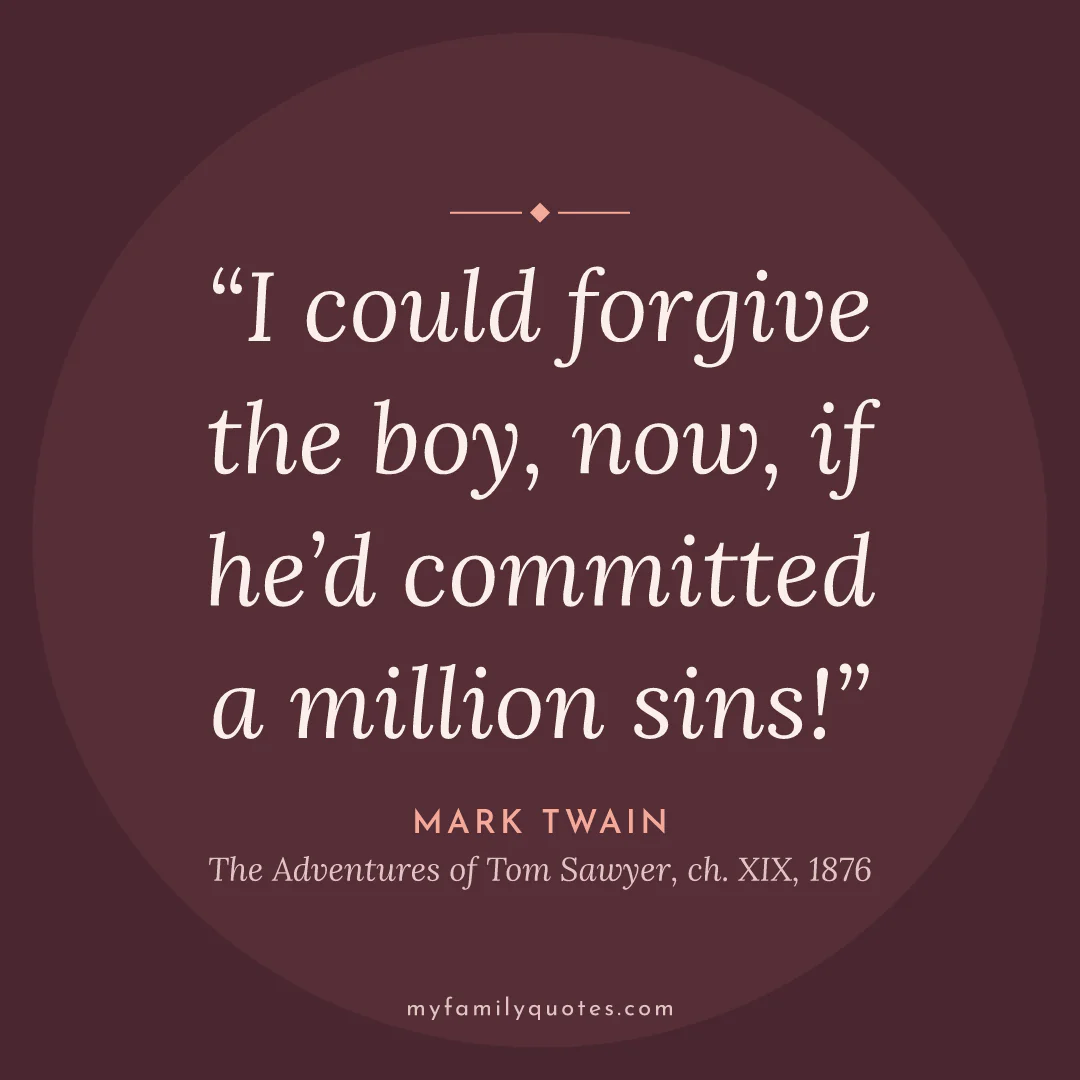
"I could forgive the boy, now, if he'd committed a million sins!"
— Mark Twain, The Adventures of Tom Sawyer, chapter XIX (1876)
After the boys reappear at their own funeral, Polly finds a piece of bark in Tom's jacket pocket. He had written on it that he was not dead, meaning to leave it for her, and then had not. She reads it "through flowing tears". The sentence is pure Polly: exaggerated, forgiving, a little absurd. It suits a note after a teenage nephew's first real mistake, when you want him to know the door is still open.
What to borrow: name one specific trait, not a general virtue. Polly does not say "he's a good boy"; she says he is like a colt. A card that says "you have never once arrived anywhere quietly" will mean more to a ten-year-old than "you're special".
When he finishes school: Jane Austen's letter to James Edward
Jane Austen had many nephews, and the one she wrote to in December 1816 was James Edward Austen, then eighteen and just home from Winchester College. He was also trying to write a novel. Fifty-three years later he published the Memoir of Jane Austen at the end of 1869, and he printed this letter in it; the lines below are from the enlarged 1871 edition.
"One reason for my writing to you now is, that I may have the pleasure of directing to you Esqre. I give you joy of having left Winchester. Now you may own how miserable you were there; now it will gradually all come out, your crimes and your miseries."
— Jane Austen to James Edward Austen, Chawton, 16 December 1816 (in J. E. Austen-Leigh, A Memoir of Jane Austen, 1871 ed.)
The first joke is about the address on the envelope. A schoolboy was "Master"; a young man who has left school can be written to as "Esquire", and his aunt is delighted to be the first to do it. The second joke, about the crimes he can now confess, is how a good aunt congratulates: she treats him as a grown-up who is allowed to admit that school was not wonderful. This is the best graduation line on this page, because it is about the graduate, not about the future.
"What should I do with your strong, manly, vigorous sketches, full of variety and glow? How could I possibly join them on to the little bit (two inches wide) of ivory on which I work with so fine a brush, as produces little effect after much labour?"
— Jane Austen to James Edward Austen, 16 December 1816 (same letter)
James Edward had lost two and a half chapters of his manuscript, and his aunt teases that nobody can suspect her of stealing them. Then she turns it into praise: his writing is bold and broad, hers is miniature painting on ivory. Readers now quote the "two inches wide" phrase as Austen's own description of her art, and they are right to, but it was written to cheer up a nephew. It is the model for writing to a nephew who makes things, whether that is music, code or furniture: praise the work by name, and make yourself smaller in the comparison.
"But what I want you to be, Trot, … is, a firm fellow. A fine firm fellow, with a will of your own. With resolution … With determination. With character, Trot—with strength of character that is not to be influenced, except on good reason, by anybody, or by anything."
— Charles Dickens, David Copperfield, chapter 19 (1850); Betsey Trotwood speaking
Betsey Trotwood is David's great-aunt, his father's aunt, who took him in when he ran away. This speech comes in the chapter where his school days at Doctor Strong's end and he must choose a profession. We have shortened it: the "…" removes the narrator's tag and her aside that she means character, not health, and the second "…" cuts the narration where she shakes her cap at him. The phrase "except on good reason" is what makes it more than a pep talk: she wants him firm, not stubborn. It fits a card for a nephew leaving for college or his first job.
When he needs advice: an uncle writing from Paris
Back to Jefferson. Peter Carr was the son of Jefferson's sister Martha and his close friend Dabney Carr. His letter of 20 April 1785 had confessed that he had wasted time at school, and Jefferson's reply begins by scolding him. Then it changes tone.
"Give up money, give up fame, give up science, give the earth itself and all it contains, rather than do an immoral act."
— Thomas Jefferson to Peter Carr, Paris, 19 August 1785 (text from the Avalon Project, Yale Law School)
Notice the order of the list: money, then fame, then learning (Jefferson's "science"), then the whole world. Each item is bigger than the last, and the one he loved most himself sits near the top. We quote the wording exactly as the Avalon transcription prints it ("give the earth itself"). This is the line for a nephew facing his first real temptation, or for the card you tuck into a graduation present.
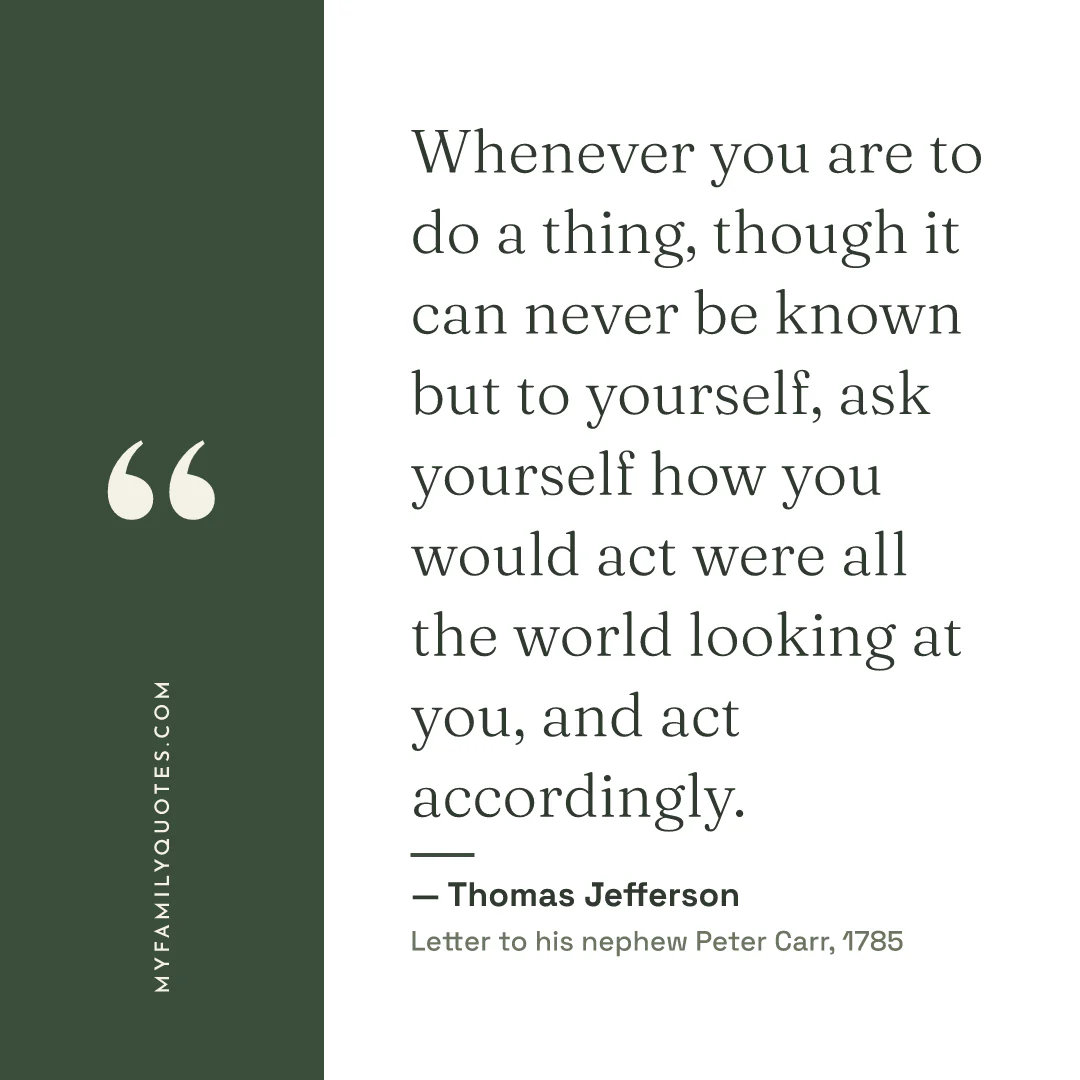
"Whenever you are to do a thing, though it can never be known but to yourself, ask yourself how you would act were all the world looking at you, and act accordingly."
— Thomas Jefferson to Peter Carr, 19 August 1785 (same letter)
A sentence later, Jefferson adds that virtues "will gain strength by exercise, as a limb of the body does". That is the practical heart of the letter: character is a habit, built in small private moments. An uncle can write this line out by hand on the inside cover of a book. It needs no explanation, and it reads as well at sixty as at fifteen.
What to borrow: advice lands better after a confession. Jefferson spends a paragraph on Peter's lost time before he gets to the moral rule, so the rule answers a real problem instead of floating in the air. If you want to give a nephew advice, start with the thing he is actually worried about. For more on what makes a good uncle, see our uncle quotes page.
When you have drifted apart
Not every uncle is Jefferson. Ebenezer Scrooge's nephew Fred is the son of Scrooge's dead sister Fan, and in Stave One he walks into the counting-house to invite his uncle to Christmas dinner and is turned away. In Stave Three he tells his guests, "I mean to give him the same chance every year, whether he likes it or not, for I pity him." In Stave Five, Scrooge finally takes the chance.
"Why bless my soul!" cried Fred, "who's that?"
"It's I. Your uncle Scrooge. I have come to dinner. Will you let me in, Fred?"
— Charles Dickens, A Christmas Carol, Stave Five (1843)
Dickens answers the question in the next line: "Let him in! It is a mercy he didn't shake his arm off." The whole reconciliation takes four short sentences, and that is the lesson. If you are an aunt or uncle who has been absent, the first message does not need to explain the years. "Will you let me in?" is enough, said plainly, and it is the nephew's own patience, renewed every year, that makes it possible.
Nephews in the Bible: the "sister's son"
When the King James Version says "nephews" it usually means grandchildren (1 Timothy 5:4 is an example). For a brother's or sister's boy it simply says "brother's son" or "sister's son". Abram's nephew Lot is introduced as "Lot his brother's son" (Genesis 12:5), and Abram later rides out to rescue him. Two New Testament passages are even more useful for a card.
"And when Paul's sister's son heard of their lying in wait, he went and entered into the castle, and told Paul."
— Acts 23:16, King James Version
More than forty men had sworn not to eat until they had killed Paul. His nephew, never named, overhears the plot, walks into the Roman fortress and warns his uncle, and the commander moves Paul out of Jerusalem that night under guard. It is the only scene in the Bible where a nephew saves his uncle's life, and it is the verse for a nephew who has stood up for you.
"Aristarchus my fellowprisoner saluteth you, and Marcus, sister's son to Barnabas, (touching whom ye received commandments: if he come unto you, receive him;)"
— Colossians 4:10, King James Version
A translation note: the Greek word here is usually rendered "cousin" in modern Bibles such as the ESV and NIV, so Mark may have been Barnabas's cousin rather than his nephew. The story behind the verse is worth knowing either way. In Acts 15, Paul refused to take Mark on a second journey because he had left the first one early, and Barnabas split with Paul rather than abandon his young relative. By the time Colossians was written, Paul is asking churches to welcome Mark. "If he come unto you, receive him" is a fine line for a nephew who is starting over.
When a nephew dies: Emily Dickinson's letter to Sue
Thomas Gilbert Dickinson, called Gib, was the youngest child of Emily Dickinson's brother Austin and his wife Susan, who lived next door. In the autumn of 1883 he caught typhoid fever, and he died on 5 October at the age of eight. According to the Emily Dickinson Museum, Dickinson, who rarely left her house by then, went next door to sit by his bed the night before he died. Afterward she wrote to his mother. In one passage she remembers him crying out "Dont tell, Aunt Emily"! (her spelling), a boy who, as she puts it, "rejoiced in Secrets".
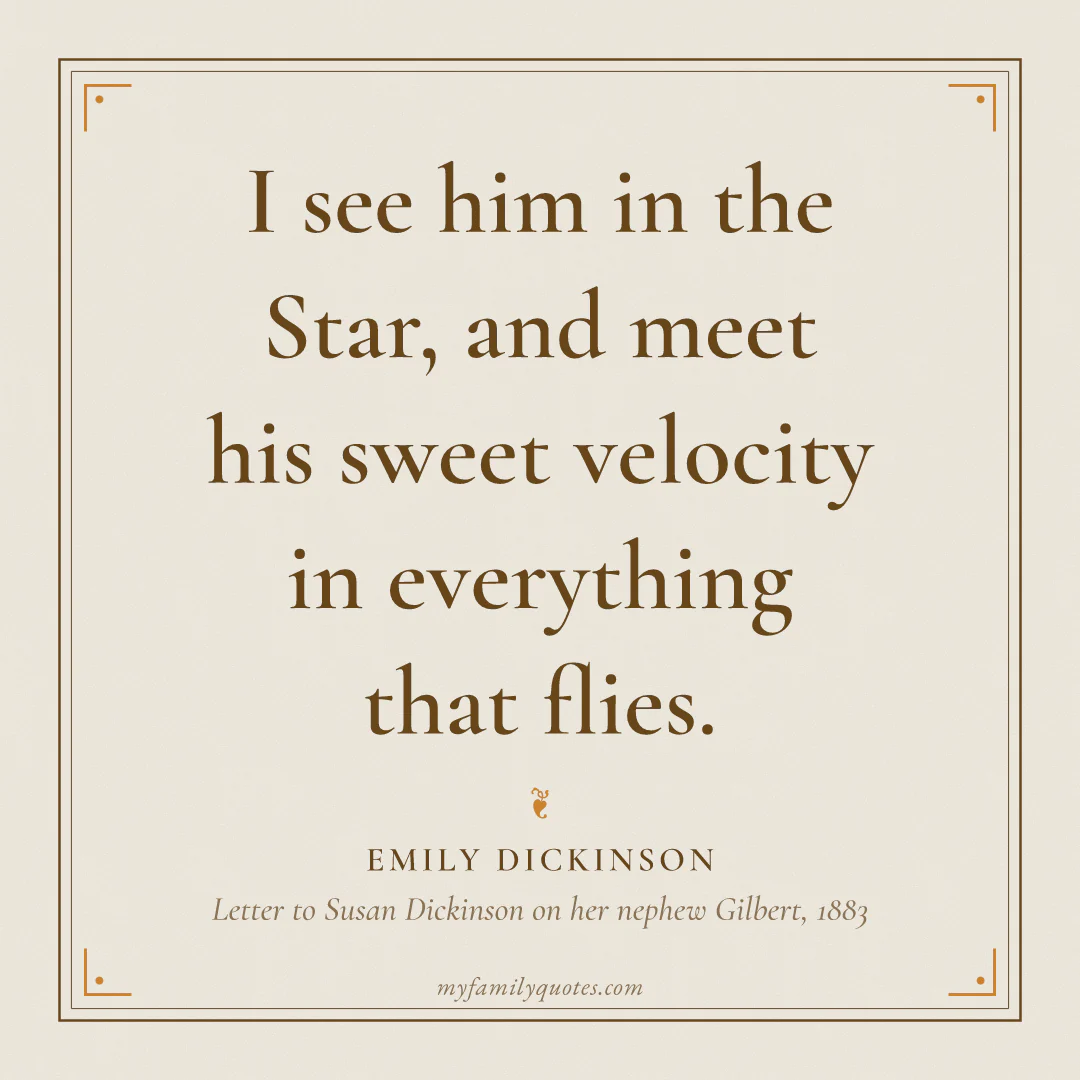
"I see him in the Star, and meet his sweet velocity in everything that flies - His Life was like the Bugle, which winds itself away, his Elegy an Echo - his Requiem Ecstacy -"
— Emily Dickinson to Susan Dickinson, October 1883 (manuscript H B79, Johnson L868; transcription at the Dickinson Electronic Archives)
We have kept Dickinson's dashes and her spelling "Ecstacy". The image of the bugle is exact: a bugle call does not stop suddenly, it "winds itself away", and the echo stays in the air after the note is gone. For an aunt or uncle who has lost a nephew, the first clause alone, "I see him in the Star", is a gentle line for a memorial card or a candle.
"Pass to thy Rendezvous of Light, / Pangless except for us - / Who slowly ford the Mystery / Which thou hast leaped across!"
— Emily Dickinson to Susan Dickinson, October 1883 (closing lines of manuscript H B79)
The letter ends with these four lines, which were later printed as a separate poem. The contrast does the work: the child "leaped across", the grown-ups "slowly ford". "Pangless except for us" says in three words what grieving relatives often cannot say at all: he is past the pain, and it has all passed to the people who loved him. If you are writing to a brother or sister who has lost a son, these lines can stand alone on a card, signed with your name and nothing else. Our page on losing a brother has more lines for family grief.
How to write your own note to a nephew
The letters above share a pattern that works for birthdays, graduations and hard days alike:
- Start with something only you would know. Austen opens with the envelope joke; Polly with "harum-scarum". A detail proves the note was written for him.
- Treat him one step older than he is. Austen calls an eighteen-year-old "Esquire"; Jefferson gives a fifteen-year-old an adult's moral rule. Nephews remember being taken seriously.
- Give one piece of advice, not five. If you use a quote, let it carry the advice and add a single sentence of your own.
- Leave the door open. Fred's "same chance every year" and Polly's forgiveness are what make these relatives worth quoting. End with an invitation, a date or a promise.
Four samples written by our editors (not quotations) to show the pattern:
- Birthday, from an aunt: "Twain's Aunt Polly called Tom 'the best-hearted boy that ever was'. She had clearly never met you. Happy 10th, troublemaker."
- Graduation, from an uncle: "Jefferson told his nephew to act as if all the world were looking. Most of the world won't be, which is exactly when it counts. Proud of you."
- Leaving home: "Jane Austen congratulated her nephew on leaving school by finally being allowed to write 'Esquire' on his letters. Consider this the first one addressed to you as a grown man."
- Reaching out after years apart: "I know it has been too long. Like Scrooge at Fred's door, I'm asking: will you let me in? Dinner is on me, whenever you say."
About the unsigned nephew sayings
Most lines on the popular nephew quote lists and image boards carry no name at all, or a first name with no source. They can still be lovely on a card, but treat them as sayings, not quotations, and don't add a famous name to make them sound weightier. If a line arrives with a celebrity's name and no book, speech or date, it is worth checking before you print it; our page on misattributed family quotes shows how often family lines get the wrong author.
Questions about quotes for a nephew
What is a short quote for a nephew from an aunt?
"He never meant any harm, and he was the best-hearted boy that ever was" (Aunt Polly in Mark Twain's Tom Sawyer, 1876) for a playful card, or "I give you joy" from Jane Austen's 1816 letter to her nephew for a graduation.
What is a good quote for a nephew from an uncle?
Thomas Jefferson's advice to his nephew Peter Carr, 19 August 1785: "ask yourself how you would act were all the world looking at you, and act accordingly." It is short enough for a card and was actually written by an uncle to a nephew.
Is there a Bible verse about a nephew?
Acts 23:16 tells how "Paul's sister's son" overheard a plot to kill Paul and warned him. Colossians 4:10 calls Mark "sister's son to Barnabas" in the King James Version, though modern translations usually say "cousin".
What can you write to an aunt or uncle who lost a nephew?
Emily Dickinson's lines on the death of her eight-year-old nephew in 1883 are gentle and short: "I see him in the Star." Add a sentence naming something you remember about him, and offer something concrete, such as a meal or a visit.
For the other side of the family tree, start with our cousin quotes and messages and, for an aunt who is just finding out, aunt to be quotes.