Misattributed Family Quotes: Who Really Said Them (14 Lines Traced to the Source)
Words My Family Quotes Editors
The Mother's Day line most often credited to Rudyard Kipling, "God could not be everywhere, and therefore he made mothers", was printed in German in 1862, three years before Kipling was born. That is typical of family quotations. They are copied onto cards, cross-stitched onto cushions and pasted into Father's Day posts, and somewhere along the way the name at the bottom changes to someone more famous.
This page traces 14 of the most widely shared family, mother, father and grandparent quotations back to the earliest source we could find. For each one you get the popular wording, the name it usually travels under, what the printed record actually shows (with a link to the evidence), and a line you can use instead that is correctly attributed. A few of the famous lines turned out to be genuine, and we say so. We will keep this page updated as new evidence turns up. Last checked: 9 October 2026.
How we check a quote
Every entry below went through the same five steps. You can use them yourself before you put a quotation on a card, a slide or a gravestone.
- Find the exact wording that is circulating. Small changes matter. "Relations" becomes "relatives", "her" becomes "my angel mother", and the new version can be searched separately.
- Look for it in the person's own work. For writers who died before 1930 the full texts are usually on Project Gutenberg or the Internet Archive, so a text search either finds the line or it does not. For speeches we go to the official transcript (for example the Nobel Foundation's).
- Check the specialist researchers. Quote Investigator (Garson O'Toole) and Barry Popik search digitized newspapers and books for the earliest dated appearance. Wikiquote keeps "Misattributed" and "Disputed" sections with cited sources.
- Date the first appearance and see who it was credited to then. A quote that first appears years after the supposed author died, or first appears credited to someone else, is a red flag.
- Write the verdict plainly. We use four: genuine (found in the author's own work), altered (the person said something, but not this), misattributed (someone else said it first) and no known source (nobody has found an origin; the famous name came later).
What we do not do: we do not treat a quote as verified because it appears on many websites, in a "quotes" book with no references, or on a poster. Repetition is how misattributions spread.
The 14 quotes at a glance
| Popular quote (short form) | Usually credited to | What the record shows | Verdict |
|---|---|---|---|
| "God could not be everywhere, so he created mothers" | Rudyard Kipling | German, 1862 (Hess, quoting a character of Leopold Kompert); English in Ben-Hur, 1880, as an "old rabbi's" saying | Misattributed |
| "All that I am, or hope to be, I owe to..." ("angel mother") | Abraham Lincoln | Herndon (1889) reports a plainer version ending "I owe to her", with no "angel"; "angel mother" first appears in Holland's 1866 biography | Altered |
| "Go home and love your family" | Mother Teresa | Not in her 1979 Nobel speech or lecture; she said love begins at home and spreads outward | Altered |
| "Mother is the name for God in the lips and hearts of little children" | W. M. Thackeray | Vanity Fair, ch. 37 (1848), in an ironic passage | Genuine |
| "The hand that rocks the cradle is the hand that rules the world" | William Ross Wallace (sometimes "anonymous") | Wallace's poem "What Rules the World", 1865 | Genuine |
| "When I was a boy of 14..." (the "ignorant father" line) | Mark Twain | First credited to Twain in 1915, five years after his death; not in his writings | No known source |
| "Two lasting bequests... roots, the other, wings" | Goethe, Henry Ward Beecher, Jonas Salk | Hodding Carter, 1953, quoting an unnamed "wise woman" | Misattributed |
| "If you want your children to be intelligent, read them fairy tales" | Albert Einstein | Secondhand anecdote, 1958; the popular wording is not his | Altered |
| "It takes a village to raise a child" | "African proverb" | No specific language or people traced; similar ideas in Swahili and Kijita sayings | No known source (as worded) |
| "Children learn what they live" | Anonymous | Dorothy Law Nolte, Torrance Herald, 1954 | Misattributed (author known) |
| "Insanity is hereditary; you get it from your children" | Erma Bombeck, W. C. Fields, Ann Landers | Sam Levenson, credited in print in April 1961 | Misattributed |
| "Never have children, only grandchildren" | Gore Vidal | Vidal quoting his grandfather, Senator Thomas Gore, in Palimpsest (1995) | Misattributed |
| "The blood of the covenant is thicker than the water of the womb" | "The original proverb" | No source before the 1990s; the real proverb is centuries old and means the opposite | No known source |
| "The bond that links your true family is not one of blood..." | Richard Bach | Illusions (1977) | Genuine |
Lines about mothers
"God could not be everywhere, and therefore he made mothers"
Usually credited to: Rudyard Kipling, sometimes "a Jewish proverb".
What the record shows: Barry Popik's citation file finds it in Moritz Hess's Rom und Jerusalem (1862), where Hess quotes "die alte Babele" from Leopold Kompert's stories of Bohemian Jewish life: "Gott konnte nicht überall sein, darum hat er die Mutter geschaffen." Kipling was born in 1865. The first well-known English appearance is in Lew Wallace's novel Ben-Hur (1880), Book Four, chapter 9, where Ben-Hur recalls his mother and sister and says he has "never seen harm in the saying of the old rabbi". We checked that passage in the Project Gutenberg text. Popik notes that it has been credited to Kipling since at least the 2000s, but nobody has found the line in Kipling's work.
Verdict: misattributed. If you want to credit someone, "a Jewish saying, quoted in Lew Wallace's Ben-Hur (1880)" is accurate.
"God could not be everywhere, and, therefore, he made mothers." — Lew Wallace, Ben-Hur: A Tale of the Christ, Book Four, chapter 9, 1880 (quoting "the old rabbi")
In the novel the line is not sweet at all. Ben-Hur says it moments before telling how Roman soldiers broke into the family house and how he has not seen his mother or sister since. If you use it, you are quoting a son who does not know whether his mother is alive.
"All that I am, or hope to be, I owe to my angel mother"
Usually credited to: Abraham Lincoln.
What the record shows: Lincoln left no such sentence in his own writings. It comes from people who knew him. His law partner William Herndon, in Herndon's Lincoln (1889), vol. 1, pages 3–4, describes a buggy ride on which Lincoln talked about his mother, Nancy Hanks, and the qualities he believed he had inherited from her. Herndon's wording is "God bless my mother; all that I am or ever hope to be I owe to her" (scan on the Internet Archive). There is no "angel" in it. Wikiquote traces the "angel mother" version to Josiah G. Holland's Life of Abraham Lincoln (1866, p. 23) and George Alfred Townsend (1867). Some retellings apply the "angel mother" version to his stepmother, Sarah Bush Lincoln, but Herndon's account settles which mother he meant: the remark came on a ride to court in Menard County, Illinois, about 1850, in a talk about inherited traits, right after Lincoln said his mother was "the illegitimate daughter of Lucy Hanks and a well-bred Virginia farmer or planter" and credited his "better nature and finer qualities" to that "broad-minded, unknown Virginian." Herndon's line is about Nancy Hanks.
Verdict: altered. The memory is plausible and comes from a close colleague, but the famous wording is a biographer's polish, and it is reported speech either way.
Use instead: Herndon's version, labelled as reported speech. Credit it as "Lincoln, as recalled by William Herndon, Herndon's Lincoln". The words are: "God bless my mother; all that I am or ever hope to be I owe to her." For more lines about mothers and sons with the source attached, see our mother and son quotes traced to the poem, letter or speech they came from.
"Go home and love your family"
Usually credited to: Mother Teresa, supposedly answering a reporter who asked what people could do for world peace when she received the Nobel Peace Prize in 1979.
What the record shows: We read both of her Nobel texts. The phrase is in neither. In her acceptance speech of 10 December 1979 she said that if we love, "naturally, we will try to do something. First in our own home, our next door neighbor, in the country we live, in the whole world." In her Nobel lecture of 11 December she said "Love begins at home". We found no contemporary report of the reporter exchange. Columnist Laura Kelly Fanucci reached the same conclusion in "What Mother Teresa actually said about home" (August 2024): the short version keeps the home and drops the "whole world".
Verdict: altered. The sentiment is hers; the four-word slogan is not on the record.
"Love begins at home, and it is not how much we do, but how much love we put in the action that we do." — Mother Teresa, Nobel Lecture, Oslo, 11 December 1979
This is the documented line, and it is more interesting than the slogan. She was talking about effort, not geography: the amount you do matters less than the love you put into it. It suits a card for a parent who does a hundred small things nobody notices.
Two mother quotes that are exactly what they claim to be
Not everything famous is fake. These two are often reposted with "Unknown" or a wrong name, but the original authors are documented.
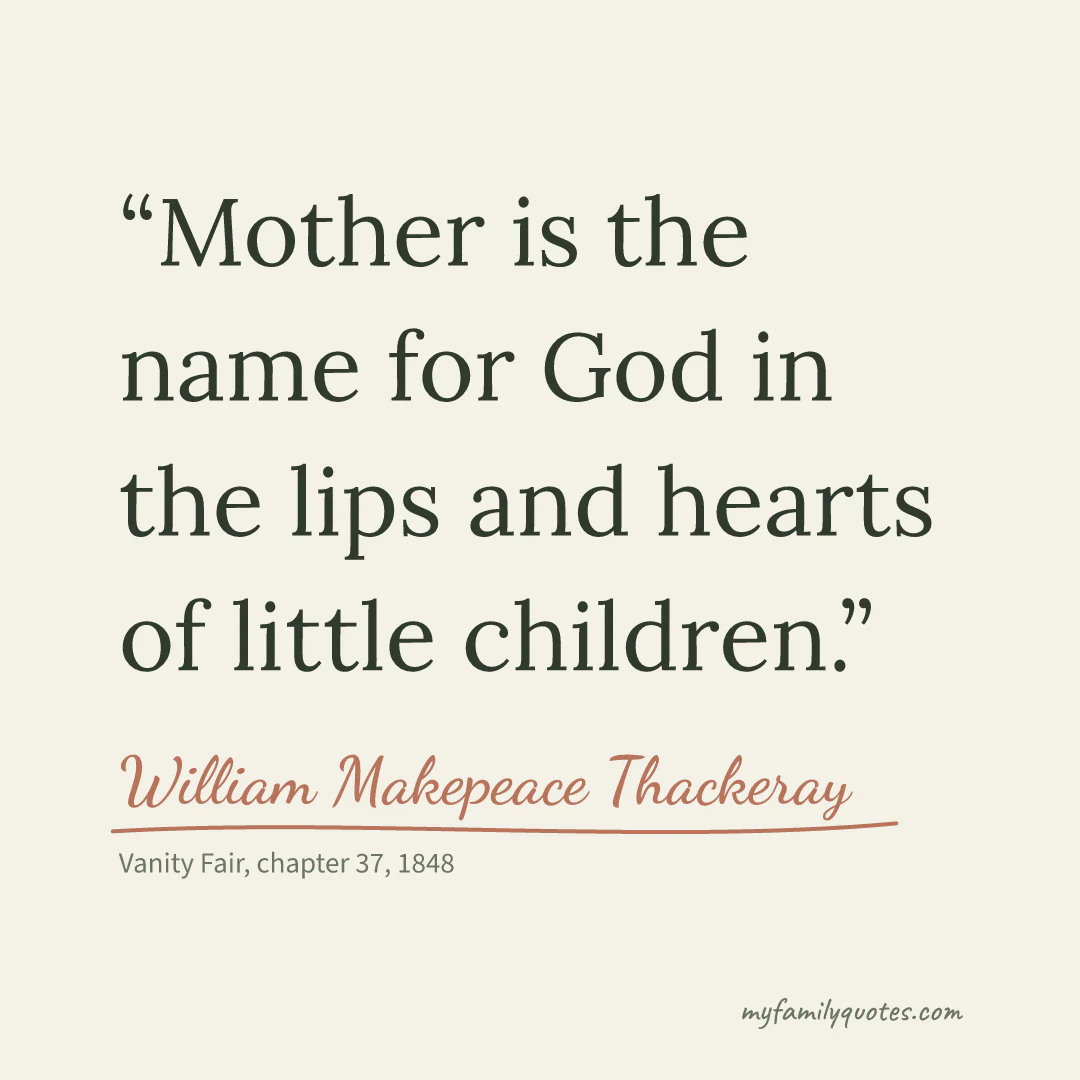
"Mother is the name for God in the lips and hearts of little children." — William Makepeace Thackeray, Vanity Fair, chapter 37, 1848
The line is genuine (Gutenberg text), but its context is usually lost. Thackeray is describing little Rawdon Crawley, a neglected boy who adores his glamorous mother, Becky Sharp, from a distance. The full sentence ends: "and here was one who was worshipping a stone!" It is a line about how children love even mothers who do not deserve it. On a card for a loving mother it still works, but now you know where it comes from.
"For the hand that rocks the cradle / Is the hand that rules the world." — William Ross Wallace, "What Rules the World", 1865
The American poet William Ross Wallace published the poem in 1865 under the title "What Rules the World" (Wikipedia); Bartlett's Familiar Quotations (10th edition, 1919) credits it to him (Wikiquote). It is often printed as anonymous or as a proverb, and the 1992 thriller of the same name has given it a darker echo. Credit Wallace and you are on safe ground.
Lines about fathers
"When I was a boy of 14, my father was so ignorant I could hardly stand to have the old man around"
Usually credited to: Mark Twain. It continues: "But when I got to be 21, I was astonished at how much the old man had learned in seven years."
What the record shows: Quote Investigator found the earliest Twain attribution in The Square Deal magazine in December 1915, in an article by Fred N. Rindge, with different ages (seventeen and twenty-five). The modern wording settled in a 1937 Reader's Digest item. Twain died in 1910, and no one has found the line in his books, notebooks or letters. There is also a biographical problem: Twain's father, John Marshall Clemens, died in 1847, when Twain was eleven, so there was no father around at 21 to admire.
Verdict: no known source. It works well as an anonymous joke; it should not carry Twain's name.
"It is a wise father that knows his own child." — William Shakespeare, The Merchant of Venice, Act 2, scene 2, c. 1596
A real line with a real joke behind it. Launcelot Gobbo says it to his own father, old Gobbo, who is nearly blind and does not recognise him. It is the same comedy as the Twain story turned around: here it is the father who cannot see the son clearly. Our funny family quotes with their sources have more lines in this spirit.
Lines about raising children
"There are only two lasting bequests we can hope to give our children. One of these is roots, the other, wings"
Usually credited to: Johann Wolfgang von Goethe, Henry Ward Beecher, or Jonas Salk.
What the record shows: Quote Investigator traces it to the journalist Hodding Carter's book Where Main Street Meets the River (1953), chapter 27, where he wrote: "A wise woman once said to me that there are only two lasting bequests we can hope to give our children. One of these is roots, the other, wings." The Beecher credit had no supporting evidence (it was repeated in a 1982 White House Grandparents Day message), and the Salk credits appear decades after Carter. We found no Goethe source, and QI's history of the saying does not include one.
Verdict: misattributed. The honest credit is "Hodding Carter, 1953, quoting an unnamed wise woman".
"If you want your children to be intelligent, read them fairy tales. If you want them to be more intelligent, read them more fairy tales"
Usually credited to: Albert Einstein.
What the record shows: Stephen Winick of the Library of Congress's American Folklife Center followed this one back to the New Mexico Library Bulletin of January 1958. A librarian, Elizabeth Margulis, recounted a story in which Einstein recommended "fairy tales and more fairy tales" to a mother who wanted her child to become a scientist. It is a secondhand anecdote, and the neat two-sentence version grew out of it in retelling. Winick calls the popular quotation folklore.
Verdict: altered at best. "Einstein reportedly recommended fairy tales" is fair; putting the polished quotation in his mouth is not.
"My first and last philosophy, that which I believe in with unbroken certainty, I learnt in the nursery." — G. K. Chesterton, Orthodoxy, chapter 4, "The Ethics of Elfland", 1908
If you want a writer's case for fairy tales, Chesterton made it in print (Gutenberg text). He goes on to say that he learned it from "the nurse", the keeper of fairy tales, and the whole chapter argues that fairy tales teach children how the world works.
"It takes a village to raise a child"
Usually credited to: "an African proverb", made famous by Hillary Clinton's 1996 book It Takes a Village.
What the record shows: NPR's Goats and Soda desk tried to trace it in "It Takes A Village To Determine The Origins Of An African Proverb" (Joel Goldberg, 30 July 2016). Scholars could not link the English wording to a specific language or people. One cited a Kijita proverb, "Omwana ni wa bhone" (a child's upbringing belongs to the community), and the Swahili "Asiyefunzwa na mamae hufunzwa na ulimwengu" (whoever is not taught by the mother will be taught by the world). Others suggested Native American origins, or no traditional origin at all.
Verdict: no known source for this wording. The idea is real in many cultures; "an African proverb" without a people or a language is not a citation.
"Children Learn What They Live"
Usually credited to: "Anonymous", and on many school handouts, nobody.
What the record shows: The poem that begins "If a child lives with criticism, he learns to condemn" was written by Dorothy Law Nolte, a family-life teacher, for the Torrance Herald in California in 1954. Barry Popik's entry explains that a baby-formula company handed it out to millions of new parents, which is why it circulated without her name for nearly twenty years before she copyrighted it in 1972. The title phrase has an older cousin: in 1938 the education professor William Heard Kilpatrick was quoted as saying "people learn what they live".
Verdict: author known. Credit Dorothy Law Nolte (1954).
"Insanity is hereditary; you get it from your children"
Usually credited to: Erma Bombeck, W. C. Fields, Ann Landers, Oscar Levant, even Grace Kelly.
What the record shows: Quote Investigator found it credited to the humorist and former teacher Sam Levenson in The Ada Weekly News (Oklahoma) on 6 April 1961: "Insanity is hereditary. You can get it from your children." Levenson used the joke again in his 1973 memoir. The other names were attached later.
Verdict: misattributed. Credit Sam Levenson.
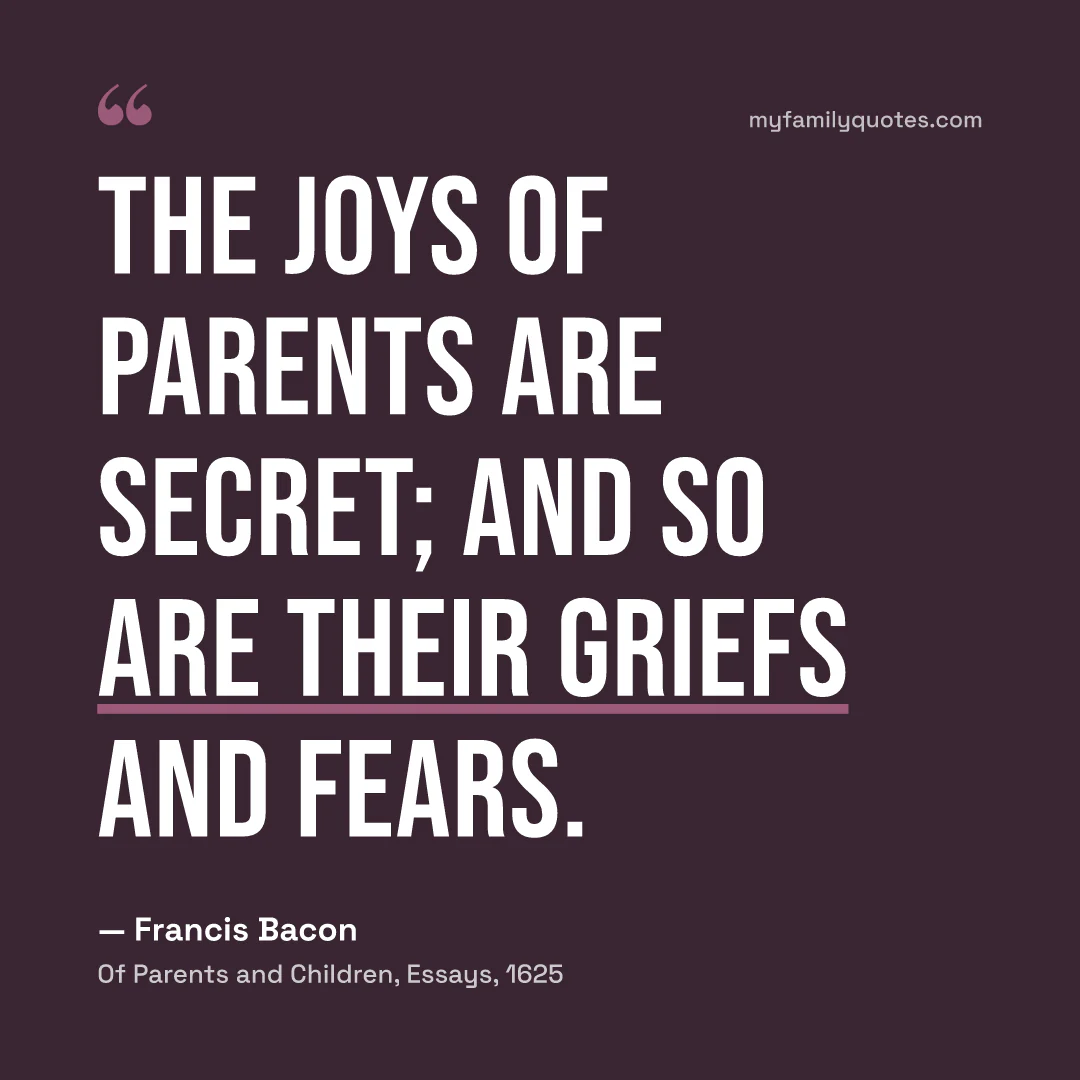
"The joys of parents are secret; and so are their griefs and fears. They cannot utter the one; nor they will not utter the other." — Francis Bacon, "Of Parents and Children", Essays, 1625 edition
Bacon (Gutenberg text) makes the serious version of Levenson's joke: parenting changes you in ways you do not say out loud. He continues, "Children sweeten labors; but they make misfortunes more bitter."
A line about grandparents
"Never have children, only grandchildren"
Usually credited to: Gore Vidal.
What the record shows: Vidal was quoting someone else. In his memoir Palimpsest (1995), chapter 3, he recalls that his grandfather, the blind Oklahoma senator Thomas Pryor Gore, changed "his usual line from 'Never have children, only grandchildren' to 'Be not fruitful, do not multiply.'" Wikiquote lists it under "Misattributed" for that reason.
Verdict: misattributed. Credit Senator Thomas Gore, as recalled by his grandson Gore Vidal, which makes it a better grandparent quote anyway.
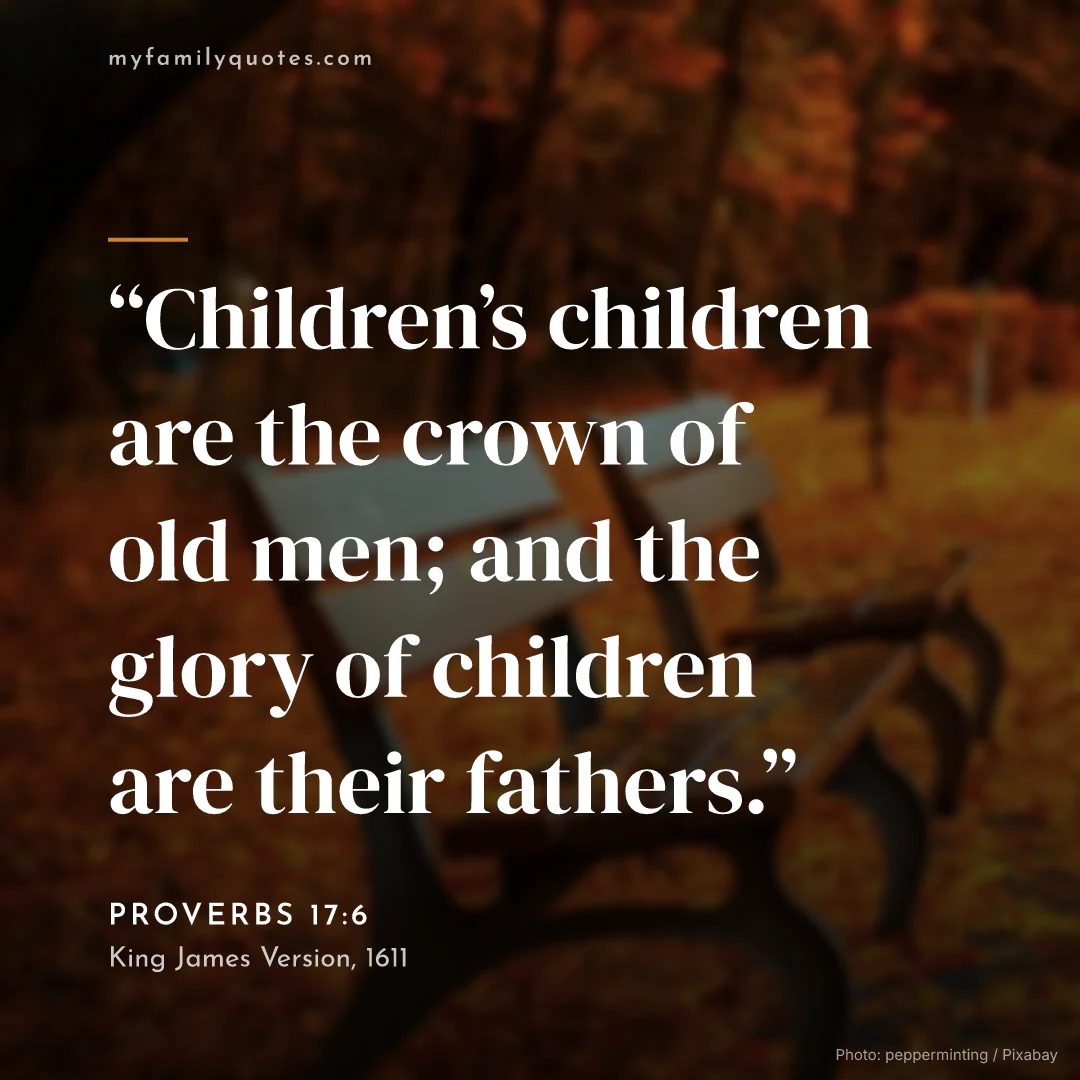
"Children's children are the crown of old men; and the glory of children are their fathers." — Proverbs 17:6, King James Version, 1611
The oldest line in this list, and it goes both ways: grandchildren are their grandparents' pride, and parents are their children's. It suits a grandparent's birthday card or a four-generation photo. For more grandparent lines from memoirs, with sources, see authors on ancestry: thankful for grandparents quotes.
Blood, water and chosen family
"The blood of the covenant is thicker than the water of the womb"
Usually credited to: "the original, full version" of the proverb "blood is thicker than water", shared to argue that chosen bonds beat family ones.
What the record shows: There is no evidence for this "original". The Wikipedia article on the proverb traces the claim to two authors writing from the 1990s on, the Messianic minister Richard Pustelniak and the popular writer Albert Jack, and notes that neither cites any source. The real proverb is old and means what it seems to mean: family ties are stronger than others. A version appears in the German beast epic Reinhart Fuchs (around 1180), and Walter Scott used it in Guy Mannering (1815). We checked Scott's wording in the Gutenberg text.
Verdict: no known source. The "covenant" version is a modern invention presented as the lost original.
"Weel, blude's thicker than water; she's welcome to the cheeses and the hams just the same." — Walter Scott, Guy Mannering, chapter 38, 1815
In the novel the Border farmer Dandie Dinmont has just heard the will of an elderly kinswoman read, and she has left him nothing. After a sulky silence he says this: she was family, so she was still welcome to the cheeses and hams he used to send her. It is a warmer use of the proverb than most people expect, and a good one for a relative who gives more than they get back.
"The bond that links your true family is not one of blood"
Usually credited to: Richard Bach. Correctly, for once.
What the record shows: The full line, "The bond that links your true family is not one of blood, but of respect and joy in each other's life. Rarely do members of one family grow up under the same roof", is from Bach's novel Illusions: The Adventures of a Reluctant Messiah (1977), as listed on Wikiquote. If you want a line about chosen family, use this one instead of the "covenant" proverb. It says the same thing and has a real author. Our piece on enduring definitions of kinship collects more lines on what makes a family.
Before you print a quote on a card, a cake or a headstone
- If you love the words but cannot find a source, drop the name. "As the saying goes" or no credit at all is better than a famous name that is wrong. The roots-and-wings and Twain lines read perfectly well without one.
- Prefer the version with a page number. Herndon's "God bless my mother" is less polished than "angel mother" but it is the one with a book and a page behind it.
- Read the paragraph around the line. Thackeray's "name for God" is about a neglected child; Ben-Hur's "made mothers" comes just before a family is torn apart. That may change your mind, or it may make the line mean more.
- Be wary of "the original version". Claims that a familiar proverb once meant the opposite (the "covenant" case) almost never come with a dated source.
- Credit translations and reported speech honestly. "As recalled by", "quoted in" and "translated by" are useful words.
Questions readers ask
Did Rudyard Kipling say "God could not be everywhere, so he created mothers"?
No evidence says so. The saying was printed in German in 1862, before Kipling was born, and in English in Lew Wallace's Ben-Hur in 1880 as an old rabbi's saying. The Kipling credit has been common only since about the 2000s.
What did Lincoln actually say about his mother?
His law partner William Herndon published his account in Herndon's Lincoln in 1889. In it Lincoln says: "God bless my mother; all that I am or ever hope to be I owe to her." The "angel mother" wording comes from an 1866 biography by Josiah G. Holland.
Is "blood of the covenant is thicker than the water of the womb" the original meaning of "blood is thicker than water"?
No. No source for the "covenant" wording has been found before the 1990s. The traditional proverb goes back at least to the 12th-century Reinhart Fuchs and means that family ties come first.
Found an earlier source, or a quote we should add? Tell us through the site's contact page and we will check it and update this page, with credit if you like.