Uncle Quotes: Real Lines From Twain, Vonnegut and Sterne, and What to Write to Yours
Words My Family Quotes Editors

The English word uncle comes, through Old French oncle, from the Latin avunculus. That is a diminutive of avus, "grandfather," so the word means something like "little grandfather." To the Romans it named one particular man, your mother's brother. The father's brother had a separate word, patruus. English kept only the first word and stretched it to cover every uncle, by blood or by marriage. It even covers the family friend children are told to call "Uncle."
That loose, generous meaning is a good way into uncle quotes too. Most of the lines shared online under that heading have no name or source attached. The real ones are more interesting: a Roman historian on why the mother's brother mattered, a nephew writing about the uncle he watched sail toward Vesuvius, Mark Twain on the farm where he spent his boyhood summers, and the gentlest uncle in English fiction letting a fly out of the window. This page is organized around the questions people actually ask about uncles. Each quotation gives the book, letter or play it comes from, and the second half has help with cards, toasts and eulogies.
Why did the mother's brother matter so much?
In many older societies the maternal uncle was a second father, and sometimes a more important one. Anthropologists call this bond the avunculate. The earliest written description of it in Europe comes from Tacitus, writing about the Germanic tribes around AD 98.
"Children are regarded with equal affection by their maternal uncles as by their fathers: some even consider this as the more sacred bond of consanguinity, and prefer it in the requisition of hostages, as if it held the mind by a firmer tie, and the family by a more extensive obligation." — Tacitus, Germania, chapter 20, AD 98 (the Oxford translation, revised)
Tacitus was a Roman senator describing peoples he regarded as outsiders, so his account is not neutral, but the detail about hostages is telling. When a tribe had to hand over a guarantee of good behavior, the sister's son was thought to bind the family more firmly than the man's own son. The line is too formal for a birthday card. It works well in a speech, though, when you want to say that an uncle's role is older and weightier than the jokes suggest.
The Bible's best-known uncle and nephew are Abram (later Abraham) and Lot, the son of his brother. When their herdsmen began fighting over grazing land, Abram settled it without pulling rank:
"And Abram said unto Lot, Let there be no strife, I pray thee, between me and thee, and between my herdmen and thy herdmen; for we be brethren." — Genesis 13:8, King James Version, 1611
Abram is the elder and the head of the family, yet he offers Lot first choice of the land. "Brethren" here means kinsmen, not brothers. The verse suits a family reunion, a toast to an uncle who keeps the peace, or a note to a relative after a quarrel. The first half alone ("Let there be no strife, I pray thee, between me and thee") fits on a card.
What are some quotes about the bond between an uncle and a nephew?
Some of the best come from nephews writing about their uncles after the fact. The most famous is a letter from the Roman lawyer Pliny the Younger. His uncle, the naturalist Pliny the Elder, took him in after his father's death and adopted him in his will. In AD 79 the elder Pliny commanded the fleet at Misenum, across the bay from Mount Vesuvius, and sailed toward the eruption to rescue people and observe it. He died on the shore. Years later the historian Tacitus asked his nephew for an account, and the letter opens with a tribute:
"Happy I esteem those to be to whom by provision of the gods has been granted the ability either to do such actions as are worthy of being related or to relate them in a manner worthy of being read; but peculiarly happy are they who are blessed with both these uncommon talents: in the number of which my uncle, as his own writings and your history will evidently prove, may justly be ranked." — Pliny the Younger, Letters 6.16, to Tacitus, written about 106–107, translated by William Melmoth, revised by F. C. T. Bosanquet
Pliny was seventeen at the time of the eruption and stayed behind at Misenum to study. His two letters about that day are still the main eyewitness source for it. The tribute praises an uncle who both did things worth writing about and wrote things worth reading. That makes it a fitting line for a eulogy or memorial for an uncle who was a scholar, a teacher or a storyteller.
Mark Twain's uncle, John A. Quarles, owned a farm near Florida, Missouri, where the boy spent two or three months every year until he was eleven or twelve. Late in life Twain dictated this about him:
"I have not come across a better man than he was." — Mark Twain, Chapters from My Autobiography, serialized in the North American Review, 1906–07 (this passage: 1 March 1907)
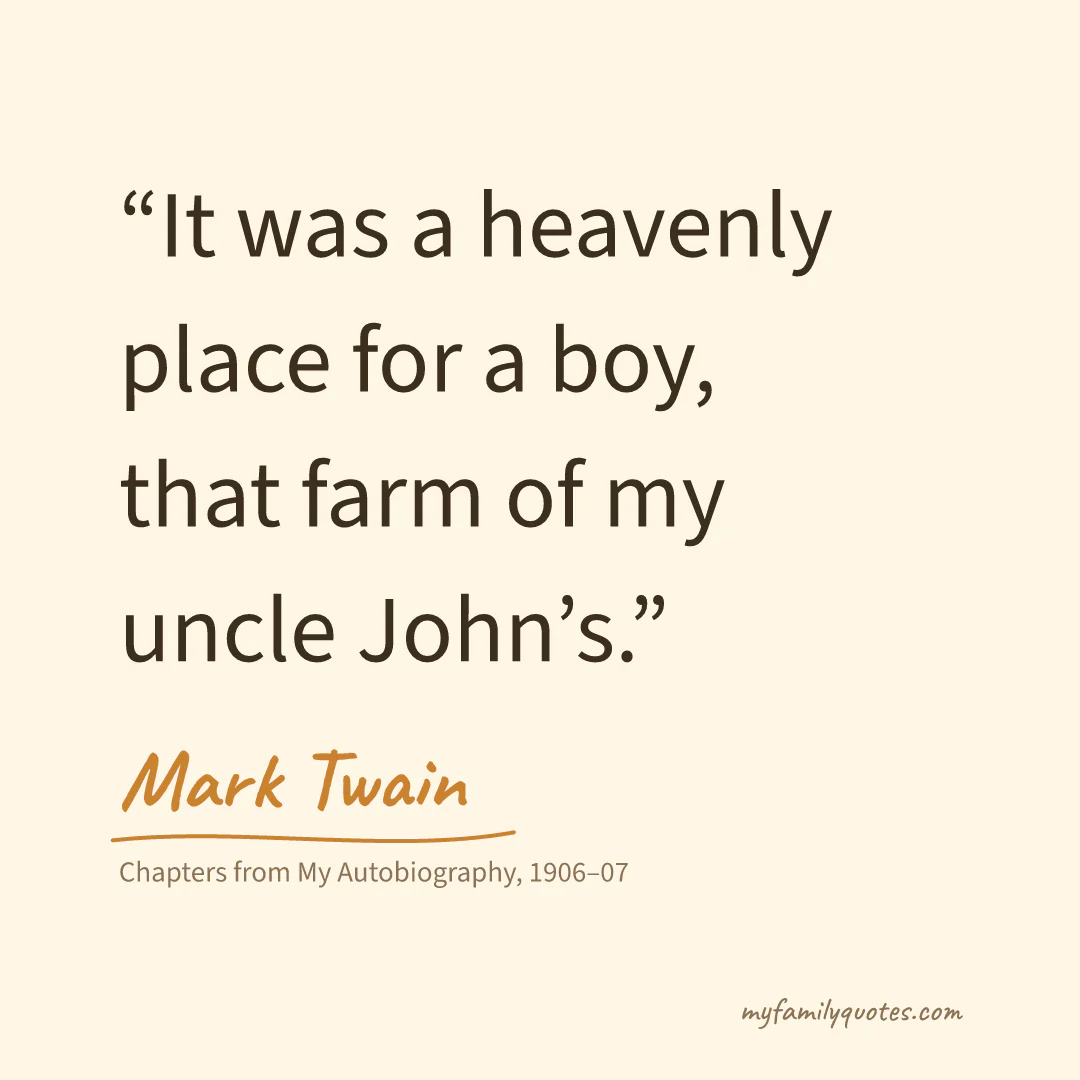
"It was a heavenly place for a boy, that farm of my uncle John's." — Mark Twain, Chapters from My Autobiography, North American Review, 1 March 1907
The farm turned up in Twain's fiction too. He moved it, in his words, six hundred miles south to Arkansas and used it as the Phelps farm in Adventures of Huckleberry Finn. The second line is the one to borrow. It describes an uncle's house as the place where a childhood happened, which is how a lot of people remember theirs. Swap in the details of the uncle's place, a cabin or a kitchen or a workshop, and the sentence fits a card or a eulogy.
Not every famous nephew is admiring. In Dickens's A Christmas Carol, the nephew is the warm one. Fred visits his uncle Ebenezer Scrooge every Christmas Eve to invite him to dinner, and every year he is turned away. His answer to "What good has Christmas ever done you?" ends like this:
"And therefore, uncle, though it has never put a scrap of gold or silver in my pocket, I believe that it has done me good, and will do me good; and I say, God bless it!" — Charles Dickens, A Christmas Carol, Stave One, 1843
Fred keeps inviting Scrooge anyway, and at the end of the book Scrooge finally turns up at his door. The scene is a reminder that the uncle-nephew bond can run both ways. Sometimes the younger relative is the one who refuses to give up. The line is a natural fit for a Christmas card to an uncle, especially a gruff one.
What makes a person a great uncle?
Search for this question and you get lists of adjectives: fun, reliable, generous. The writers who described real or fictional uncles tend to point at something narrower. A good uncle notices the child, and he notices the good moments.
Harper Lee gives the clearest example in To Kill a Mockingbird. Uncle Jack Finch, Atticus's younger brother, comes home for Christmas and spanks his niece Scout after she fights her cousin Francis, without asking why she did it. Scout tells him he didn't understand children much. Later that night Atticus gives his brother this advice, while Scout listens from the hallway:
"When a child asks you something, answer him, for goodness' sake. But don't make a production of it. Children are children, but they can spot an evasion quicker than adults, and evasion simply muddles 'em." — Harper Lee, To Kill a Mockingbird, chapter 9, 1960
Jack takes it well. In the same chapter he jokes, "I shall never marry, Atticus," and when asked why, "I might have children." He later admits that Scout "gave me my first lessons this afternoon." The exchange is a neat summary of what nieces and nephews value in an uncle: he takes their questions seriously and owns up when he gets it wrong. It is a good passage to copy into a card for a brand-new uncle.
The novelist Kurt Vonnegut credited his uncle with the most repeated piece of advice in his books and speeches. Alex Vonnegut was his father's younger brother, a Harvard graduate who sold life insurance in Indianapolis:
"His principal complaint about other human beings was that they so seldom noticed it when they were happy. So when we were drinking lemonade under an apple tree in the summer, say, and talking lazily about this and that, almost buzzing like honeybees, Uncle Alex would suddenly interrupt the agreeable blather to exclaim, 'If this isn't nice, I don't know what is.'" — Kurt Vonnegut, A Man Without a Country, 2005
Vonnegut added that he does the same now, and so do his children and grandchildren, and he urged readers to do it too. Notice how the habit spread: from an uncle to a nephew, then to that nephew's children and to millions of readers. "If this isn't nice, I don't know what is" is a near-perfect caption for a photo with an uncle, and a good toast at a family dinner. Credit it to Uncle Alex by way of Kurt Vonnegut.
Uncle Toby, from Laurence Sterne's comic novel Tristram Shandy, shows the third quality: gentleness. He is a retired soldier who spends his days rebuilding old battlefields in the garden, and he is the kindest man in the book. The narrator remembers watching him at dinner, when Toby finally caught a fly that had been buzzing around his nose all meal:
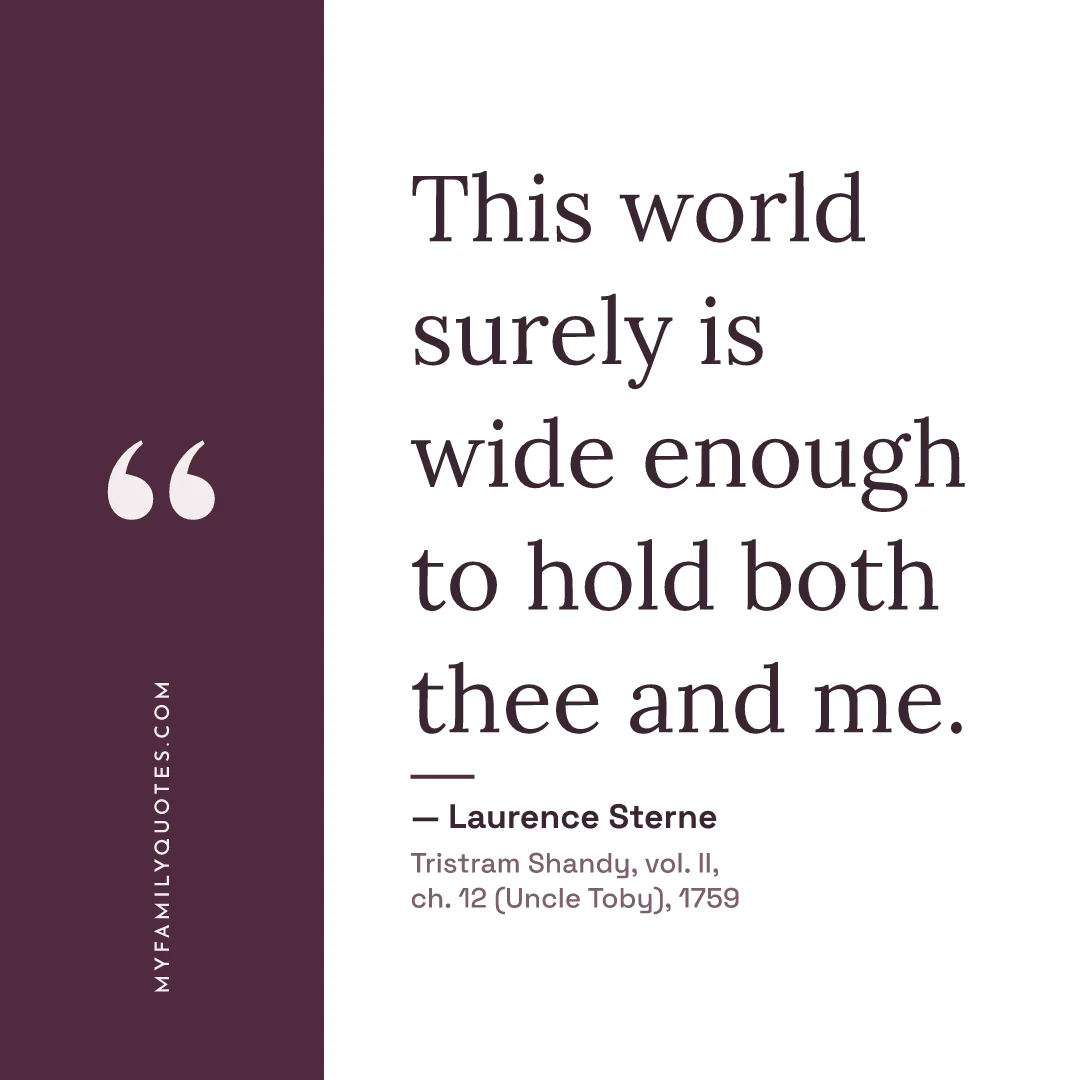
"Go, says he, lifting up the sash, and opening his hand as he spoke, to let it escape;—go, poor devil, get thee gone, why should I hurt thee?——This world surely is wide enough to hold both thee and me." — Laurence Sterne, The Life and Opinions of Tristram Shandy, Gentleman, Volume II, chapter 12, 1759
The narrator says he was ten years old when he saw this and that the lesson never left him. It became one of the best-known passages of the eighteenth century. It also captures something many people say about a favorite uncle: he taught them kindness by example rather than by lecture. The last sentence on its own makes a lovely card for a soft-spoken uncle.
Which uncles in books are worth quoting, and which are a warning?
Literature has more bad uncles than good ones, mostly because a wicked uncle is a convenient plot device: close enough to inherit, distant enough to betray. Shakespeare's Claudius is the model. He has murdered his brother, married his brother's widow and taken the throne, and in his first scene he greets Hamlet as "my cousin Hamlet, and my son." Hamlet's first words in the play are a muttered reply:
"A little more than kin, and less than kind." — William Shakespeare, Hamlet, Act 1, Scene 2, about 1600
The pun is double. Claudius is now more than kin (uncle and stepfather at once), but less than "kind," which in Shakespeare's English meant both "affectionate" and "of the same nature." It is a sharp line for a strained family relationship, and people still use it about in-laws and step-relatives. It does not belong in any card meant to be warm.
Anton Chekhov's Uncle Vanya (1899) is named for its uncle, but the play's last word belongs to his niece. Vanya and Sonya have spent their lives running a country estate to support a famous professor who turns out to be a fraud. In the final scene, after everyone else has left, Sonya comforts her uncle:
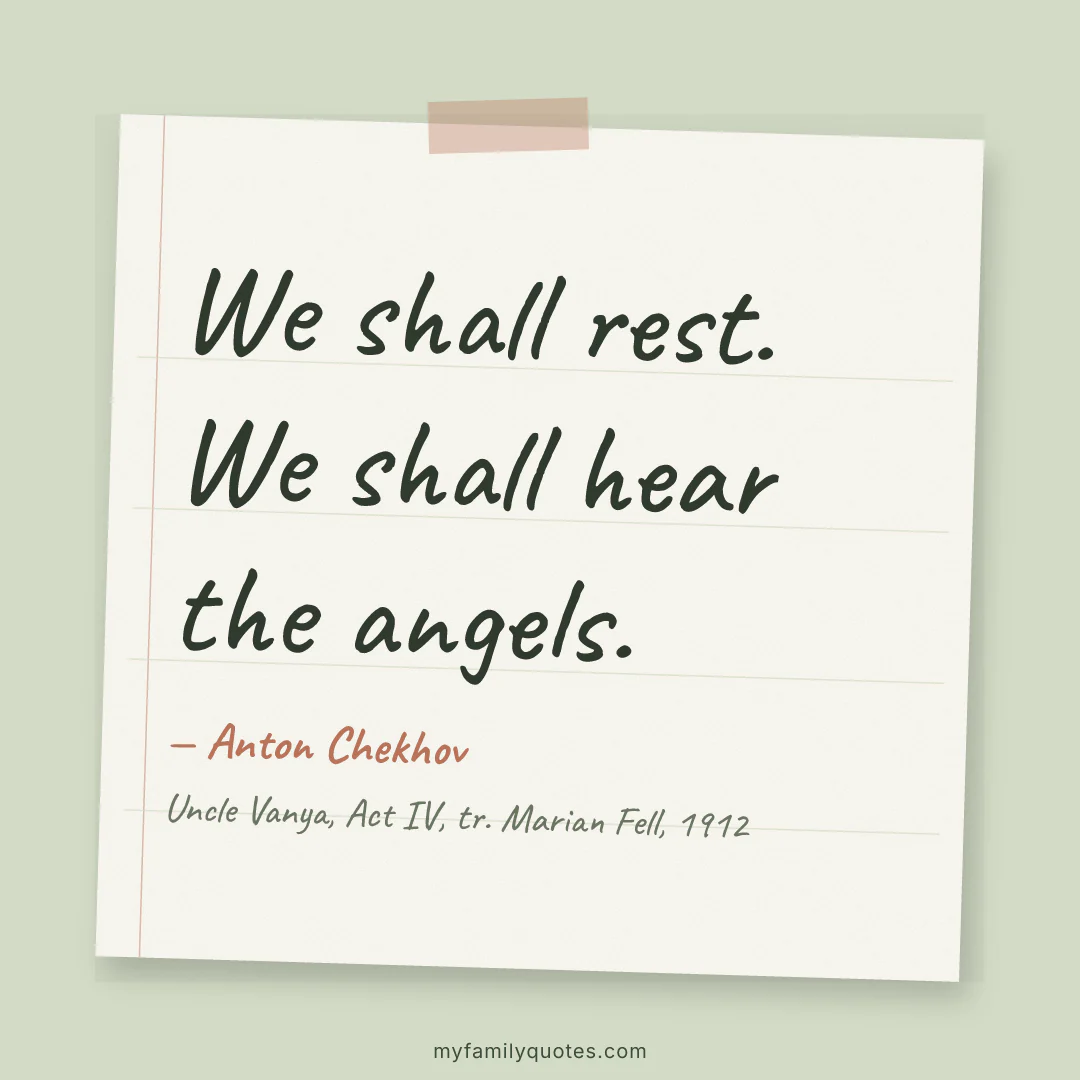
"We shall rest. We shall hear the angels. We shall see heaven shining like a jewel." — Anton Chekhov, Uncle Vanya, Act IV, 1899, translated by Marian Fell, 1912
It is one of the great niece-and-uncle moments in drama: the young woman holding up the older man, not the other way round. Earlier in the same speech she tells him, "You have never known what happiness was, but wait, Uncle Vanya, wait!" Read at a funeral, the passage speaks to a life of hard, unthanked work. It suits an uncle who looked after others more than himself. For the relationship from the aunt's side, with real letters to a niece, see quotes for a niece from her aunt.
Did Uncle Ben really say "With great power comes great responsibility"?
Not in the original comic. The most famous uncle line in popular culture first appeared in Amazing Fantasy #15 (August 1962), the issue that introduced Spider-Man, and nobody speaks it there. It is a narration caption in the last panel, after Peter Parker learns that the burglar he didn't bother to stop has killed his Uncle Ben:
"And a lean, silent figure slowly fades in the gathering darkness, aware at last that in this world, with great power there must also come -- great responsibility!" — Stan Lee (writer) and Steve Ditko (artist), Amazing Fantasy #15, Marvel Comics, August 1962
The words were put in Uncle Ben's mouth later. The earliest comic in which Peter remembers Ben telling him the phrase is Spider-Man vs. Wolverine #1 (1987), and the film Spider-Man (2002) gave him the short form most people know. The idea itself is much older. On 8 May 1793 the French Committee of Public Safety reminded the Convention's representatives that "a great responsibility is the inseparable result of a great power," and Winston Churchill told the House of Commons in 1906, "Where there is great power there is great responsibility." So if you use the line in a card or a speech about an uncle, "as Uncle Ben says in Spider-Man (2002)" is accurate. "As Uncle Ben said in the comics" is not. For more family lines that drifted away from their real authors, see our page on misattributed family quotes.
Famous uncles at a glance
| Uncle | Where he appears | What kind of uncle | Quote him in… |
|---|---|---|---|
| Claudius | Shakespeare, Hamlet (about 1600) | Usurper; Hamlet's uncle and stepfather | Essays on difficult families, never a card |
| Uncle Toby | Sterne, Tristram Shandy (1759) | The gentle one | A thank-you to a kind, quiet uncle |
| Ebenezer Scrooge | Dickens, A Christmas Carol (1843) | The grump, won over by his nephew Fred | Christmas cards, funny or warm |
| Uncle John Quarles | Twain, autobiography (1907) | Real uncle; the farm summers | Birthday cards, eulogies, captions |
| Uncle Vanya | Chekhov, Uncle Vanya (1899) | The overworked one, comforted by his niece | Memorials, readings |
| Uncle Jack Finch | Lee, To Kill a Mockingbird (1960) | The well-meaning uncle still learning | New-uncle cards |
| Uncle Alex Vonnegut | Vonnegut, A Man Without a Country (2005) | Real uncle; noticed happiness | Toasts, photo captions |
| Uncle Ben Parker | Spider-Man film (2002) | The mentor | Graduation or coming-of-age cards (credit the film) |
Aunts get their own literary tour in our aunt quotes from Austen, Dickens, Twain and Wodehouse. Many uncles are also fathers of your cousins; for those relationships, see cousin quotes and messages.
What should I write in a card for my uncle?
Uncle cards are harder than they look, because "uncle" covers so many different relationships. He might be a second dad, a fun visitor twice a year, a godfather, a mentor at work, or someone you have barely spoken to since you were twelve. Start by placing yours, then pick the tone.
| Your uncle is… | Tone that fits | A line or idea to build on |
|---|---|---|
| The one who stepped in when a parent couldn't | Plain gratitude, no jokes | Pliny's uncle took him in; say what yours took on, and that you noticed |
| The fun uncle (snacks, bad influence, best stories) | Teasing, affectionate | Twain's "a heavenly place for a boy", rewritten around his house or car |
| The peacemaker at family gatherings | Warm, a little formal | Genesis 13:8, "Let there be no strife, I pray thee, between me and thee" |
| The gruff one who pretends not to care | Light, persistent | Fred to Scrooge: "And therefore, uncle… I say, God bless it!" |
| The gentle one | Quiet thanks | Uncle Toby's "This world surely is wide enough to hold both thee and me" |
| A new uncle (your sibling just had a baby) | Congratulations, a job description | Atticus's advice to his brother Jack: answer the child's questions |
A good card to an uncle usually does three things in three or four sentences. It names one specific memory or habit ("the fishing trips", "the way you always asked about school"), says what it meant, and ends with a wish. The specific detail does more work than any quote, so use a quotation as the frame, not the message. Below are a few drafts written by our editors. Change the details to match your uncle.
- Birthday, close uncle: "Happy birthday to the man who taught me to cast a line, change a tire and lose at cards gracefully. Every kid should have an uncle like you, and I'm glad I got the real thing."
- Father's Day, for an uncle who filled in: "You didn't have to show up for all of it, and you did. Thank you for every school play, every ride and every talk in the car. Today is partly yours."
- Christmas, to a distant or grumpy uncle: "Like Scrooge's nephew, I'm inviting you again this year. The door's open and there's a seat with your name on it."
- Congratulations, new uncle: "Welcome to the best job in the family: all the fun, and you get to hand them back. They're going to think you invented jokes."
- Wedding toast by a nephew or niece: Keep it to one story, one line of thanks and a raised glass. "Uncle Joe taught me that being family is about turning up. Today we're all turning up for him." (Swap in his real name.)
One caution: the unsigned "uncle sayings" that circulate on image sites ("An uncle is a dad and a best friend in one", "Uncles are superheroes in disguise" and similar) have no traceable author. They are fine in a casual card, but don't credit them to anyone, and don't pass them off as quotations from a book.
What can you say about an uncle at his funeral?
A eulogy for an uncle has a particular problem. You often knew one side of him, the side he showed nieces and nephews, while his children, siblings or partner knew the rest. That is worth saying out loud rather than working around. Talk about what he was like with you, and leave room for the others.
Three approaches tend to work:
- The place. Like Twain with the Quarles farm, describe where you spent time with him: the kitchen, the workshop, the boat. A room can carry a whole relationship.
- The habit. One small, repeated thing (the joke he always told, the way he said goodbye) says more than a list of virtues.
- The lesson. If he taught you something, name it. Uncle Toby taught the narrator of Tristram Shandy kindness by letting a fly go, and the boy remembered it for life.
For a reading, Sonya's closing speech from Uncle Vanya (quoted above) works for a hard life that ended in peace. Pliny's tribute suits an uncle who was a reader or a teacher. For a religious service, Genesis 13:8 can be read with a sentence about the peace he kept in the family. Keep the eulogy itself to three or four minutes, and if you choose a quotation, read it slowly and say who wrote it.
Quick answers
What is a good short quote for an uncle?
"If this isn't nice, I don't know what is" (Uncle Alex Vonnegut, as reported by Kurt Vonnegut in A Man Without a Country, 2005) is short, real and works for almost any occasion. For a gentle uncle, try Uncle Toby's "This world surely is wide enough to hold both thee and me" (Tristram Shandy, 1759). For a memory of summers at his place, try Twain's "It was a heavenly place for a boy, that farm of my uncle John's."
Who counts as an uncle?
Strictly, your parent's brother (an uncle by blood) or the husband of your parent's sister or brother (an uncle by marriage). In practice many families also use "uncle" for a parent's close friend or a godfather. Latin was stricter: avunculus meant only the mother's brother and patruus the father's. Because an uncle is your parent's sibling, lines about brothers and sisters often fit him too. See our sourced sibling love quotes.
Is "With great power comes great responsibility" an Uncle Ben quote?
Only in later retellings. In Amazing Fantasy #15 (1962) it is an unspoken narration caption. Uncle Ben says it in the 2002 Spider-Man film, so credit the film if you use it.
The best uncle quote is usually the one only you can write: the sentence about his kitchen, his car, his terrible jokes or the day he showed up. If you borrow a line from Twain or Vonnegut, let it introduce your own words rather than replace them.