Cousin Quotes and Messages for Birthdays, Reunions, Reconnecting and Loss
Words My Family Quotes Editors

What do you write to someone who shared your grandparents, your childhood holidays and possibly your bathwater, but whom you now see at weddings and funerals? Cousins sit in an odd spot in a family. You did not choose them, yet nobody expects you to be close, so when you are, it feels like a friendship that happened to come with a family tree attached.
That is why "cousin quotes" are hard to find in a usable form. Most of what circulates online is unsigned, and very little of it says anything a cousin would recognize. This page is organized by situation instead: a birthday, the cousin who was your first best friend, the reunion group photo, getting back in touch after years, a wedding or a new baby, and a loss. Each group starts with a few short messages written by our editors that you can copy or adapt, followed by the literary lines that actually fit, quoted from the play, novel or dedication they come from. At the end there is a quick guide to "second cousin" and "once removed", and a note on the sayings that have no known author.
Birthday lines for a cousin
A cousin's birthday message works best when it points at something only the two of you share: the house you both stayed in, the relative you both imitate, the game nobody else understood. If you cannot think of one, the lines below are short enough for a text and warm enough for a card.
- Happy birthday to the only other person who remembers how the family really was before everyone started telling it nicely.
- Cousin by birth, friend by choice, alibi by necessity. Happy birthday.
- Another year of you keeping my worst childhood stories to yourself. Thank you, and happy birthday.
- Same grandparents, different chaos. Have a wonderful birthday.
- Thanks for being family I would actually pick. Happy birthday, cousin.
If you would like a real quotation inside the card, one of the best comes from a novel that is entirely about cousins.
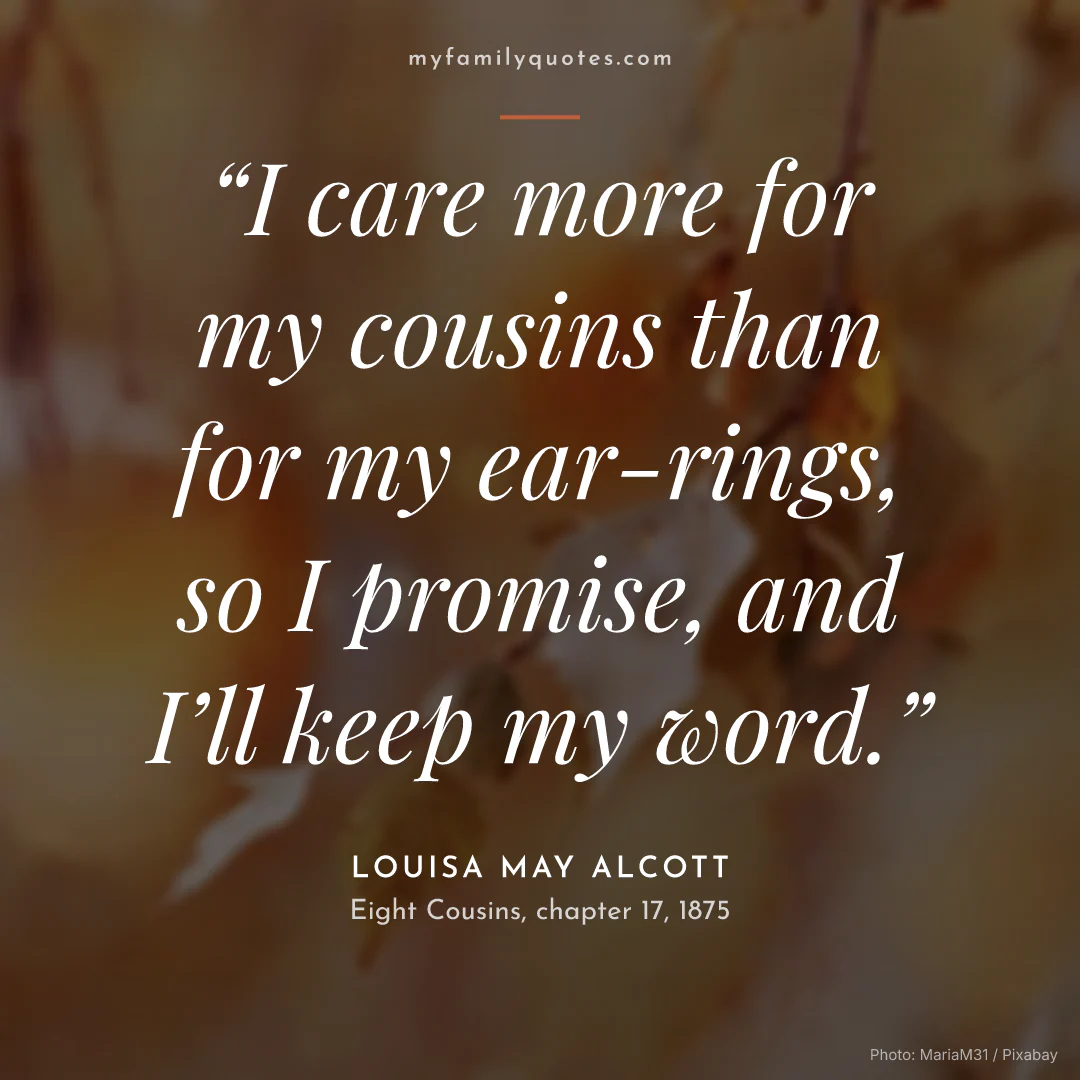
"I care more for my cousins than for my ear-rings, so I promise, and I'll keep my word." — Louisa May Alcott, Eight Cousins, chapter 17 ("Good Bargains"), 1875
In Alcott's novel, the orphaned Rose Campbell is sent to live among her father's family and finds herself the only girl among seven boy cousins. In this chapter the boys agree to give up a bad habit if Rose gives up the ear-rings her aunt dislikes, assuming she will refuse. She takes them out on the spot and gives each cousin a ring from them to wear as a reminder of the deal. The line is about loyalty that costs something, which makes it a good fit for a cousin who has shown up for you when it was inconvenient.
For the cousin who was your first best friend
Many people's first close friend was a cousin, simply because a cousin was always there at holidays and in the summer. Shakespeare built one of his comedies around this kind of bond. In As You Like It (written around 1599, printed in 1623), Rosalind and Celia are first cousins, the daughters of two brothers who are at war with each other, and the play keeps telling us that their friendship is stronger than their fathers' feud.
"Never two ladies loved as they do." — William Shakespeare, As You Like It, Act 1, Scene 1 (Charles the wrestler, describing Rosalind and Celia)
Charles explains that Celia "so loves" Rosalind, "being ever from their cradles bred together", that she would have followed her into exile. It is a third person describing the cousins, which makes it work as a caption under a photo of the two of you, or as a line in a speech at a cousin's wedding.
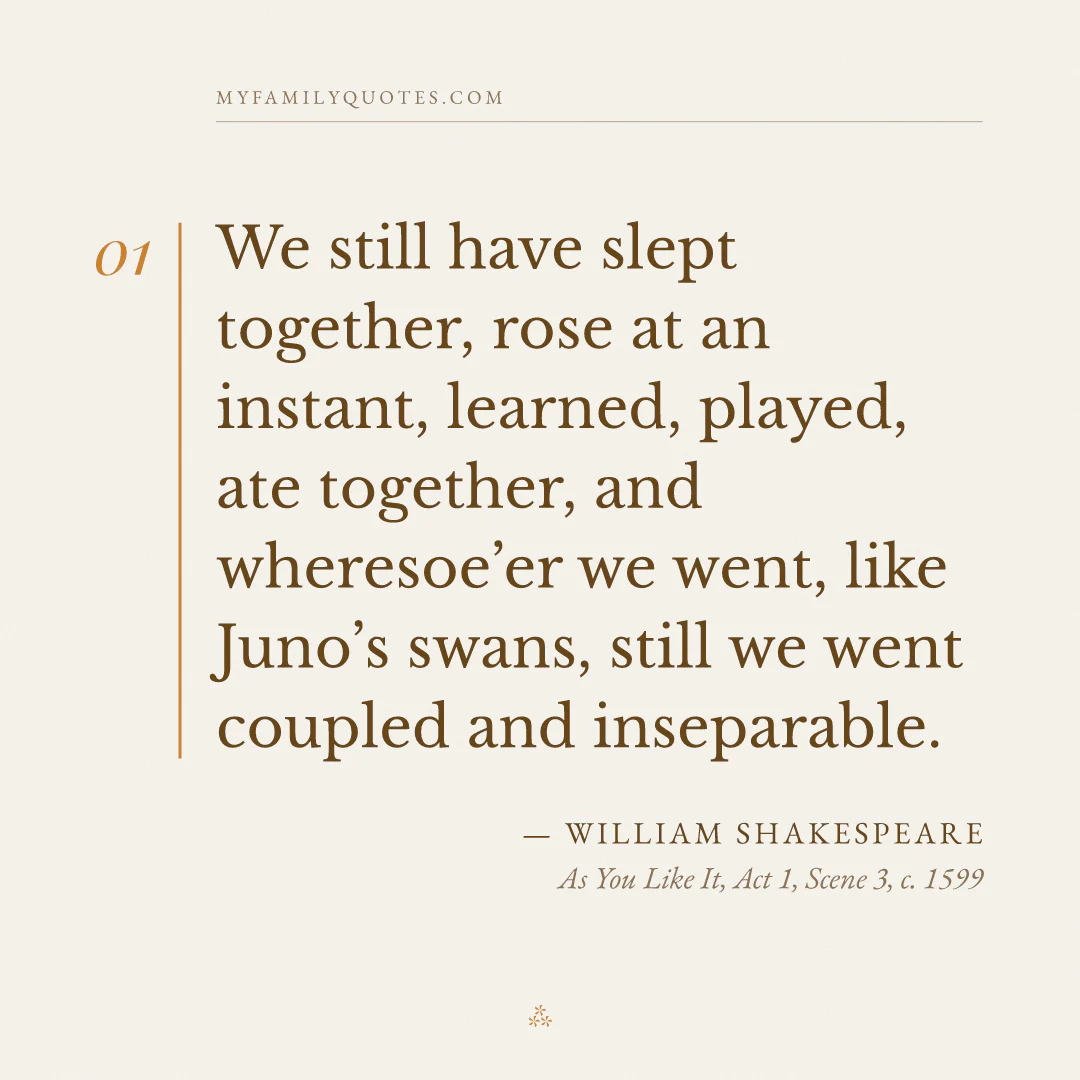
"We still have slept together, / Rose at an instant, learned, played, ate together, / And wheresoe'er we went, like Juno's swans, / Still we went coupled and inseparable." — William Shakespeare, As You Like It, Act 1, Scene 3
Celia says this to her own father, the Duke, when he banishes Rosalind and calls her a traitor. "If she be a traitor, why, so am I," Celia replies, and then lists everything the two girls did together as children. Juno's swans were imagined as a pair pulling the goddess's chariot. It is the most complete description in English literature of growing up beside a cousin, and the first half works on its own as a card message.
"Shall we be sundered? Shall we part, sweet girl? / No, let my father seek another heir." — William Shakespeare, As You Like It, Act 1, Scene 3
A few lines later Celia decides to run away with her cousin rather than stay behind as her father's heir. The two disguise themselves and leave for the Forest of Arden together. Use this one when a cousin is moving far away, or when you want to thank a cousin who chose you over an easier option.
Messages for this situation, written by our editors:
- You were my first best friend, and you never had to apply for the job.
- Every good childhood memory I have, you are standing somewhere in the background of it.
- Siblings had to share a room with me. You chose to keep coming back.
Reunions, group photos and the family chat
Captions for a cousins' photo or a reunion post can afford to be funny, and the two literary lines that suit them best are both about being overwhelmed by relatives.
"I could stand the aunts, but there are dozens of cousins, dreadful boys all of them, and I detest boys!" — Louisa May Alcott, Eight Cousins, chapter 1 ("Two Girls"), 1875
This is Rose on her first day in the family house, before she has met the cousins she will later give her ear-rings for. She has grown up alone with an invalid father and is terrified of the seven boys. Placed next to a photo of a crowd of grown cousins, it is a neat joke about first impressions, and it works whatever the mix of boys and girls in your own family.
"I don't know half of you half as well as I should like; and I like less than half of you half as well as you deserve." — J. R. R. Tolkien, The Fellowship of the Ring, Book I, chapter 1 ("A Long-expected Party"), 1954
Bilbo Baggins says this in his speech at his eleventy-first birthday party, to a dinner crowded with relatives: Bagginses, Tooks, Brandybucks and more. It takes the audience a moment to work out whether it was a compliment. The family in this book is tangled enough that, earlier in the same chapter, the Baggins gardener explains that Frodo is Bilbo's "first and second cousin, once removed either way". As a caption for a reunion, the line is affectionate and a little cheeky; it is best kept for families who will laugh at it.
Short captions written by our editors:
- Same grandparents, very different outcomes.
- Cousins' table, still the loudest one in the room.
- We grew up. We did not calm down.
- Annual proof that we are, in fact, related.
- The group chat, but in person.
For more lines about the older generation that usually appears in these photos, see our funny grandparent quotes.
Getting back in touch after years apart
Cousins drift apart more easily than siblings: a parent's falling-out, a move, or simply the end of shared holidays is enough. The first message after a long gap does not need a quotation. It needs to be short, specific, and easy to answer. Two things help: mention something real you have in common, and ask a question that does not require them to explain the silence.
- "I came across a photo of us at Grandma's and realized how long it has been. How are you doing?"
- "I'm sorry we lost touch. No reason, life just got loud. I'd love to catch up if you're up for it."
- "I heard about your new job from Aunt [name] and wanted to say congratulations myself."
Two novels capture what a cousin's kindness can mean, including from a cousin you once got along with badly.
"My dear little cousin," said he, with all the gentleness of an excellent nature, "what can be the matter?" — Jane Austen, Mansfield Park, chapter 2, 1814
Ten-year-old Fanny Price has been sent to live with her rich relatives and has cried herself to sleep every night for a week. Her cousin Edmund, the youngest son, finds her crying on the attic stairs and is the first person in the house to ask why. The scene is short, and it sets up the whole novel. It is a good line to quote to a cousin who once did the same for you, and it can open a thank-you letter that has been overdue for years.
"I don't think you're a waste of space." — J. K. Rowling, Harry Potter and the Deathly Hallows, chapter 3 ("The Dursleys Departing"), 2007
Dudley Dursley spent six books bullying his cousin Harry. When the family is forced into hiding, Dudley, to everyone's surprise, refuses to leave without saying something, and this awkward sentence is it. Harry treats it, correctly, as a large step. Readers often quote it when a difficult relative makes a clumsy first move toward peace; it is a reminder that a reconciliation between cousins can start with very little.
If the distance comes from real harm rather than drift, you are not obliged to reach out at all. Our page on what keeps brothers and sisters close covers some of the same ground for siblings.
Weddings, new babies and other milestones
At a cousin's wedding you are usually a guest, not a speaker, so the message goes in the card. Keep it to two sentences: one about your shared past, one about their future. For a new baby, the fact worth celebrating is that your children will be cousins too, the same relationship you had.
- Wedding: "I have known you since before either of us could spell 'wedding'. I am so happy to see you marry someone who loves you this much."
- Wedding: "Welcome to the family, [name]. You are now officially required at every holiday, and we are glad of it."
- New baby: "Our kids are going to be cousins. I hope they have half as much fun as we did, and get caught half as often."
- Graduation: "From the kids' table to this. So proud of you, cousin."
- New home: "Congratulations on the new place. Tell me which room is the new version of Grandma's basement."
If a cousin's wedding toast is coming up and you have been asked to speak, the Rosalind and Celia lines above work well, since the play itself ends in a group wedding.
When a cousin dies or is grieving
The most moving writing about a cousin we know of comes from L. M. Montgomery, the author of Anne of Green Gables, and it is not in a novel but in two dedications to the same woman, her first cousin Frederica "Frede" Campbell.
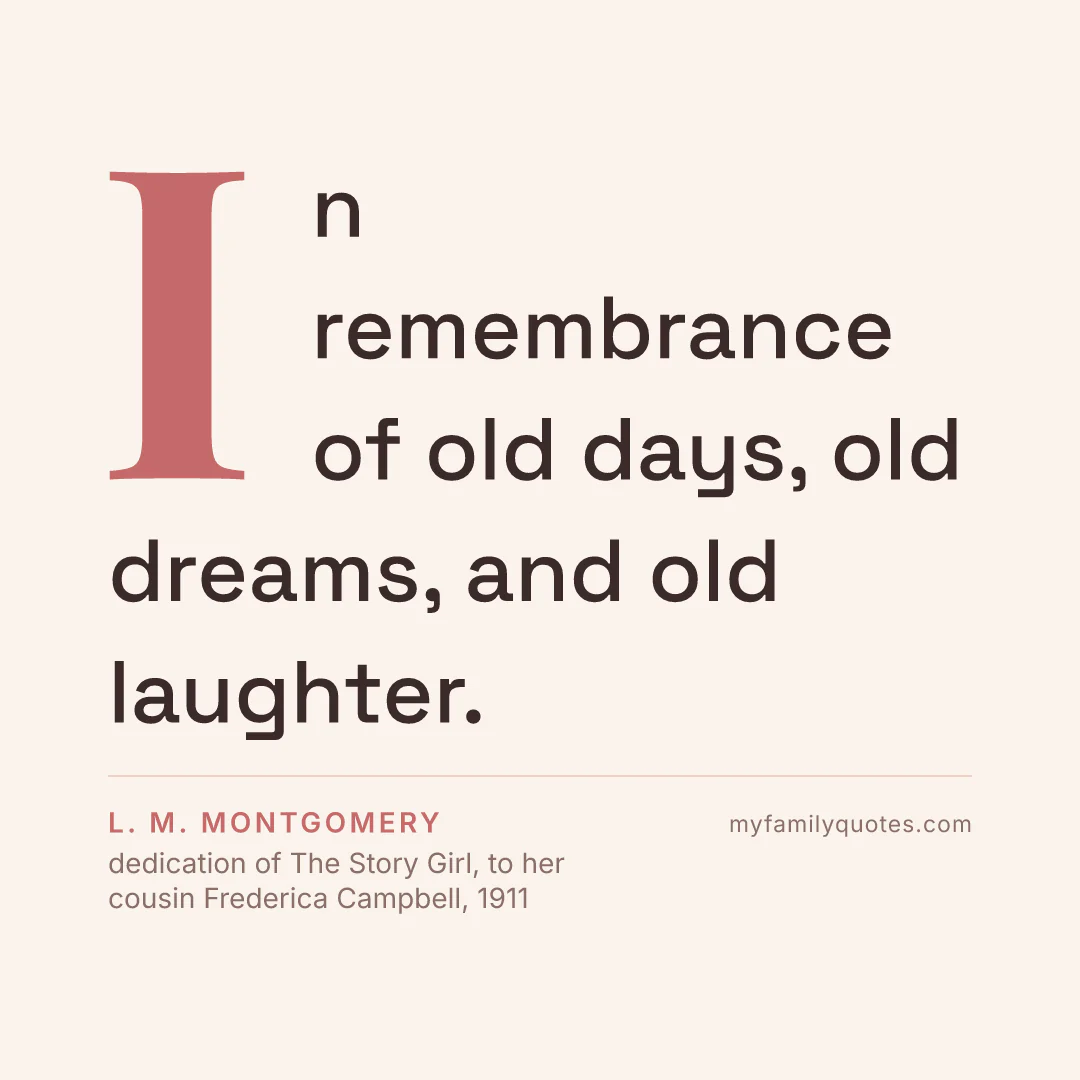
"To my cousin Frederica E. Campbell, in remembrance of old days, old dreams, and old laughter." — L. M. Montgomery, dedication of The Story Girl, 1911
The Story Girl follows a group of cousins spending a summer on their grandparents' farm on Prince Edward Island, so the dedication fits the book. Montgomery and Frede were also each other's closest friend. The three "olds" make a fine line for a memorial card, a eulogy, or a birthday card to a cousin you have known all your life.
"To the memory of Frederica Campbell Macfarlane who went away from me when the dawn broke on January 25th, 1919—a true friend, a rare personality, a loyal and courageous soul." — L. M. Montgomery, dedication of Rilla of Ingleside, 1921
Frede died in the influenza pandemic that followed the First World War, and Montgomery wrote Rilla of Ingleside, her novel about a family on the home front during that war, in the years just after. Ten years separate the two dedications. Read together, they show a whole adult friendship between cousins in two sentences. The second one, especially the phrase "a true friend, a rare personality, a loyal and courageous soul", is often used on memorial cards and in eulogies.
Messages for a grieving cousin, written by our editors:
- "I keep thinking about your mom at every family gathering. I am so sorry. I am here, and I'm not going anywhere."
- "There is nothing right to say, so I'll just say I love you and I'll call on Sunday."
- "Our family is smaller and quieter without [name]. Thinking of you."
First cousin, second cousin, once removed: what to call them
It helps to know the right word before writing "my cousin" on a wedding place card or in an obituary. The terms follow two rules. The number (first, second, third) tells you how far back the shared ancestor is. "Removed" tells you how many generations apart the two of you are.
| Relationship | What you share | Example |
|---|---|---|
| First cousin | Grandparents | Your aunt's or uncle's child |
| Second cousin | Great-grandparents | Your parent's first cousin's child |
| Third cousin | Great-great-grandparents | Your parent's second cousin's child |
| First cousin once removed | Your grandparents are their great-grandparents (or the reverse) | Your parent's first cousin, or your first cousin's child |
| First cousin twice removed | Two generations apart | Your grandparent's first cousin, or your first cousin's grandchild |
| "Kissing cousin" | No fixed relationship | An old American expression for a relative, often distant, close enough to greet with a kiss |
In everyday cards nobody expects precision: "cousin" covers all of them. The exact term matters most in obituaries, family trees, and wedding seating plans. For the generation above, see our aunt quotes from Austen, Dickens, Twain and Wodehouse.
Unsigned cousin sayings, and why we left them out
Search for cousin quotes and the same sentences come up again and again: "Cousins are childhood playmates who grow up to be forever friends", "A cousin is a little bit of childhood that can never be lost", "Cousins by chance, friends by choice." None of them comes with a book, a speech or a date, and we could not find one. Several are adaptations of sister or friend sayings with the noun swapped. The "little bit of childhood" line, for example, also circulates word for word about sisters.
That does not make them bad to use. A card is not a citation, and many families like these lines. But if you put one under a name on a printed program, or quote it as "a famous saying", it is worth knowing that nobody can say who wrote it. The lines on this page, by contrast, can all be found in the text they are credited to.
The simplest rule for any message to a cousin: name one thing only the two of you remember. That sentence will matter more than any quotation, including the good ones above.