Aunt Quotes From Austen, Dickens, Twain and Wodehouse: 10 Passages and Where They Come From
Words My Family Quotes Editors
Jane Austen was an aunt many times over, and she wrote to several of her nieces and nephews. Those letters survive, which makes her one of the best-documented aunts in English literature: we can read what she actually said to the children in her family, not just what she invented for her characters. The novelists who came after her gave the aunt a few recurring roles. She is the guardian who takes in a runaway, the soft touch who cannot bring herself to punish, and the formidable relative a young man flees from.
This piece follows those roles through ten passages. Each one is quoted from the letter, novel, play or film it appears in, with the year. After them you will find a table for matching a line to the aunt you have in mind, some notes on writing to an aunt, niece or nephew, and a warning about the unsigned "aunt quotes" that fill gift shops and social feeds.
Aunt Jane, in her own letters
Austen's letters to her nieces are affectionate and funny, and they take the children seriously. Three of them are quoted most often.
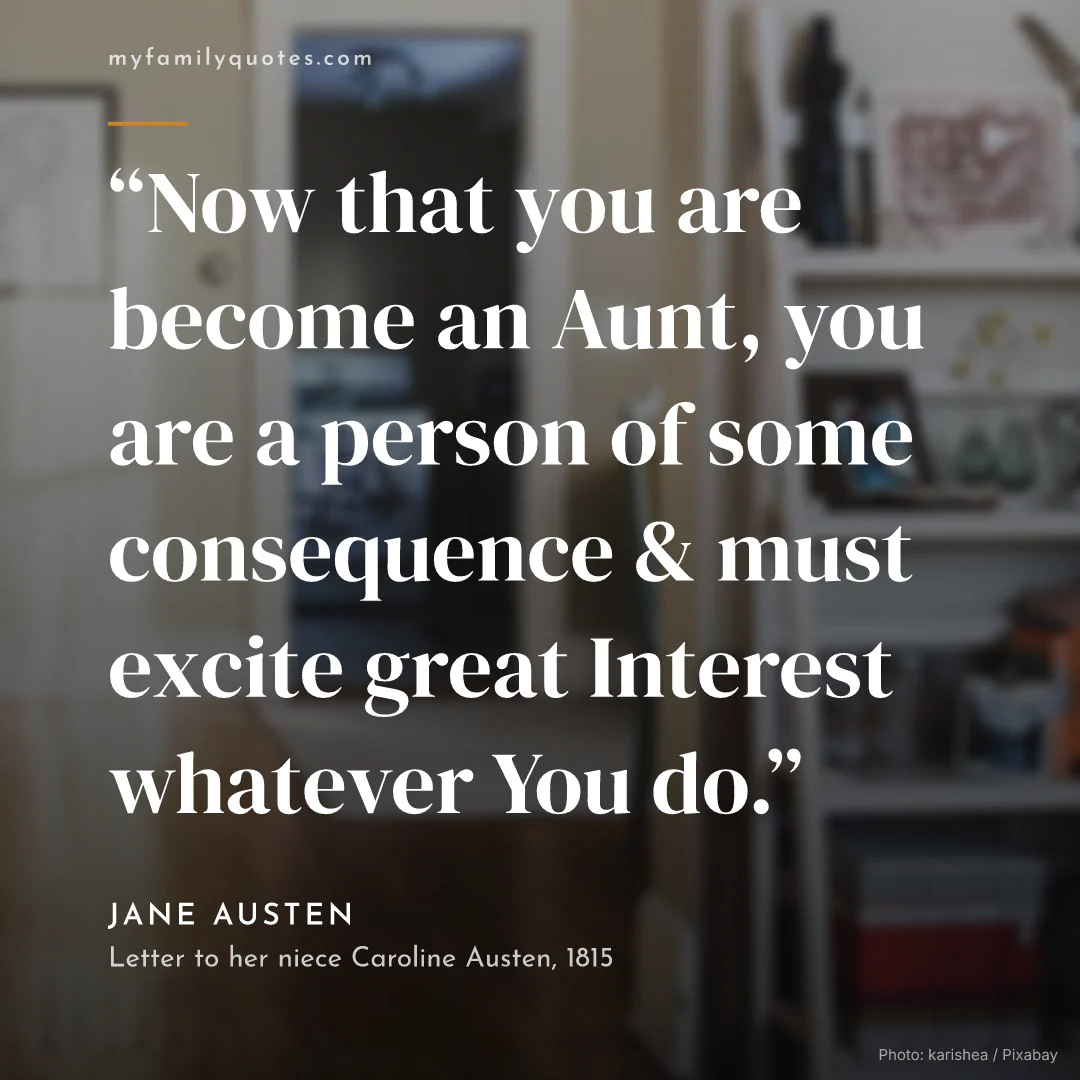
"Now that you are become an Aunt, you are a person of some consequence & must excite great Interest whatever You do. I have always maintained the importance of Aunts as much as possible, & I am sure of your doing the same now." — Jane Austen, letter to her niece Caroline Austen, 30 October 1815
Caroline was ten. Her half-sister Anna had just had her first baby, so Caroline had become an aunt herself, and Austen wrote to congratulate her as one aunt to another. She closed with "Beleive me my dear Sister-Aunt" (the spelling is hers). The joke is gentle: a ten-year-old does not gain much consequence from a newborn niece, but Austen treats the new title as a real promotion. This is the line to copy into a card for a new aunt, especially a young one. For the aunt-to-be herself, Louisa May Alcott's journal and letters from the week her nephew was born make a good companion read.
"You are now collecting your people delightfully, getting them exactly into such a spot as is the delight of my life. Three or four families in a country village is the very thing to work on." — Jane Austen, letter to her niece Anna Austen, 9 September 1814 (as printed in The Letters of Jane Austen, ed. Susan Coolidge, 1892)
Anna was writing a novel and sent the chapters to her aunt for comments. Austen's reply is a page of detailed, sometimes blunt notes on plot and character. In the middle of it she praises the setting Anna had chosen, and the sentence has since become one of the most quoted descriptions of Austen's own method. It shows a less familiar side of being an aunt: the honest reader, generous with praise but unwilling to flatter.
"You are inimitable, irresistible. You are the delight of my life." — Jane Austen, letter to her niece Fanny Knight, 20 February 1817
Fanny, the eldest daughter of Austen's brother Edward, had been sending her aunt long letters about her love life. Austen wrote this a few months before her death in July 1817. It is the warmest sentence in her surviving correspondence, and it works almost unchanged in a birthday message to a niece.
"We did not think of her as being clever, still less as being famous; but we valued her as one always kind, sympathising, and amusing." — James Edward Austen-Leigh, A Memoir of Jane Austen, 1869
James Edward was one of the nephews. Fifty years after her death he wrote the first full memoir of his aunt, and just before this sentence he says he has not forgotten that "Aunt Jane" was "the delight of all her nephews and nieces." It is one of the few famous lines written by a nephew about an aunt, and it suits a eulogy or a memorial card: three plain adjectives, none of them about achievement.
The aunt who takes the child in
Victorian and American fiction is full of children raised by aunts after a parent dies or fails them. Two of these aunts are remembered for what they said while doing it.
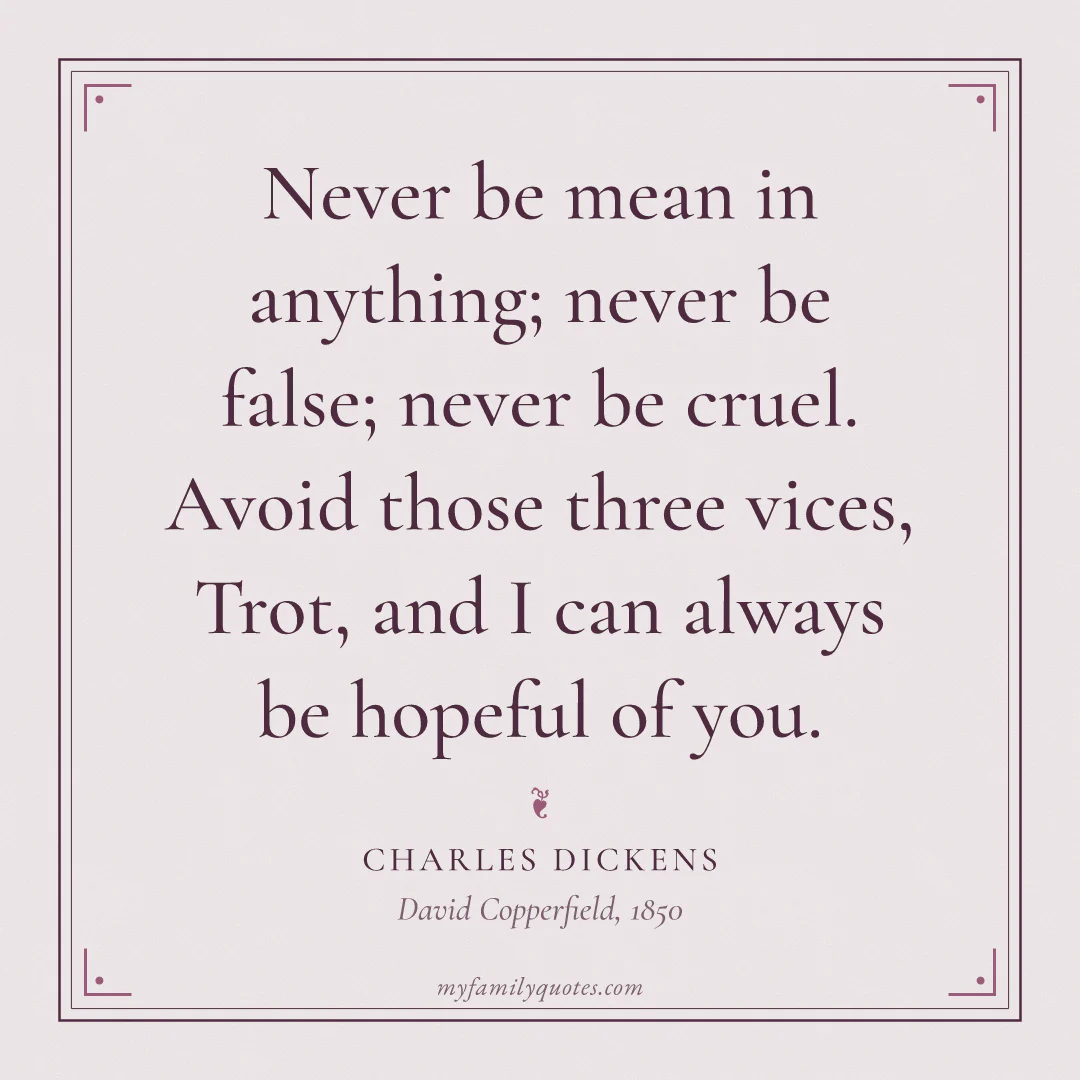
"Never," said my aunt, "be mean in anything; never be false; never be cruel. Avoid those three vices, Trot, and I can always be hopeful of you." — Charles Dickens, David Copperfield, chapter 15, 1850
Betsey Trotwood is famous for her temper and her war against donkeys on the lawn. When her runaway great-nephew David turns up on foot, she takes him in, gives him the nickname Trot and sends him to school. She says these words as she leaves him there. The three "nevers" make a good blessing for a nephew or niece starting school, a first job or a life away from home.
"He's my own dead sister's boy, poor thing, and I ain't got the heart to lash him, somehow. Every time I let him off, my conscience does hurt me so, and every time I hit him my old heart most breaks." — Mark Twain, The Adventures of Tom Sawyer, chapter 1, 1876
Aunt Polly speaks this to herself on the first pages of the novel, right after Tom has tricked her and escaped over the fence. She quotes "Spare the rod and spile the child" and then admits she cannot follow it. Physical punishment has aged badly, but the conflict underneath has not: an aunt raising a child who is not hers, unsure whether she is doing enough. Use the second sentence alone if you quote it.
The comic aunt, from Wilde to Wodehouse
The aunt as a figure of fun reached its peak in English comedy between the 1890s and the 1930s. These lines are for the group chat, the family-reunion banner and the birthday card for the aunt who can take a joke.
"Some aunts are tall, some aunts are not tall. That is a matter that surely an aunt may be allowed to decide for herself." — Oscar Wilde, The Importance of Being Earnest, Act I, 1895
Jack says this when Algernon finds a cigarette case inscribed "From little Cecily" and asks why Jack's "aunt" calls herself little. Cecily is in fact Jack's young ward, so the line is a flustered lie. Out of context it reads as a defence of every aunt's right to be exactly who she is.
"On the occasions when Aunt is calling to Aunt like mastodons bellowing across primeval swamps …, the clan has a tendency to ignore me." — P. G. Wodehouse, The Inimitable Jeeves, chapter 16 ("The Delayed Exit of Claude and Eustace"), 1923
Bertie Wooster explains why he is usually left out of family rows. The full sentence has an aside about Uncle James's letter on Cousin Mabel's "peculiar behaviour" being passed round the family. Anyone whose aunts run a family group chat will recognise it.
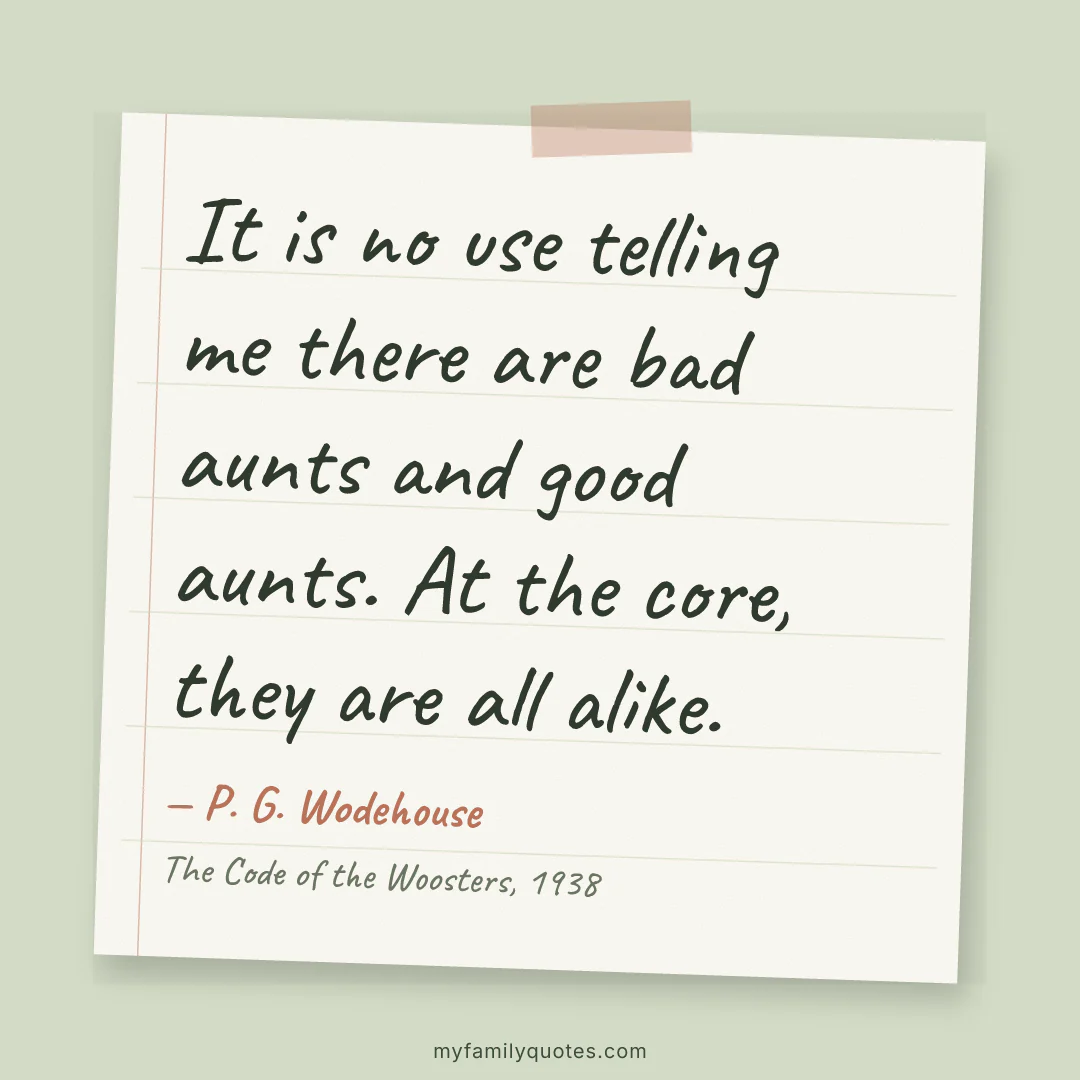
"It is no use telling me there are bad aunts and good aunts. At the core, they are all alike. Sooner or later, out pops the cloven hoof." — P. G. Wodehouse, The Code of the Woosters, 1938
Bertie has two aunts: the terrifying Aunt Agatha and the kinder Aunt Dahlia. The line comes when even the "good" one, Dahlia, sends him off to steal a silver cow-creamer. It is affectionate, not bitter; Wodehouse's aunts are dangerous because Bertie loves them too much to say no. It suits a card for an aunt who will be amused to be called a mastermind.
The aunt who opens the door
"Life is a banquet, and most poor suckers are starving to death!" — Mame Dennis (Rosalind Russell), Auntie Mame, film, 1958
Patrick Dennis's 1955 novel Auntie Mame is about an orphaned boy sent to live with his eccentric aunt in 1920s Manhattan. This exact line belongs to the 1958 film starring Rosalind Russell, not to the novel, so credit the film if you use it. It is the motto of the aunt who takes you to your first museum, your first play or your first restaurant with a wine list, and it makes a lively toast at a milestone birthday.
Matching a line to your aunt
Most people looking for an aunt quote already know which aunt they mean. This table pairs each kind of aunt with the passage that fits her and the place it works best.
| The aunt (or niece, or nephew) | Line to use | Works best in |
|---|---|---|
| A brand-new aunt, at any age | Austen: "Now that you are become an Aunt…" | Baby announcement, card to a sibling's child |
| A niece you are proud of | Austen: "You are inimitable, irresistible…" | Birthday, graduation |
| A niece or nephew who writes, paints or makes things | Austen: "Three or four families in a country village…" | Note tucked into a gift notebook |
| A nephew or niece leaving home | Dickens: "Never be mean in anything…" | Graduation card, first-job message |
| An aunt who helped raise you | Twain: "Every time I let him off…" | Mother's Day card to an aunt, a toast |
| An aunt who has died | Austen-Leigh: "always kind, sympathising, and amusing" | Eulogy, memorial card |
| An aunt with a sense of humour | Wodehouse: "out pops the cloven hoof" or Wilde: "Some aunts are tall…" | Birthday card, family reunion |
| The adventurous aunt | Auntie Mame: "Life is a banquet…" | Milestone birthday toast |
Writing to an aunt, niece or nephew: what Austen's letters teach
A quote opens a card, but the sentence you add yourself is what the reader keeps. Austen's letters are a good model because they are specific, and none of them is generic.
- Answer something they did. Austen responds to Anna's chapters and to Fanny's letters, not to a birthday. "I loved the story you told at dinner about the flat tyre" says more than "you're the best."
- Treat the relationship as a title. Austen made "Sister-Aunt" a rank. You can do the same: "From your aunt and chief bad influence," or "To my favourite (and only) nephew."
- Praise one thing precisely. Anna got detailed notes and one exact compliment, about her choice of setting. Pick one quality and name it.
- Keep the joke affectionate. The Wodehouse and Wilde lines work because everyone involved is fond of the aunt. If the relationship is strained, leave the comic lines out.
A few sample messages built on these habits, written by our editors for you to adapt:
- For a new aunt: "Austen told her ten-year-old niece that becoming an aunt made her 'a person of some consequence.' Welcome to the rank."
- For a niece's graduation: "Betsey Trotwood's three rules still hold: never mean, never false, never cruel. You have all three covered. Proud of you."
- For an aunt's birthday: "Thank you for every museum, every late night and every second helping. Life is a banquet, and you made sure I never went hungry."
If the family has a mother-and-son or grandparent occasion coming up as well, our mother and son quotes with their sources and funny grandparent quotes follow the same approach.
A note on the unsigned "aunt quotes"
Search for aunt quotes and most results are short lines with no author: comparisons of an aunt to a second mother or a best friend, or rhymes about aunts being "the fun one." Many of these were written for greeting cards or social media posts and never had a named author. We could not trace the common ones to a book, speech or interview, so they are not in this collection. They are fine to use in a card, but credit them to no one rather than adding a famous name. For sourced lines about the wider family, see our collection of enduring definitions of kinship.
The passages above can all be checked. Austen's letters, David Copperfield, Tom Sawyer, The Importance of Being Earnest, The Inimitable Jeeves and Austen-Leigh's memoir are free to read on Project Gutenberg. Two hundred years on, a ten-year-old's promotion to "Sister-Aunt" is still on record, which is more than most greeting cards can say.