Aunt to Be Quotes: 10 Sourced Lines for the Baby News, From Alcott, Austen and Dickinson
Words My Family Quotes Editors
On a snowy Saturday evening in March 1863, Bronson Alcott burst into the family house in Concord, wet and beaming, with news from Boston: his eldest daughter Anna had a baby boy. His daughter Louisa, thirty years old and still weak after nursing soldiers in Washington that winter, had been certain the baby would be a girl. She laughed, wrote the scene into her journal and sent her sister a letter of mock outrage. It is one of the best accounts we have of what it feels like to become an aunt, and it is real.
The best aunt to be quotes come from moments like that one: women and writers who put the news on paper the week it arrived. Below are 10 lines we traced to a letter, journal, novel or verse, each checked against the original text, with notes on where each one fits: the announcement post, a card for your pregnant sister or sister-in-law, a twins reveal, or the first time you hold the baby. If you need one line right now, use Betsey Trotwood's promise from David Copperfield: "I intend to be her friend." Swap "her" for "him" if the scan says boy.
The 10 lines at a glance
| Line (short form) | Source | Use it for |
|---|---|---|
| "… a vent for a happy aunt." | Louisa May Alcott, journal, March 1863 | Your own announcement post |
| "… three cheers for my nephew. Hurrah!" | Alcott, letter to her sister Anna, 1863 | When you guessed the wrong gender |
| "I intend to be her friend." | Dickens, David Copperfield, ch. 1 (1849–50) | Card to the parents-to-be |
| "It's a boy." | Dickens, David Copperfield, ch. 1 | Funny gender-reveal caption |
| "Shut your eyes and hold out your arms" | Alcott, Little Women, ch. 28 (1869) | Telling someone they will be an aunt or uncle |
| "It's the best joke of the season" | Alcott, Little Women, ch. 28 | A twins announcement |
| "Is it true, dear Sue? Are there two?" | Emily Dickinson, note to Susan Dickinson, 1861 | Short caption, text to your sister-in-law |
| "… almost another sister" | Jane Austen, letter to Cassandra, October 1808 | Proud aunt of an older niece |
| "… her cousins heard … and they rejoiced with her." | Luke 1:58 | Christian card or baby shower |
| "But Jehosheba … took Joash" | 2 Kings 11:2 | The protective aunt (read the story first) |
A snowstorm, a wrong guess and a "happy aunt": Alcott's 1863 journal and letter
Louisa May Alcott had come home from her post as a Civil War nurse in Washington early in 1863, too ill to do much more than read. Her journal for March records the evening her father came back from Boston with the news of Anna's first child. Note the reference to "B. Trotwood"; we come back to it in the next section.
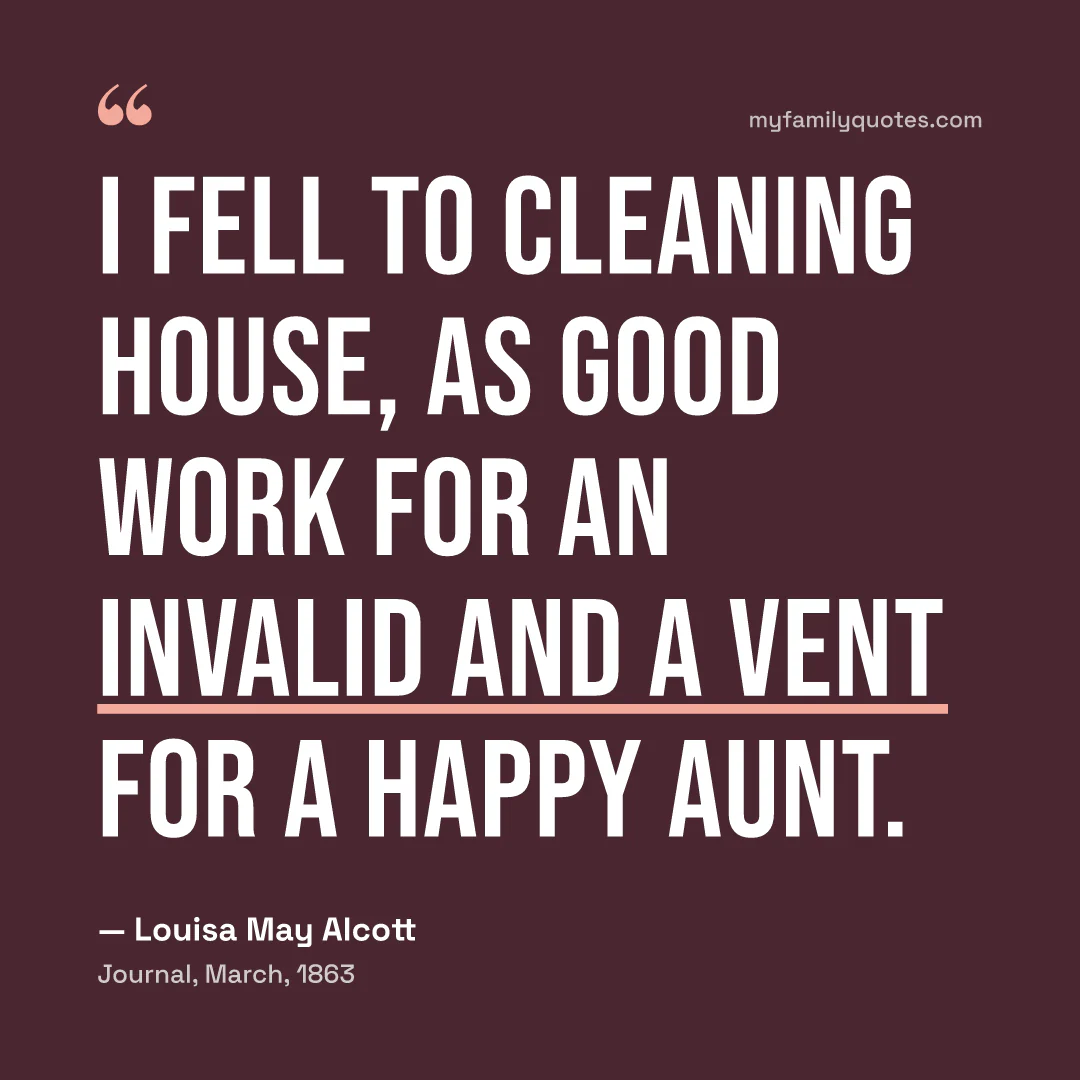
"We all screamed out when he burst in, snowy and beaming; then Mother began to cry, May to laugh, and I to say, like B. Trotwood, 'There, I knew it wouldn't be a girl!' … and I fell to cleaning house, as good work for an invalid and a vent for a happy aunt." — Louisa May Alcott, journal, March 1863, in Ednah D. Cheney (ed.), Louisa May Alcott: Her Life, Letters, and Journals (1889)
"A vent for a happy aunt" is the line to borrow. It admits what nobody says in the polished announcement posts: the news arrives, you can't do anything useful yet, and the excitement has to go somewhere, so you clean, bake, knit or text everyone you know. It works as a caption for your own "I'm going to be an aunt" post, and it is funnier if the photo shows you doing something oddly practical.
The same week, Louisa wrote to Anna herself. She had planned on a niece, down to the initials "L. C." on a pincushion.
"Allow me to ask who was a true prophet. Also to demand, 'Where is my niece, Louisa Caroline?' No matter, I will forgive you, and propose three cheers for my nephew. Hurrah! hurrah! Hurray!" — Louisa May Alcott, letter to her sister Anna Alcott Pratt, "Monday Eve." after the birth, 1863, in Cheney (ed.), Her Life, Letters, and Journals
This is the line for anyone who guessed wrong at the gender reveal. The joke lands because the disappointment lasts exactly one sentence before the cheering starts. Later in the same letter she promises, "I know I shall fall down and adore when I see that mite," which is about as honest a summary of first-time aunthood as exists. The boy was Frederick Alcott Pratt; in April her journal says she was sewing "little shirts and gowns for my blessed nephew."
Where "B. Trotwood" comes from: the aunt who walked out of David Copperfield
Alcott could expect her family to get the reference. In the first chapter of David Copperfield, Miss Betsey Trotwood, the great-aunt of the baby about to be born (she is his late father's aunt), arrives at the house on the night of the birth and announces what the child will be.
"From the moment of this girl's birth, child, I intend to be her friend. I intend to be her godmother, and I beg you'll call her Betsey Trotwood Copperfield." — Miss Betsey Trotwood, in Charles Dickens, David Copperfield, chapter 1 (1849–50)
Cut down to "I intend to be her friend," this is a fine promise for a card to the parents-to-be, and it fits a great-aunt as well as an aunt. Leave out the part about naming the baby after yourself unless your family has a strong sense of humour. The scene ends with the doctor coming downstairs:
"'And SHE. How is SHE?' said my aunt, sharply. … 'Ma'am,' returned Mr. Chillip, 'I apprehended you had known. It's a boy.'" — Charles Dickens, David Copperfield, chapter 1
Betsey says nothing, hits the doctor with her bonnet, and walks out; she does not appear in person again until chapter 13. So Alcott's "There, I knew it wouldn't be a girl!" is not a quotation at all. Betsey was sure it would be a girl, and Alcott, who had made the same mistake, was turning the joke on herself. If you post the line, credit it to Alcott, not Dickens. (For other family lines that picked up the wrong name, see our page on misattributed family quotes.) As a caption, "And SHE. How is SHE? … It's a boy" makes a good gender-reveal joke for an aunt who had her heart set on a niece.
For a twins reveal or a surprise announcement: Jo March as the new aunt
Alcott used her own experience in fiction. In the second part of Little Women, Meg has twins, and her sister Jo gets to break the news to their friend Laurie. Jo is the new aunt here, and she plays it as a prank.
"'Shut your eyes and hold out your arms,' she said invitingly. … 'Then you shan't see your nevvy,' said Jo decidedly, turning as if to go." — Jo March, in Louisa May Alcott, Little Women, chapter 28, "Domestic Experiences" (1869)
Laurie gives in, shuts his eyes, and opens them to find a baby in each arm. "Shut your eyes and hold out your arms" is a lovely way to tell a brother or sister that they are about to be an aunt or uncle, especially if you hand over a scan photo, a tiny pair of socks or two of each.
"It's the best joke of the season, isn't it? I wouldn't have told you, for I set my heart on surprising you, and I flatter myself I've done it." — Jo March, in Louisa May Alcott, Little Women, chapter 28
This one suits a twins announcement or any reveal you planned for weeks. It also gives the new aunt permission to be a little smug about keeping the secret, which is half the fun of being told first.
Short aunt to be quotes for a card, text or caption
Emily Dickinson's brother Austin and his wife Susan lived next door to her in Amherst, at the house called The Evergreens. When their first child, Edward, known as Ned, was born on 19 June 1861, Dickinson sent Susan a short verse instead of walking across the lawn.
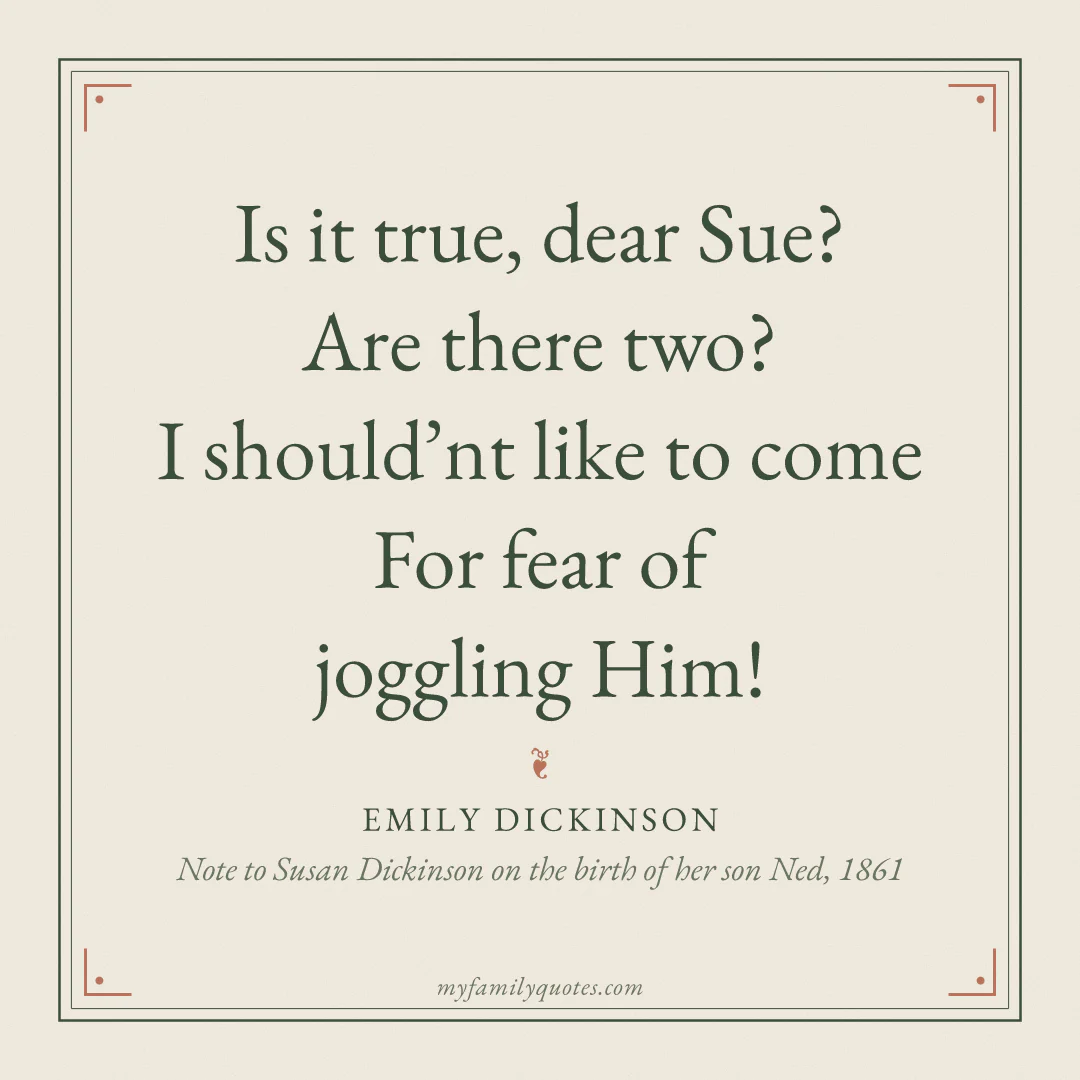
"Is it true, dear Sue?
Are there two?
I should'nt like to come
For fear of joggling Him!
If I could shut him up
In a Coffee Cup,
Or tie him to a pin
Till I got in –
Or make him fast
To 'Toby's' fist –
Hist! Whist! I'd come!" — Emily Dickinson, verse note to Susan Dickinson on the birth of Ned, June 1861 (Franklin 189; text as given by the Emily Dickinson Museum)
Toby was the family cat. The note is a joke about being too nervous to visit a newborn, from a woman who went on to be a devoted aunt to Ned and his younger sister and brother. The first two lines, "Is it true, dear Sue? Are there two?", make a perfect text to a sister-in-law who has just shared the news; just change the name. Keep her spelling "should'nt" if you quote the whole verse, since that is how the manuscript has it.
Other short options from this page: "a vent for a happy aunt" (Alcott), "I intend to be her friend" (Dickens), and "Hurrah! hurrah! Hurray!" (Alcott again), which needs no explanation at all.
Proud to be an aunt: what a niece can become
Jane Austen had a large tribe of nieces and nephews, and her letters show the bond growing as they grew up. In October 1808 her sister Cassandra was staying at Godmersham, the Kent house of their brother Edward, whose wife had just had another baby. Cassandra wrote home about Edward's eldest daughter, Fanny, then fifteen, and Jane answered from Southampton.
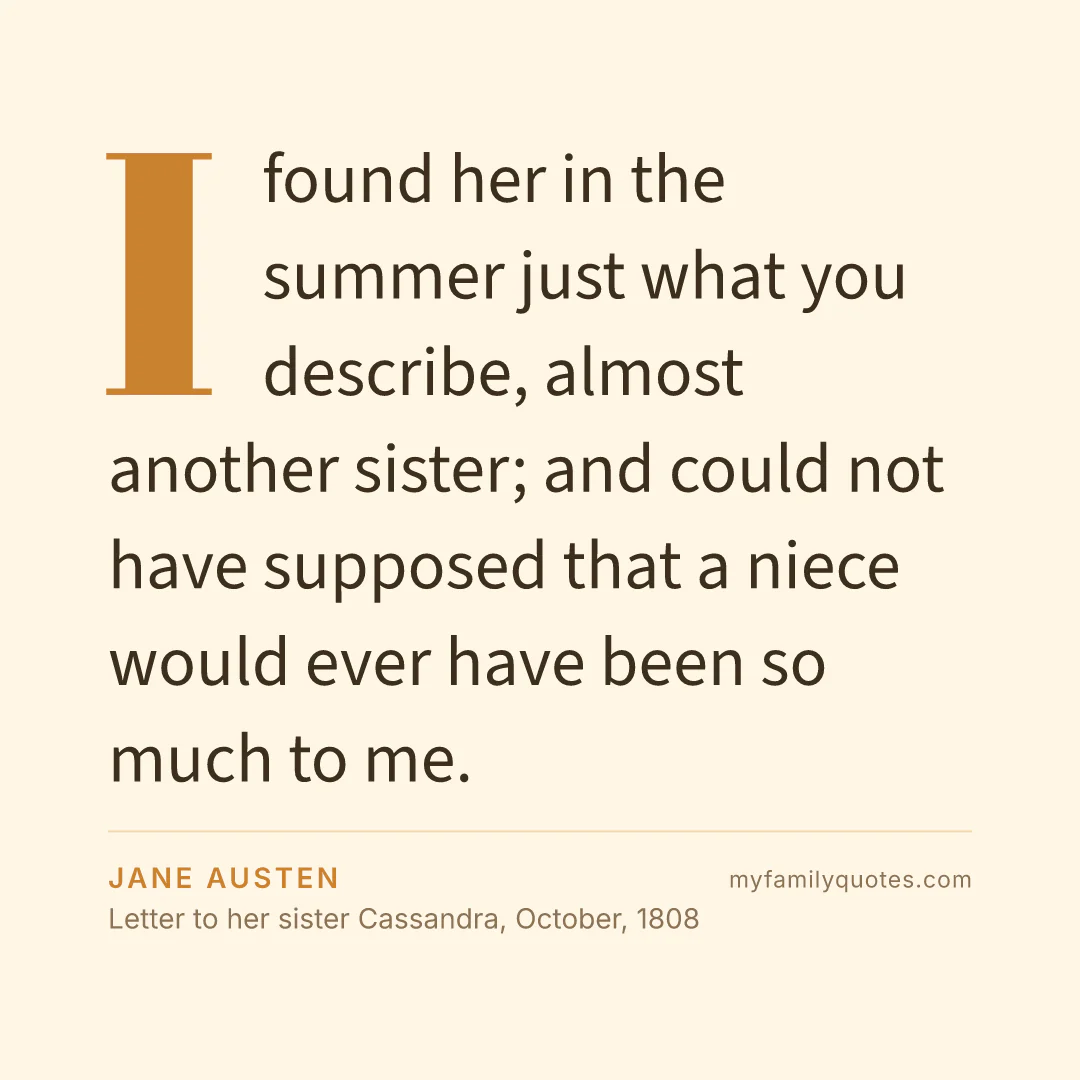
"I am greatly pleased with your account of Fanny; I found her in the summer just what you describe, almost another sister; and could not have supposed that a niece would ever have been so much to me. She is quite after one's own heart." — Jane Austen, letter to Cassandra Austen, Castle Square, Southampton, begun Friday 7 October 1808 (Brabourne edition, letter XLIV)
"Could not have supposed that a niece would ever have been so much to me" is the honest version of every "proud to be an aunt" post: you expect to like the baby, and you are not ready for how much the child will come to matter. It is a good line to save for a later card, a niece's graduation or wedding, and to quote now to an anxious aunt-to-be who wonders whether she will feel close to the child.
Austen also wrote the most famous welcome letter to a brand-new aunt, to her niece Caroline when Caroline's half-sister Anna had a baby in 1815: "Now that you are become an Aunt, you are a person of some consequence." We quote it in full, with its context, on our page of aunt quotes from literature, along with Aunt Polly, Betsey Trotwood in her later chapters and Wodehouse's fearsome aunts.
Is there a Bible verse for an aunt to be?
The Bible has no verse addressed to aunts, but two passages fit. The first describes the relatives who gathered when Elisabeth, the mother of John the Baptist, gave birth after years of waiting:
"And her neighbours and her cousins heard how the Lord had shewed great mercy upon her; and they rejoiced with her." — Luke 1:58 (King James Version)
In the King James Version, "cousins" means kinsfolk in general, which is why the verse works for any relative who is about to gain a niece or nephew. It suits a baby shower card, especially for a long-awaited pregnancy, and it puts the aunt where she belongs that day: rejoicing with the mother, not competing for attention.
"But Jehosheba, the daughter of king Joram, sister of Ahaziah, took Joash the son of Ahaziah, and stole him from among the king's sons which were slain; and they hid him, even him and his nurse, in the bedchamber from Athaliah, so that he was not slain." — 2 Kings 11:2 (King James Version)
Jehosheba is the Bible's clearest example of an aunt: the sister of the dead king, she rescued her baby nephew Joash from a massacre ordered by his own grandmother, and hid him in the temple for six years (2 Kings 11:3) until he could be crowned. It is a story about a protective aunt, but a violent one, so use it in a Bible-study note or a speech where you can tell the story, not on a baby shower banner.
What to say when you find out you're going to be an aunt
The first reply matters more than any quote. Your sibling or sibling-in-law is watching your face, or waiting for your text, and what they need is joy first and questions later. A few rules we drew from the letters above:
- Cheer before you ask. Alcott's letter opens with "Hurrah!" and only then asks for "his weight, inches, color, etc." Ask about due dates and names after the congratulations.
- Don't make the gender about you. Betsey Trotwood is the warning, Alcott the model: one joking sentence about the niece you imagined, then three cheers for the nephew you got.
- Offer something concrete. Alcott sewed shirts; even Dickinson, joking about her nerves, ended her note with "I'd come!" Name one thing you will do: meals, a night of babysitting, a visit.
- Keep the secret until they say otherwise. Jo March's pride in "surprising you" only works because she was allowed to tell.
If you would rather use your own words, here are a few replies we wrote for this page (no source needed, use them freely):
- "I'm going to be an aunt! Tell me everything, then tell me what I can do."
- "Aunt again, and just as excited as the first time."
- "Is it true? Are there two? (Please say there are two.)"
- "I already know I'll fall down and adore this baby. Hurrah!"
For a card to the parents, pair one sourced line with one sentence of your own: "From the moment of this baby's birth, I intend to be their friend, as Betsey Trotwood put it. I can't wait to meet them." If the baby turns out to be a girl, our page of newborn daughter quotes has lines for the birth card; for the father-to-be, see new father to be quotes.
How to be a good aunt, starting before the birth
"How to be a good aunt" is one of the most common questions behind this search, and the writers on this page answer it by example. Austen wrote long, funny letters to her nieces and read the stories they sent her; Alcott sewed for the baby; Dickinson sent verses and notes. What they share is attention over time, not grand gestures.
- Before the birth: help the parents, not the nursery. Cook, drive, listen.
- The first weeks: visit briefly, wash your hands, hold the baby if asked, and leave before you are tired of being there.
- From far away: write. A short letter or voice note every month builds the kind of bond Austen describes with Fanny, long before the child can answer.
- Later: be the adult who is on the child's side without undermining the parents. That trust is what makes an aunt the person a teenager calls first. Our cousin quotes and messages page covers the next generation of that bond.
Sayings we could not trace
Most of what fills this search on Pinterest and in caption lists has no author, no date and no source. That doesn't make it bad, but it does mean you should not put a famous name under it. When we checked the common "aunt to be" sayings, "proud to be an aunt" poems and "auntie" slogans, we found them on shirts, pins and printables, not in any book or letter we could fetch, so we left them off this list. If you love one, use it unsigned. If a site credits it to Austen, Alcott or Dickinson, check their letters first; the real lines above are better anyway.
Questions readers ask
What do you say when you find out you're going to be an aunt?
Start with joy, then offer help. Louisa May Alcott's reply to her sister in 1863 is a good model: "three cheers for my nephew. Hurrah! hurrah! Hurray!", followed by questions about the baby. Save worries and advice for later.
What is a good caption for becoming an aunt?
Alcott's journal line "a vent for a happy aunt" is short, sourced and funny. For a text or caption about a sister-in-law's pregnancy, Emily Dickinson's "Is it true, dear Sue? Are there two?" also works; change the name to fit.
Is there a Bible verse about being an aunt?
No verse speaks to aunts directly. Luke 1:58, where Elisabeth's "neighbours and her cousins" rejoiced at her baby's birth, fits a baby shower card. 2 Kings 11:2 tells of Jehosheba, an aunt who saved her nephew Joash, but the story is violent, so it suits a talk better than a card.
How can I be a good aunt from far away?
Write regularly. Jane Austen built her bond with her niece Fanny largely through letters, and by the time Fanny was fifteen Austen called her "almost another sister." A short monthly letter, card or voice note does the same job today.
Whatever you send, the real lines on this page share one thing: they were written by aunts who had just heard the news and couldn't sit still. That's the feeling to aim for.