Short Blended Family Quotes: 10 Sourced Lines for Weddings, Step-Parents and Hard Days
Words My Family Quotes Editors
Benjamin Franklin grew up in a blended family, though nobody called it that. His father Josiah had children with two wives, seventeen in all, and Franklin was the youngest son of the second. When he sat down to write his life story he did not describe two families; he described one crowded table. Abraham Lincoln's household in Indiana was blended too, and the short lines he wrote about his stepmother and stepbrother are some of the plainest, truest things anyone has written about step-relatives.
Below are 10 short blended family quotes, each traced to the letter, book or verse it comes from and checked against the full text: Franklin, Lincoln, two Jane Austen novels and the King James Bible. They are grouped by the moment you need them for (a wedding, a step-parent, the whole household, a hard week), and each comes with a note on what it meant and where it fits. If you need one line right now, use Franklin's: "of which I remember thirteen sitting at one time at his table."
Pick a line by moment
| Moment | Short line | Source |
|---|---|---|
| Wedding reading or vow card | "… put on charity, which is the bond of perfectness" | Colossians 3:14 (KJV) |
| Welcoming new children at a wedding | "… ye are no more strangers and foreigners" | Ephesians 2:19 (KJV) |
| Thanking a stepmom or stepdad | "She proved a good and kind mother to A." | Abraham Lincoln, 1860 |
| A first note to a new step-parent | "… he had written to his new mother" | Jane Austen, Emma |
| Family photo or holiday caption | "… thirteen sitting at one time at his table" | Benjamin Franklin, Autobiography |
| Sign-off for the whole extended family | "Give my love to Mother, and all the connections." | Lincoln to his father, 1848 |
| Step-siblings and half-siblings | "Be kindly affectioned one to another" | Romans 12:10 (KJV) |
| A hard conversation with a step-sibling | "You have always been kind to me …" | Lincoln to his stepbrother, 1848 |
| What not to say about half-siblings | "… only by half blood" | Jane Austen, Sense and Sensibility |
| Adoption into a new family | "… and he became her son" | Exodus 2:10 (KJV) |
Short blended family quotes for the wedding
When a couple with children marries, the ceremony is also the moment two sets of children become one household. Most couples want a reading that speaks to everyone in the room, not only the two people at the front. Two short verses from Paul's letters do that well, and both are about people from different backgrounds learning to live as one body.
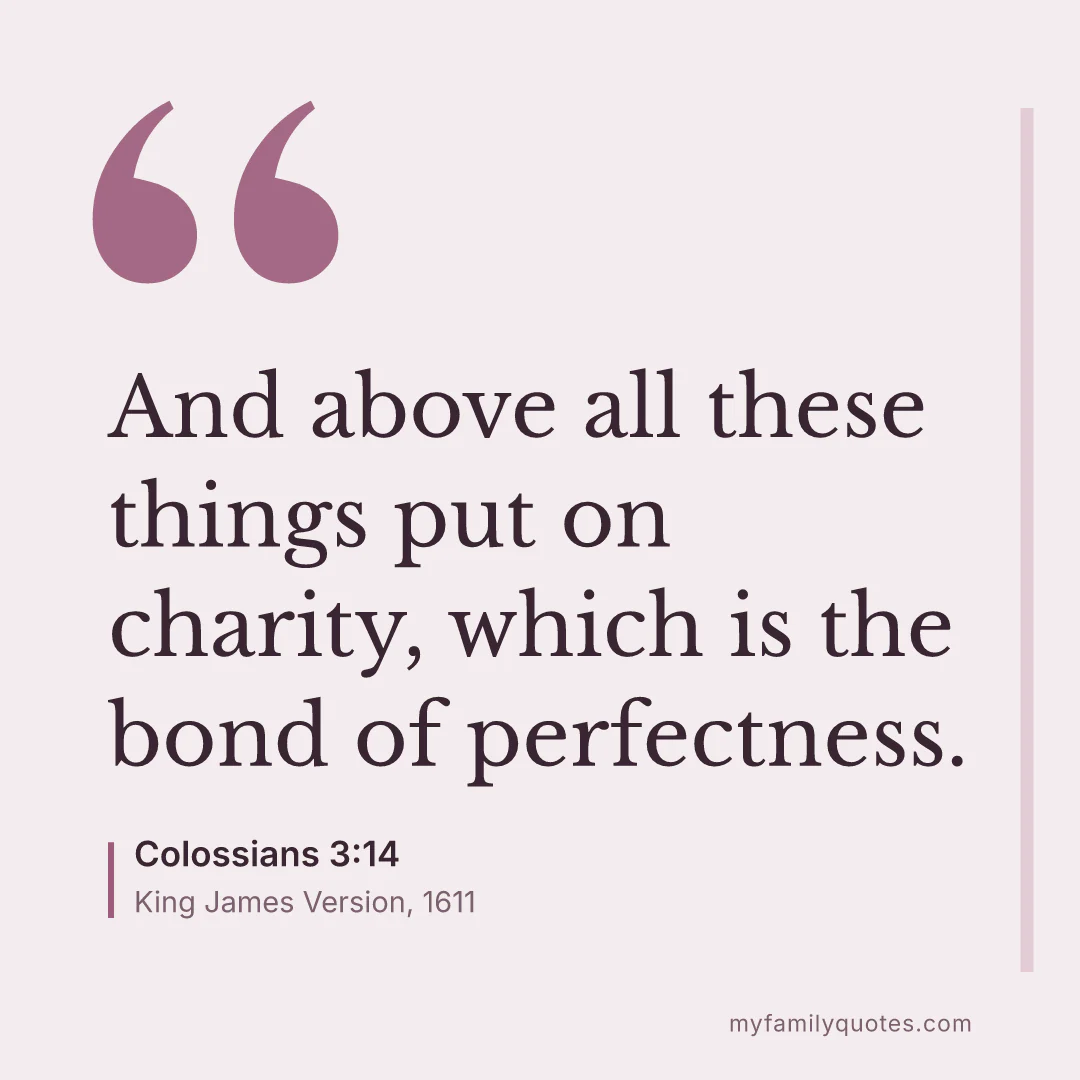
"And above all these things put on charity, which is the bond of perfectness." — Colossians 3:14 (King James Version)
"Charity" in the King James Bible means love in the broad sense, and the verse sits at the end of a list of everyday virtues: kindness, patience, "forbearing one another, and forgiving one another" (3:13). That context is why it suits a blended family: it is not about romantic love but about the daily patience a shared house needs. Read 3:12-14 together if you want a reading of thirty seconds; use 3:14 alone on a printed program or a unity-candle card.
If the children are taking part in the ceremony, the second verse speaks directly to them:
"Now therefore ye are no more strangers and foreigners, but fellowcitizens with the saints, and of the household of God …" — Ephesians 2:19 (King James Version)
Paul wrote it to two groups who had been kept apart and were now told they belonged to one household. Read the first half aloud ("ye are no more strangers") and it becomes a welcome to stepchildren who are meeting a new parent, or each other, on the same day. It works best when an older child or a grandparent reads it rather than the couple.
For a stepmom or stepdad who stepped in
Lincoln's mother, Nancy Hanks Lincoln, died in 1818, when he was nine. On 2 December 1819 his father married Sarah Bush Johnston, a widow who brought her three children, John, Matilda and Elizabeth, into the Lincoln cabin, according to the National Park Service. Some forty years later, writing a short third-person life of himself for the campaign biographer John L. Scripps, Lincoln gave her a single sentence:
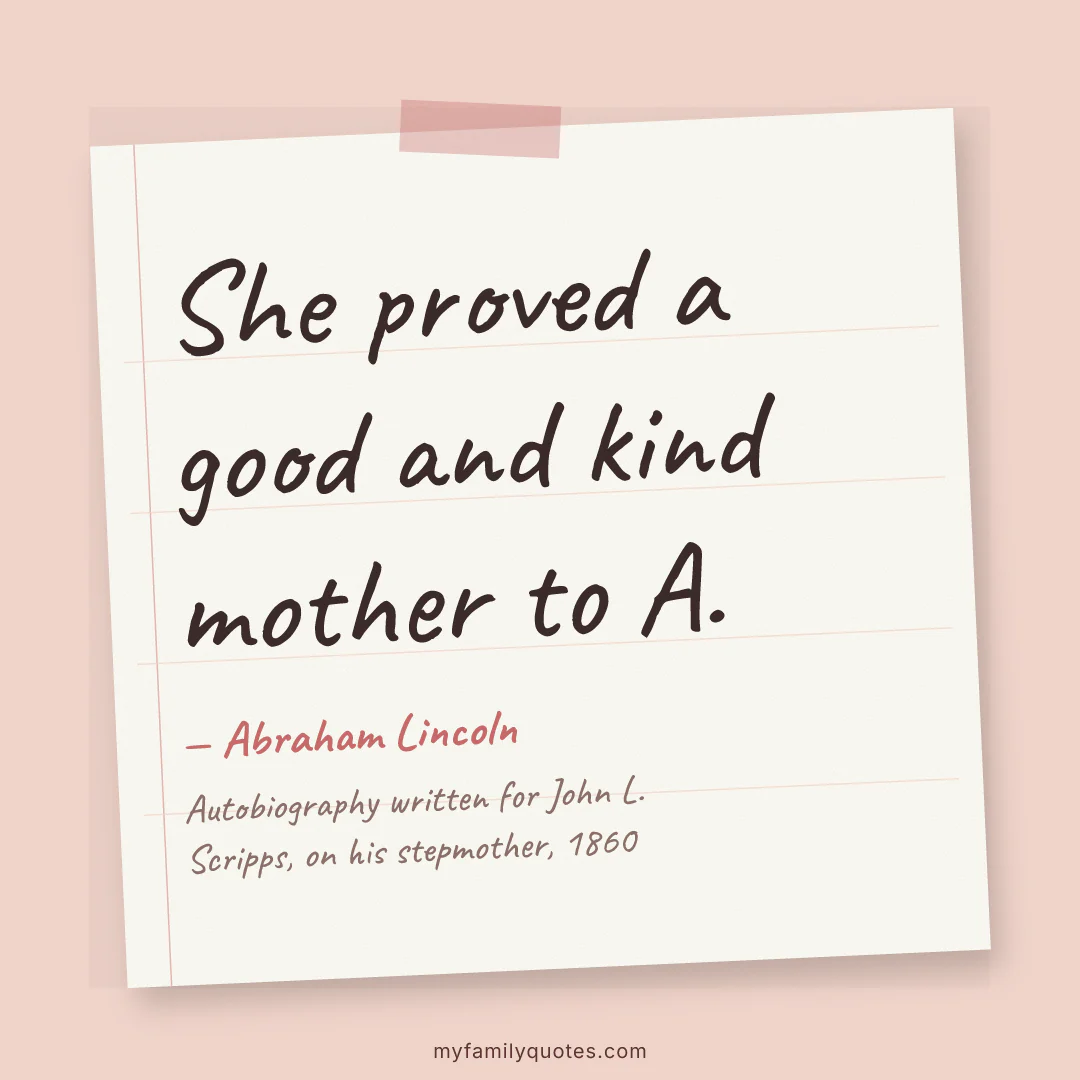
"She proved a good and kind mother to A." — Abraham Lincoln, autobiography written for John L. Scripps, 1860 (Collected Works of Abraham Lincoln, ed. Roy P. Basler, vol. 4)
"A." is Lincoln himself; the whole sketch is written in the third person. The sentence is almost dry, and that is its strength: it gives the facts and lets "good and kind" do the work. It is the line to borrow for a stepparent who would be embarrassed by anything grander. In a card you can write it as it stands and sign your own initial in place of the "A." Our stepmom quotes page has what Sarah Bush Lincoln herself later said about him, and there is a separate page of step dad quotes from a daughter.
Jane Austen wrote the other side of that moment, the very first contact between a stepson and his father's new wife. In Emma (1815), Mr. Weston's son Frank has been raised by his aunt and uncle and has never met Miss Taylor, who has just married his father. The village waits to see what he will do:
"Now was the time for Mr. Frank Churchill to come among them; and the hope strengthened when it was understood that he had written to his new mother on the occasion." — Jane Austen, Emma, vol. 1, ch. 2 (1815)
Austen calls the letter "a highly prized letter", and Mrs. Weston treasures it as proof of the young man's "great good sense." The lesson is practical: a short, warm note from an adult stepchild to a new step-parent, sent soon after the wedding, is remembered for years. If you are that stepchild, write it; three sentences is enough.
Captions for the whole table
Franklin opens his Autobiography (begun in 1771 as a letter to his son) with the family's history, and the line about his father's two marriages ends on the image of everyone at dinner:
"By the same wife he had four children more born there, and by a second wife ten more, in all seventeen; of which I remember thirteen sitting at one time at his table …" — Benjamin Franklin, Autobiography (begun 1771)
Franklin does not sort his siblings into "full" and "half"; they are all at the table. A few lines later he adds that his father liked to invite "some sensible friend or neighbor" to dinner and to start "some ingenious or useful topic for discourse." For a holiday photo of a big combined family, the short form works on its own: "Thirteen sitting at one time at his table (Benjamin Franklin)." Change the number to yours.
Lincoln's sign-off in a letter to his father has the same instinct, folding everybody in:
"Give my love to Mother, and all the connections." — Abraham Lincoln, letter to Thomas Lincoln, Washington, 24 December 1848
"Mother" here is his stepmother, Sarah; his own mother had died thirty years before. "All the connections" takes in the Johnstons, the Hankses and everyone else who had married in. It is a lovely closing line for a group text or a card addressed to a large blended family, and it avoids the problem of listing every name.
For the step-siblings in the picture, one verse from Romans is short enough for a caption:
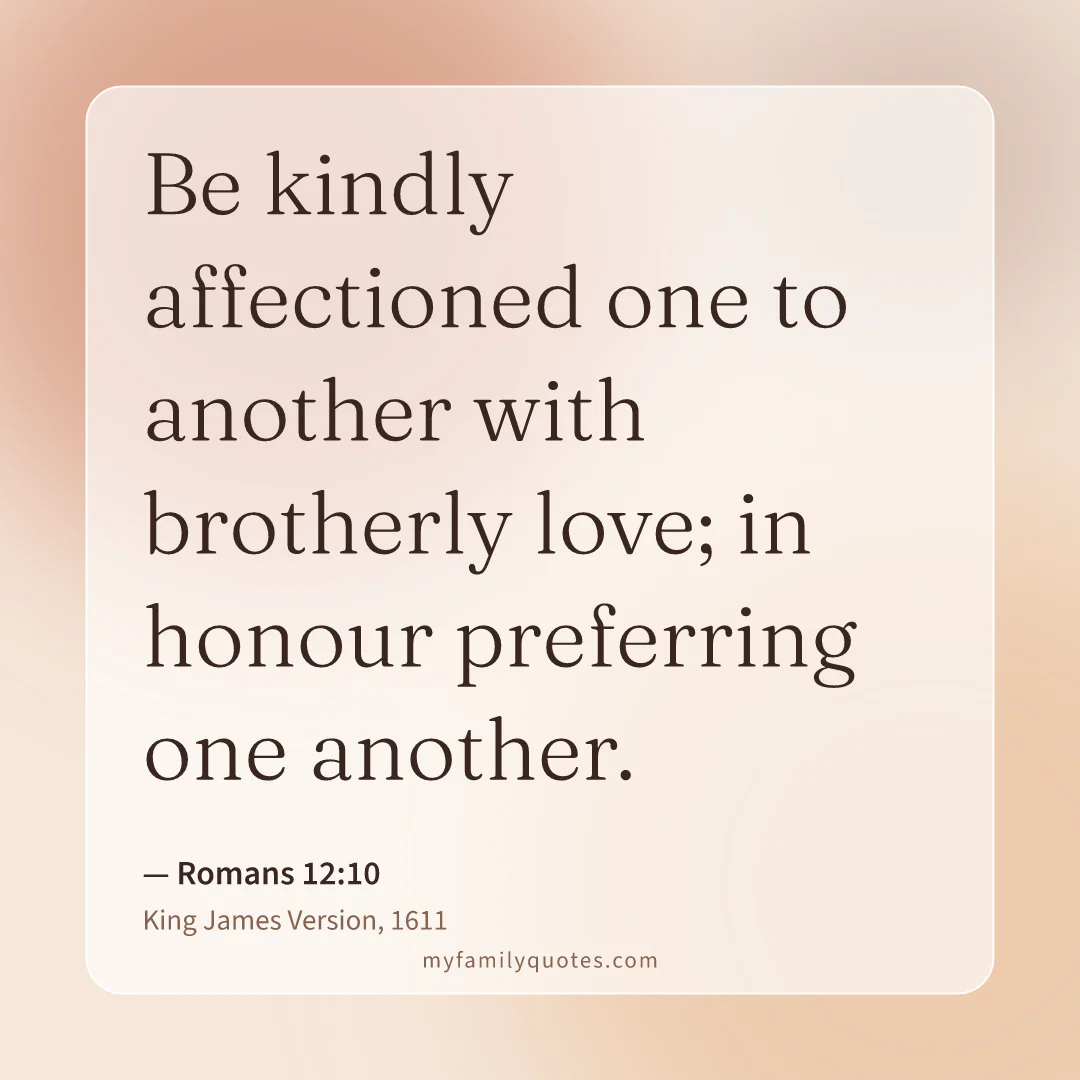
"Be kindly affectioned one to another with brotherly love; in honour preferring one another …" — Romans 12:10 (King James Version)
"In honour preferring one another" means letting the other person go first, which is exactly what step-siblings who share a bathroom, a back seat or a holiday schedule have to learn. It is a good line for a sibling group photo or for a parent's note to children who are moving into one house.
If you want something shorter and less formal, here are five captions written by our editors (they are not quotes, so don't attribute them to anyone):
- Two last names, one dinner table.
- We didn't start together. We stayed together.
- Yours, mine, ours, and the dog.
- More chairs, more noise, more love.
- Different beginnings, same front door.
When it's hard: quotes for blended family struggles
Blended families have real friction over money, rules and loyalty, and the most useful lines here are honest ones. The same day Lincoln wrote to his father, he added a letter to his stepbrother, John D. Johnston, on the same sheet. Johnston had asked for eighty dollars. Lincoln refused, told him bluntly that he was "not lazy, and still you are an idler", and offered to match every dollar Johnston earned by working instead. Then he wrote this:
"You have always been kind to me, and I do not now mean to be unkind to you." — Abraham Lincoln, letter to John D. Johnston, 24 December 1848
He signed it "Affectionately your brother," not "stepbrother." The letter is a model for a hard conversation between step-siblings: say the difficult thing, keep the relationship, and say out loud that you are on the same side. The line itself works for a message after an argument, when you need to be firm and kind in the same breath.
Austen gives the opposite example, which is worth knowing so you never sound like it. In Sense and Sensibility (1811), John Dashwood has promised his dying father to help his stepmother and his half-sisters. His wife Fanny talks him out of it:
"… what possible claim could the Miss Dashwoods, who were related to him only by half blood, which she considered as no relationship at all, have on his generosity to so large an amount." — Jane Austen, Sense and Sensibility, ch. 2 (1811)
The chapter goes on to cut the promised gift, step by step, from three thousand pounds down to almost nothing. It is a comic scene, but it names a real hurt: being told that a half-sibling or stepchild "doesn't really count." Quote it with a wink to someone who has heard that, or simply as a reminder of what not to say. (Fanny Dashwood also turns up on our page about toxic in-laws.)
What the Bible says about blended families
People often ask what God says about blended families. The honest answer is that the Bible is full of them and does not pretend they are easy. Abraham's household split over Sarah and Hagar's sons (Genesis 21:10, "Cast out this bondwoman and her son"); Jacob's twelve sons had four mothers and fought bitterly. But the same book also tells stories of children raised and loved by someone other than a birth parent. The clearest is Moses, nursed by his own mother and then raised in Pharaoh's palace:
"And the child grew, and she brought him unto Pharaoh's daughter, and he became her son." — Exodus 2:10 (King James Version)
"He became her son" is four plain words about a parent who was not there at the birth. It suits an adoption day, a stepparent adoption, or a card to a step-parent who has become a parent in every way that matters. The New Testament adds Joseph, who raised Jesus as his own; that story is on our step dad page. For the wider family, Psalm 68:6 ("God setteth the solitary in families") is on our page of Bible quotes for family.
How to write your own short blended family line
A quote gets you started, but in a blended family the most valued words are usually your own. A few things help:
- Name the people, not the labels. "To Dana and the kids" lands better than "To my blended family". Some children dislike being called "step" anything in a card.
- Thank them for something specific. Rides to practice, learning a new house's rules, sharing a room: a concrete act says more than "for everything."
- Don't compete with the other parent. Avoid lines like "better than a real dad." Respect for a child's other parent is the kindest thing a step-parent card can show.
- Keep it short. Lincoln needed one sentence for his stepmother. One or two sentences under a quote is plenty.
Three examples written by our editors you can adapt:
- "You didn't have to love us, and you did it anyway, every ordinary day. Happy Mother's Day, Jen."
- "Thank you for making room at your table, and in your life, for three more of us."
- "From two houses to one home: happy first anniversary as a family."
Blended family sayings we couldn't trace
Some of the most shared lines have no author anyone can find. "Blended families are made with love, not blood" and "A step-parent is someone who stepped up" appear on hundreds of pins and mugs with no source; use them freely, but don't attach a famous name. The same goes for "Family isn't always blood", whose history we trace on our page Family Is Not Always Blood. For more lines that are pinned to the wrong person, see misattributed family quotes.
Questions about blended family quotes
What does God say about blended families?
The Bible does not use the term, but it is full of blended households, from Abraham's and Jacob's quarrelling families to Moses, raised as the son of Pharaoh's daughter (Exodus 2:10), and Joseph, who raised Jesus. Colossians 3:13-14 ("forbearing one another, and forgiving one another … put on charity") is the verse most often read for a family coming together.
What is a blended family?
A blended family, or stepfamily, is one in which at least one partner has children from an earlier relationship. Franklin's father, with children from two marriages, and Lincoln's father, who married a widow with three children, both headed one.
What are some inspirational quotes about stepchildren?
Lincoln's "She proved a good and kind mother to A." (1860) is the classic tribute from a stepchild to a step-parent, and "he became her son" (Exodus 2:10) is a short line about a child who became truly someone's own. From Austen's Emma, Frank Churchill's letter "to his new mother" shows how much a stepchild's first kind word is remembered.
What is a good short caption for a blended family photo?
Franklin's "thirteen sitting at one time at his table" (change the number to yours) or Lincoln's "Give my love to Mother, and all the connections." If you prefer something unsigned, try "Two last names, one dinner table."