Toxic In-Laws Quotes: 10 Real Lines and Straight Answers to What People Ask
Words My Family Quotes Editors
Terri Orbuch, a psychologist at the University of Michigan's Institute for Social Research, followed a group of married couples for 26 years. Husbands who said they were close to their wife's parents had a divorce risk about 20% lower than the group overall. For wives who felt close to their husband's parents, the risk was about 20% higher. The Wall Street Journal reported the findings in November 2012, and Orbuch's reading was that because a woman's identity as a wife and mother is so central to her, she may hear her in-laws' advice as interference in exactly that role. In other words, the trouble with in-laws is rarely the big scene. It's the steady drip.
That drip is what people mean when they search for toxic in-laws quotes. This page answers the questions they ask alongside it (how do you tell if your in-laws are toxic, whose job is it to deal with them, when do you step back), and puts ten real lines under those questions. Each line has a speaker, a work and a year, checked against the full text. Mothers-in-law have their own page of quotes. This one covers the whole set: parents-in-law, sisters- and brothers-in-law, and the family that comes with the person you married.
How do you tell if your in-laws are toxic, not just difficult?
Most in-law friction is ordinary. Two families have two sets of habits, and both think theirs is normal. The word "toxic" fits when the pattern is repeated, aimed at you or your marriage, and doesn't change after you've raised it calmly. This table is a rough guide we wrote, not a clinical test:
| Difficult (annoying but workable) | Toxic (a pattern that hurts the marriage) |
|---|---|
| Unasked-for advice about cooking, money or the kids | Overruling your decisions with your children once you've left the room |
| Forgetting your birthday | Leaving you out of plans on purpose and making sure you hear about it |
| Long visits | Turning up unannounced after you've asked them not to |
| Different politics or religion | Treating your marriage as a phase their child will get over |
| Complaining to your spouse once | Asking your spouse to choose between them and you |
Literature's best portrait of the quiet kind is Fanny Dashwood. Jane Austen introduces her in the first chapter of her first published novel with a single line:
"Mrs. John Dashwood was a strong caricature of himself;—more narrow-minded and selfish." — Jane Austen, Sense and Sensibility, chapter 1 (1811)
"Himself" is her husband John, who has just promised his dying father to look after his stepmother and half-sisters. Austen has already called him "rather cold hearted, and rather selfish". Fanny is that, only stronger. She never raises her voice. In chapter 2 she simply talks her husband down from three thousand pounds to the odd neighbourly present, one reasonable-sounding step at a time. If you've watched an in-law work on your spouse rather than on you, this is the line that names it.
"Certainly not; but if you observe, people always live for ever when there is an annuity to be paid them." — Fanny Dashwood, in Jane Austen, Sense and Sensibility, chapter 2 (1811)
She is talking about her husband's stepmother, a healthy widow "hardly forty", and the small yearly income John had thought of giving her. It's one of the coldest sentences in Austen, and it's funny because Fanny says it as if it were plain good sense. Use it when the in-law trouble is about money: a will, a loan, a promise that keeps shrinking. It works best with people who know the book. Without the context, it can read as a wish that someone would die.
What's a good quote for fake in-laws?
"Fake in laws quotes" is one of the most searched follow-ups. It usually means relatives who are warm at the table and cutting behind your back. The oldest description of that feeling is in the Psalms:
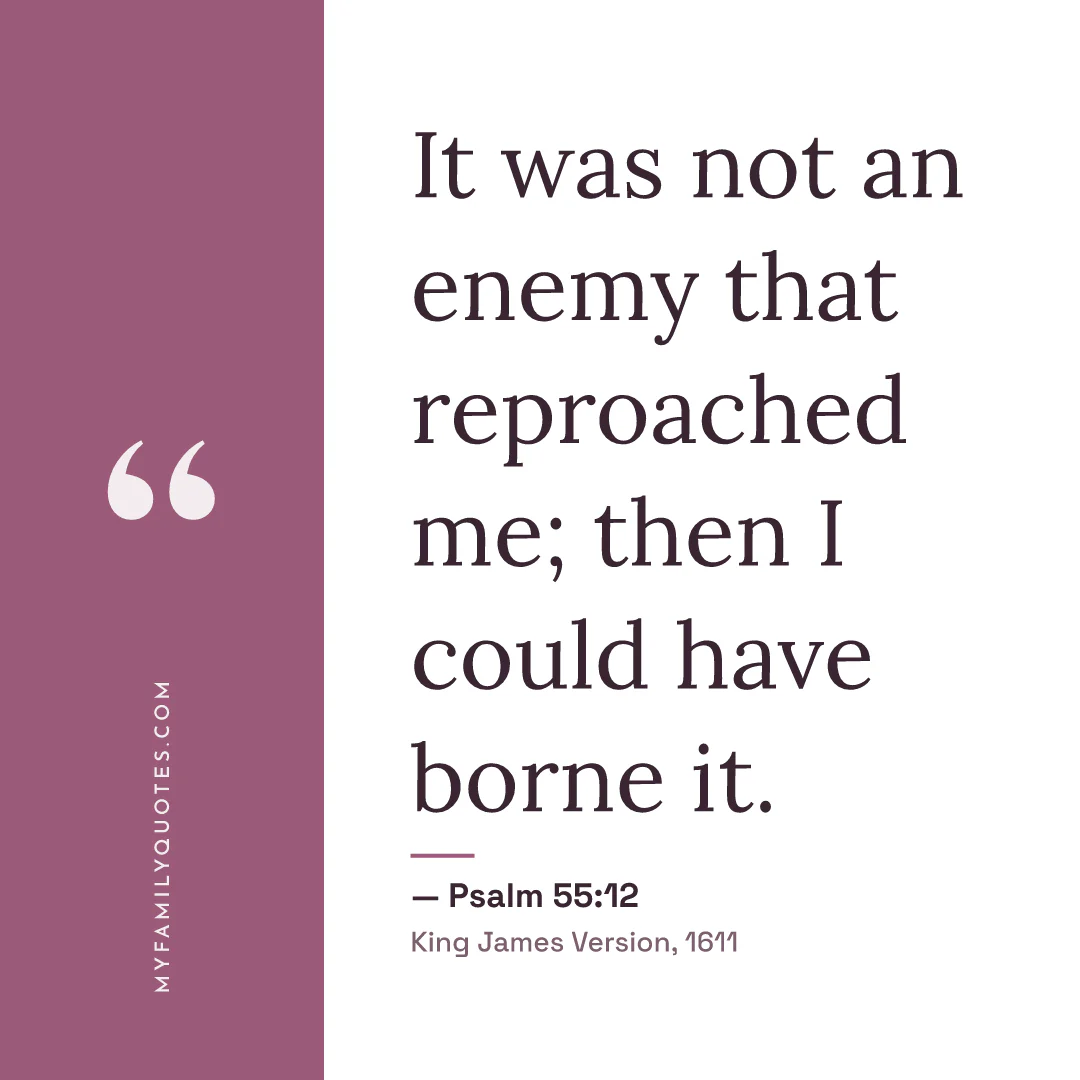
"For it was not an enemy that reproached me; then I could have borne it: neither was it he that hated me that did magnify himself against me; then I would have hid myself from him: But it was thou, a man mine equal, my guide, and mine acquaintance." — Psalm 55:12–13 (King James Version, 1611)
The next verse adds the detail that cuts deepest: "We took sweet counsel together, and walked unto the house of God in company." The pain isn't the insult. It's who delivered it. That's why the line suits in-laws who made you feel welcome at the wedding. For a caption, the first clause, "It was not an enemy that reproached me; then I could have borne it", carries the meaning alone.
A note on tone: once you post a fake-family quote, every relative who sees it will decide whether it's about them. If the point is to be understood by one person, a direct conversation will do more than a public line.
Whose job is it to deal with them: yours or your spouse's?
Ask a family therapist and you'll usually hear: your spouse handles their own family, and you handle yours. The reason is old and almost blunt. The Bible's first statement about marriage is about leaving:
"Therefore shall a man leave his father and his mother, and shall cleave unto his wife: and they shall be one flesh." — Genesis 2:24 (King James Version, 1611)
The verse comes right after the creation of Eve, and the New Testament repeats it three times (Matthew 19:5, Mark 10:7 and Ephesians 5:31). It doesn't tell anyone to abandon their parents. It sets an order of loyalty: the new household comes first. When a husband or wife keeps a parent's opinion above the marriage, this is the verse couples counsellors tend to bring up. Quote it to your spouse, not to your in-laws.
The other half of the answer is that the couple doesn't have to merge into one opinion either. Kahlil Gibran put it in the passage on marriage in The Prophet:
"But let there be spaces in your togetherness, And let the winds of the heavens dance between you." — Kahlil Gibran, The Prophet, "On Marriage" (1923)
The prophet Almustafa gives this answer when the seeress Almitra asks him about marriage, and it goes on to "stand together yet not too near together". It's a wedding-reading favourite, but it also fits in-law trouble. Supporting your spouse against a pushy parent doesn't mean you must feel the same about that parent. You can be on their side and still have your own view.

Why do in-laws complain to you about each other?
Being the person everyone confides in sounds flattering until you're carrying messages between two houses. Austen wrote the definitive version in Persuasion, where Anne Elliot stays with her married sister Mary next door to Mary's in-laws, the Musgroves:
"One of the least agreeable circumstances of her residence there was her being treated with too much confidence by all parties, and being too much in the secret of the complaints of each house." — Jane Austen, Persuasion, chapter 6 (1817; published posthumously)
What follows is a run of complaints from both sides. Mary moans about her mother-in-law, the mother-in-law about Mary, and each one wants Anne to pass a message on. Austen's answer is Anne's method: "She could do little more than listen patiently, soften every grievance, and excuse each to the other." That's still the best tactic. Listen, don't relay, and don't agree with anyone's complaint about someone who isn't there.
The complaint at the centre of that chapter is the most common in-law fight of all: grandparents and the children's diet.
"I hate sending the children to the Great House, though their grandmamma is always wanting to see them, for she humours and indulges them to such a degree, and gives them so much trash and sweet things, that they are sure to come back sick and cross for the rest of the day." — Mary Musgrove, in Jane Austen, Persuasion, chapter 6 (1817)
Two centuries on, the only thing that has changed is the snacks. Austen lets both women be partly right: the grandmother spoils the boys, and Mary can't manage them either. Use this one to laugh at the grandparent sugar war rather than to wage it. If the issue is a real allergy or safety rule, though, that's a boundary, not a matter of taste, and your spouse should say it to their parents plainly.
Are there funny in-law quotes that aren't cruel?
The related search "toxic in laws quotes funny" turns up plenty of memes that are just insults. These two older lines are funnier, partly because they're aimed at everyone, the speaker included.
"I admire all my three sons-in-law highly," said he. "Wickham, perhaps, is my favourite; but I think I shall like your husband quite as well as Jane's." — Mr Bennet, in Jane Austen, Pride and Prejudice, chapter 59 (1813)
He says this to Elizabeth after giving his consent to her marriage to Darcy. Wickham is the son-in-law who eloped with the youngest daughter, ran up debts and had to be paid to marry her, so calling him the favourite is pure irony. Every family has a Wickham. This is the line for a sibling's group chat after a holiday dinner, said with an eye-roll rather than a grudge.

"Withdraw thy foot from thy neighbour's house; lest he be weary of thee, and so hate thee." — Proverbs 25:17 (King James Version, 1611)
It's the King James Bible's answer to the in-laws who stay ten days. The Hebrew verb behind "withdraw" literally means "make rare" (the Greek Septuagint has "bring thy foot sparingly"), so the advice is to visit less often, not to stop visiting. It's gentle enough to quote to the in-laws themselves, especially in a family that reads scripture, and it cuts both ways. Next time it's your turn to stay with them, it applies to you.
When is it time to step back from toxic in-laws?
"When to cut off toxic in-laws" is a real search, and there's no quote that can answer it for you. A useful test is whether the harm continues after both of you, not just you, have clearly asked for a change. If your spouse has spoken to their own parents, the rule was simple, and it was still broken, distance is a reasonable step. It doesn't have to be permanent or announced. Shorter visits, staying in a hotel, or holidays at home are all forms of stepping back. If you're past that point, our sad family quotes about estrangement are written for that quieter stage.
Before you go that far, keep this proverb in mind. It's about why family quarrels last so long:
"A brother offended is harder to be won than a strong city: and their contentions are like the bars of a castle." — Proverbs 18:19 (King James Version, 1611)
The verse says nothing about who is right. Its point is that a family wound hardens faster than a quarrel with a stranger, because there's more history to defend. Read it as a warning against the parting shot. Step back if you have to, but avoid the email or post that makes a later return impossible. Brothers-in-law and sisters-in-law fall under it as much as brothers do.
What to say when your in-laws disrespect you
Quotes are for captions. In the room, you need plain sentences. These are our own suggestions, not quotations. Each one names the behaviour without starting a trial:
- When they overrule you with the kids: "We've decided on this one. I know you'd do it differently, and that's fine at your house."
- When they show up unannounced: "We love seeing you. Text first, though, because some days we can't have anyone over."
- When a comment is aimed at you through your spouse: "If there's something about me that bothers you, I'd rather you told me."
- When they compare you to an ex or another in-law: "I'm going to skip that comparison."
- When they push your spouse to choose: (your spouse says it) "Nobody's choosing. We're a family of our own now, and we decide together."
- When you need to leave: "We're heading out now. Thanks for dinner." Then actually leave.
For in-laws you like but find hard work, a gentler register helps. Our guide to writing to a sister-in-law has examples for strained relationships too.
Short versions for captions
"Toxic in laws quotes short" is the most common related search, so here are the lines above cut to caption length. A shortened line is still a quotation, so keep the attribution.
| Short line | Source | Words | Best for |
|---|---|---|---|
| "It was not an enemy that reproached me; then I could have borne it." | Psalm 55:12 (KJV) | 14 | Fake in-laws |
| "Let there be spaces in your togetherness." | Gibran, The Prophet (1923) | 7 | Couple boundaries |
| "Withdraw thy foot from thy neighbour's house." | Proverbs 25:17 (KJV) | 7 | Long visits |
| "A brother offended is harder to be won than a strong city." | Proverbs 18:19 (KJV) | 12 | Family feuds |
| "People always live for ever when there is an annuity to be paid them." | Austen, Sense and Sensibility (1811) | 14 | Money and wills (dark) |
| "Wickham, perhaps, is my favourite." | Austen, Pride and Prejudice (1813) | 5 | The problem son-in-law (ironic) |
A small spelling point that comes up in captions: the plural is "in-laws", and in the full compounds the "s" goes on the person, not the law: "sisters-in-law", "parents-in-law". The possessive of the plural is "my in-laws' house".
Many of the in-law "quotes" shared online have no source at all, and some are pinned on famous names. If a line credits Mark Twain or Oscar Wilde and gives no book or year, check our misattributed family quotes before you share it.
Quick answers
What is a short quote about toxic in-laws?
"It was not an enemy that reproached me; then I could have borne it" (Psalm 55:12, King James Version) is short and serious and fits in-laws who were friendly at first. For a lighter one, use Mr Bennet's "Wickham, perhaps, is my favourite" from Pride and Prejudice (1813).
Should my spouse deal with their own parents?
Usually, yes. Genesis 2:24 puts the new household first, and in practice a boundary carries more weight coming from their own child. Your part is to agree on the boundary together first.
Is there a book about toxic in-laws?
Yes. The best-known is Susan Forward's Toxic In-Laws: Loving Strategies for Protecting Your Marriage (HarperCollins, 2001). We haven't quoted from it here because we couldn't check exact wording against the text.