Favoritism in Family Quotes: 13 Passages From Genesis, King Lear, Austen and Dickens
Words My Family Quotes Editors

Do parents really have a favorite child? When the sociologists J. Jill Suitor, Megan Gilligan and Karl Pillemer asked 406 mothers aged 65 to 75 which adult child they would prefer as a caregiver, and asked again seven years later, about three-quarters named the same child both times, according to Purdue University's summary of the study in the Journal of Marriage and Family (2013). One of the biggest predictors of who stayed the favorite was how similar the mother felt that child was to herself. Storytellers knew this long before anyone ran a survey: the oldest family stories we have are full of a parent who loves one child more, and of the brothers and sisters who notice.
This page collects favoritism in family quotes from those stories, 13 passages from Genesis, the Gospel of Luke, King Lear, Cinderella, Jane Austen and Charles Dickens. Each one is quoted from a fetched copy of the original text, with its chapter, the situation around it and what it says about favoritism, so you can use it knowing exactly what you are quoting. Near the end there is a short guide to using these lines when you are the overlooked child, the favored one, or the parent. If you want one line now, the most famous is Genesis 37:3: "Now Israel loved Joseph more than all his children."
Four generations of favorites in Genesis
Read Genesis as one family history and favoritism turns out to be its inheritance. It passes from parents to son to grandson, and every time it splits the brothers. It starts with twins.
"And Isaac loved Esau, because he did eat of his venison: but Rebekah loved Jacob."
— Genesis 25:28 (King James Version, 1611)
One sentence, two favorites, and a reason given for only one of them. Isaac's love has a motive as plain as a meal: Esau was the hunter who brought him game. Rebekah's love for the quieter twin is simply stated. Each parent has a child, and neither has both, and the rest of the story follows from that. It is a useful verse for anyone who grew up in a house split the same way, because it shows the pattern is not new and not invented. It is also an honest line for a parent to read, since it names how small the reasons for preferring a child can be.
Two chapters later, Rebekah helps Jacob take the blessing Isaac meant for Esau. When Esau comes in from the field and learns what has happened, he asks his father the question every overlooked child has asked in some form.
"And Esau said unto his father, Hast thou but one blessing, my father? bless me, even me also, O my father. And Esau lifted up his voice, and wept."
— Genesis 27:38 (King James Version, 1611)
"Hast thou but one blessing?" is the heart of it. Favoritism feels to the other child as if love were rationed, as if there were one portion and someone else got it. Esau is a grown man here, and he still weeps. That is why this verse speaks to adult children too: the hurt does not end when you leave home. Use it when you want to describe the feeling rather than accuse anyone; it carries more weight than any modern caption because it is one of the oldest scenes of a son pleading with his father in all literature.
Jacob, the favored twin, grows up and does the same thing. He marries two sisters, Leah and Rachel, and "he loved also Rachel more than Leah" (Genesis 29:30); the next verse says plainly that "Leah was hated." When Rachel finally has a son, that son becomes the favorite of the next generation.
"Now Israel loved Joseph more than all his children, because he was the son of his old age: and he made him a coat of many colours."
— Genesis 37:3 (King James Version, 1611)
Israel is Jacob's other name, so this is the boy who was once Rebekah's favorite now picking a favorite of his own. The coat matters because it is visible. A private preference might have been bearable; a garment that announces it every day was not. That is the lesson people quote this verse for: favoritism does the most damage when it is shown, in gifts, attention or public praise. The coat of many colours has become the shorthand for exactly that, and the verse works well when you want to name the problem without naming a person.

The next verse is the cost.
"And when his brethren saw that their father loved him more than all his brethren, they hated him, and could not speak peaceably unto him."
— Genesis 37:4 (King James Version, 1611)
Notice who the brothers hate. Not their father, who did the favoring, but Joseph, who only received it. That is one of the truest things ever written about favoritism: the anger usually lands on the sibling, because the parent is harder to blame. "Could not speak peaceably unto him" is a precise description of a family where every conversation turns into a fight. The story goes on to the pit, the sale into Egypt and, many chapters later, a reconciliation, when Joseph tells them, "I am Joseph your brother, whom ye sold into Egypt" (Genesis 45:4). Even then the pattern is not quite finished. As an old man, Jacob crosses his hands to give the younger grandson the greater blessing, a scene we tell on our page of Bible verses about grandparents.
The elder brother's complaint: Luke 15
The parable of the prodigal son is usually read for its returning son and its forgiving father. Favoritism readers should start at the end, where the older brother comes in from the field, hears music and is told a feast is being held for the brother who wasted his inheritance.
"And he answering said to his father, Lo, these many years do I serve thee, neither transgressed I at any time thy commandment: and yet thou never gavest me a kid, that I might make merry with my friends."
— The elder brother, Luke 15:29 (King James Version, 1611)
This is the voice of the reliable child, the one who stayed, did the work and was never celebrated. Look at the next verse and he no longer says "my brother" but "this thy son" (Luke 15:30), pushing the younger one away from himself and onto his father. Anyone who has been the dependable sibling while another got the attention will hear themselves in "these many years do I serve thee." It is an exact, sourced line for that feeling, and it is far older than the internet's version of it.
The father's answer is the part that makes the parable more than a complaint.
"And he said unto him, Son, thou art ever with me, and all that I have is thine."
— The father, Luke 15:31 (King James Version, 1611)
He does not argue with the facts. He does not say the elder son is imagining it. He tells him two things: you have always had my company, and nothing is being taken from you. The parable ends there, without saying whether the older brother went in to the feast. That open ending is why this is the best verse on this page for a parent. It shows a father who notices the child who feels passed over, goes out to him (Luke 15:28: "therefore came his father out, and intreated him") and reassures him without taking anything back from the other.

"Which of you shall we say doth love us most?" King Lear
Shakespeare's King Lear, written around 1606, opens with a father turning his love into a contest. He is about to divide his kingdom among his three daughters and announces that the biggest share will go to whoever loves him most.
"Tell me, my daughters,— / Since now we will divest us both of rule, / Interest of territory, cares of state,— / Which of you shall we say doth love us most? / That we our largest bounty may extend / Where nature doth with merit challenge."
— King Lear, King Lear, Act 1, Scene 1 (William Shakespeare, c. 1606)
Goneril and Regan flatter him extravagantly. Cordelia, the youngest, says she loves him "according to my bond; nor more nor less", and he disowns her on the spot. The scene is quoted whenever a family ties love to money, inheritance or performance: the parent who asks the children to compete is the one who loses. As a line, "which of you shall we say doth love us most?" works for any situation where a will, a house or a parent's approval is being handed out as a prize.
The twist is that Cordelia was the favorite all along. Lear says so himself, in the middle of his rage.
"I loved her most, and thought to set my rest / On her kind nursery."
— King Lear, of Cordelia, King Lear, Act 1, Scene 1 (William Shakespeare, c. 1606)
He had planned to spend his old age in her care ("her kind nursery"), and the moment she refuses to flatter him, the favorite becomes the outcast. This is the other side of favoritism that lists rarely mention: being the favorite is conditional, and the condition is usually that you keep giving the parent what they want. It is a sharp line for the favored child who has been dropped, and a warning for any parent who has a "best" child in mind.
The two older daughters have been watching all this for years, and once Cordelia leaves for France, Goneril says it out loud to her sister.
"He always loved our sister most; and with what poor judgment he hath now cast her off appears too grossly."
— Goneril to Regan, King Lear, Act 1, Scene 1 (William Shakespeare, c. 1606)
"He always loved our sister most" is perhaps the most quotable sentence ever written about favoritism, and it is worth knowing who says it. Goneril is not a sympathetic witness: she and Regan go on to treat their father with real cruelty. Shakespeare gives the truest line about a favorite to the daughters who resent it, and lets the audience see that resentment and accuracy can go together. Quote it for its honesty, not as a portrait of the speaker.
The stepmother's favorites: Cinderella
Charles Perrault published his Cinderella in 1697, in the collection usually called Tales of Mother Goose. In the English version Andrew Lang printed in The Blue Fairy Book (1889), the first paragraph after the wedding states the whole problem.
"No sooner were the ceremonies of the wedding over but the mother-in-law began to show herself in her true colors. She could not bear the good qualities of this pretty girl, and the less because they made her own daughters appear the more odious."
— Cinderella, or the Little Glass Slipper, in Andrew Lang's The Blue Fairy Book (1889), after Charles Perrault (1697)
Two things are worth noticing. "Mother-in-law" is the old English word for stepmother here, not a husband's mother. And Perrault gives a reason for the favoritism that is more psychological than the fairy-tale image suggests: the stepdaughter is resented because she makes the favored daughters look worse. The same page adds that she "dared not tell her father", because "his wife governed him entirely". That is the bystander parent, the one who does not favor anyone but lets it happen. For blended families it is a story to handle carefully, since most stepparents are nothing like this one; our page of short blended family quotes has lines for the many families where it goes well.
Jane Austen's parents who prefer one daughter
Austen wrote about favoritism with more comedy and less violence than Genesis or Shakespeare, but she was just as exact. Pride and Prejudice (1813) shows it in its very first chapter, when Mr. Bennet says he will put in "a good word for my little Lizzy" and his wife objects.
"Lizzy is not a bit better than the others: and I am sure she is not half so handsome as Jane, nor half so good-humoured as Lydia. But you are always giving her the preference." / "They have none of them much to recommend them," replied he: "they are all silly and ignorant like other girls; but Lizzy has something more of quickness than her sisters."
— Mrs. and Mr. Bennet, Pride and Prejudice, Chapter 1 (Jane Austen, 1813)
Both parents have favorites, and each accuses the other of having one. Mrs. Bennet's list gives her own away: Jane for looks, Lydia for spirits. Mr. Bennet's defence is the classic one: he doesn't love Lizzy more, she is simply better. It is a light, recognisable exchange, good for a caption about the "favorite child" joke many families keep up, and a reminder that two parents can split a house of five daughters between them without saying a word about it to the girls.
Persuasion, Austen's last finished novel (published at the end of 1817), opens with a far colder father. Sir Walter Elliot dotes on his eldest daughter, Elizabeth, who is handsome and "very like himself". Austen's verdict on the other two is one of the bleakest sentences she wrote.
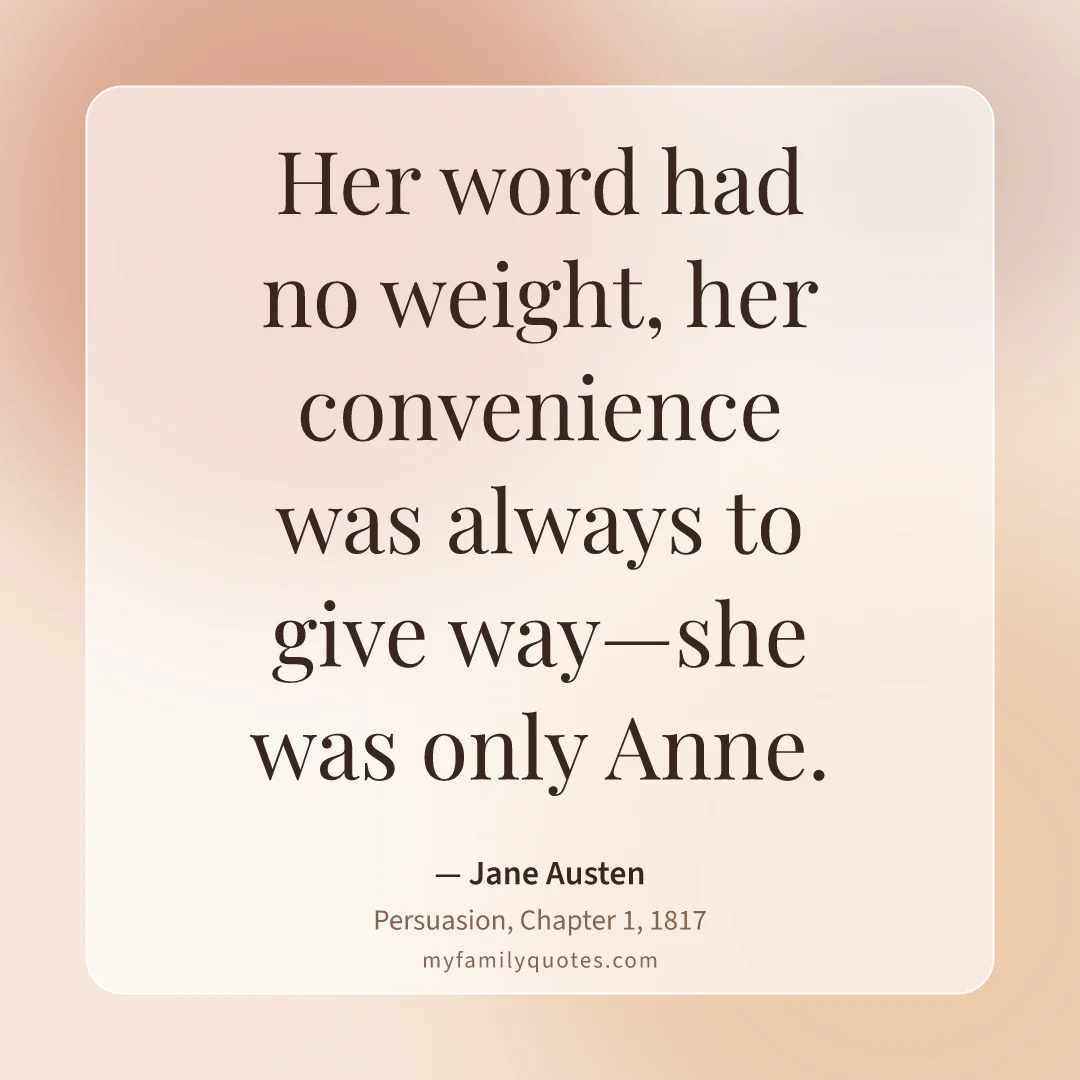
"His two other children were of very inferior value. Mary had acquired a little artificial importance, by becoming Mrs Charles Musgrove; but Anne, with an elegance of mind and sweetness of character, which must have placed her high with any people of real understanding, was nobody with either father or sister; her word had no weight, her convenience was always to give way—she was only Anne."
— Persuasion, Chapter 1 (Jane Austen, 1817)
"She was only Anne" has become a phrase readers use for the child who is overlooked not because of any fault but because she is quiet and does not resemble the parent. That matches the similarity finding in the study above surprisingly well: Elizabeth is the favorite because she is like her father. The sentence also explains how favoritism is lived day to day: her word has no weight, and her convenience always gives way. The novel then shows Anne valued by people outside the family, which is why the line is often quoted as encouragement rather than complaint.
Dickens and the daughter who was "merely a piece of base coin"
Dickens's Dombey and Son (1848) begins on the day Mr. Dombey's longed-for son is born. His daughter Florence, born some six years before, has slipped into the room and is crouching in a corner to see her mother's face, and the narrator tells us what she is worth to her father.
"But what was a girl to Dombey and Son! In the capital of the House's name and dignity, such a child was merely a piece of base coin that couldn't be invested—a bad Boy—nothing more."
— Dombey and Son, Chapter 1 (Charles Dickens, 1848)
This is favoritism by sex and by usefulness: the son can carry the firm's name, the daughter cannot. The money language ("capital", "base coin", "invested") is Dickens's point, a father who sees his children as assets. Much of the novel follows Florence loving a father who will not look at her. Quote this line when the favoritism in a family follows a rule, the boy, the eldest, the one who will take over the business, rather than personality.
What the stories agree on
Put side by side, these passages describe the same few patterns again and again. A short summary:
| The story | Why one child is preferred | Who pays for it |
|---|---|---|
| Isaac and Rebekah (Genesis 25-27) | Each parent prefers the twin who suits them | Both sons, who become enemies |
| Jacob and Joseph (Genesis 37) | Son of his old age, son of the wife he loved | Joseph, hated by ten brothers |
| The prodigal son (Luke 15) | The returning son gets the feast | The reliable elder brother |
| King Lear | Love measured by flattery | The favorite herself, then the whole family |
| Cinderella | A stepmother prefers her own daughters | The stepdaughter, while her father looks away |
| Persuasion | The daughter who resembles her father | Anne, "only Anne" |
| Dombey and Son | A son can carry the family firm | Florence, the daughter |
Three lessons repeat. Favoritism is usually passed down, as it is through four generations in Genesis. The resentment tends to fall on the favored sibling instead of the parent. And being the favorite is rarely safe, as Cordelia and Joseph both find out.
Using these lines without starting a fight
Most people looking for favoritism quotes want to say something they have not been able to say directly. A sourced line can help, because it shifts the conversation from "you did this" to "this is an old and well-known pattern". Some practical notes from the passages above:
- If you are the overlooked child, describe the feeling rather than the verdict. Esau's "Hast thou but one blessing?" or the elder brother's "these many years do I serve thee" say how it felt without listing grievances. "She was only Anne" works for a caption about being the quiet one.
- If you are talking to a brother or sister, Genesis 37:4 is the honest one: the brothers blamed Joseph for what their father did. Saying that the favoritism was not your sibling's choice can open a conversation that blame closes. Our page of toxic sibling quotes covers rivalries that have gone further.
- If you are the parent, the father in Luke 15:31 is the model: go out to the child who feels passed over, and reassure without taking anything from the other. Avoid quoting Lear's "I loved her most" to anyone but yourself.
- If it is grandparents doing the favoring, Jacob's crossed hands in Genesis 48 show it can skip a generation. The same rule applies: name the pattern, not the person.
- For social media, remember that the people you mean will often read it. A public caption about a sibling's coat of many colours is a coat of its own. If you need to mark a break, our page on black sheep of the family quotes has lines about being the one who doesn't fit, which point at you rather than at them.
One more caution. Goneril's "He always loved our sister most" is true and very quotable, but she says it while planning to take power from her father. If you quote it, quote it for what it says, and know the scene it comes from.
Questions people ask about favoritism in families
Is there a Bible verse about favoritism in family?
The clearest is Genesis 37:3-4: Israel "loved Joseph more than all his children", and when his brothers saw it "they hated him, and could not speak peaceably unto him." Genesis 25:28 (Isaac loved Esau, Rebekah loved Jacob) and the elder brother's complaint in Luke 15:29 are the other two most used passages.
Do parents really have a favorite child?
Many say they do. In the Suitor, Gilligan and Pillemer study of 406 older mothers, about three-quarters named the same preferred child as caregiver seven years apart, and perceived similarity between mother and child was one of the biggest predictors. Literature shows the same thing in Sir Walter Elliot, who favors the daughter "very like himself".
What is a short quote about favoritism in family?
"He always loved our sister most" (Goneril, King Lear, Act 1, Scene 1) and "she was only Anne" (Persuasion, Chapter 1) are short enough for a caption and are both quoted exactly from the original texts above.
How do you deal with parents who favor one child?
The stories suggest two things: talk about the pattern rather than attacking the favored sibling, who usually did not choose it, and say how it feels rather than keeping score. A line like Esau's "bless me, even me also" can say that more gently than an argument. If the situation is harming you, a family counsellor can help in ways a quote cannot.