Bible Verses About Grandparents: 12 KJV Verses and the Questions They Answer
Words My Family Quotes Editors
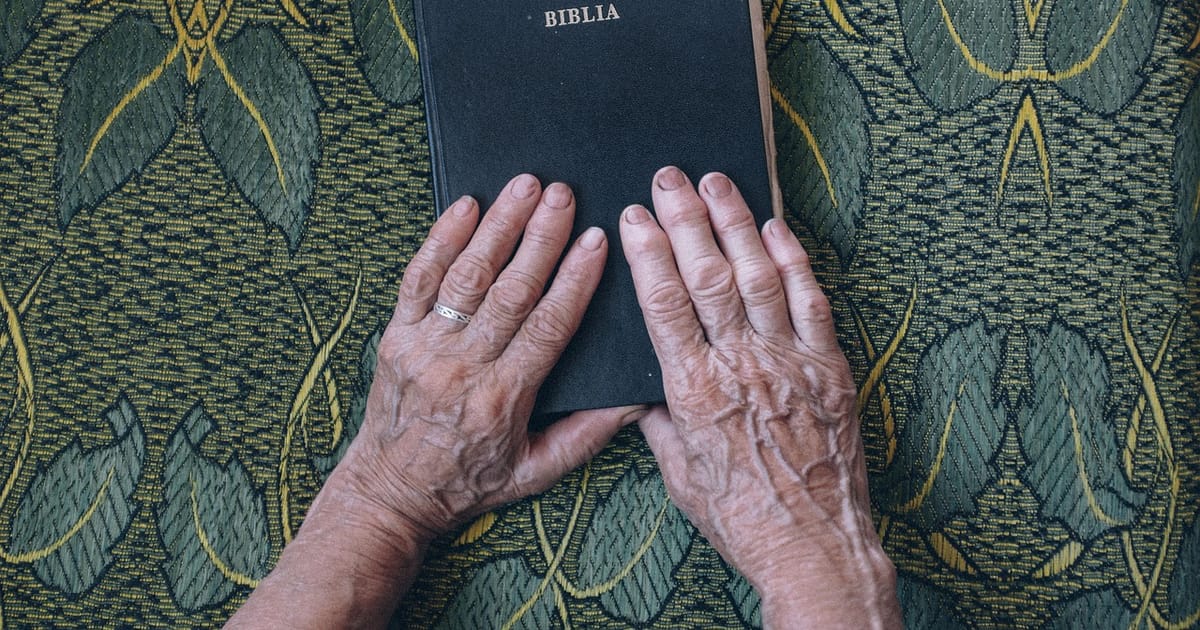
Near the end of Genesis, an old man who can barely see asks for his grandsons. Jacob is in Egypt, his eyes "dim for age", when Joseph brings in his two boys, Manasseh and Ephraim. Jacob kisses them and holds them. Then, as Joseph guides the elder boy toward his grandfather's right hand, Jacob crosses his arms and lays his right hand on the younger one instead, "guiding his hands wittingly" (Genesis 48:10-14). It is one of the most detailed scenes of a grandparent with grandchildren anywhere in the Bible, and it ends with a blessing that people still read aloud at baptisms and birthdays.
Most lists of Bible verses about grandparents give you the same three or four lines without saying where they come from or what they meant. This page takes the questions people actually ask, from "is the word grandmother even in the Bible?" to "what does the Bible say about grandparents interfering?", and answers each with the verse that addresses it. There are 12 verses, all quoted from the King James Version and checked against its text, each with its story and a note on when to use it. Near the end you will find a simple way to put a verse on a card. If you need one verse right now, the classic is Proverbs 17:6: "Children's children are the crown of old men."
Which verse answers which question
A quick map of the page. Every verse is quoted in full further down, with its context.
| The question | The verse (short form) | Where to find it |
|---|---|---|
| What does the Bible say about grandparents? | "Children's children are the crown of old men" | Proverbs 17:6 |
| Does the Bible tell grandparents to pass on their faith? | "Declare them to their children" | Psalm 78:5-6 |
| Is the word grandmother in the Bible? | "Thy grandmother Lois" | 2 Timothy 1:5 |
| Where are grandchildren hiding in old translations? | "Children or nephews" | 1 Timothy 5:4 |
| How did a grandfather bless his grandsons? | "Bless the lads" | Genesis 48:16 |
| A goodbye from a grandparent | "Kissed his sons and his daughters, and blessed them" | Genesis 31:55 |
| A grandchild who gives an older woman new life | "A restorer of thy life" | Ruth 4:15 |
| Faith that reaches the third generation | "Thou, and thy son, and thy son's son" | Deuteronomy 6:2 |
| Older women teaching younger ones | "Teachers of good things" | Titus 2:3-4 |
| Honoring grandparents | "Rise up before the hoary head" | Leviticus 19:32 |
| A grandparent growing old or ill | "Even to hoar hairs will I carry you" | Isaiah 46:4 |
| Grandparents kept away, or getting in the way | "Hast not suffered me to kiss" | Genesis 31:28 |
What does the Bible say about grandparents?
The short answer: grandparents are almost never called by that name, but they are everywhere in the idea of "generations". The verse that comes closest to a definition is a two-part proverb from the collection credited to Solomon.
"Children's children are the crown of old men; and the glory of children are their fathers."
— Proverbs 17:6 (King James Version, 1611)
Most cards print only the first half, and that is a pity, because the proverb runs in both directions. Grandchildren are the old man's crown: the visible honour of a long life. And fathers, meaning parents and the older generation in general, are the children's glory: something to be proud of, not just obeyed. Read whole, it is a verse about a family where each generation makes the other look good. Use the first half on a grandparent's birthday card; use the whole verse when a grandchild is writing to a grandparent, because then the second half is the grandchild's own compliment. It appears on our page of blessed family Bible verses too, with a note on where it fits in a family blessing.
The other key passage is a psalm about telling the next generations what God has done. Count the generations in these two verses.
"For he established a testimony in Jacob, and appointed a law in Israel, which he commanded our fathers, that they should make them known to their children: That the generation to come might know them, even the children which should be born; who should arise and declare them to their children."
— Psalm 78:5-6 (King James Version, 1611)
There are four: "our fathers", "their children", "the children which should be born", and "their children" again. In other words, the psalm is not satisfied when parents teach their own children. The job is done only when the story has reached people who were not yet born when it was first told. That is exactly the position of a grandparent, who is the only person in a family who can hand something across two generations at once. It is the right verse for a grandparent who reads to grandchildren, keeps the family Bible or tells the old stories at the table.
Is the word "grandmother" in the Bible?
Once. In the King James Version, our count of the full text finds the word "grandmother" a single time and "grandfather" not at all, while the phrase "children's children" appears 10 times and "son's son" 6 times. The Bible talks about grandparents mostly by counting generations, not by naming the relationship. The one grandmother named as a grandmother is Lois.
"When I call to remembrance the unfeigned faith that is in thee, which dwelt first in thy grandmother Lois, and thy mother Eunice; and I am persuaded that in thee also."
— Paul to Timothy, 2 Timothy 1:5 (King James Version, 1611)
Lois is mentioned nowhere else, and that one sentence is enough to make her the patron of every praying grandmother. The background makes it stronger. Acts 16:1 says Timothy was "the son of a certain woman, which was a Jewess, and believed; but his father was a Greek". So the faith Paul praises did not come down the father's line at all. It went from grandmother to mother to son. "Unfeigned" means without pretence, and "dwelt" means it lived there, at home. For a grandmother whose faith shaped a grandchild, especially in a family where not everyone shares it, there is no better verse. It also works for a grandchild's confirmation, baptism or ordination card, signed by the grandmother.
There is a second place where grandchildren appear, though readers of the King James Version usually miss it, because the 1611 translators used a word whose meaning has since changed.
"But if any widow have children or nephews, let them learn first to shew piety at home, and to requite their parents: for that is good and acceptable before God."
— 1 Timothy 5:4 (King James Version, 1611)
"Nephews" here means grandchildren. The Greek word, ekgonos, means a descendant, and Strong's concordance glosses it as "specially grandchild"; it occurs only in this verse in the New Testament. In older English, "nephew" (from the Latin nepos) could still mean a grandson, which is why the KJV used it. Modern translations, including the NIV, ESV, NASB, NKJV and NRSV, all read "children or grandchildren". So this is the clearest instruction in the New Testament addressed to grandchildren: look after your widowed grandmother, and think of it as paying back ("requite") what she gave. It is the verse for a grandchild who is now the one doing the caring.
Which grandparents appear in the Bible?
Several, even if the text rarely uses the word. Here are the ones with a verse worth keeping, in the order they appear.
Jacob blesses Joseph's sons
The scene from the opening of this page ends with Jacob's blessing. He speaks it over the boys while his hands are still crossed on their heads.
"The Angel which redeemed me from all evil, bless the lads; and let my name be named on them, and the name of my fathers Abraham and Isaac; and let them grow into a multitude in the midst of the earth."
— Jacob, blessing his grandsons, Genesis 48:16 (King James Version, 1611)
What makes this blessing moving is "let my name be named on them". Jacob is adopting his grandsons as his own: two verses earlier he tells Joseph that Ephraim and Manasseh "are mine" (Genesis 48:5), and their names later become two of the tribes of Israel. A grandfather is putting his name, and the names of his own father and grandfather, on two boys born in a foreign country. "Bless the lads" is three plain words a grandfather can still say, or write in a card for a grandson's birthday, baptism or graduation. Four verses later Jacob adds "God make thee as Ephraim and as Manasseh" (Genesis 48:20), and many Jewish parents still bless their sons with that wish on Friday night before the Sabbath meal.
Laban says goodbye
Laban is not a hero. He tricked Jacob into marrying the wrong daughter and changed his wages again and again. But when Jacob finally leaves with Leah, Rachel and their children, Laban chases them for seven days, and the story ends with this.
"And early in the morning Laban rose up, and kissed his sons and his daughters, and blessed them: and Laban departed, and returned unto his place."
— Genesis 31:55 (King James Version, 1611)
"His sons" here are his grandchildren, Jacob's boys (Laban's own sons stayed behind; they are the ones grumbling about Jacob in Genesis 31:1), and the NIV, ESV, NASB and NRSV all translate the phrase as "his grandchildren and his daughters". The King James keeps the literal Hebrew word "sons", which is why the grandparent in the verse is easy to miss. It is the Bible's clearest goodbye from a grandparent, and a tender one: up early, a kiss for each of them, a blessing, and then he goes home. It fits the end of a summer visit, a grandparent who lives far away, or a card for grandchildren moving to another city. If you want a verse about a grandparent's love that has not been printed on a thousand mugs, this is it.
Naomi holds Obed
Naomi lost her husband and both sons in Moab and came home calling herself Mara, "bitter". The Book of Ruth ends with her daughter-in-law's baby, and the women of Bethlehem tell her what the child will mean to her.
"And he shall be unto thee a restorer of thy life, and a nourisher of thine old age: for thy daughter in law, which loveth thee, which is better to thee than seven sons, hath born him."
— The women of Bethlehem to Naomi, Ruth 4:15 (King James Version, 1611)
"A restorer of thy life" is what many grandparents say about a first grandchild in other words: the baby arrived after a hard season and gave life back. The verse also praises the daughter-in-law, which makes it unusual and useful: it is a line a grandmother can send to her son's wife after a birth. The next verse, where Naomi lays the child in her bosom and becomes his nurse, is the Bible's picture of a grandmother helping to raise a grandchild; we quote it on our page of grandparents love quotes. The women name the boy Obed, and Ruth 4:17 adds that he became the grandfather of King David.
Joseph, a great-grandfather
Genesis closes with Joseph living to see "Ephraim's children of the third generation", and with the children of Manasseh's son Machir "brought up upon Joseph's knees" (Genesis 50:23). It is a single line, but it is the Bible's image of a great-grandparent with babies on his lap, and it suits a card for a great-grandparent's birthday.
A warning: Athaliah
Not every grandparent in the Bible is a model. When her son King Ahaziah died, Queen Athaliah "arose and destroyed all the seed royal", meaning her own grandchildren, to take the throne. One baby grandson, Joash, survived because his aunt Jehosheba hid him in the temple for six years (2 Kings 11:1-3). The Bible does not pretend that age makes people good. That honesty is worth remembering when we get to the harder questions below.
What should grandparents pass on?
Moses' speech in Deuteronomy explains why the commandments were given, and it names three generations in one breath.
"That thou mightest fear the LORD thy God, to keep all his statutes and his commandments, which I command thee, thou, and thy son, and thy son's son, all the days of thy life; and that thy days may be prolonged."
— Deuteronomy 6:2 (King James Version, 1611)
"Thy son's son" is the grandson, written into the purpose of the law itself. A few verses later comes the famous instruction to teach these words "diligently unto thy children" and talk of them at home and on the road (Deuteronomy 6:7). Read together, the chapter assumes that a grandfather is still part of the teaching. It suits a gift of a Bible from grandparents to a grandchild: write the reference on the flyleaf with the date and both names.
The New Testament gives older women a specific job description in Paul's letter to Titus.
"The aged women likewise, that they be in behaviour as becometh holiness, not false accusers, not given to much wine, teachers of good things; That they may teach the young women to be sober, to love their husbands, to love their children."
— Titus 2:3-4 (King James Version, 1611)
"Teachers of good things" is the phrase to keep. The passage is about older women in a church community, not only grandmothers, and the list includes some blunt warnings (no gossip, no drinking too much) that make it human. But the core is the same pattern as Lois: the older woman teaches, and the young mother learns how "to love their children" from her. For a grandmother's birthday, "a teacher of good things" makes a fine three-word tribute.
Is there a Bible verse about honoring grandparents?
The fifth commandment, "Honour thy father and thy mother", does not mention grandparents by name. The verse that comes closest sits in the holiness laws of Leviticus.
"Thou shalt rise up before the hoary head, and honour the face of the old man, and fear thy God: I am the LORD."
— Leviticus 19:32 (King James Version, 1611)
"Hoary head" means grey hair. The command is physical: stand up when an old person comes in. It covers all elders, not just your own grandparents, which is exactly why it makes a good lesson for children. A grandparent can read it with a grandchild and turn it into a family habit: you stand up, you look them in the face, you greet them first. Together with 1 Timothy 5:4 above, it is the honest answer to "what does the Bible say about respecting your grandparents": stand up for them while they are strong, and look after them when they are not.
Which verse fits a grandparent who is growing old?
This verse is the one people search for most by its number, and it has a context that makes it better than its fridge-magnet reputation.
"And even to your old age I am he; and even to hoar hairs will I carry you: I have made, and I will bear; even I will carry, and will deliver you."
— Isaiah 46:4 (King James Version, 1611)
The chapter opens with the gods of Babylon, Bel and Nebo, being loaded onto animals: idols that have to be carried, "a burden to the weary beast" (Isaiah 46:1). Then God speaks to the "house of Jacob" and turns the picture around: I am the one who carries you, from the womb (46:3) to grey hair (46:4). Strictly, it is a promise to the whole people of Israel, not a verse about grandparents. But that is why it comforts an aging grandparent: it says that being carried is not a failure. Use it in a card for a grandparent who has moved into care, is facing surgery, or is simply tired. For a grandparent who has died, our page of losing grandma quotes has verses and lines chosen for the funeral and the card; Genesis 25:8, where Abraham dies "in a good old age, an old man, and full of years", is the classic reading.
What does the Bible say about grandparents interfering?
No verse says "grandparents, don't interfere", but the Laban story deals with both sides of the problem, and it is surprisingly current. When Laban catches up with Jacob's family, his first complaint is not about money or stolen idols. It is this.
"And hast not suffered me to kiss my sons and my daughters? thou hast now done foolishly in so doing."
— Laban to Jacob, Genesis 31:28 (King James Version, 1611)
Here is a grandfather who was not allowed to say goodbye to his grandchildren, and the Bible lets him say so. Yet the same chapter shows why Jacob left: Laban had cheated him for twenty years and still claimed "these children are my children ... and all that thou seest is mine" (Genesis 31:43). So the story holds both truths at once. Grandparents have a real place and a real grief when they are cut off. And the young family is its own household: the first rule about marriage in the Bible is that a man shall "leave his father and his mother, and shall cleave unto his wife" (Genesis 2:24). The ending is the model. They talk, they set a boundary (the heap of stones and the covenant in Genesis 31:44-52), and then Laban kisses the children, blesses them and goes home. If you are a parent dealing with an overbearing grandparent, or a grandparent kept at a distance, this chapter is worth reading in full before you reach for a verse to prove a point. Our page on toxic in-laws quotes covers the harder cases.
How to put one of these verses on a card
A verse alone can feel like a sermon. A verse with one sentence of your own feels like a letter. This pattern works for birthdays, Grandparents Day and Christmas:
- Pick the verse by the relationship, not by popularity. Grandmother who shared her faith: 2 Timothy 1:5. Grandfather who blesses: Genesis 48:16. Far-away grandparent: Genesis 31:55. Grandparent who is ill: Isaiah 46:4.
- Quote only the part you mean. "Children's children are the crown of old men" is enough on a small card. Always write the reference so they can look it up.
- Connect it to one real thing. A habit, a phrase they always say, the place where they pray, the story they tell every Christmas.
- End with the present tense. What they still do for you, not only what they did.
Three examples we wrote to show the pattern (adapt the details; they are not quotations):
- For a grandmother: "Paul wrote that Timothy's faith 'dwelt first in thy grandmother Lois.' In our family it dwelt first in you. Thank you for every prayer you never told us about. (2 Timothy 1:5)"
- For a grandfather on his birthday: "'Bless the lads,' Jacob said, with his hands on his grandsons' heads. You have been doing that for us our whole lives. Happy birthday, Grandpa. (Genesis 48:16)"
- For grandparents after a visit: "'Early in the morning Laban rose up, and kissed his sons and his daughters, and blessed them.' That's you at every goodbye on the driveway. Come back soon. (Genesis 31:55)"
For a pregnancy announcement to future grandparents, our page of grandma to be quotes has verses chosen for that moment, and for sisters there is a similar guide to Bible verses about sisters.
Questions people ask
What does it say in the Bible about grandchildren?
The best-known verse is Proverbs 17:6, "Children's children are the crown of old men." Psalm 78:5-6 asks each generation to pass the story on to children not yet born, and 1 Timothy 5:4 tells grandchildren (the KJV says "nephews") to care for a widowed grandmother. All three are explained above.
What does Isaiah 46:4 say?
In the King James Version: "And even to your old age I am he; and even to hoar hairs will I carry you: I have made, and I will bear; even I will carry, and will deliver you." It is God's promise to Israel to carry them from birth to grey hair, set against idols that have to be carried by animals.
Who are Jesus' grandparents in the Bible?
The two genealogies name Joseph's father differently: Jacob in Matthew 1:16 and Heli in Luke 3:23. Mary's parents are not named in the Bible. The names Joachim and Anne come from a later non-biblical text, the Gospel of James, usually dated to the second century.
What is a good Bible verse for grandparents' love?
Genesis 31:55, where Laban kisses his grandchildren and blesses them before going home, is the Bible's clearest picture of a grandparent's affection. Genesis 48:10, where blind Jacob "kissed them, and embraced them", is the other. For a card, add the reference and one line of your own.