Losing Grandma Quotes: 12 Sourced Lines for the Funeral, the Card and the Grief That Comes Later
Words My Family Quotes Editors

In Proust's In Search of Lost Time, the narrator loses his grandmother and, for more than a year, barely seems to miss her. Then, on his first night back at the seaside hotel in Balbec, he bends down to take off his boots, and the memory of her face leaning over him on their first evening there, years before, comes back whole. He breaks down in sobs, and only then, he says, does he learn that she is dead. Anyone who has lost a grandma or grandpa will recognise some part of that: the grief does not always arrive on the day of the funeral.
Below are 12 losing grandma quotes (four of them chosen for a grandpa), each checked against the novel, essay, poem or verse it comes from. For each one you get who wrote it, what was happening around the line, and where it works best: a sympathy card, a eulogy, an order of service or a quiet post. If you need one line right now, Emily Dickinson's "The sweeping up the heart, / And putting love away" fits almost any card, and Job 5:26 ("Thou shalt come to thy grave in a full age") is the classic line for a grandparent who lived a long life.
When the grief comes late
Proust gave this experience a name, "les intermittences du cœur", the intermittences of the heart: love and grief that switch off and come back without warning. The passage below is the moment it comes back.
"It was only now, more than a year after her burial, because of that anachronism which so often keeps the calendar of facts from matching the calendar of feelings, that I had just learned she was dead." — Marcel Proust, Sodome et Gomorrhe II, "Les intermittences du cœur" (1922); our translation
The French reads: "ce n'était qu'à l'instant, plus d'une année après son enterrement, à cause de cet anachronisme qui empêche si souvent le calendrier des faits de coïncider avec celui des sentiments, que je venais d'apprendre qu'elle était morte." Just before it, the narrator remembers his grandmother as she was before her stroke on the Champs-Élysées, his "real" grandmother rather than the one he had been surprised to miss so little. Our translation stays close to the French; the published English versions word it differently.
Use it for: a grandchild who did not cry at the funeral and feels guilty about it, or a post on a first anniversary. "The calendar of facts" and "the calendar of feelings" is the part people remember; it can stand on its own in a card.
Quotes for a grandmother who lived a long life
A grandparent's death is often the first death in a family that comes in the right order, after a long life. These three lines honour the length and fullness of that life without pretending the loss is small.
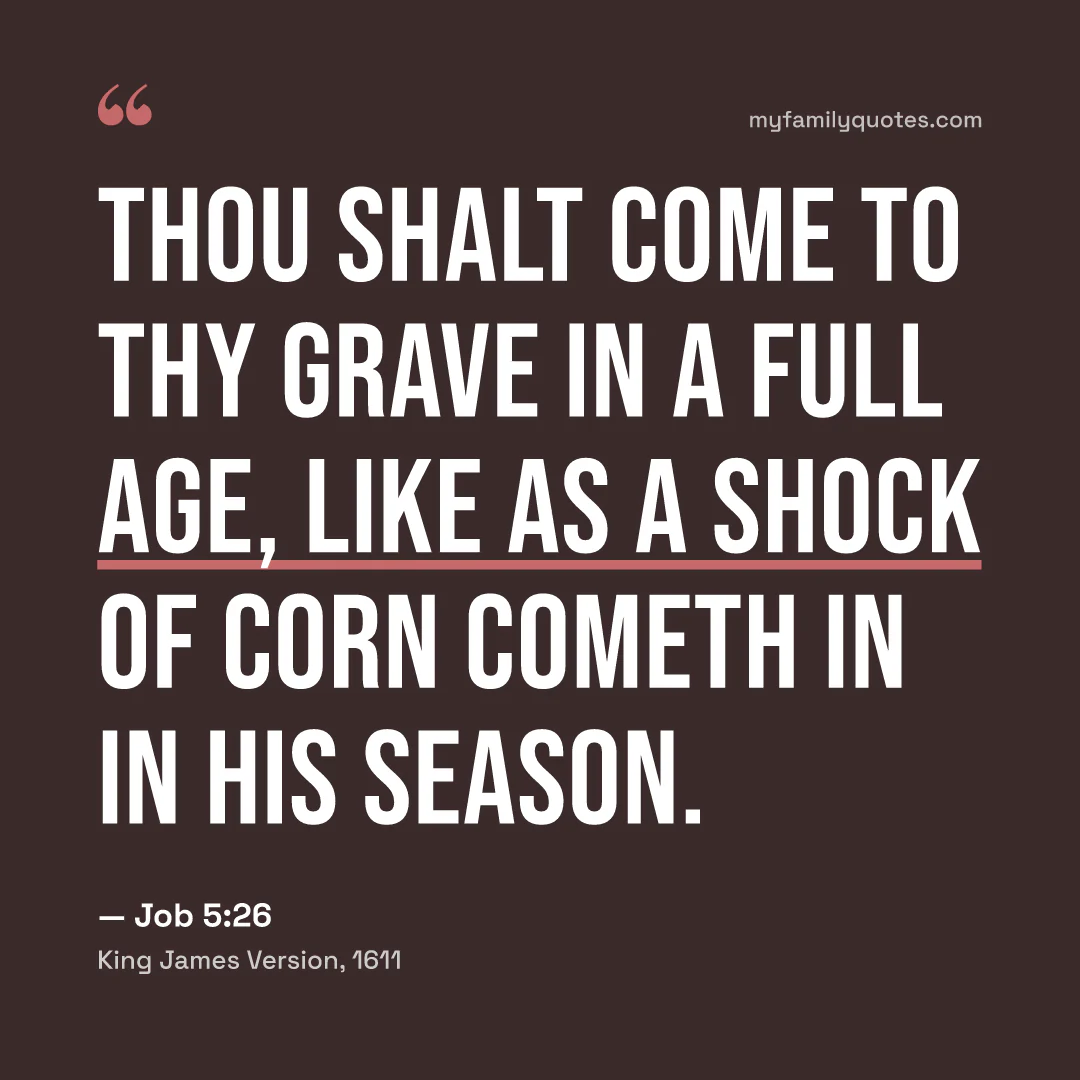
"Thou shalt come to thy grave in a full age, like as a shock of corn cometh in in his season." — Job 5:26, King James Version (1611)
Eliphaz says this to Job as a promise to the righteous: a life that ends like a harvest, gathered at the right time rather than cut early. A "shock" of corn is a bundle of sheaves stood up in the field to dry before it is carried in. For a farming family, or any grandparent who kept a garden, the image needs no explaining. It reads well printed under a name and two dates on a memorial card.
"...her funeral was attended by a concourse of all the poor, and some of the gentry too, of the neighbourhood for many miles round, to show their respect for her memory, because she had been such a good and religious woman; so good indeed that she knew all the Psaltery by heart, ay, and a great part of the Testament besides." — Charles Lamb, "Dream-Children; A Reverie", Essays of Elia (1823)
Lamb's essay is one of the best things written in English about a grandmother. He sits telling two small children about their great-grandmother Field, who kept a great country house, and the children interrupt him as he goes. Behind the essay is Lamb's real maternal grandmother, Mary Field, for many years a servant of the Plumer family and later in sole charge of their large house, Blakesware, in Hertfordshire; Lamb's visits there gave him some of his fondest childhood memories (Wikipedia, Charles Lamb). The funeral detail, "all the poor, and some of the gentry too", is the sort of line that works in a eulogy for a grandmother who was known in her town or her church.
"Then I told how good she was to all her grand-children, having us to the great-house in the holydays, where I in particular used to spend many hours by myself, in gazing upon the old busts of the Twelve Cæsars..." — Charles Lamb, "Dream-Children; A Reverie", Essays of Elia (1823)
The second excerpt is the one grandchildren tend to keep: not her virtues, but the house in the holidays and the hours a child spent wandering it. The essay then turns. The children fade, and Lamb wakes in his "bachelor arm-chair": they were never his, only "what might have been". That ending is why some readers find the essay too sad to read aloud. The first half, quoted here, is safe for a service; read the whole thing before you choose.
For the morning after and the first weeks
The days right after a death are full of jobs: phone calls, forms, clearing a room. Two of the lines below come from writers who noticed that the housework of grief is itself a kind of mourning.
"The bustle in a house / The morning after death / Is solemnest of industries / Enacted upon earth, -- / The sweeping up the heart, / And putting love away / We shall not want to use again / Until eternity." — Emily Dickinson, "The Bustle in a House", Poems (1890)
Dickinson's eight lines were printed in 1890, four years after her death, in the first collection of her poems (Wikipedia, list of Dickinson poems; it is J1078 in Johnson's numbering). The poem treats the clearing-up after a death as the most serious work there is, and then quietly turns the tidying into the putting away of love. For anyone sorting through a grandmother's kitchen drawers, sewing box or wardrobe, it is uncomfortably exact. The second half works alone in a card.

"And when the earth shall claim your limbs, then shall you truly dance." — Kahlil Gibran, "On Death", The Prophet (1923)
This is the last line of the chapter "On Death", which answers the seeress Almitra near the end of The Prophet. The sentences just before it ask "what is it to die but to stand naked in the wind and to melt into the sun?" Gibran's answer is gentle rather than religious in any one tradition, which makes it a common choice when a family has mixed beliefs. It suits a grandparent who loved to dance, or one whose last years were spent in a failing body.
"Fear no more the heat o' th' sun, / Nor the furious winter's rages; / Thou thy worldly task hast done, / Home art gone, and ta'en thy wages." — William Shakespeare, Cymbeline, Act 4, Scene 2 (First Folio, 1623)
Two brothers sing this over the body of a young companion they believe has died (it turns out to be their sister, alive and in disguise). The song outlived the play and is often read at funerals. "Thy worldly task hast done" is the line for a grandparent who worked hard all their life: on a farm, in a mill, raising other people's children as well as their own.
Quotes for losing grandpa
Searches for grandpa are fewer than for grandma, but the need is the same. These four lines lean toward the plain and the outdoors, which suits many grandfathers.
"Then Abraham gave up the ghost, and died in a good old age, an old man, and full of years; and was gathered to his people." — Genesis 25:8, King James Version (1611)
The verse just before gives Abraham's age as "an hundred threescore and fifteen years", 175, and the next verse has both his sons, Isaac and Ishmael, burying him together. "Full of years" and "gathered to his people" are two of the oldest phrases for a death that completes a life, and the detail of two half-brothers who grew up apart standing together at the grave is worth knowing if your family has its own rifts.
"The hoary head is a crown of glory, if it be found in the way of righteousness." — Proverbs 16:31, King James Version (1611)
"Hoary" means grey or white with age. The proverb makes grey hair a crown, but only on a life lived well, which is what a eulogy is trying to say. It is short enough for a headstone or the back of an order of service.
"Under the wide and starry sky, / Dig the grave and let me lie. / Glad did I live and gladly die, / And I laid me down with a will. / This be the verse you grave for me: / Here he lies where he longed to be; / Home is the sailor, home from sea, / And the hunter home from the hill." — Robert Louis Stevenson, "Requiem", Underwoods (1887)
Stevenson wrote his own epitaph, and it was carved on his tomb on Mount Vaea in Samoa after he died there in 1894 (Wikipedia, Robert Louis Stevenson). The last two lines are the ones families choose for a grandfather who fished, sailed, farmed, hunted or simply loved to be outside. Note the wording: the poem says "home from sea", and the version on the tomb and on most cards adds "the".
"For tho' from out our bourne of Time and Place / The flood may bear me far, / I hope to see my Pilot face to face / When I have crost the bar." — Alfred, Lord Tennyson, "Crossing the Bar" (1889)
Tennyson wrote the poem in 1889, three years before he died, and shortly before his death asked his son Hallam to "put 'Crossing the Bar' at the end of all editions of my poems" (Wikipedia, Crossing the Bar). The "bar" is the sandbar at a harbour mouth that a ship crosses on its way out to open sea. For a grandfather who served in the navy, worked on boats or lived by the coast, this is the poem; the final stanza above is the one most often printed.

When one of them is left behind
Often the person who needs words most is not a grandchild but the grandparent who is still here. Robert Burns wrote the best-known song about two people growing old together.
"John Anderson, my jo, John, / We clamb the hill thegither; / And mony a cantie day, John, / We've had wi' ane anither: / Now we maun totter down, John, / And hand in hand we'll go, / And sleep thegither at the foot, / John Anderson, my jo." — Robert Burns, "John Anderson, My Jo" (Scots Musical Museum, vol. III, 1790)
In Scots, "jo" means sweetheart, "clamb" climbed, "cantie" cheerful, and "maun" must. A wife speaks to her husband: they climbed the hill of life together, and now they will go down it hand in hand and lie together at the bottom. An older, bawdier song of the same name existed; Burns rewrote it into this tender one for James Johnson's Scots Musical Museum (Ballad Index). Read it at the funeral of a grandparent married for decades, or copy it into a card for the one left at home.
Which line for which goodbye
Word counts are for the quoted part only, so you can judge what fits on a card, a memorial stone or a phone screen.
| Line | Words | Best for | Use it on |
|---|---|---|---|
| Proverbs 16:31, "The hoary head is a crown of glory" | 17 | A grandfather who lived well | Headstone, order of service |
| Job 5:26, "a full age, like as a shock of corn" | 21 | A long life, a farming family | Memorial card |
| Gibran, "then shall you truly dance" | 13 | Mixed-belief families; a grandparent who loved to dance | Sympathy card, social post |
| Dickinson, "The sweeping up the heart" | 18 (second half) | The days of clearing her house | Card, a note left in her kitchen |
| Stevenson, "Home is the sailor, home from sea" | 14 (last two lines) | An outdoors grandpa | Headstone, eulogy close |
| Tennyson, "Crossing the Bar" | 31 (last stanza) | Navy, boats, the coast | Reading at the service |
| Shakespeare, "Thou thy worldly task hast done" | 26 | A hard-working life | Reading, order of service |
| Burns, "John Anderson, My Jo" | 43 (second verse) | A long marriage; the grandparent left behind | Reading, card to the widow or widower |
| Lamb, "Dream-Children" | Long | A grandmother known in her community | Eulogy |
| Proust, "the calendar of feelings" | Long; 10-word excerpt | Grief that arrived late | Anniversary post, a private note |
Writing a few words for her funeral or card
A quote carries more weight when it sits next to something only your family knows. A simple order that works for a card, a eulogy or a post:
- Start with what she was called. "Nana", "Oma", "Grandma Rose", "Pop": the family name says more than "my grandmother".
- Give one concrete thing. A dish, a phrase she always said, the chair he sat in, the drive to their house. One real detail is better than a list of virtues.
- Add the line. Pick it by what was true of them, using the table above: a long life (Job 5:26), a long marriage (Burns), a love of the sea (Tennyson, Stevenson), a house full of things to clear (Dickinson).
- Credit it properly. "Emily Dickinson" or "Job 5:26" under the line. Unsigned lines on cards are often misquoted; see the note below.
- End with the people still here. A sympathy card is for the living: "Thinking of you and Grandad this week" does more than another line about heaven.
For a card to a parent who has lost their own mother, our page of sympathy quotes for the loss of a mother is written for exactly that reader. If the anniversary of a father's death is close, see dad death anniversary quotes, organised by the hard dates of the year.
Lines we checked and changed
- "Home is the sailor, home from the sea." Stevenson printed "home from sea" in Underwoods (1887); "the" appears in the version carved on his tomb and in most quotations since. Either is defensible, but if you are quoting the poem, use the printed text.
- "Crossing the Bar" as a deathbed poem. It is often introduced as Tennyson's last poem. He wrote it in 1889 and lived until 1892; what he asked at the end of his life was that it be placed last in his collected poems.
- "Grandmas hold our tiny hands for just a little while, but our hearts forever." This is on countless memorial cards and pins, always unsigned. We found no printed source or named author for it. It is fine to use; just don't credit it to anyone.
- Proust in English. The best-known translations give the boot passage in their own words, and the wording you see online varies. The French above is from the Gallimard text (Project Gutenberg edition); the English on this page is ours.
If you want lines for a grandparent who is still alive, to thank them while you can, start with our thankful for grandparents quotes. For grief that has gone on longer than anyone expected, C. S. Lewis is honest company; see C. S. Lewis on mourning.
Frequently asked questions
What do you say when your grandma passes away?
Say her name, say one thing you remember, and keep it short: "I keep thinking of Nana's kitchen. I'm so sorry." If you want a line to add, Emily Dickinson's "The sweeping up the heart, / And putting love away" or Job 5:26 ("Thou shalt come to thy grave in a full age") are both gentle and both sourced.
What is a short quote for losing a grandparent?
Gibran's "And when the earth shall claim your limbs, then shall you truly dance" (The Prophet, 1923) is 13 words. Proverbs 16:31, "The hoary head is a crown of glory", fits on a headstone, and Stevenson's "Home is the sailor, home from sea, / And the hunter home from the hill" is the classic short line for a grandpa.
What is a good poem to read at a grandparent's funeral?
Tennyson's "Crossing the Bar" (1889) and Stevenson's "Requiem" (1887) are both short enough to read in under a minute. For a couple married for decades, Burns's "John Anderson, My Jo" (1790) is the traditional choice, and the "Fear no more the heat o' th' sun" song from Cymbeline suits a grandparent who worked hard all their life.