Dad Death Anniversary Quotes: 12 Sourced Lines for the Anniversary, His Birthday and Father's Day
Words My Family Quotes Editors

The oldest written account of a child keeping a day for a dead father is in Genesis: when Jacob died, Joseph "made a mourning for his father seven days" (Genesis 50:10). People have been marking the days after a father's death ever since, and the dates that come back every year (the anniversary, his birthday, Father's Day, the first Christmas) are when most of us go looking for words. Below are 12 dad death anniversary quotes, each checked against the book, letter, play or verse it comes from, grouped by the day you need them for, with who wrote it, what had just happened to them, and how to use the line in a post, a card or a memorial.
The short answer, if you need one line today: Robert Anderson's "Death ends a life, but it does not end a relationship" (1968) says what an anniversary feels like better than almost anything written since. For a eulogy, Hamlet's "He was a man, take him for all in all, / I shall not look upon his like again" has done the job for four hundred years.
The hard dates, and a line for each
Grief after losing a dad does not run in a straight line; it runs on a calendar. This table pairs each of the dates people search for with what tends to make it hard and the line from this page that fits it best.
| The day | What makes it hard | A line that fits |
|---|---|---|
| The funeral and the first weeks | Everything is practical; there is no time to grieve properly | Hamlet: "I shall not look upon his like again" |
| The first death anniversary | The year of firsts is over, and people around you assume you are too | Anderson: "Death ends a life, but it does not end a relationship" |
| Later anniversaries (5, 10, 20 years) | Fewer people remember the date | Hamlet: "while memory holds a seat" |
| His birthday ("heavenly birthday") | You still know how old he would be | Dickinson: "no other like it exists" |
| Father's Day | Shops, adverts and feeds are full of fathers for a month | The Lion King: "Remember who you are" |
| Christmas and family gatherings | His chair, his job at the table | Burns: "The tender father, and the gen'rous friend" |
One tradition has a name for the anniversary itself. In Judaism the yahrzeit is the yearly anniversary of a death, counted on the Hebrew calendar; families light a memorial candle that burns for about 24 hours and say the Mourner's Kaddish, and it is most often kept for a parent (Wikipedia, Yahrzeit). Even outside any religion, the idea travels well: one fixed day a year, one light, a few words said out loud.
For the funeral and the first weeks
These two are the oldest lines on the page, and both come from a son standing next to a dead father.
"And Joseph fell upon his father's face, and wept upon him, and kissed him." — Genesis 50:1, King James Version (1611)
This is the first thing Joseph does when Jacob dies, before the embalming, before the long procession back to Canaan that ends with the seven days of mourning quoted above. It is a single sentence with three verbs and no comfort in it at all, which is why it suits a funeral order of service or a note to a friend in the first raw days: it says that weeping is the right response, and that Scripture's best-known son did exactly that.
"He was a man, take him for all in all, / I shall not look upon his like again." — William Shakespeare, Hamlet, Act 1, Scene 2 (c. 1600)
Hamlet says this to Horatio less than two months after his father's death, when everyone else at court has already moved on to his mother's remarriage. "Take him for all in all" means taking the whole man, faults included, which is what makes it honest enough for a eulogy: you are not claiming he was perfect, only that he was singular. In the same scene King Claudius tells Hamlet that "your father lost a father; / That father lost, lost his," and that grieving too long is "unmanly." Claudius is the man who killed Hamlet's father, so if anyone quotes that part to you as comfort, you are entitled to ignore it.
Quotes for a dad's death anniversary
The anniversary is the date most people search for, and the hardest to write for, because by then the cards have stopped. These three lines are about what happens to the bond after the funeral.
"Death ends a life, but it does not end a relationship, which struggles on in the survivor's mind towards some final resolution, some clear meaning, which it perhaps never finds." — Robert Anderson, I Never Sang for My Father, opening speech (1968)
Anderson's play opened on Broadway in 1968, and these are its first words, spoken by Gene, a widowed middle-aged son, about his difficult, proud old father; a version of the line returns at the very end (WIST). The short form, "Death ends a life, not a relationship," is now usually credited to Mitch Albom, because his teacher Morrie Schwartz says it in Tuesdays with Morrie (1997), almost thirty years later. Anderson's full sentence is the better one for a complicated dad: it admits that the relationship may never resolve.
"Remember thee? / Ay, thou poor ghost, while memory holds a seat / In this distracted globe." — William Shakespeare, Hamlet, Act 1, Scene 5 (c. 1600)
The ghost of Hamlet's father leaves with three words, "Adieu, adieu, adieu. Remember me," and this is his son's answer: as long as memory has a seat in this "distracted globe" (his own head, and the Globe theatre where the line was first spoken). For a fifth or tenth anniversary, when fewer people remember the date, it is a quiet promise that you still do.
"It reveals itself to me as a piece of my self-analysis, as my reaction to the death of my father, that is, to the most important event, the most poignant loss in a man's life." — Sigmund Freud, preface to the second edition of The Interpretation of Dreams (1908; A. A. Brill translation)
Freud's father Jacob died in October 1896, and only when Freud revised his most famous book did he realise that he had written much of it as a response to that death (full preface at York University's Classics in the History of Psychology). It is not a greeting-card line, but it is useful on an anniversary for a different reason: if the loss still shapes your year, a man who spent his life studying the mind called it the most important event in a man's life.
When you lost him young
Some people search for dad death anniversary quotes for a father they barely remember. One of the most famous books of the ancient world opens with exactly that situation.
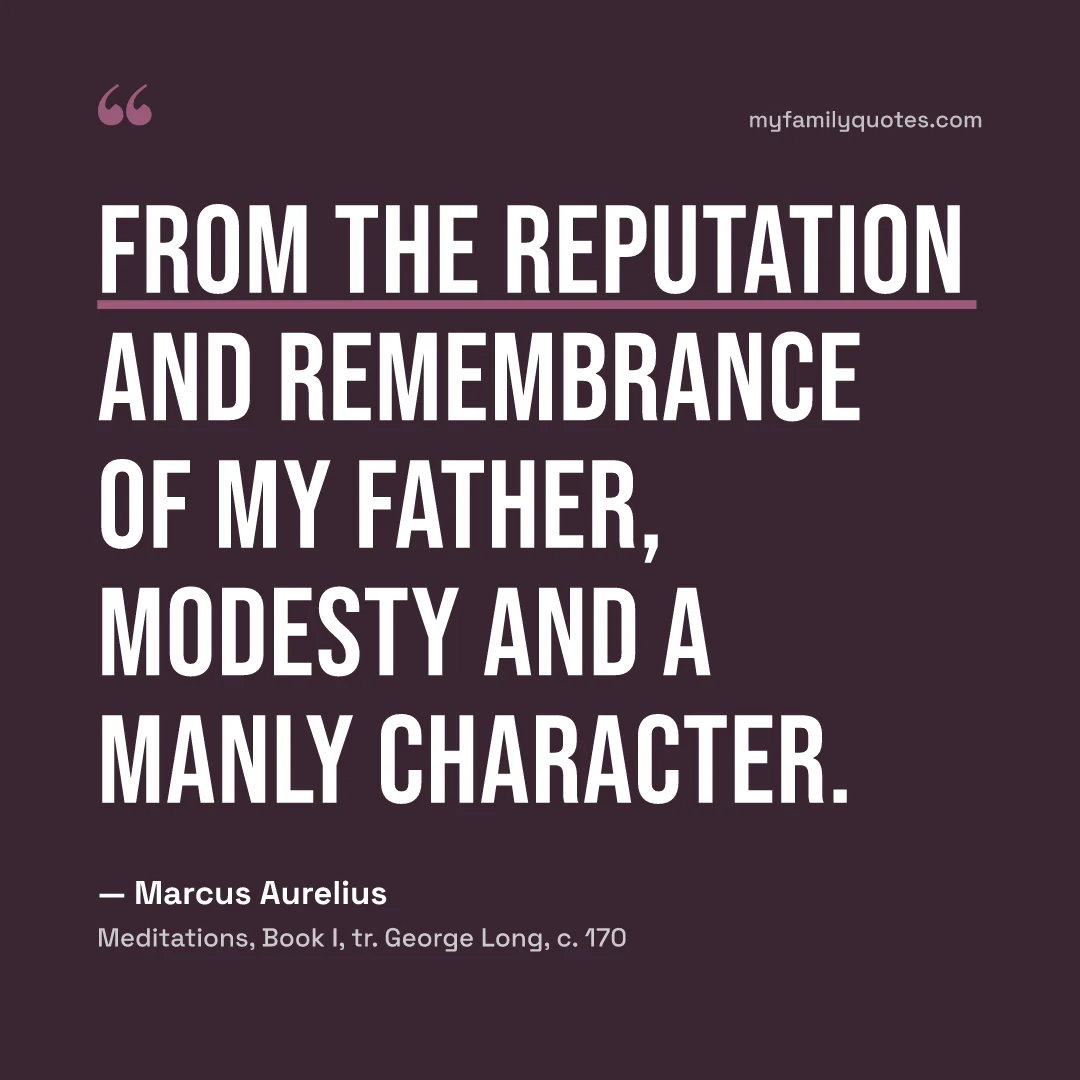
"From the reputation and remembrance of my father, modesty and a manly character." — Marcus Aurelius, Meditations, Book I, section 2 (written c. 170–180; George Long translation, 1862)
Marcus Aurelius was about three when his father, Marcus Annius Verus, died, and he was raised by his mother and grandfather (Wikipedia). Book I of the Meditations is a list of what the emperor learned from each person in his life, and for his father he can only write "reputation and remembrance": what other people told him and the little he kept. It is the right line for an anniversary post about a dad you know mostly from photographs and stories, because it says those still count.
From a daughter: Emily Dickinson's letter
The best thing ever written by a daughter about a dead father may be a short letter Emily Dickinson sent to her friend and editor Thomas Wentworth Higginson in July 1874, a few weeks after her father, Edward Dickinson, died suddenly while away in Boston. She tells him about their last afternoon together: she sent her mother off on an invented errand so she could sit with him, and he said he "would like it to not end." The next morning she woke him for his train and never saw him again. Then come these two sentences.
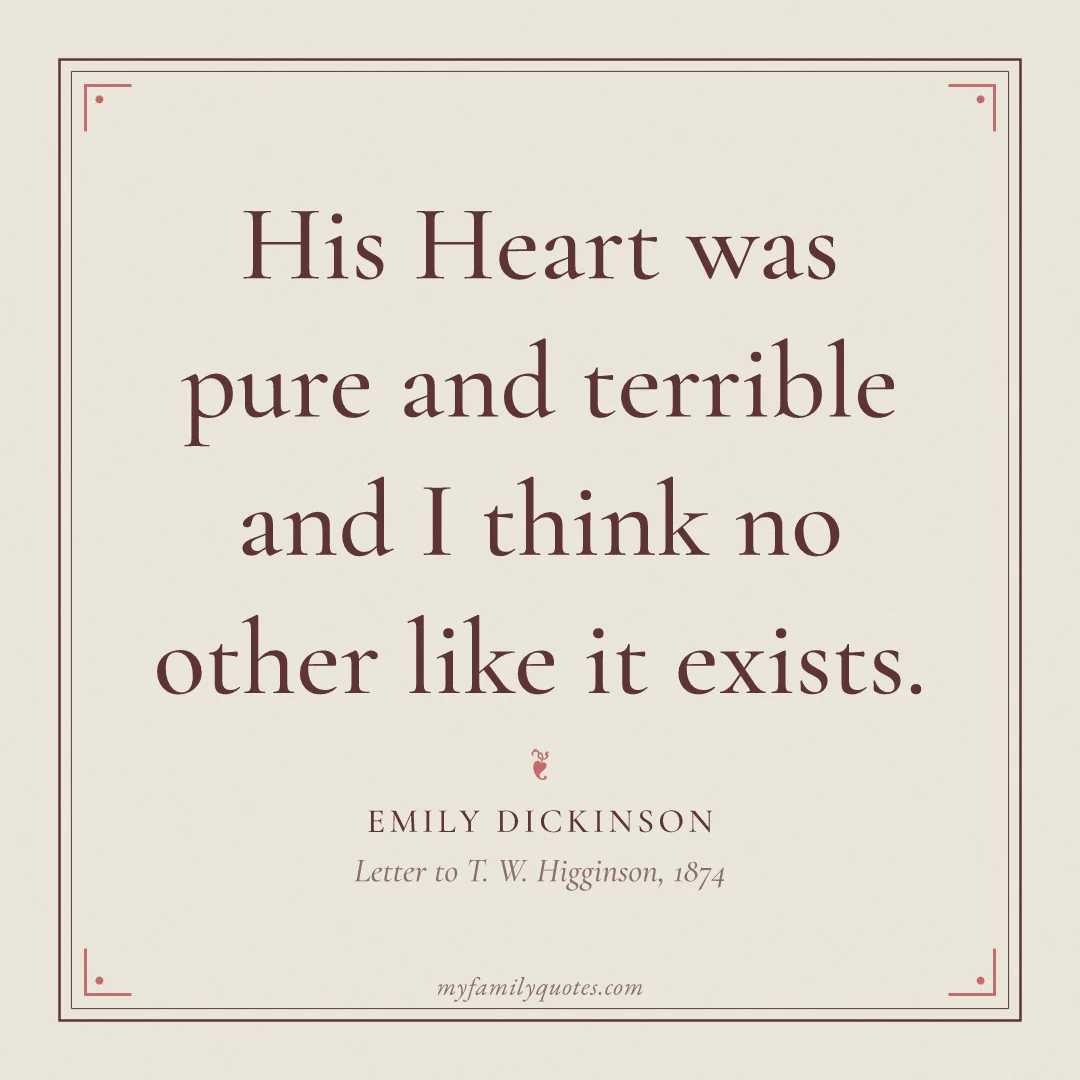
"His Heart was pure and terrible and I think no other like it exists." — Emily Dickinson, letter to Thomas Wentworth Higginson, July 1874 (Letter 418)
"Terrible" here is the old sense of awe-inspiring, even frightening; Edward Dickinson was a stern, formal lawyer and congressman, and his daughter does not pretend otherwise. That mix of love and fear is why the line works for daughters whose fathers were not easy men. It fits his birthday, when you are thinking about who he actually was rather than who a card says he was.
"I am glad there is Immortality - but would have tested it myself - before entrusting him." — Emily Dickinson, the same letter (July 1874)
This is the "dad in heaven" line for people who are not sure about heaven. Dickinson does not deny it; she says she would have liked to check it first, the way you would check a house before letting your father move in. It is wry, protective and completely a daughter's sentence. The letter's full text is transcribed in the Dickinson Electronic Archives. For more on what daughters have written about their fathers while they were alive, see our page on daughters and their fathers.
From a son: his birthday and Father's Day
Sons searching for missing dad quotes tend to want something less ornate. Two of the lines most used on Father's Day come from a cartoon and a poem, and both are usually told with the story slightly wrong.
"Remember who you are. You are my son, and the one true king. Remember." — Mufasa, The Lion King (Walt Disney Pictures, 1994)
Mufasa says this as a voice in the clouds to his grown son Simba, who has spent years avoiding his father's memory and his own responsibilities. Just before it, the baboon Rafiki tells Simba that his father "lives in you." For a whole generation this was the first film scene about losing a dad, which is why the line turns up so often in Father's Day posts: it treats remembering a father as something that changes how you live, not only how you feel.
"And you, my father, there on the sad height, / Curse, bless, me now with your fierce tears, I pray." — Dylan Thomas, "Do not go gentle into that good night" (written 1947, published 1951)
This is the final stanza of the most famous poem a son ever addressed to his father, and it is usually introduced as written at his father's deathbed. It was not: Thomas wrote it in 1947, it first appeared in the journal Botteghe Oscure in 1951, and his father, D. J. Thomas, died in December 1952 (Wikipedia). It is a poem about a father growing old and losing his fight, which makes it a better fit for a dad whose last years were a long illness than for a sudden death.
For a headstone, a memorial card or a tattoo
Short, permanent places need lines that will still read well in thirty years. These two have already lasted centuries.
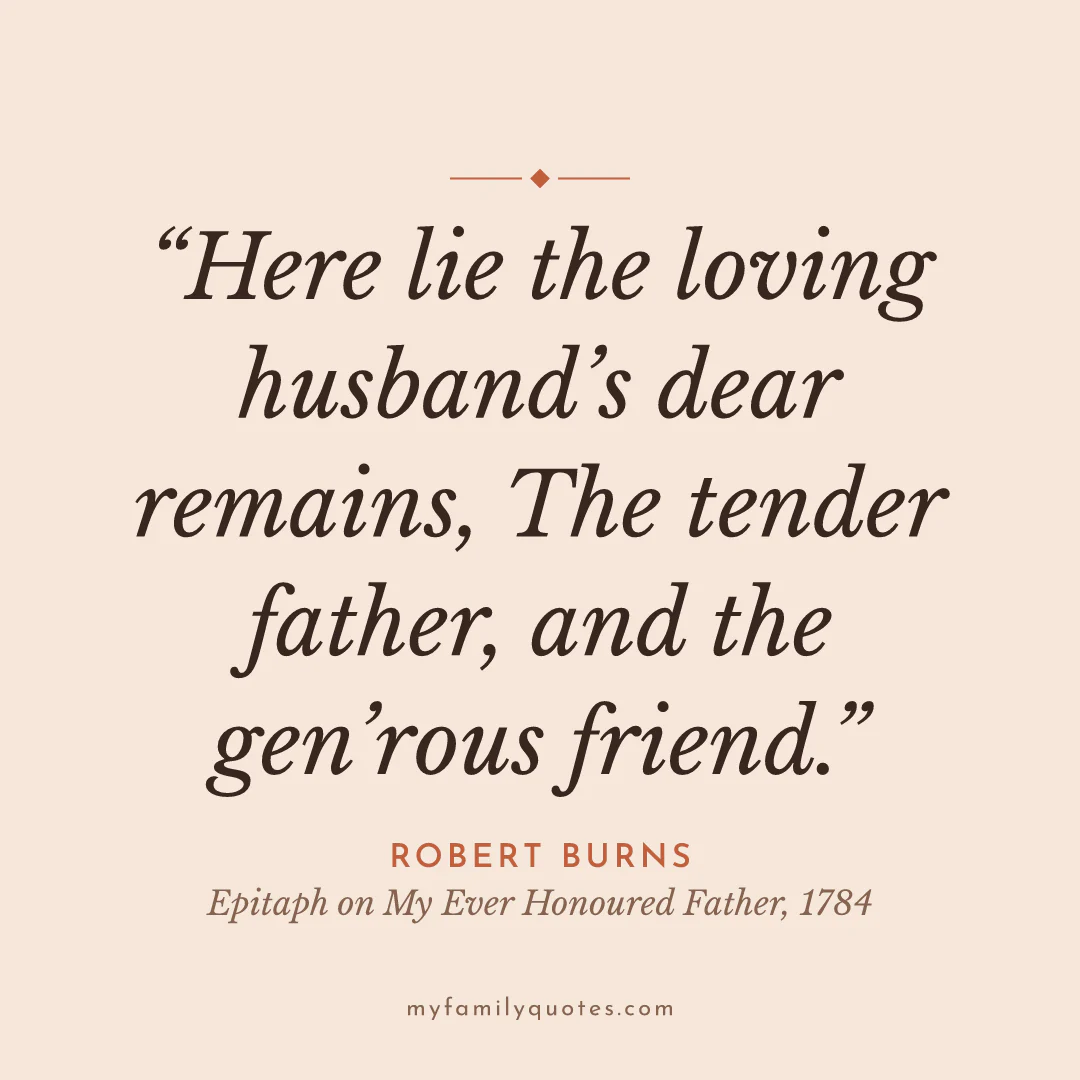
"O ye whose cheek the tear of pity stains, / Draw near with pious rev'rence, and attend! / Here lie the loving husband's dear remains, / The tender father, and the gen'rous friend." — Robert Burns, "Epitaph on My Ever Honoured Father" (1784)
Burns's father, William Burnes, a tenant farmer, died of consumption and exhaustion at Lochlea farm in Ayrshire in February 1784, and the family buried him in Alloway kirkyard. His son wrote this epitaph that year and printed it in his first book, the Kilmarnock edition of 1786. The second couplet is the part that works on a memorial card or a stone: three roles (husband, father, friend), each with one honest adjective.
"In my Father's house are many mansions: if it were not so, I would have told you. I go to prepare a place for you." — John 14:2, King James Version (1611)
In the Gospel, "my Father" is God, and Jesus is comforting his disciples the night before his death. At funerals the verse has picked up a second, gentler meaning for families: a father going ahead to "prepare a place." The first clause alone, eight words, fits a headstone or a small tattoo. For more verses about fathers, see our page of Bible verses on fathers.
How to write a death anniversary post or card for your dad
A quote rarely does the whole job. What people remember is the sentence you add to it. A simple order that works for a social post, a card to your mother, or a few words at a graveside:
- Name the day plainly. "Five years today." "Dad would have been 70 today." Saying the number is easier for others than guessing it.
- Add one concrete detail about him. A phrase he used, a job he always did, his order at a diner. One true detail is worth more than three adjectives.
- Then the quote, with its author. Pick it from the table above by day, not by how sad it sounds. Credit it properly (the attributions on this page are checked), and leave the long ones for cards rather than captions.
- Say what you are doing today. Lighting a candle, visiting the grave, cooking his recipe, watching his team. It gives friends a way to join in.
- If you are writing to someone else who lost him (your mother, a sibling), say his name. Most people avoid it, and most grieving families want to hear it.
If you are writing to a friend whose father has just died, rather than marking an anniversary, the sympathy lines on our sympathy quotes page work for either parent, and C. S. Lewis's notes in A Grief Observed are honest about the months after a death.
Lines we checked and did not use as written
- "Death ends a life, not a relationship" credited to Mitch Albom. The idea and almost the same words appear in Robert Anderson's 1968 play, decades before Tuesdays with Morrie; credit Anderson, or Morrie Schwartz as quoted by Albom. More corrections like this are on our misattributed family quotes page.
- "Do not go gentle" as a deathbed poem. It was written five years before D. J. Thomas died; fine to use, but don't caption it "written as his father lay dying."
- Claudius's "your father lost a father." Often shared as comfort, but in the play it is the murderer telling the son to stop mourning. We kept it in the commentary only.
Quick answers
What do I write on my dad's death anniversary?
Name the day ("Ten years today"), add one real detail about him, then a short sourced line such as Robert Anderson's "Death ends a life, but it does not end a relationship" (1968), and say how you are marking the day. A candle, a grave visit or his favourite meal gives friends a way to join in.
What is a beautiful tribute to a father who passed away?
Hamlet's "He was a man, take him for all in all, / I shall not look upon his like again" and Robert Burns's epitaph for his father, "The tender father, and the gen'rous friend" (1784), are two of the oldest tributes still in use. Emily Dickinson's "His Heart was pure and terrible and I think no other like it exists" (1874) suits a father who was loved but not easy.
Who said "Death ends a life, not a relationship"?
Robert Anderson wrote it first, as the opening of a play that reached Broadway in 1968, and Morrie Schwartz repeats the idea in Mitch Albom's Tuesdays with Morrie (1997), which is why it is often credited to Albom. Anderson's play is I Never Sang for My Father, and its first speech begins "Death ends a life, but it does not end a relationship".