First Christmas Without Mom Quotes: 13 Sourced Lines for the Card, the Empty Chair and the Tree
Words My Family Quotes Editors

The first Christmas without Mom is hard in a particular way: the whole season runs on her traditions, and every one of them now has a gap in it. The words that help most are rarely greeting-card verses. They come from people who lived through that December and wrote it down the same week: Henry Wadsworth Longfellow, whose five children spent Christmas 1861 without their mother; Queen Victoria, who lost her mother and her husband in the same year; Alfred Tennyson, Charles Dickens and Mark Twain. This page collects 13 of their lines, each checked in its original source, and sorts them by the moment you need them: the card, Christmas Eve, the empty chair at dinner, the tree.
There are lines here for a first Christmas without Dad, a grandparent or a child as well, a table that matches each line to its use, six ways to honor someone at Christmas that come straight from these writers' own houses, and wording for a card to a friend. If the loss is very recent and you need words for the funeral first, start with our sympathy quotes for the loss of a mother. For more pages on grief and the harder side of family life, see the deep family quotes hub.
Which line fits which moment
Use this as a shortcut. Every line is quoted in full further down, with the story behind it.
| The moment | A line that fits | Source |
|---|---|---|
| A card to a friend whose mom died this year | "an unseen presence blessed the scene" | Longfellow, journal, 1861 |
| Your own post on Christmas Day | "'A merry Christmas,' say the children; but that is no more, for me." | Longfellow, journal, 1862 |
| Christmas Eve, lighting a candle | "one mute Shadow watching all" | Tennyson, In Memoriam XXX |
| A grace or toast at dinner | "You shall hold your cherished places in our Christmas hearts" | Dickens, 1851 |
| Keeping an empty chair or one of their things | "a crutch without an owner, carefully preserved" | Dickens, A Christmas Carol |
| The first Christmas without Dad | "his spirit will guide and inspire me" | Queen Victoria, December 1861 |
| Presents or decorations they never finished | "the hands are forever idle that would have labeled them" | Mark Twain, Christmas Eve 1909 |
| The second Christmas | "The quiet sense of something lost" | Tennyson, In Memoriam |
| A church card or a message of faith | "the light shineth in darkness" | John 1:5 (KJV) |
First Christmas without Mom: what the Longfellow house did
On 9 July 1861, Fanny Appleton Longfellow was sealing locks of her children's hair into an envelope with hot wax when her dress caught fire at their home in Cambridge, Massachusetts. She died the next morning. Her husband was burned trying to save her, badly enough that he could not attend her funeral. They had five living children, the youngest, Anne Allegra, just six. Longfellow kept a journal, and his brother Samuel printed the Christmas entries after the poet's death.
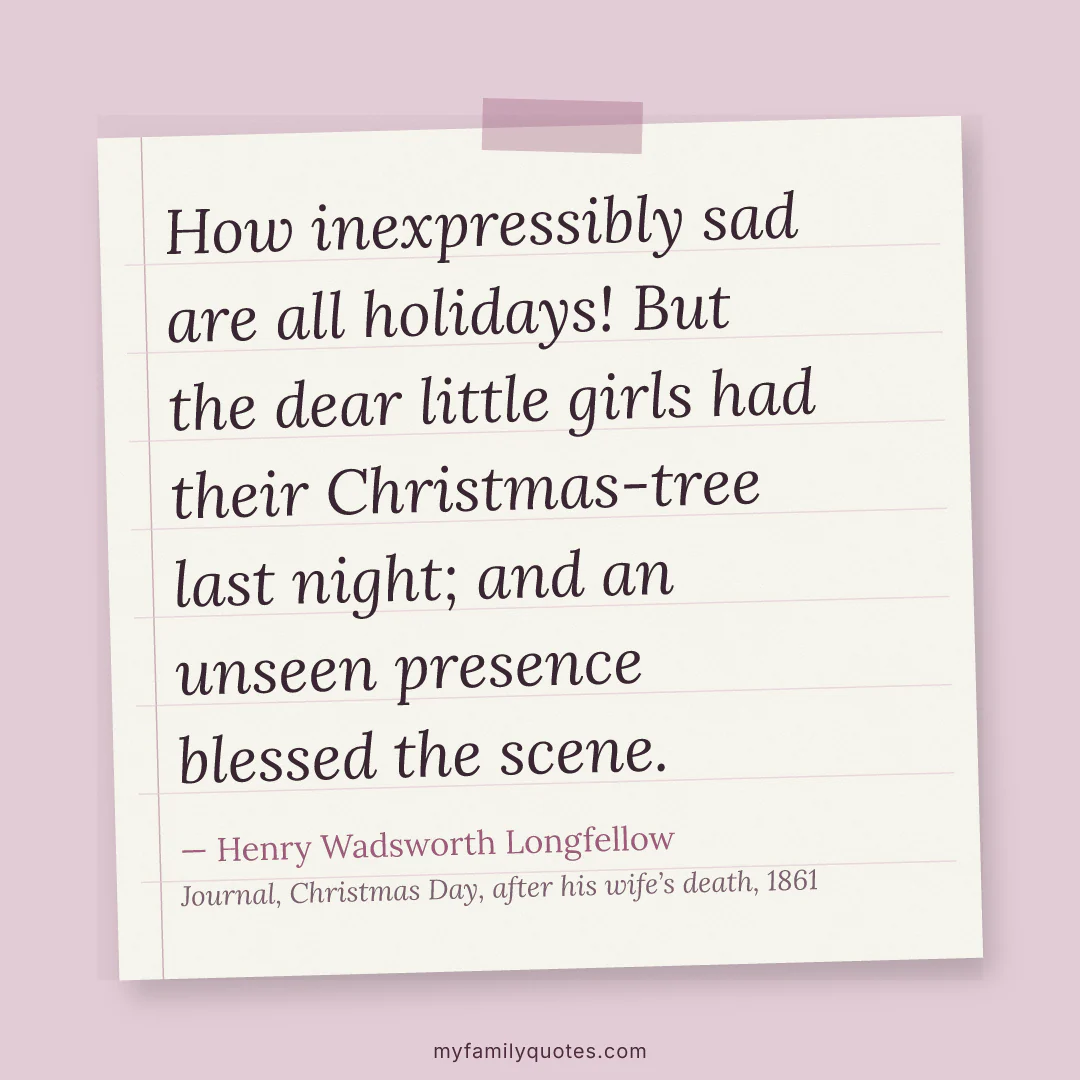
"How inexpressibly sad are all holidays! But the dear little girls had their Christmas-tree last night; and an unseen presence blessed the scene."
— Henry Wadsworth Longfellow, journal, 25 December 1861, printed in Samuel Longfellow, Life of Henry Wadsworth Longfellow, vol. 2 (1886) (Internet Archive scan)
Two sentences, and they hold the whole first Christmas: the adult who cannot feel the holiday, and the children who still get their tree. "An unseen presence blessed the scene" is the line most people reach for, and it is the right one for a card, because it says she was there without claiming to know how. Notice also what Longfellow did not do. He did not cancel Christmas for three little girls because he could not bear it himself. If you are the parent in this story, that is permission to do the same: the tree can go up even if you sit beside it in silence.
A year later, the entry was shorter and no less honest.
"'A merry Christmas,' say the children; but that is no more, for me. Last night the little girls had a pretty Christmas-tree."
— Henry Wadsworth Longfellow, journal, 25 December 1862, in Life of Henry Wadsworth Longfellow, vol. 2 (1886)
This is the line for anyone who is tired of being told the holidays will feel normal again soon. It is said plainly, without self-pity, and it sits next to the children's tree again, so the grief and the ritual are in the same two sentences. For an adult child posting on Christmas Day, the first clause alone is enough: "'A merry Christmas,' say the children; but that is no more, for me."
Queen Victoria's year began with the loss of her mother. Victoria, the Duchess of Kent, died at Frogmore near Windsor on 16 March 1861, with her daughter holding her hand. That same day the Queen wrote to her uncle, King Leopold of the Belgians.
"That precious, dearly beloved tender Mother—whom I never was parted from but for a few months—without whom I can't imagine life—has been taken from us!"
— Queen Victoria to King Leopold of the Belgians, Frogmore, 16 March 1861, The Letters of Queen Victoria, vol. 3 (1907) (Project Gutenberg)
"Without whom I can't imagine life" is the phrase for a daughter or son who lived close to their mother, in the same town or the same house, and who finds that the first December makes the absence physical: no one to call about the recipe, no one to ask where the box of ornaments went. The Queen was 41 and a mother of nine when she wrote it, which is worth knowing. You do not stop needing your mother because you have children of your own. (The emphasis in the printed letter is hers; we have left out the italics.)
Christmas Eve, when everyone feels the gap
Arthur Hallam was Tennyson's closest friend and was engaged to his sister Emily. He spent Christmas 1832 with the family at the rectory in Somersby, Lincolnshire, and died suddenly in Vienna on 15 September 1833, aged 22. Tennyson spent seventeen years writing the long elegy that became In Memoriam, and it marks three Christmases. The first one, section XXX, is Christmas Eve 1833.
"With trembling fingers did we weave
The holly round the Christmas hearth;
A rainy cloud possess'd the earth,
And sadly fell our Christmas-eve.
At our old pastimes in the hall
We gambol'd, making vain pretence
Of gladness, with an awful sense
Of one mute Shadow watching all."
— Alfred Tennyson, In Memoriam, section XXX (first edition, Moxon, 1850) (Project Gutenberg)
"Making vain pretence of gladness" is the most accurate description in English of a family playing the old games because nobody knows what else to do. A few lines further on, the family sings "A merry song we sang with him / Last year", stops, and weeps. That pattern is worth borrowing. If there is a carol or a silly song she always started, sing it, and let it be fine if nobody gets to the end. For a Christmas Eve post with a photo of a candle, "one mute Shadow watching all" is short enough to stand alone.
The empty chair at the table
The most famous empty seat in Christmas literature appears in A Christmas Carol (1843), when Scrooge asks the Ghost of Christmas Present whether Tiny Tim will live.
"I see a vacant seat," replied the Ghost, "in the poor chimney-corner, and a crutch without an owner, carefully preserved."
— Charles Dickens, A Christmas Carol, Stave 3 (1843) (Project Gutenberg)
Two words make this line useful to grieving families: "carefully preserved". Dickens imagined the Cratchits keeping Tim's crutch where it always stood, and many families do something similar without knowing the source: Mom's apron on its hook, her chair at the table with a candle on it, her handwriting on the recipe card propped by the stove. If someone at your table asks why the chair is set, this is a quiet answer.
In the next stave, the Ghost of Christmas Yet to Come shows Scrooge the Cratchit family in the days after Tim has died. Bob Cratchit comes home from the grave and talks to his children.
"But however and whenever we part from one another, I am sure we shall none of us forget poor Tiny Tim—shall we—or this first parting that there was among us?"
— Charles Dickens, A Christmas Carol, Stave 4 (1843)
"This first parting that there was among us" is the phrase for a toast at the first family dinner after a death, especially when grown siblings are together again for the first time since the funeral. It treats the loss as something the family went through together and promises that nobody will forget. Dickens follows it with Bob's hope that remembering Tim will keep them from quarrelling, which is not a bad thing to wish for on a first Christmas either.
Saying their names out loud: Dickens's own Christmas, 1851
Dickens wrote A Christmas Carol as a young man. In 1851 he lost his father, John, on 31 March, and his infant daughter Dora, seven months old, that same year. In 1851 he also wrote a short Christmas essay called "What Christmas Is as We Grow Older", about the people a family carries into the holiday after they have gone. It ends with a list.
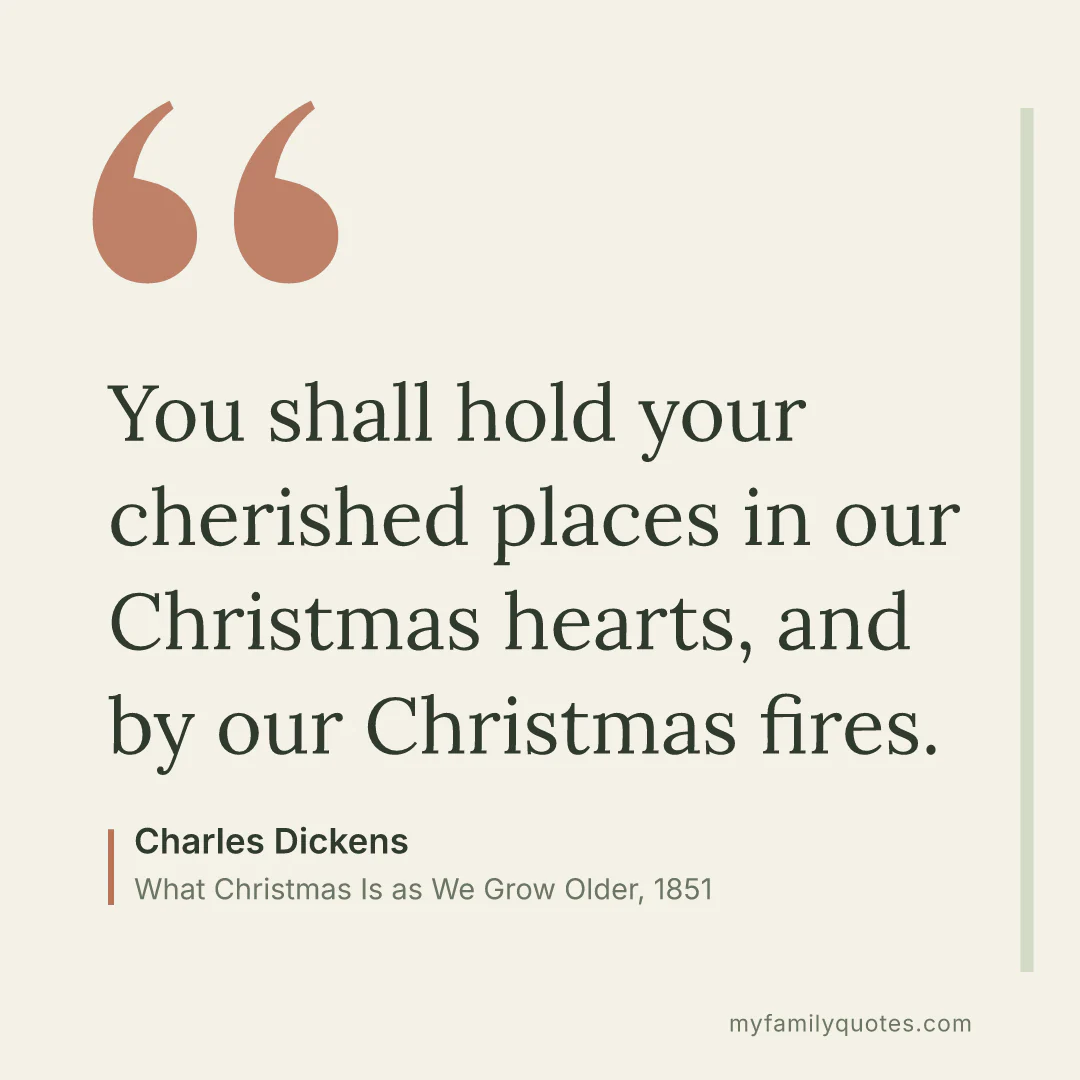
"Lost friend, lost child, lost parent, sister, brother, husband, wife, we will not so discard you! You shall hold your cherished places in our Christmas hearts, and by our Christmas fires; and in the season of immortal hope, and on the birthday of immortal mercy, we will shut out Nothing!"
— Charles Dickens, "What Christmas Is as We Grow Older" (1851) (Project Gutenberg, Some Christmas Stories)
Earlier in the essay he calls the cemetery "the City of the Dead" and says that on Christmas Day the family will turn toward it "and from its silent hosts bring those we loved, among us". That is the opposite of the advice grieving people often get, to keep the day light and not mention the person. Dickens says to mention them. A grace that names her, or a toast that begins "To Mom, who would have" and finishes with something true, is exactly what he meant. The middle sentence works on its own in a card or as a caption.
First Christmas without Dad
Prince Albert died at Windsor Castle on 14 December 1861, aged 42, eleven days before Christmas. He and Victoria had nine children, the youngest, Beatrice, only four. Six days later, writing from Osborne on the Isle of Wight, the Queen told King Leopold how she meant to go on.
"If I must live on (and I will do nothing to make me worse than I am), it is henceforth for our poor fatherless children—for my unhappy country, which has lost all in losing him—and in only doing what I know and feel he would wish, for he is near me—his spirit will guide and inspire me!"
— Queen Victoria to King Leopold of the Belgians, Osborne, 20 December 1861, The Letters of Queen Victoria, vol. 3 (1907)
This is the line for a mother writing the first Christmas card to her children after their father has died, or for a widow who needs to say why she is putting up the tree at all. "In only doing what I know and feel he would wish" turns the holiday into something done for him rather than in spite of his absence. If that is too formal, the last six words, "his spirit will guide and inspire me", fit inside a card or under a photo of his ornament.
Tennyson's poem has a line for a father, too. The third Christmas in In Memoriam is spent in a new house, after the family left Somersby (around 1837), where the poet's father, the rector, had died in 1831. "Our father's dust is left alone / And silent under other snows," Tennyson writes. Families who spend the first Christmas away from the town where a parent is buried will recognise it. For more lines about losing a father, including the hard dates after the funeral, see our dad death anniversary quotes.
When it is a child or a young person who is missing
Jean Clemens, Mark Twain's youngest daughter, had epilepsy. She was staying with her father at Stormfield, his house in Redding, Connecticut, in December 1909 and had spent days decorating it for Christmas. Early on the morning of 24 December she was found dead in her bath after a seizure. She was 29. Her mother, Olivia, had died in 1904. Twain began writing about her that same morning and kept going for two days. His biographer Albert Bigelow Paine printed the piece after Twain's own death in April 1910.
"And now here is Jean's parlor looking just as that nursery used to look. The presents are not labeled—the hands are forever idle that would have labeled them today. Jean's mother always worked herself down with her Christmas preparations."
— Mark Twain, "The Death of Jean", written at Stormfield, 24 December 1909, in What Is Man? and Other Essays (Project Gutenberg)
Twain is remembering Christmas Eves when he and his wife crept into the nursery at midnight to look at the presents, and seeing the same scene in his grown daughter's room with no one left to finish it. Earlier in the piece he describes the tree Jean had been decorating, "drenched with silver film", with the ornaments still on a table beside it, and asks: "What desecrating hand will ever banish that eloquent unfinished surprise from that place? Not mine, surely." Families who lose someone in December face that exact question about the half-wrapped gifts and the decorations. Twain left them. Finishing them is just as loving. The point of quoting him is that either choice is allowed.
The Christmas story itself contains a bereaved mother. After the visit of the wise men, Herod orders the killing of the boys of Bethlehem, and Matthew quotes the prophet Jeremiah.
"In Rama was there a voice heard, lamentation, and weeping, and great mourning, Rachel weeping for her children, and would not be comforted, because they are not."
— Matthew 2:18 (King James Version) (Project Gutenberg)
"Would not be comforted" is not a line to send to grieving parents in a card. It is a line that tells them they are seen. It sits inside the same chapter as the star and the gifts, and it is a reminder that Christmas has always had room for people who cannot be cheered up. Use it for a church memorial service, or quote it to yourself when someone insists you should feel better by now. For a grandparent's first Christmas gone, our losing grandma quotes page has gentler lines.
Is the second Christmas easier?
Tennyson's answer is the most honest we know. Section LXXVI of the 1850 first edition (numbered LXXVIII in later editions, after two sections were added earlier in the poem) describes the next Christmas Eve, in the same words as the first, but with snow instead of rain.
"Again at Christmas did we weave
The holly round the Christmas hearth,
The silent snow possess'd the earth,
And calmly fell our Christmas-eve;
The yule-clog sparkled keen with frost,
No wing of wind the region swept,
But over all things brooding slept
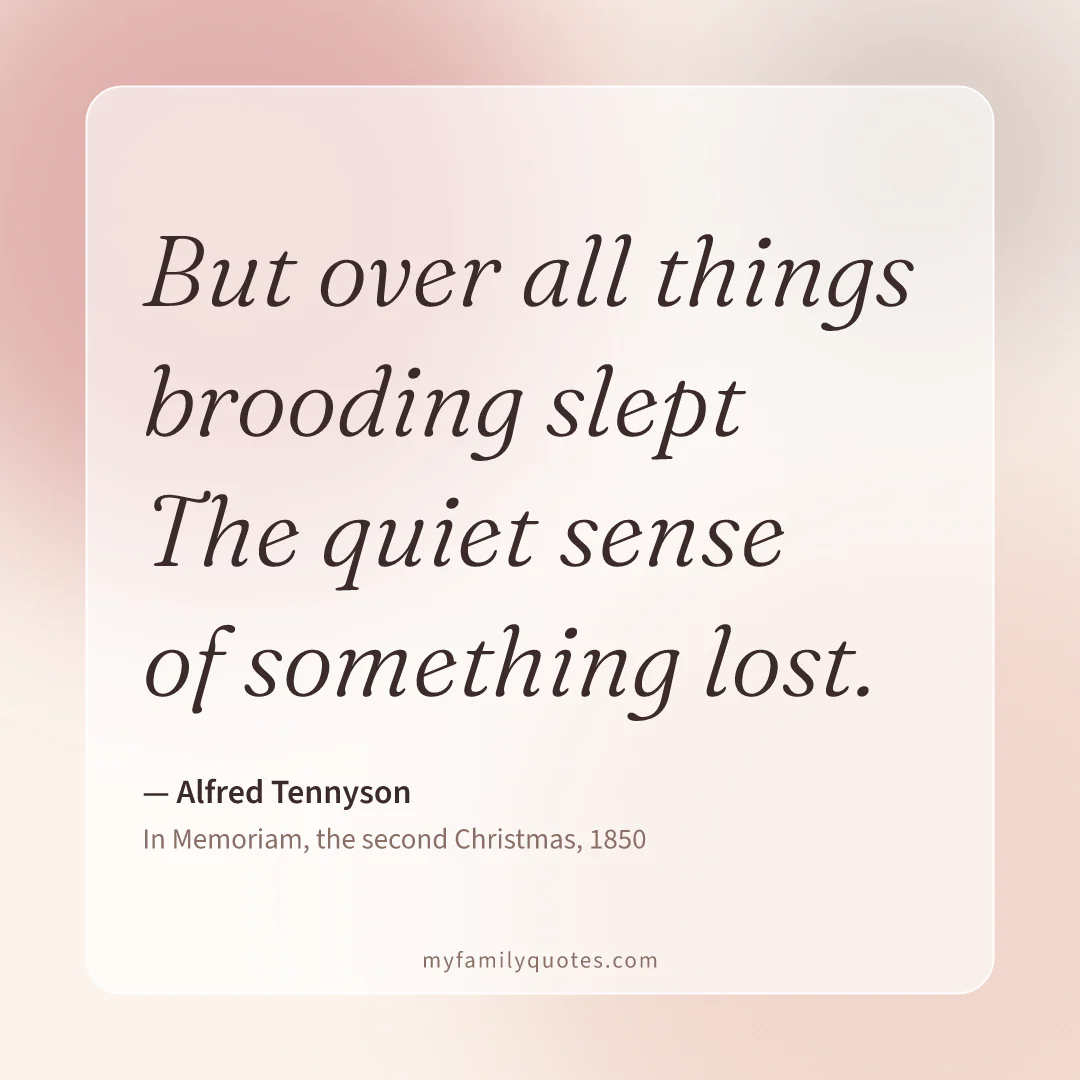
The quiet sense of something lost."
— Alfred Tennyson, In Memoriam, section LXXVI (first edition, 1850)
"Sadly fell" has become "calmly fell". The family plays its games again, and nobody cries. Then Tennyson asks whether grief can really shrink, "O grief, can grief be changed to less?", and answers that the bond is the same, "But with long use her tears are dry." In other words, grief gets quieter, not smaller. If you are dreading the second Christmas because the first one took all your strength, this is a fair description of what many people find: less raw, still there. "The quiet sense of something lost" is also a good line for a card to someone in their second or third year, when friends have mostly stopped asking.
When faith feels far away: two Christmas readings
Longfellow's "Christmas Bells" is best known as the carol "I Heard the Bells on Christmas Day". He wrote it during the Civil War, after his wife's death and after his eldest son, Charles, who had joined the Union Army without his blessing, was badly wounded at Mine Run in November 1863. It was first published in February 1865 in the magazine Our Young Folks. Two stanzas about cannon are usually left out when it is sung. The stanza grieving people recognise is the one just before the turn.
"And in despair I bowed my head;
'There is no peace on earth,' I said:
'For hate is strong,
And mocks the song
Of peace on earth, good-will to men!'"
— Henry Wadsworth Longfellow, "Christmas Bells" (published 1865) (Project Gutenberg)
The next stanza answers it: "Then pealed the bells more loud and deep: / 'God is not dead; nor doth he sleep!'" Many readers need the despair before they can accept the answer, and Longfellow gives them both. For a church bulletin or a card from someone who shares the faith, quote the two stanzas together. For anyone else, the despair stanza alone is more honest than most sympathy verses.
The other reading is the Gospel set for Christmas Day in the Book of Common Prayer, the opening of John. One verse in it speaks straight to a dark December.
"And the light shineth in darkness; and the darkness comprehended it not."
— John 1:5 (King James Version)
"Comprehended" in the King James English means "overcame" or "took hold of" as much as "understood", which is why modern translations differ. Either way, the verse says that the light keeps shining in the dark, which is something a grieving family can believe on a hard day. It fits a candle lit for her on Christmas Eve, a memorial ornament, or the inside of a card.
Six ways to honor someone who died, taken from these houses
"How do you honor someone who passed away at Christmas?" is one of the questions Google shows next to this search. The families on this page have already answered it, in what they actually did.
- Let the children keep their tree. Longfellow wrote that all holidays were "inexpressibly sad", and his daughters had their tree on Christmas Eve anyway, in 1861 and again in 1862.
- Keep one of their things in its place. Dickens's Cratchits kept the crutch "carefully preserved". An ornament she made, her stocking, his reading glasses on the mantel: one object is enough.
- Say their names at the table. "We will not so discard you!" Dickens wrote in 1851, the year he lost a parent and a child. A one-sentence grace that names her does more than a silent minute.
- Sing their song, and let it stop. Tennyson's family sang the song they had sung with Hallam the year before, broke off and wept. That was the moment they were closest to him.
- Finish what they started, or leave it. Twain could not touch Jean's half-decorated tree. Another family might finish hanging the ornaments in her honor. Both are right.
- Change the place if the house is too much. Tennyson's third Christmas was in a new home, and he wrote that "change of place, like growth of time, / Has broke the bond of dying use." A Christmas at a sibling's house, or away, is not running away from her.
What to write in a card on someone's first Christmas without their mom
A card for this Christmas does not need a long message. Four parts are enough, in this order:
- Name her. "Your mom" or her first name, not "your loss".
- Say it is the first Christmas. They know, and it helps to know that you know.
- Add one line from the table above, if it says something you can't.
- Offer one concrete thing. A call on a set day, a walk, a dish dropped off. "Let me know if you need anything" leaves all the work to them.
Three examples, written by our editors to show the method (they are not quotations):
Editor's example, to a friend: "Thinking of you this Christmas, your first without your mom. After his wife died, Longfellow wrote that when his daughters lit their tree, 'an unseen presence blessed the scene.' I hope you feel her there too. I'll call you on the 27th."
Editor's example, to a family who lost their father: "To all of you, at the first Christmas without [his name]. Dickens wrote that the people we lose 'shall hold your cherished places in our Christmas hearts, and by our Christmas fires.' We will be lighting a candle for him on Christmas Eve."
Editor's example, for your own post: "Our first Christmas without Mom. We put up her tree, kept her chair, and sang her carol until we couldn't. 'You shall hold your cherished places in our Christmas hearts' (Charles Dickens, 1851)."
If you want lighter lines for the rest of the family's cards this year, our short Christmas quotes about family are all sourced too, and C. S. Lewis's notebook on mourning his wife, covered in our page on A Grief Observed, is a good companion for the weeks after the holidays.
Quick answers
How do you honor someone who passed away at Christmas?
Keep one of their traditions going, keep one object of theirs in its usual place, and say their name out loud at the table. Dickens urged the last in his 1851 Christmas essay ("we will not so discard you"), and Longfellow's daughters still had their tree the Christmas after their mother died.
What do you say to someone on their first Christmas without their mom?
Name her, say you know it is the first Christmas without her, and offer one concrete thing, such as a call or a visit on a set day. A short line such as Longfellow's "an unseen presence blessed the scene" can sit between those sentences.
What is a good Bible verse for a first Christmas after a death?
John 1:5, "And the light shineth in darkness; and the darkness comprehended it not," comes from the Christmas Day Gospel and suits a card or a candle. Matthew 2:18, Rachel "weeping for her children," is part of the Christmas story itself and acknowledges the loss of a child.
Is the second Christmas after a death easier?
Not always. Tennyson's In Memoriam describes the second Christmas after his friend's death as calmer on the surface, with "no single tear," yet "the quiet sense of something lost" still lies over everything. His answer is that grief gets quieter, not that it ends.