What Is a Mother? 10 Quotes That Answer It, Traced to the Poem, Novel or Verse
Words My Family Quotes Editors

Noah Webster's 1828 American Dictionary of the English Language answers the question in one line: a mother is "a female parent; especially, one of the human race; a woman who has borne a child." It is accurate, and nobody has ever put it on a Mother's Day card. Poets, novelists, a man who escaped slavery, a newspaper humorist and two Hebrew prophets gave other answers to "what is a mother?", and those are the lines people actually search for. Below are 10 "a mother is" quotes, each checked against the poem, novel, column or verse it comes from, with the year and the story around it.
Some of these lines are tender, one is funny, and two come with a warning: in their original setting they mean something different from what they seem to say on a greeting card. The notes tell you which is which. Further down there is a short method for finishing the sentence "A mother is…" in your own words, and a list of popular definitions we could not trace to anyone.
The ten answers at a glance
| "A mother is…" in short | Who said it | Where, and when | Best for |
|---|---|---|---|
| the most devotional word the angels know | Edgar Allan Poe | sonnet "To My Mother", 1849 | a mother-in-law, an aunt, a stepmother |
| everything: consolation, hope, strength | Kahlil Gibran | The Broken Wings, 1912 | a tribute or eulogy |
| the one who kissed the place to make it well | Ann Taylor | "My Mother", 1804 | a card from a grown child |
| the one who came in the night | Frederick Douglass | Narrative, 1845 | a speech, a history lesson |
| not a person to lean upon | Dorothy Canfield | Her Son's Wife, 1926 | a graduation or moving-out card |
| the one who doesn't care for pie | Robert Quillen | newspaper column, 1937 | a funny caption |
| a mother still, the holiest thing alive | Samuel Taylor Coleridge | "The Three Graves", 1809 | use with care (see the note) |
| the only true thing in life | James Joyce | Ulysses, 1922 | a reader who loves Joyce |
| the one who cannot forget her child | Isaiah 49:15 | King James Version, 1611 | a religious card |
| like mother, like daughter | Ezekiel 16:44 | King James Version, 1611 | not a compliment in context |
A mother is a word
Two writers answered the question by looking at the word itself, and both put that word inside a scene of grief.
"Because I feel that, in the Heavens above, / The angels, whispering to one another, / Can find, among their burning terms of love, / None so devotional as that of 'Mother'" — Edgar Allan Poe, "To My Mother" (1849)
The surprise in Poe's sonnet is who it is for. It is addressed to Maria Clemm, his aunt and mother-in-law, who had looked after him and his young wife Virginia until Virginia died in 1847. Poe's own mother, the actress Eliza Poe, died when he was a small child, and the sonnet says so plainly: she "was but the mother of myself", while Mrs. Clemm is "more than mother unto me." According to John Henry Ingram's edition of the poems, Poe sent it to a magazine early in 1849, but it did not appear until after his death. That makes it the best classic line on this page for a woman who became a mother to you without giving birth to you: a mother-in-law, an aunt, a stepmother. The full text is in Ingram's edition on Project Gutenberg.
"The mother is every thing — she is our consolation in sorrow, our hope in misery, and our strength in weakness." — Kahlil Gibran, The Broken Wings (1912)
This is the passage most "what is a mother" pages half-quote. It comes in the chapter "Before the Throne of Death": Selma's father, Farris Effandi, is dying, and he takes a small framed picture of her mother from under his pillow. Selma kisses the picture, and the narrator breaks off to say that "the most beautiful word on the lips of mankind is the word 'Mother'". So the line was written about a daughter who has lost her mother and is about to lose her father too. It is too long for most cards, but it suits a eulogy or a written tribute. Gibran wrote the novel in Arabic; the English wording above is from the text posted by Project Gutenberg Australia, where it is spelled "every thing" as two words.
A mother is the one who shows up
The plainest answers describe what a mother does rather than what she is. One comes from a children's book, the other from one of the most important memoirs in American history.
"Who ran to help me when I fell, / And would some pretty story tell, / Or kiss the place to make it well? / My Mother." — Ann Taylor, "My Mother", Original Poems for Infant Minds (1804)
Ann Taylor and her sister Jane (who wrote "The Star", better known as "Twinkle, Twinkle, Little Star") wrote most of this collection with a few other young writers, and it first appeared in 1804. Each verse of "My Mother" asks a question and answers it with the same two words. The poem was reprinted and recited for more than a century; Ann Taylor's son Josiah Gilbert later wrote that it and "The Star" were the two poems "more frequently quoted than any." Read the whole thing, though. In the later stanzas the child promises to care for the mother when she is "feeble, old, and grey", which makes it a fitting card from a grown son or daughter to an elderly mother. The text is on the University of Toronto's Representative Poetry Online.
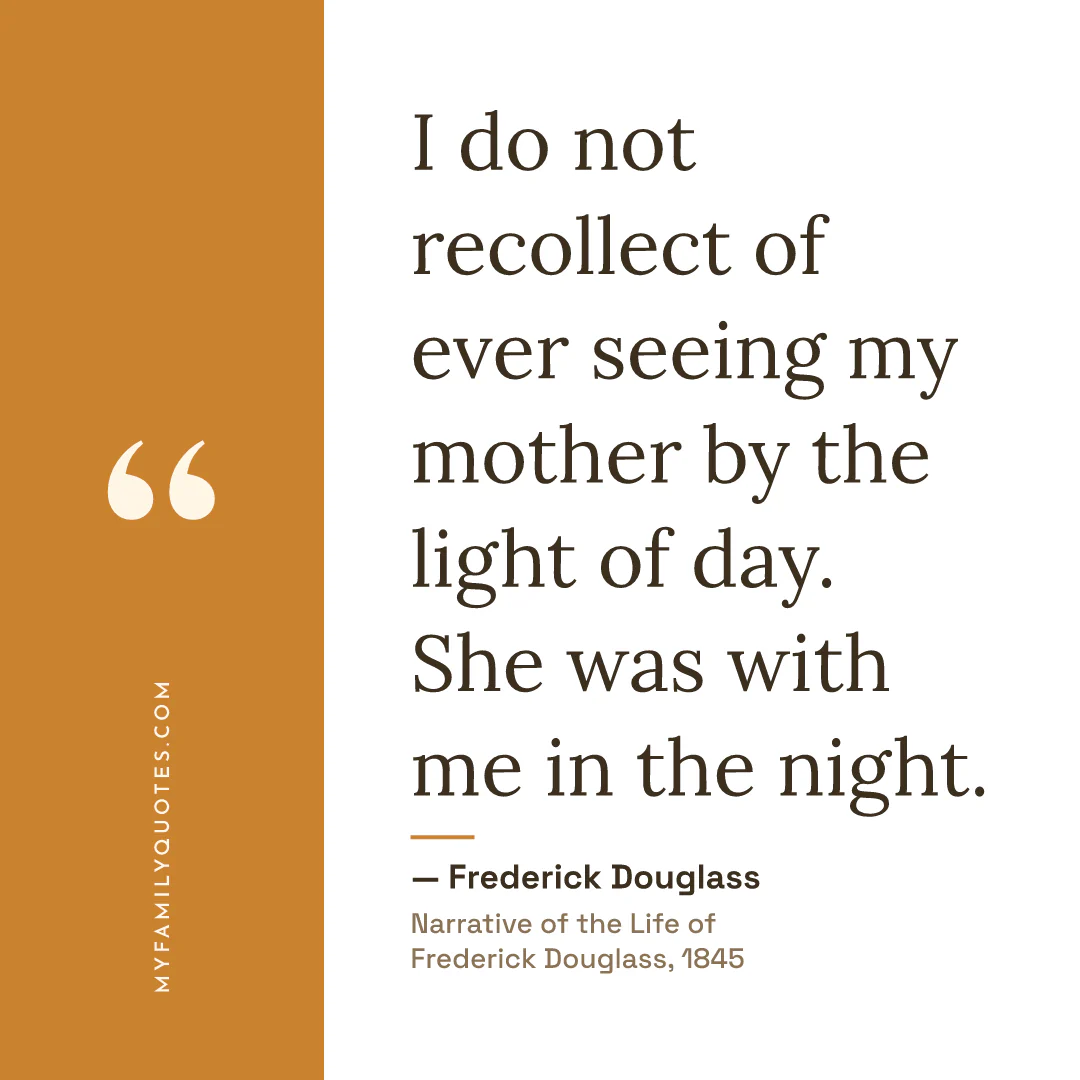
"I do not recollect of ever seeing my mother by the light of day. She was with me in the night." — Frederick Douglass, Narrative of the Life of Frederick Douglass, an American Slave (1845)
Douglass was separated from his mother, Harriet Bailey, as an infant. She was hired out to a farm about twelve miles away, and he writes that he saw her only four or five times. Each time she walked the whole distance at night, after a day's work in the fields, to lie down with him until he fell asleep, and she was gone before he woke. She died when he was about seven. These two sentences are not a greeting-card line. They are a definition of a mother by what she was willing to do when almost everything was taken from her. They belong in a speech, a lesson, or a tribute to a mother who worked nights. The full chapter is on Project Gutenberg.
A mother is not a person to lean upon
Two of the best-known definitions in the family turn the sentimental version on its head. One is serious and one is a joke, and both usually circulate with the wrong name or the wrong wording.
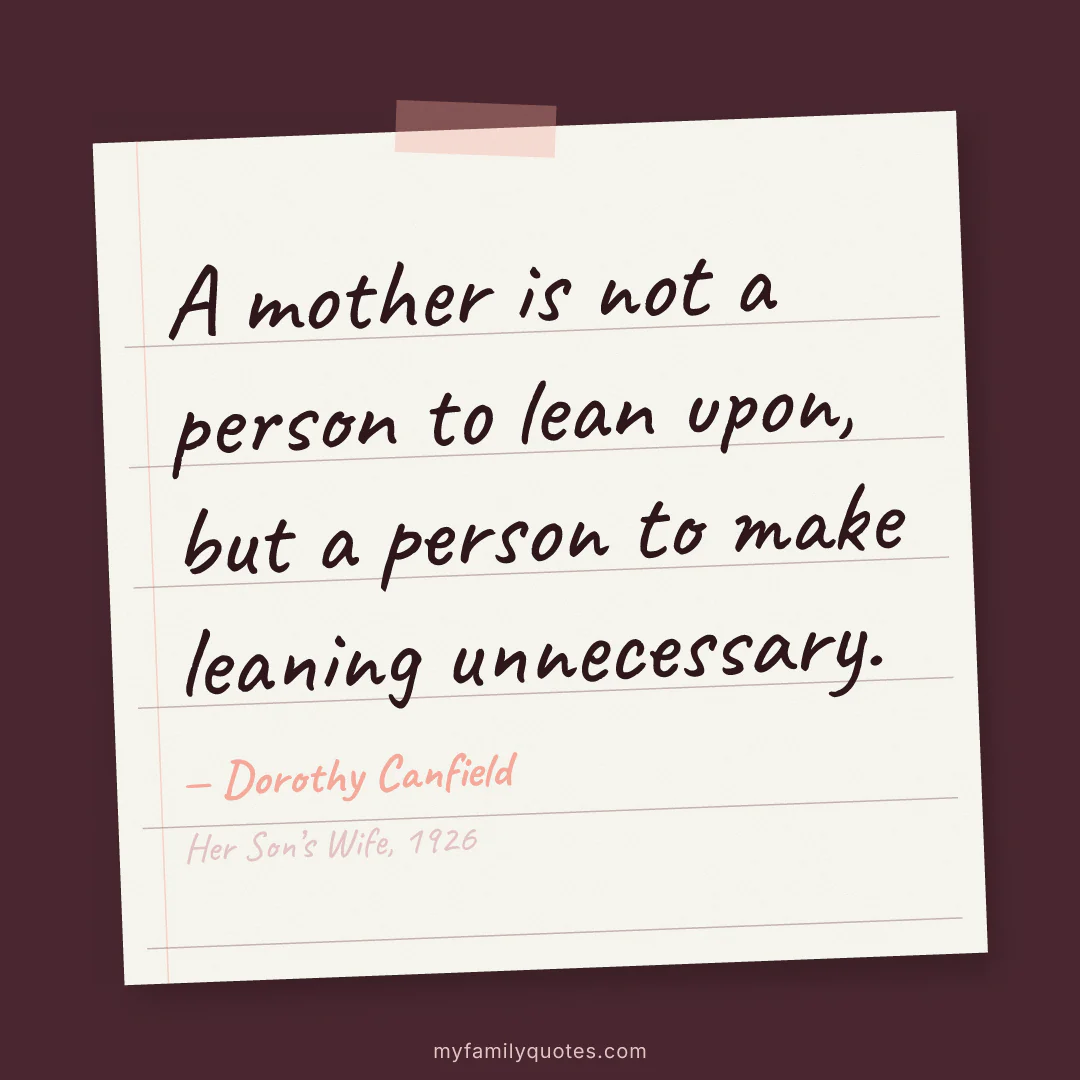
"A mother is not a person to lean upon, but a person to make leaning unnecessary." — Dorothy Canfield, Her Son's Wife (1926)
This line is usually credited to "Dorothy Canfield Fisher" and quoted with "lean on". The 1926 novel, published under the name Dorothy Canfield, has "lean upon" (page 275 in the Grosset & Dunlap printing scanned at the Internet Archive). It is not a slogan in the book. Mrs. Bascomb, a schoolteacher, is drifting off to sleep after an exhausting day when she realises she has been enjoying her grown son Ralph's dependence on her and calling it mother-love. The sentence is her correction of herself. That makes it the right line for a moment of letting go: a graduation, a first apartment, a wedding. It thanks a mother for making herself less needed.
"A mother is a person who sees there are only four pieces of pie for five people and says she doesn't care for pie." — Robert Quillen, syndicated newspaper column (1937)
You will usually see this credited to Tenneva Jordan. The researcher Barry Popik found it in Robert Quillen's syndicated column, printed in the Charleston Evening Post on 14 June 1937. Quillen was a South Carolina humorist whose short sayings ran in newspapers across the country. Jordan's name is attached to it in a Michigan newspaper in 1966, almost thirty years later. It is still the funniest true thing on this page: a mother is the person who quietly takes the smallest share. Use it for a caption, a birthday card or a Mother's Day post, and credit Quillen.
A mother is a mother still
These two lines are the ones to read in full before you borrow them. Each sounds like pure praise, and neither quite is.
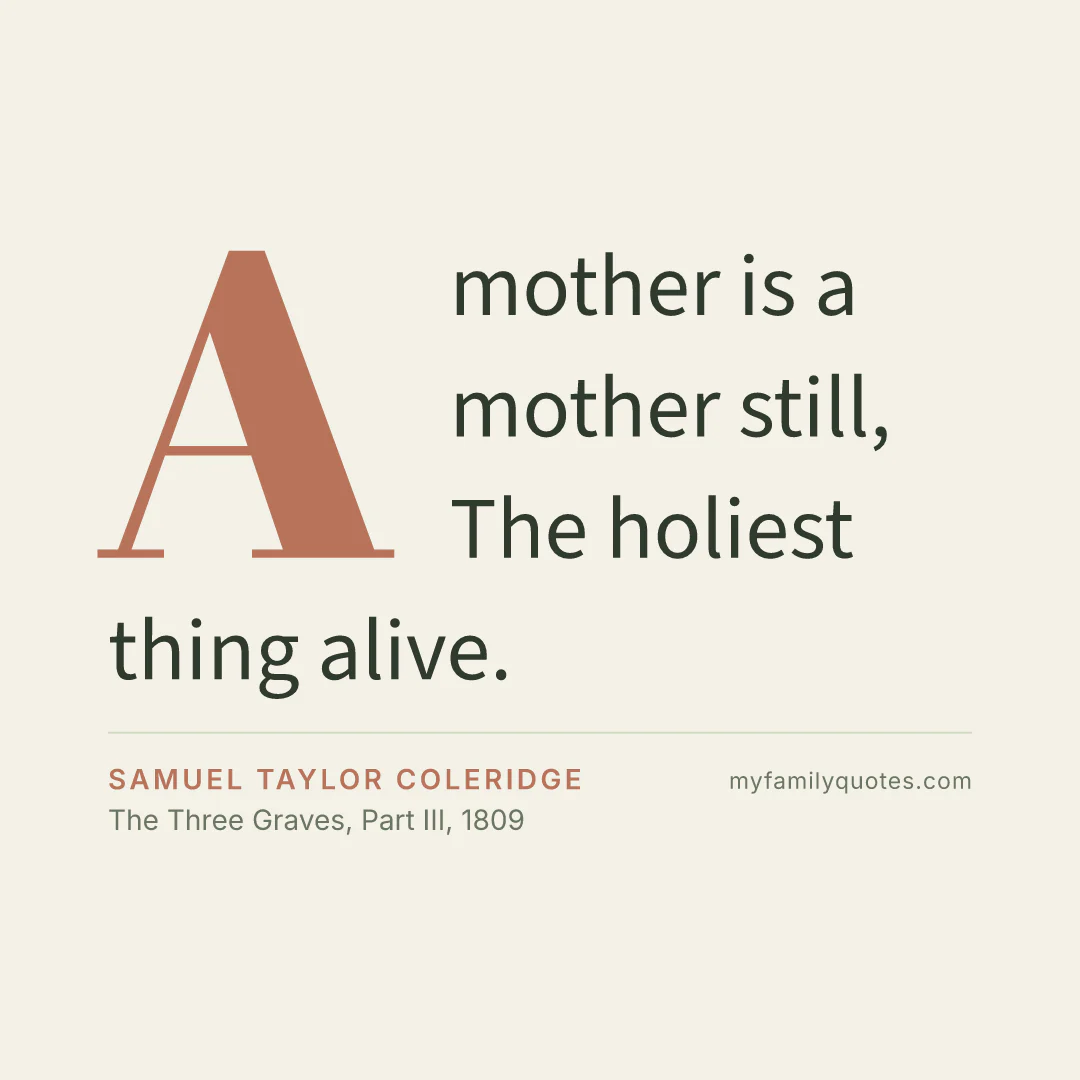
"A mother is a mother still, / The holiest thing alive." — Samuel Taylor Coleridge, "The Three Graves", Part III (1809)
Coleridge first printed this part of his ballad in his journal The Friend on 21 September 1809, according to Ernest Hartley Coleridge's edition of the poems. The ballad is a sexton's tale about a "ruthless mother" who curses her own daughter Mary over her marriage. In the stanza just before these lines, the narrator explains why the curse ruins Mary's happiness: "Beneath the foulest mother's curse / No child could ever thrive." Even a cruel mother keeps her power over a child, because she is still the mother. On a card, the couplet reads as reverence, and many people use it that way. Just know that in the poem it is closer to a warning about how much a mother's words weigh. That is worth remembering on hard days too.
"Amor matris, subjective and objective genitive, may be the only true thing in life." — James Joyce, Ulysses (1922)
Amor matris is Latin for "a mother's love", and Stephen Dedalus notes that it works both ways: the love a mother gives (subjective) and the love she receives (objective). Stephen thinks the phrase first while tutoring a struggling boy whose mother protected him, and comes back to it in the National Library, where he adds that "paternity may be a legal fiction." His own mother has recently died, and he is haunted by having refused to pray at her bedside. So the line comes from guilt as much as tenderness. It is a fine line for a reader who knows the book, and a strange one for a casual card.
What is a mother in the Bible?
Scripture rarely defines a mother directly. It does use her as the measure for other things, and two verses come up again and again when people search for this.
"Can a woman forget her sucking child, that she should not have compassion on the son of her womb? yea, they may forget, yet will I not forget thee." — Isaiah 49:15 (King James Version, 1611)
The prophet uses a nursing mother as the strongest image of faithfulness he can think of, and then says that God's memory is stronger still. The first half is the part people quote about mothers, and it works on its own in a card for a new mother or a mother whose child is far away. The verse after it continues the thought: "Behold, I have graven thee upon the palms of my hands."
"Behold, every one that useth proverbs shall use this proverb against thee, saying, As is the mother, so is her daughter." — Ezekiel 16:44 (King James Version, 1611)
This is the biblical source of "like mother, like daughter", and it is not a compliment. Ezekiel is condemning Jerusalem, and the next verse calls her "thy mother's daughter, that lotheth her husband and her children." If you want the phrase for a photo of a mother and daughter who look alike, use the English proverb and leave out the chapter and verse. For verses that do praise mothers, Proverbs 31 and the quotes on our page of short mother-daughter quotes about unconditional love are better places to start.
Write your own "A mother is…" line
The classic lines work because each one names something specific: pie, a scraped knee, a long walk at night. A line about your own mother will land better than any of them if you follow the same pattern.
- Pick one habit, not a virtue. "Kind" and "strong" are true of many people. The thing she always did is true only of her: the note in the lunchbox, the phone call every Sunday, the seat she always took at the back.
- Put it after "A mother is someone who…". Quillen's sentence is the template: a person who sees one thing and does another. Keep it under twenty words.
- Add the twist, if there is one. Canfield's line works because it says the opposite of what you expect. If your mother's love showed up as tough advice or a refusal to rescue you, say so.
- Match the length to the place. A caption needs one sentence. A card can hold the sentence plus one classic line from this page. A toast or eulogy can open with the dictionary definition and then give your own answer.
If you would rather quote than write, here are the short forms that fit on a card or under a photo, all taken from the full lines above:
- "A mother is a mother still." — Coleridge
- "A person to make leaning unnecessary." — Dorothy Canfield
- "She was with me in the night." — Frederick Douglass
- "Or kiss the place to make it well? My Mother." — Ann Taylor
- "Our strength in weakness." — Kahlil Gibran
"A mother is…" lines we could not trace
These definitions are everywhere online, but we could not find any of them in a book, speech or article by the person they are credited to. If you use one, leave the name off or say "attributed to".
- "A mother is she who can take the place of all others but whose place no one else can take." Credited to Cardinal Gaspard Mermillod, the Swiss bishop (1824–1892). We found no sermon or letter of his that contains it.
- "Making the decision to have a child — it is momentous. It is to decide forever to have your heart go walking around outside your body." Credited to the writer and professor Elizabeth Stone. We could not locate the original publication, so we can't give you a source or a year.
- "The moment a child is born, the mother is also born." Credited to the Indian guru Rajneesh (Osho). No talk or book with this sentence turned up.
- "God could not be everywhere, and therefore he made mothers." Usually called a Jewish proverb or credited to Rudyard Kipling. We trace it in our guide to misattributed family quotes.
Kipling did write one real mother poem, the dedication "Mother o' Mine" that opens The Light That Failed. You'll find it with its source, along with lines for sons, on our page of mother and son quotes traced to the poem, letter or speech.
Questions people ask
What is the best definition of a mother?
The dictionary definition is about giving birth: Webster's 1828 dictionary calls a mother "a female parent; especially, one of the human race; a woman who has borne a child." Most writers define her by what she does instead. Dorothy Canfield's "a person to make leaning unnecessary" (1926) is the most quoted of these, and Poe's sonnet to his mother-in-law shows the title can be earned without giving birth.
What is a short quote about what a mother is?
"A mother is a mother still, / The holiest thing alive" (Coleridge, 1809) is only ten words. For something lighter, Robert Quillen's 1937 line about the four pieces of pie works as a caption. Both are explained above, including the darker setting of Coleridge's couplet.
Where does the Bible say "like mother, like daughter"?
Ezekiel 16:44: "As is the mother, so is her daughter." In context it is a rebuke of Jerusalem, not praise, so it doesn't suit a Mother's Day card. Isaiah 49:15, about a mother who cannot forget her nursing child, is the gentler verse.
If you are looking for words because your mother has died, our page of sympathy quotes for loss of a mother was written for that moment. And if none of the ten answers above fits her, that is the best reason to write the eleventh yourself.