16 Short Unconditional Love Mother-Daughter Quotes That Will Anchor Your Perspective

Rain streaks the glass of a cramped Tokyo apartment. A woman empties the pockets of a wool coat she hasn't worn since last winter. She pauses. That tiny scrap of paper, bearing three scribbled words from her mother, suddenly outweighs the relentless mechanical noise of the sprawling city below. Brief expressions of maternal devotion bypass intellectual filters and strike directly at the core of our shared history.
The Architecture of Early Attachment
The initial bond between a mother and her female child establishes the blueprint for every subsequent relationship. Maya Angelou captured this foundational security in her 2013 memoir Mom & Me & Mom, detailing how maternal presence acts as a psychological shield against a hostile world. Early attachment requires no complex vocabulary. It relies entirely on presence.
"My mother shed her protective love down around me and without knowing why people sensed that I had value." — Maya Angelou
"My mother was my first country, the first place I ever lived." — Nayyirah Waheed
"We are born of love; love is our mother." — Rumi
"A mother is a daughter's first friend." — Unknown
While the final quote frequently circulates on social media without clear attribution, its persistence highlights a universal psychological truth about primary socialization. The mother serves as the initial mirror for a young girl's developing identity. She watches closely. She provides the necessary reflection that allows a child to measure her own worth against the vastness of human experience, offering a stable reference point in a chaotic environment.
Related: how female authors describe maternal ties
Related: the intricacies of maternal connection
Navigating the Middle Years

Adolescence and early adulthood frequently introduce friction into the maternal dynamic. Victoria Secunda explored this complex renegotiation of boundaries in her 1992 sociological study Women and Their Fathers, noting how daughters often pivot between intense rebellion and desperate need. The transition from dependent child to independent adult rarely follows a linear path. We stumble constantly.
"A daughter is a mother's gender partner, her closest ally in the family confederacy." — Victoria Secunda
"As mothers and daughters, we are connected with one another." — Shirley Abbott
"The older I get, the more I see the power of that young woman, my mother." — Sharon Olds
"No matter how old she may be, sometimes a girl just needs her mom." — Cardinal Mermillod
Maturity eventually brings a profound shift in perspective regarding the sacrifices made during those turbulent middle years. A daughter begins to recognize her mother not merely as a caregiver, but as a flawed and resilient woman navigating her own complex existence. This changes everything. This realization bridges the generational divide and fosters a deeper, more egalitarian form of mutual respect.
Related: the psychological glue keeping households intact
The Language of Shared Resilience
Crises inevitably test the structural integrity of family bonds. Agatha Christie, writing in her 1926 short story collection The Last Séance, observed the fierce, almost primal nature of maternal protection during moments of intense vulnerability. Shared trauma or hardship often strips away superficial disagreements. Truth remains.
"A mother's love for her child is like nothing else in the world." — Agatha Christie

"To describe my mother would be to write about a hurricane in its perfect power." — Maya Angelou
"Mothers and daughters together are a powerful force to be reckoned with." — Melina Marchetta
"I am a strong woman because a strong woman raised me." — Unknown
The oral tradition of passing down strength from one generation of women to the next forms a critical defense mechanism against societal pressures. When a daughter faces systemic obstacles or personal failures, she instinctively draws upon the reservoir of grit her mother demonstrated during similar trials. It protects her. This inherited fortitude becomes a quiet armor worn daily against the inevitable friction of public life.
Related: strategies for weathering domestic crises
Distance and the Unbroken Thread
Physical separation forces the mother-daughter relationship to adapt to new methods of communication. Whether separated by a few miles across town or entire continents, the emotional tether stretches but rarely snaps entirely under the strain of modern adult obligations. Absence distills the connection down to its absolute essence. Love endures.
"A mother’s treasure is her daughter." — Catherine Pulsifer
"Words are not enough to express the unconditional love that exists between a mother and a daughter." — Caitlin Houston
"Mother and daughter never truly part, maybe in distance but never in heart." — Unknown
"A daughter is someone you laugh with, dream with, and love with all your heart." — Unknown
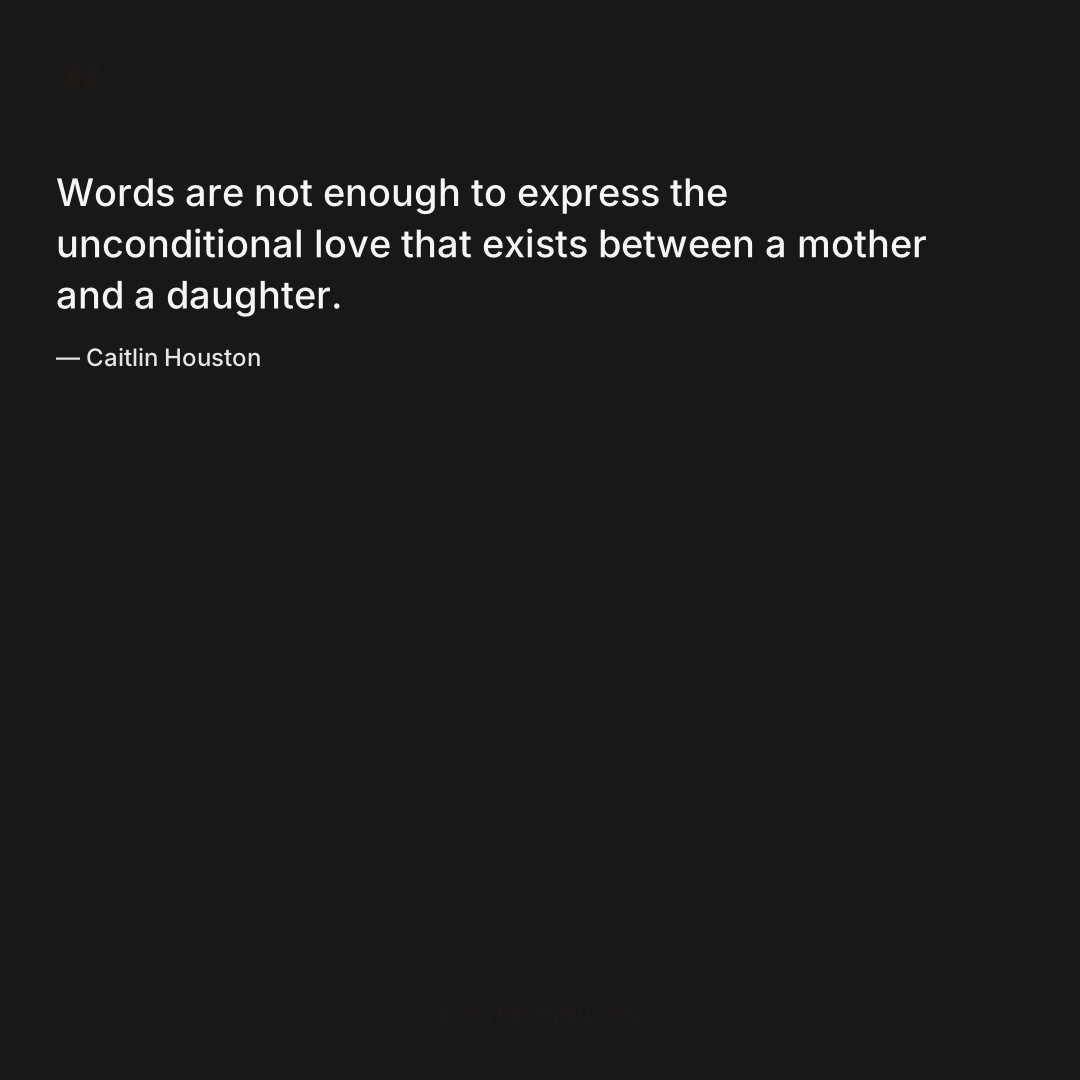
Geographic distance often clarifies the emotional importance of the relationship by removing the daily friction of shared living spaces. A brief phone call or a text message carrying a simple affirmation can instantly recalibrate a daughter's emotional state, proving that maternal influence transcends physical proximity. Distance fades away. The bond requires minimal maintenance to retain its profound psychological impact.
Frequently Asked Questions
Why do short quotes capture maternal love so effectively?
Brevity forces language to abandon unnecessary decoration and focus entirely on the emotional core of the relationship. It hits hard. A concise sentence mirrors the intuitive, often unspoken understanding that exists between a mother and her child, bypassing the need for exhaustive psychological analysis.
How can I use these quotes in daily life?
Incorporating these brief statements into your daily routine requires very little effort but yields significant emotional dividends over time. Small gestures matter. You might write one on a small card and place it inside a book your daughter is currently reading, or send a single line via text message during a particularly stressful Tuesday afternoon.
Are these quotes suitable for a strained mother-daughter relationship?
Complicated family dynamics often make grand declarations of affection feel hollow or unearned to the recipient. Start small today. Short quotes offer a low-pressure method of extending an olive branch, allowing both parties to acknowledge the enduring nature of their biological and emotional connection without demanding immediate reconciliation or forcing a complex conversation.
The words we choose to share with our family members eventually become the internal monologue they carry through life. You do not need a lengthy speech to solidify the ground beneath your daughter's feet or to thank your mother for her decades of quiet labor. Take a pen right now. Write a single line from this page on a sticky note and press it onto her bathroom mirror before she wakes up tomorrow.