16 Mother-Daughter Bond Quotes for Letters and Scrapbooks
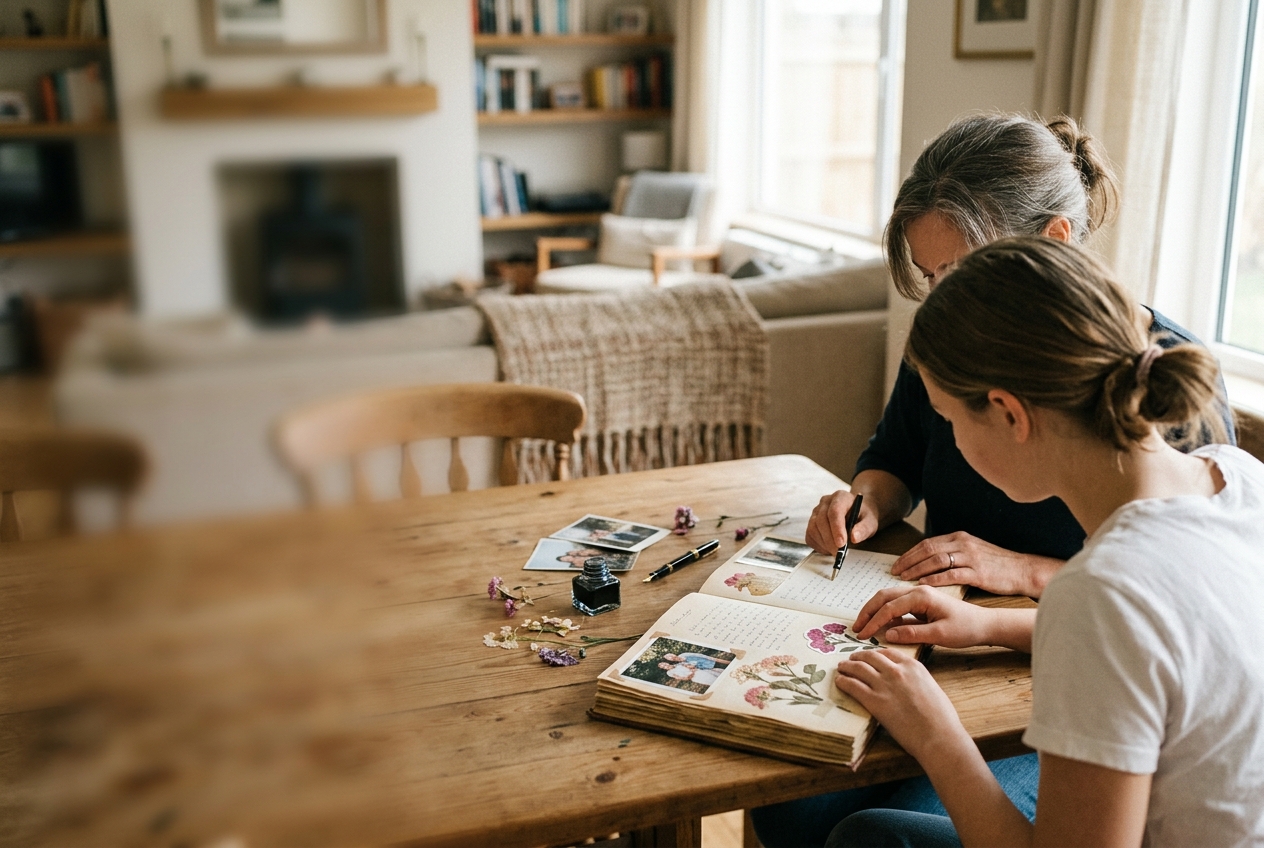
"A mother's treasure is her daughter," wrote novelist Catherine Cookson. It resists easy definition. If we could gather authors, poets, and historical figures into a single room to discuss this specific dynamic, the resulting conversation would strip away the sentimentality often attached to motherhood. We would hear stories of friction, profound understanding, and generational inheritance. The following dialogue imagines that room, organizing their recorded thoughts into a curated discussion on the realities of raising and being a daughter.
On Generational Inheritance
Alice Walker often reflected on the artistic legacy passed down through Black women in the American South, noting how their stifled creativity still managed to bloom in gardens and quilts. She saw hidden genius. Her words demand our attention when examining how creativity survives under oppressive conditions and manifests in the children who bear witness to that quiet struggle.
And so our mothers and grandmothers have, more often than not anonymously, handed on the creative spark, the seed of the flower they themselves never hoped to see.
Walker published this observation in her 1983 essay collection, a groundbreaking work that forced literary critics to finally acknowledge the profound artistic contributions hidden within everyday domestic tasks. The book shifted the academic paradigm. We see a similar reverence when considering what keeps a household grounded during periods of intense transition and unexpected hardship.
Exploring the biological and emotional ties that bind us, author Jodi Picoult frames the connection as something skeletal. She writes with precision. Her novels frequently examine the intense, sometimes suffocating loyalty that develops when a family faces an unexpected medical crisis or a sudden legal battle.
My mother... she is beautiful, softened at the edges and tempered with a spine of steel. I want to grow old and be like her.
Picoult understands structural dependency. This specific quote from her fiction highlights how daughters often view their mothers as the architectural foundation of their own developing personalities and moral frameworks.
Victoria Secunda tackled the psychological alliances formed within the home, specifically looking at how gender shapes familial loyalty. She mapped the territory. Her research required hundreds of interviews with adult women who were actively trying to navigate the complex emotional landscape of their childhood homes.
A daughter is a mother's gender partner, her closest ally in the family confederacy, an extension of her self.
Secunda wrote this in her 1990 book When You and Your Mother Can't Be Friends. The alliance she describes forms the bedrock of female solidarity within the home, though it can also create immense pressure when individual identities begin to diverge.
Sometimes the inheritance is simply a matter of perspective, a shift in how we view the physical world around us. Kristin Hannah captures this well. Her fiction consistently returns to the Pacific Northwest, using the rugged landscape as a backdrop for exploring how maternal figures anchor their children against the storms of life.
As mothers and daughters, we are connected with one another. My mother is the bones of my spine, keeping me straight and true.
Hannah published this structural metaphor in her novel Summer Island. It perfectly illustrates how capturing the beauty of this bond requires acknowledging the invisible, load-bearing support that mothers provide long after their children leave home.
On Friction and Forgiveness
The dynamic is rarely without conflict, a reality author Hope Edelman explored when discussing the sudden absence of maternal guidance. She confronted the void. Her groundbreaking work on early maternal loss revealed how the idealized versions of our parents often clash with the complicated, flawed humans they actually were.
The mother-daughter relationship is the most complex. It is the most fraught with expectations, and the most heavily burdened with the past.
Edelman published these findings in Motherless Daughters (1994). The tension she identifies is precisely why people struggle to find the right words to describe the chaotic energy of family gatherings and holiday dinners.
Novelist Amy Tan frequently mines the misunderstandings between immigrant mothers and their American-born daughters. She exposes the cultural divide. Her narratives demonstrate how love can easily be misinterpreted as criticism when translated across different generations and distinct cultural expectations.
A mother is always the beginning. She is how things begin.
In The Joy Luck Club (1989), Tan illustrates that this beginning is often the source of both our deepest wounds and our greatest strengths. The novel remains a masterclass in depicting generational trauma.
The transition from childhood dependence to adult friendship requires deliberate effort and a willingness to forgive past transgressions. Empathy arrives late. This anonymous proverb speaks to the sudden, overwhelming understanding that washes over a woman the moment she brings her own child into the world.
Mothers and daughters are closest, when daughters become mothers.
Shared experience bridges the historical divide between them. The realization that parenting is largely an exercise in survival rather than perfection allows adult daughters to finally extend grace to the women who raised them.
Humor often serves as the most effective pressure valve when dealing with cyclical arguments and inherited stubbornness. Comedians know this truth. This popular adage perfectly encapsulates the frustrating, inevitable realization that our parents possessed a wisdom we stubbornly refused to acknowledge during our teenage years.
By the time a woman realizes her mother was right, she has a daughter who thinks she's wrong.
The cyclical nature of maternal friction guarantees that every generation will experience the exact same humbling defeat. It remains a universal constant.
On Unspoken Understanding
Beyond the arguments and the spoken advice, a quiet language develops over decades of shared living spaces. Viola Shipman noted this phenomenon. Her fiction frequently explores how heirloom objects and physical spaces retain the emotional resonance of the women who previously inhabited them.
A mother's and daughter's love is never separated.
Shipman used this simple declarative in The Summer Cottage to describe an unbreakable psychological tether. This silent communication is precisely why people seek out words that celebrate close-knit relatives when writing anniversary toasts or birthday cards.
The limitations of language become obvious when trying to articulate the depth of maternal devotion. Caitlin Houston observed this barrier. She recognized that the English language lacks the specific vocabulary required to accurately convey the visceral, physical pull a mother feels toward her offspring.
Words are not enough to express the unconditional love that exists between a mother and a daughter.
Houston documented this linguistic failure while writing about her own experiences raising girls in a modern, hyper-connected society. The sentiment rings entirely true.
Sometimes the understanding manifests in physical resemblance, mirrored gestures, or a shared acceptance of mutual flaws. Zoraida Pesante offered this perspective. Her observation removes the crushing pressure of perfection from the relationship, allowing both parties to exist as flawed but fiercely loyal companions.
I am not a perfect mother and I will never be. You are not a perfect daughter and you will never be. But put us together and we will be the best mother and daughter we would ever be.
Pesante frames the relationship as a collaborative effort rather than a hierarchy. This mutual grace is essential for long-term emotional survival.
The comfort of this bond often anchors our earliest, most foundational recollections of safety and warmth. The anonymous author captured it perfectly. Such sentiments are ideal when assembling albums of childhood milestones for a graduation gift or a wedding reception display.
A daughter is someone you laugh with, dream with, and love with all your heart.
This straightforward definition strips away the psychological complexity and focuses entirely on the joy of companionship. It celebrates the friendship.
On Letting Go
The ultimate task of a mother is to prepare her daughter for total independence in an unforgiving world. It requires immense sacrifice. This anonymous quote highlights the bittersweet reality of effective parenting, where the ultimate reward for doing your job perfectly is your own obsolescence.
A mother's job is to teach her children not to need her anymore. The hardest part of that job is accepting success.
The tension between protection and freedom defines the teenage years, creating a battleground where both sides are secretly terrified of the impending separation. Independence demands a heavy toll.
Erica Jong framed this separation as a necessary, albeit terrifying, flight into the unknown. She understood the stakes. Her writing consistently challenges women to embrace their autonomy, even when it means leaving behind the comfortable, familiar structures of their childhood homes.
The mother-daughter bond is a paradox. You hold them tight so they can fly away.
Jong articulated this paradox perfectly. Even after physical separation, the psychological influence remains deeply embedded in the stories we tell about our past and the traditions we carry forward.
Independence does not erase the fundamental human need for comfort during moments of profound crisis or sudden grief. Cardinal Mermillod understood this vulnerability. His famous sentiment reminds us that professional success and personal autonomy cannot replace the specific, grounding presence of the woman who first taught us how to navigate the world.
No matter how old she may be, sometimes a girl just needs her mom.
Mermillod spoke to a universal truth that transcends age, geography, and social status. The instinct to call home never truly fades.
Finally, we look at the enduring nature of this connection as it stretches across time, distance, and eventual mortality. Maya Angelou provided the definitive description. She wrote this in I Know Why the Caged Bird Sings (1969), serving as a fitting conclusion to our imagined dialogue by capturing the absolute awe daughters often feel when looking back at the women who raised them.
To describe my mother would be to write about a hurricane in its perfect power. Or the climbing, falling colors of a rainbow.
Angelou elevates the maternal figure to the status of a natural phenomenon, wild and entirely uncontrollable. It demands our respect.
Take a moment today to write one of these lines on a physical card and mail it to the woman who shaped your early years.
Frequently Asked Questions
How do you choose the right quote for a mother-daughter scrapbook?
Select a phrase that matches the specific era of the photographs you are preserving. A quote about letting go pairs well with high school graduation photos, while sentiments about generational inheritance suit heritage albums featuring grandparents and great-grandparents.
Why are mother-daughter relationships often described as complicated?
The dynamic involves a unique blend of biological mirroring and intense psychological projection. Daughters often struggle to establish individual identities while mothers must navigate the difficult transition from authoritative caregivers to adult peers.
Are there specific historical periods that produced better writing on this topic?
The late twentieth century saw a massive surge in honest, unvarnished literature about maternal bonds. Authors in the 1980s and 1990s began moving away from idealized Victorian concepts of motherhood toward much more realistic portrayals of family friction.