Disrespectful Daughter-in-Law Quotes: 10 Real Lines and What to Say to Her
Words My Family Quotes Editors

In 2015 a reader who signed herself "Mother-in-Law from Hell" wrote to the advice column Annie's Mailbox. Her two daughters-in-law, she said, only called when they needed someone to drive the children to a doctor's appointment, and one of them visited only on Christmas Day. "I am entitled to some respect," she wrote. The answer she got was not the one she wanted, and it is worth reading before you post anything about your own son's wife.
This page gathers 10 disrespectful daughter-in-law quotes from real sources, each with who said it, where, and when: a Chinese poem from around AD 200, Shakespeare, a Russian play, the Book of Genesis, an old English proverb and that 2015 column. Every line comes with the story behind it, because several of the most quotable "difficult daughter-in-law" lines were spoken by mothers-in-law the author wanted you to judge. After the quotes there is a practical part: how to tell disrespect from a boundary, and what to actually say to her.
First, a hard question: is it disrespect, or a boundary?
Many mothers-in-law who search for these quotes are hurt for good reason. Some are hurt by a decision that was never about them. The difference matters, because a quote aimed at a boundary reads as an attack, and it usually reaches your son before it reaches her. The table below is a rough guide, not a verdict.
| What happens | Often a boundary | Often disrespect | What tends to help |
|---|---|---|---|
| Fewer visits | They split holidays with her family, or both work long hours | She visits everyone else but refuses every invitation from you | Ask your son about dates directly; offer shorter, easier visits |
| Rules about the grandchildren | Sleep times, food, screens, car seats | Rules that apply only at your house, announced in public | Follow the rule first; raise the double standard later, in private |
| She doesn't take your advice | She heard it and chose differently | She mocks it to others or in front of the children | Offer advice once; then let it go |
| She contacts you only when she needs help | A stretched young family leaning on the nearest grandparent | Favours asked for with no thanks and no other contact, ever | Say yes or no plainly; ask for one non-favour visit |
| Cold or rude words | A tense moment after a long day | Insults, name-calling, or contempt in front of others | Name the words, not her character: "That comment hurt." |
If most of what you're living with sits in the left-hand column, the quotes below may still comfort you, but they are better read than posted. If it sits on the right, the practical section further down is the part to read twice.
The oldest complaint on record: a mother-in-law in Han China
The earliest long narrative poem to survive in Chinese is a story about exactly this conflict. Its short preface says it happened at the end of the Han dynasty, in the Jian'an era (196–220): a minor official in Lujiang named Jiao Zhongqing had a wife, Liu, whom his mother sent away. The poem was preserved in the sixth-century anthology New Songs from a Jade Terrace and is usually known by its first line, "Southeast Fly the Peacocks" (孔雀東南飛). The translations below are our own, kept close to the Chinese.
"此婦無禮節,舉動自專由" ("This wife has no sense of propriety; she does whatever she pleases.") — Jiao Zhongqing's mother, in "Southeast Fly the Peacocks" (孔雀東南飛), set in the Jian'an era (196–220); preserved in New Songs from a Jade Terrace
It is the first known version of the complaint people still type into search engines. The mother says it to her son, not to the wife, and goes on: "My anger has been building a long time," and she already has a neighbour's daughter in mind as a replacement. The poem does not take her side. It gives the wife a full voice, and the ending is a tragedy for everyone, including the mother who got what she asked for.
"非為織作遲,君家婦難為" ("It isn't that I am slow at the loom; it is that being a wife in your house is hard.") — Liu, the daughter-in-law, in "Southeast Fly the Peacocks" (孔雀東南飛), set in the Jian'an era (196–220); preserved in New Songs from a Jade Terrace
Liu says this to her husband after weaving five bolts of silk in three days and still hearing that she is too slow. Read side by side, the two lines show why this subject divides people: the same household looked "disrespectful" from one chair and impossible from the other. If you quote the mother's line, it helps to know the wife's line exists. China also kept a saying about how the cycle repeats: 媳婦熬成婆, "the daughter-in-law endures until she becomes the mother-in-law," recorded today in dictionaries as a traditional saying with no single author.
Shakespeare's version: Volumnia and the wife who won't come out
In Coriolanus (written around 1608 and first printed in the 1623 First Folio), Volumnia is the mother of the Roman general Caius Martius. Act 1, Scene 3 opens with her sitting and sewing beside her son's wife, Virgilia, who is quietly frightened for her husband at war. Volumnia finds the quiet itself an offence.
"I pray you, daughter, sing, or express yourself in a more comfortable sort." — Volumnia, in William Shakespeare, Coriolanus, Act 1, Scene 3 (First Folio, 1623)
Notice that she calls her daughter-in-law "daughter," which was normal usage in Shakespeare's English, and still manages to make it a correction. It is a useful line for anyone whose son's wife seems withdrawn at family gatherings: a reminder that silence can be read as rudeness when it is really worry, shyness, or exhaustion. Volumnia, for her part, never asks.

"Indeed, no, by your patience. I'll not over the threshold till my lord return from the wars." — Virgilia, in William Shakespeare, Coriolanus, Act 1, Scene 3 (First Folio, 1623)
Later in the scene a friend invites Virgilia out, and both older women press her to go. She refuses, politely and completely. From Volumnia's side this is stubbornness; from Virgilia's it is loyalty to a husband who might not come home. The scene is short, and it is one of the best places in literature to watch two women love the same man in incompatible ways.
When "respect" becomes a demand: Madame Kabanova
Alexander Ostrovsky's play The Storm (1859) is set in a merchant town on the Volga. Marfa Kabanova, a rich widow, runs the house of her son Tihon and his young wife, Katerina. Constance Garnett's English translation (her preface is dated November 1898) gives Kabanova some of the most quotable lines ever written about a disrespectful daughter-in-law. They are quotable because Ostrovsky wrote her as the household tyrant.
"Young folks show little respect to their elders, nowadays." — Madame Kabanova, in Alexander Ostrovsky, The Storm, Act I, Scene V (1859; tr. Constance Garnett)
She says it while her son swears he never departs "a hairsbreadth" from her will. In the same speech she complains that "if some word of hers doesn't please her daughter-in-law, then it's the talk all over the place, that the mother-in-law worries her to death," and accuses her son of loving his wife more than his mother. Every one of those lines would look at home on a Facebook post today, which is the point Ostrovsky was making.

"Tell her not to be saucy to her mother-in-law. … To revere her mother-in-law as her own mother." — Madame Kabanova, in Alexander Ostrovsky, The Storm, Act II, Scene III (1859; tr. Constance Garnett)
Before Tihon leaves on a journey, his mother makes him repeat her orders to his wife, line by line, in front of her. It is a scene about a son forced to stand between two women, and he obeys. At the end of the play Katerina drowns herself in the Volga, and Tihon finally turns on his mother: "Mother, you have murdered her!" If one of these lines expresses what you feel, it is worth knowing which character you are quoting. (Janáček turned the play into the opera Káťa Kabanová, so the story is still staged.)
Lines for the hurt, not the fight
Some of the best words for this situation don't accuse anyone. They describe a feeling, or they give advice to the person who is hurting.
"I am weary of my life because of the daughters of Heth: if Jacob take a wife of the daughters of Heth, such as these which are of the daughters of the land, what good shall my life do me?" — Rebekah, in Genesis 27:46 (King James Version, 1611)
Rebekah says this to her husband Isaac about their son Esau's Hittite wives, who, a chapter earlier, are described as "a grief of mind unto Isaac and to Rebekah." The Bible is candid that she also had a second motive: she wanted Jacob sent away to safety from Esau. It is the oldest scriptural line from a mother-in-law worn down by her sons' marriages, and it is honest about how tiring that is. (The verse Micah 7:6, "the daughter in law against her mother in law," is covered on our page of toxic mother-in-law quotes, which looks at the same conflict from the other side.)
"My son is my son till he have got him a wife, / But my daughter's my daughter all the days of her life." — English proverb, as listed in James Wood, Dictionary of Quotations (London: Frederick Warne, 1893)
This rhyme has no author; Wood prints it simply as a proverb, and Thomas Preston's Dictionary of English Proverbs and Proverbial Phrases records it in two slightly different wordings. It names a fear many mothers of sons carry quietly: that marriage moves a son's first loyalty, which it is meant to do. Quote it with care. Posted under a wedding photo, it reads as grief; posted after a quarrel, it reads as blame.
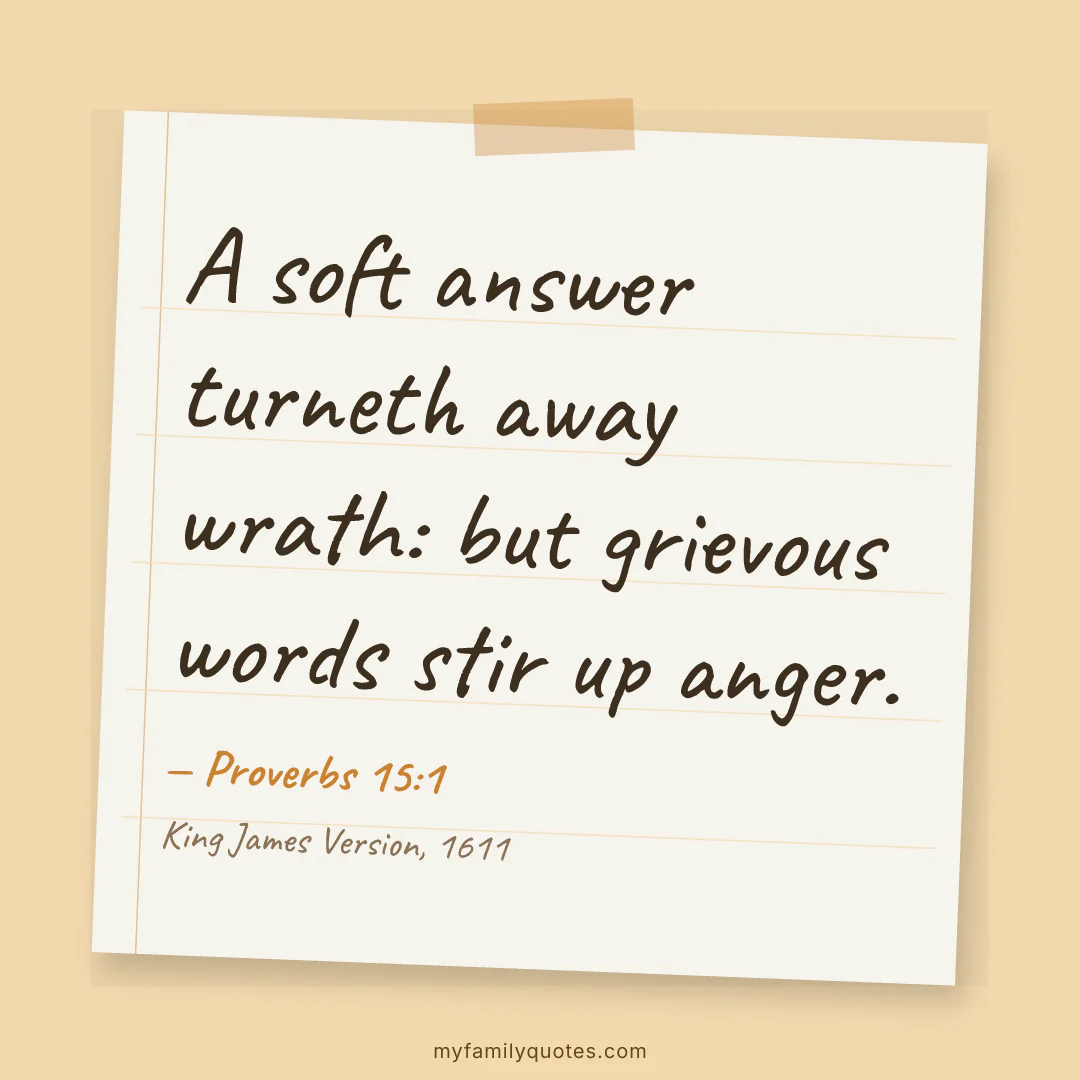
"A soft answer turneth away wrath: but grievous words stir up anger." — Proverbs 15:1 (King James Version, 1611)
This is the line to keep for yourself rather than to send. The next practical section is, in a way, a long footnote to it. A soft answer is not the same as a silent one; it means saying the true thing without the sting.
"Respect has to be earned, no matter who you are. A relationship with an in-law takes time and effort from both sides." — Kathy Mitchell and Marcy Sugar, Annie's Mailbox (Creators Syndicate, 2015; rerun 15 June 2020)
This was the reply to the letter at the top of this page. The columnists went on to point out that the writer did get to see her grandchildren, which "some parents would be thrilled" to have, and told her: "Never denigrate or criticize their wives." Their most memorable advice was blunter: "Find something to like about them if it kills you." It is not a comforting quote, but it is a useful one.
What to do when your daughter-in-law is disrespectful: five steps
"What should I do if my daughter-in-law is disrespectful?" is the question Google shows beside these searches in its "People also ask" box. Nothing here replaces family counselling where things are serious, but these steps follow the advice that keeps coming back in the sources above, from Proverbs to the 2015 column.
- Write down what actually happened. Not "she's rude," but "she didn't answer three invitations" or "she corrected me in front of the children." Specific events can be talked about. Character judgments start fights.
- Check the table above honestly. If the behaviour is a boundary you dislike, the conversation you need is about how to live with it, not about respect.
- Talk to her, not about her. Complaining to your son about his wife forces him into Tihon Kabanov's position. If you speak to your son, keep it to your own relationship with him: time together, visits, calls.
- Use one calm sentence about one thing. Say what happened and how it felt, then stop. Leave out "always," "never," and anything about her upbringing.
- Offer something before asking for something. An invitation, a thank-you, help on her terms. The column's advice ("Invite all of them over for dinner or bring dinner to them") is old-fashioned and still works more often than an ultimatum.
Sentences you can actually say
These are editor-written examples, not quotations. Change the details so they sound like you.
- For a first conversation: "Can we have a coffee, just the two of us? I'd like us to get on better, and I'm not sure I've always made that easy."
- For a specific hurt: "When you laughed at my suggestion in front of the kids, it stung. Could we keep disagreements between us?"
- For help-only contact: "I'm happy to do the school run on Thursday. I'd also love to see you all for a meal that isn't about logistics."
- For a rule you dislike but will follow: "That's not how I did it, but they're your children. I'll stick to it."
- For your son, without blame: "I miss you. Can we find a regular time to talk, even ten minutes?"
Before you post a quote about her
- Assume she will see it. So will your son, her friends and, one day, the grandchildren. A vague post aimed at one person is read as a public accusation.
- Check who said it. Lines like Kabanova's sound sympathetic until someone points out she is the villain of the play.
- Check that it's real. "No one can make you feel inferior without your consent" is often shared in these situations as Eleanor Roosevelt's, but archivists at the Roosevelt Library have not found it in her writings (see Ralph Keyes, The Quote Verifier, 2006). Our page on misattributed family quotes tracks more lines like this.
- Prefer the private version. A quote that helps you make sense of your feelings is worth saving in a note. It doesn't need an audience.
Three questions mothers-in-law ask
What should I do if my daughter-in-law is disrespectful?
Start by naming the specific behaviour and checking whether it is disrespect or a boundary you dislike. Then talk to her directly and calmly about one thing, without criticising her to your son, and offer an invitation or help before asking for change. The five steps above set this out in order.
What can I say instead of "daughter-in-law"?
Plenty of families simply use her name, which is often the warmest choice. Some use "daughter," as Volumnia does in Coriolanus; in Shakespeare's time that was ordinary usage. Newer informal terms such as "bonus daughter" work for some people, but ask her first: a label she didn't choose can feel like pressure.
Is there a Bible verse about a disrespectful daughter-in-law?
The closest are Genesis 26:35 and 27:46, where Esau's wives are "a grief of mind" to Isaac and Rebekah, and Micah 7:6, which lists "the daughter in law against her mother in law" among signs of a broken society. The Bible's best-known in-law story points the other way: Ruth's loyalty to Naomi. For a calmer verse to live by, Proverbs 15:1 is the one most families come back to. Our page on toxic in-laws quotes covers more of the scripture side.
The poem from Han China ends with both young people dead and a mother who was right about nothing that mattered. Most real families have far more time than that to fix things. If you'd like to see the bond from the son's side, our collection of mother and son quotes is a gentler place to finish.