Black Sheep of the Family Quotes: 10 Sourced Lines for the One Who Doesn't Fit
Words My Family Quotes Editors
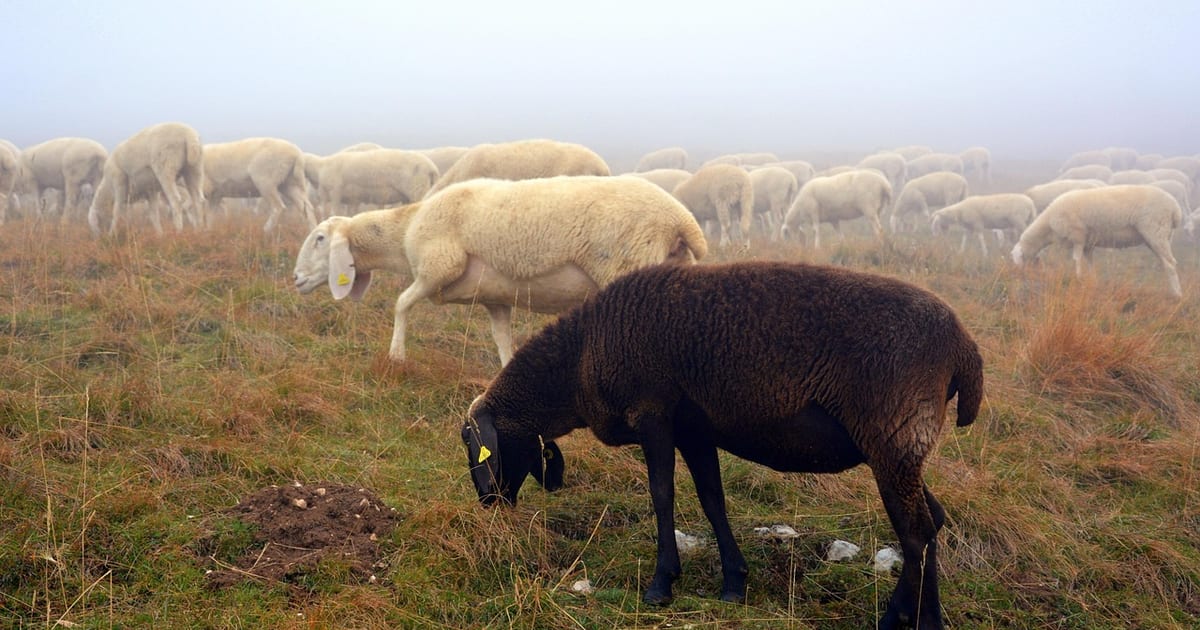
What does it mean to be the black sheep of the family? Usually it means you are the one who chose differently: a different job, faith, partner, city or way of talking, and the family has quietly decided that the difference is a fault. Writers have described that position for centuries, often from the inside. Charlotte Brontë gave it to a ten-year-old orphan, Dickens to a boy raised by a resentful sister, and Bernard Shaw to his own childhood, which he chose to laugh about.
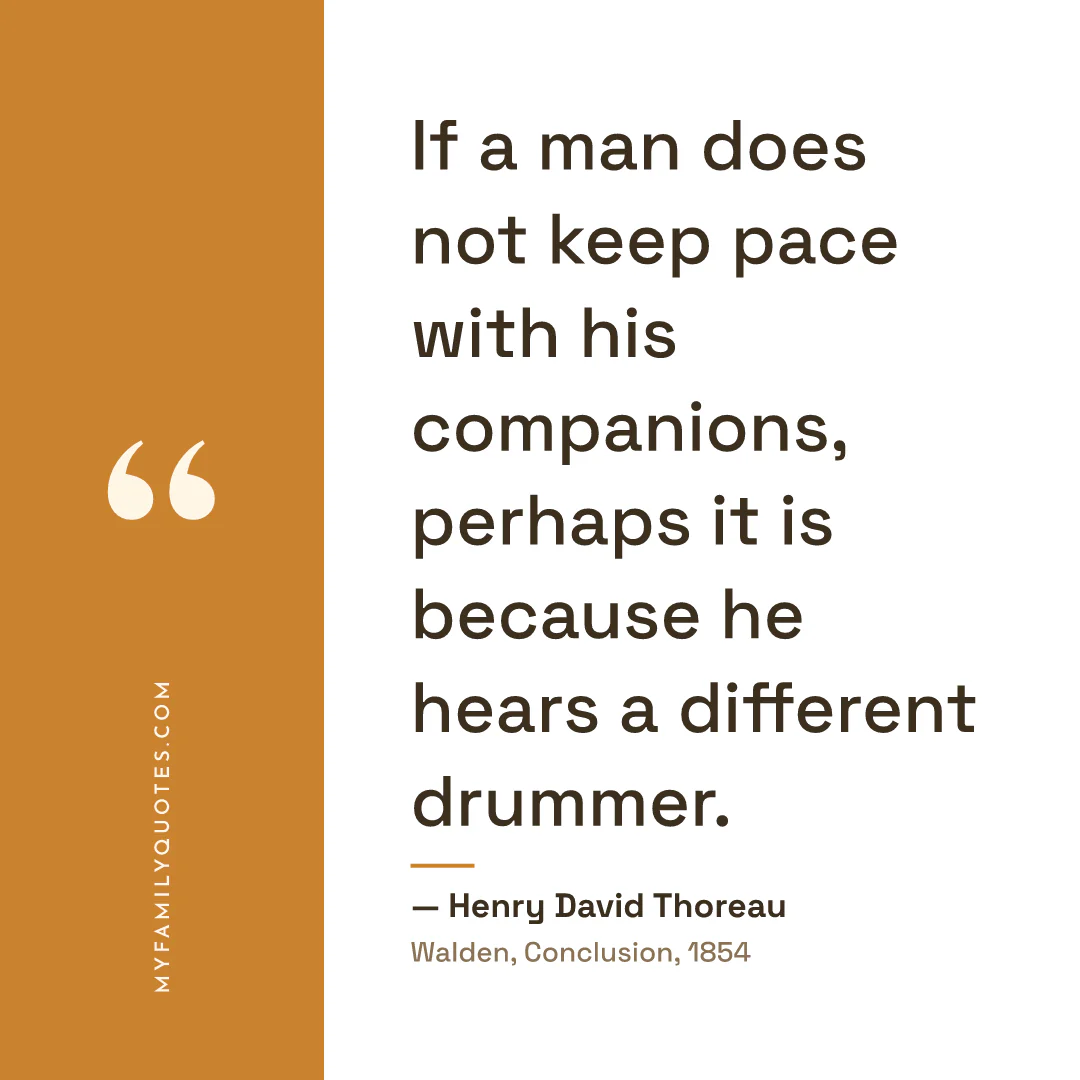
This page collects 10 black sheep of the family quotes, each checked against the full text of the book, essay or Bible it comes from, with the chapter or verse so you can find it yourself. It is organised around the questions people actually ask about being the black sheep: what the phrase means, whether it is a bad thing, what to say when it hurts, what the Bible says, and which famous "black sheep" quote is not what it seems. If you need one line now, take Thoreau's: "If a man does not keep pace with his companions, perhaps it is because he hears a different drummer."
Which line fits your situation?
| If you feel… | Line | Source |
|---|---|---|
| Proud of being different | "… he hears a different drummer." | Thoreau, Walden, 1854 |
| Ready to stop apologising | "Whoso would be a man, must be a nonconformist." | Emerson, "Self-Reliance", 1841 |
| Punished for not fitting in | "For nonconformity the world whips you with its displeasure." | Emerson, "Self-Reliance" |
| Like nobody in the house | "I was a discord in Gateshead Hall …" | Brontë, Jane Eyre, ch. 2 |
| Blamed just for existing | "… as if I had insisted on being born …" | Dickens, Great Expectations, ch. 4 |
| Not taken seriously at home | "A prophet is not without honour, but in his own country …" | Mark 6:4 (KJV) |
| Hoping someone comes after you | "… go after that which is lost, until he find it?" | Luke 15:4 (KJV) |
| Able to laugh about it | "… you may as well make it dance." | Shaw, preface to Immaturity |
| Choosing laughter over shame | "It had to be either a family tragedy or a family joke …" | Shaw, preface to Immaturity |
| Curious where the phrase began | "… which the Scripture brands for blacke sheepe …" | Thomas Shepard, 1640 |
What does "black sheep of the family" actually mean?
A black sheep is the member of a group who does not match the rest and is looked down on for it. The image is literal before it is moral. In a flock of white sheep a dark one stands out, and its fleece was worth less to wool merchants because it could not be dyed other colours. A shepherd hoping for a uniform clip had a practical reason to dislike it.
The moral sense is old. A sixteenth-century satirical ballad against begging friars has the refrain "The blacke shepe is a perylous beast," and the earliest use the Oxford English Dictionary records for a bad character comes from a Puritan sermon book printed in 1640 (both cited by the language site Grammarphobia):
"Cast out all the Prophane people among us, as drunkards, swearers, whores, lyers, which the Scripture brands for blacke sheepe, and condemnes them in a 100. places." — Thomas Shepard, The Sincere Convert (1640)
Shepard, an English-born minister of the First Church in Cambridge, Massachusetts, was stretching a point: no verse of the King James Bible actually calls sinners black sheep. The closest is Genesis 30:32, where Jacob asks Laban for "all the brown cattle among the sheep" as his wages, the off-colour animals nobody wanted. Shepard's line is useful today mainly as a warning. The phrase began as a way of naming people to "cast out", and that history is worth remembering when a family uses it as a joke.
By the eighteenth century the phrase had settled into its family meaning, the relative who drinks, marries badly, leaves the church or simply refuses the script. Other ways to say it include "the odd one out", "the outsider", "the maverick" and, in family-therapy language, "the scapegoat", though a scapegoat is blamed for the family's problems rather than simply being different.
Is being the black sheep a bad thing? Two Americans who thought not
The most quoted answers come from two neighbours in Concord, Massachusetts. Neither was writing about families in particular, but both were writing about the pressure of the people closest to you to make you ordinary, which is exactly what a black sheep feels at a family dinner.
"If a man does not keep pace with his companions, perhaps it is because he hears a different drummer. Let him step to the music which he hears, however measured or far away." — Henry David Thoreau, Walden, "Conclusion" (1854)
Thoreau wrote this after two years living alone in a cabin at Walden Pond, an experiment many of his townspeople thought eccentric or lazy. The sentence that follows is less quoted and kinder: "It is not important that he should mature as soon as an apple-tree or an oak." That is the line to keep in mind if your family measures you against a sibling who married, bought a house or "settled down" first. Use the drummer line for a caption or a card to a relative who has taken a path the family did not expect.
"Whoso would be a man, must be a nonconformist." — Ralph Waldo Emerson, "Self-Reliance", Essays: First Series (1841)
Emerson's essay is a long argument that "society everywhere is in conspiracy against the manhood of every one of its members", and the nonconformist line is its rallying cry. It reads as a statement of fact more than a boast, which is why it works for a black sheep who is tired of explaining. Swap in "person" if you are quoting it for someone who would rather not be addressed as a man; just say so if you do.
"For nonconformity the world whips you with its displeasure." — Ralph Waldo Emerson, "Self-Reliance" (1841)
A few pages later Emerson admits the cost. He describes the "sour face" that people give the person who will not conform, and advises that "a man must know how to estimate a sour face", that is, to judge how much it is really worth. Many black sheep know this exact face from the far end of a holiday table. The comfort in Emerson's next lines is that most of that displeasure has "no deep cause"; it is habit, not judgement.
Quotes for when it hurts to be the outsider
Not every black sheep chose the role. Some are children who simply did not match the family's temperament and were treated as a problem. Two Victorian novels put that experience into words better than any self-help book, because they are written from the child's side.
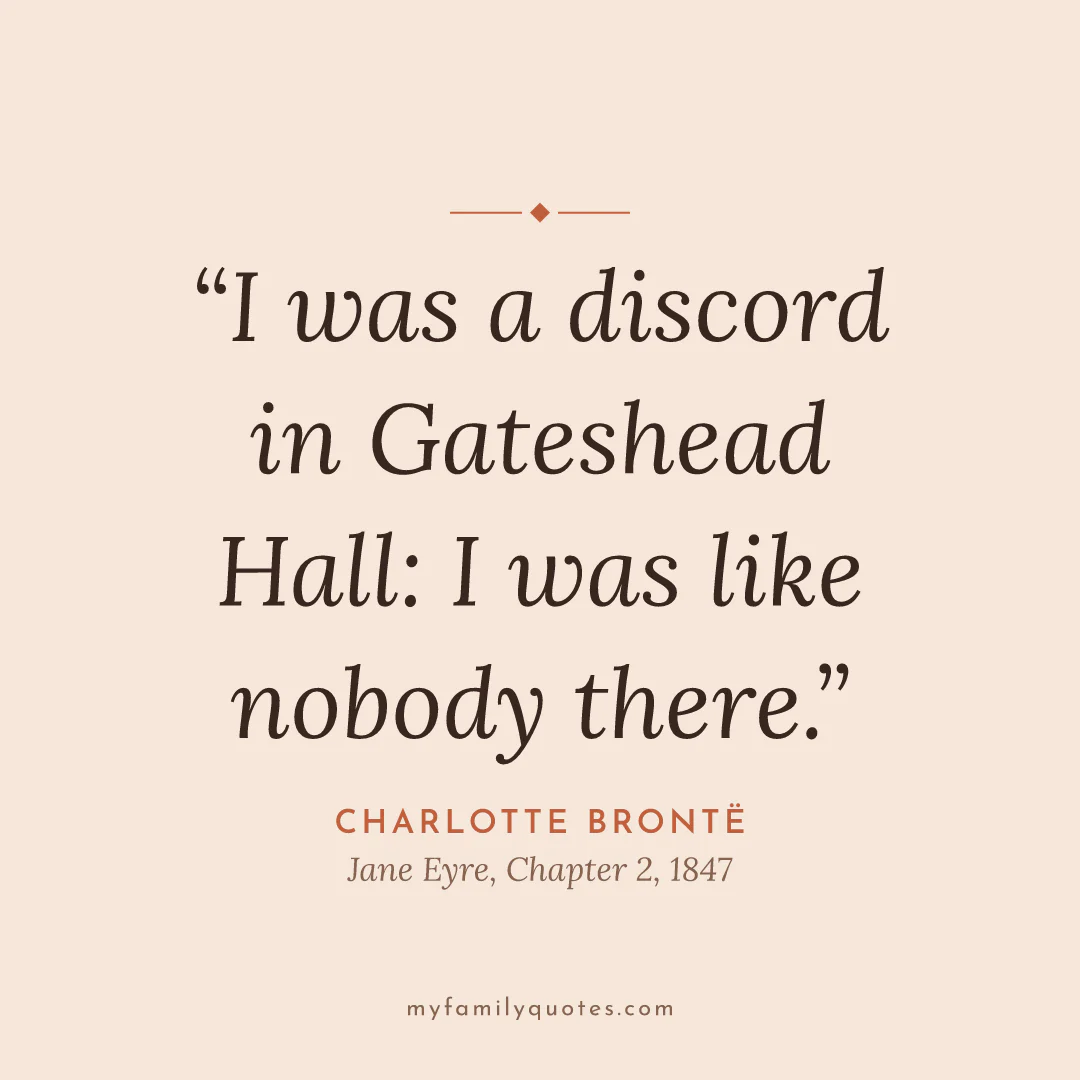
"I was a discord in Gateshead Hall: I was like nobody there; I had nothing in harmony with Mrs. Reed or her children, or her chosen vassalage." — Charlotte Brontë, Jane Eyre, Chapter 2 (1847)
Jane is ten, an orphan living with her aunt by marriage and three cousins who bully her. She has just been locked in the "red-room" as a punishment for fighting back, and the adult Jane, narrating years later, explains why the household could never love her: she was "a heterogeneous thing, opposed to them in temperament, in capacity, in propensities." Brontë does not let the child off entirely ("If they did not love me, in fact, as little did I love them"), and that honesty is why the line is trusted. It suits anyone who grew up feeling like a guest in their own family.
"I was always treated as if I had insisted on being born in opposition to the dictates of reason, religion, and morality, and against the dissuading arguments of my best friends." — Charles Dickens, Great Expectations, Chapter 4 (1861)
Pip is an orphan raised "by hand" by his much older sister, Mrs. Joe, who never lets him forget the trouble he costs her. The sentence is funny, but the joke has an edge: a child who is made to feel his existence is an imposition. Dickens follows it with the tailor told to make Pip's clothes "like a kind of Reformatory". Use this one when you want to name the feeling without sounding self-pitying; the comedy does the work.
If the distance from your family has become permanent rather than a matter of style, our page of sad family quotes on estrangement deals with that quieter grief, and family is not always blood quotes is for the people who became your family instead.
Is there a Bible verse about the black sheep of the family?
As noted above, the phrase itself is not in the Bible. But the experience is, most famously in Jesus's own home town, where people who had watched him grow up could not accept him as anything more than the carpenter.
"But Jesus said unto them, A prophet is not without honour, but in his own country, and among his own kin, and in his own house." — Mark 6:4 (King James Version)
The verse before it names the family: "Is not this the carpenter, the son of Mary, the brother of James, and Joses, and of Juda, and Simon? and are not his sisters here with us? And they were offended at him." Mark adds that Jesus "marvelled because of their unbelief." For a black sheep, the comfort is in the phrase "among his own kin": being underestimated by the people who knew you first is not proof that they are right. It is a fair verse to share with a relative whose gifts the family overlooks.
"What man of you, having an hundred sheep, if he lose one of them, doth not leave the ninety and nine in the wilderness, and go after that which is lost, until he find it?" — Luke 15:4 (King James Version)
The parable of the lost sheep opens the chapter that ends with the prodigal son, and Jesus tells it because religious leaders were complaining that "This man receiveth sinners, and eateth with them" (15:2). It is the gentlest answer the Bible gives to the black sheep idea: the one who wandered is not written off but carried home "on his shoulders, rejoicing" (15:5). It works best when you are the one reaching out, in a note to a son, daughter or sibling who has drifted, rather than as a verse aimed at someone. Other Bible lines on family conflict, including Joseph's brothers, are on our page of quotes about jealous family members.
Funny black sheep of the family quotes (from a man who meant them)
Bernard Shaw's father, George Carr Shaw, drank, and the young Shaw grew up in a Dublin household where the drinking was, in his own words, "so humiliating that it would have been unendurable if we had not taken refuge in laughter." In the summer of 1921 Shaw wrote a preface for his first novel, Immaturity, finally published in 1930, and in it he looked back at how the family had coped. Both lines below come from the same page.
"It had to be either a family tragedy or a family joke; and it was on the whole a healthy instinct that decided us to get what ribald fun was possible out of it, which, however, was very little indeed." — George Bernard Shaw, preface to Immaturity (written 1921, published 1930)
The last clause is the important one. Shaw is not saying the drinking was funny; he says the laughter was a refuge and a thin one. He describes his father, a goose under one arm and a ham under the other, "butting at the garden wall in the belief that he was pushing open the gate". That is the honest version of family humour, and it is why the line is better than the usual "every family has one" jokes.
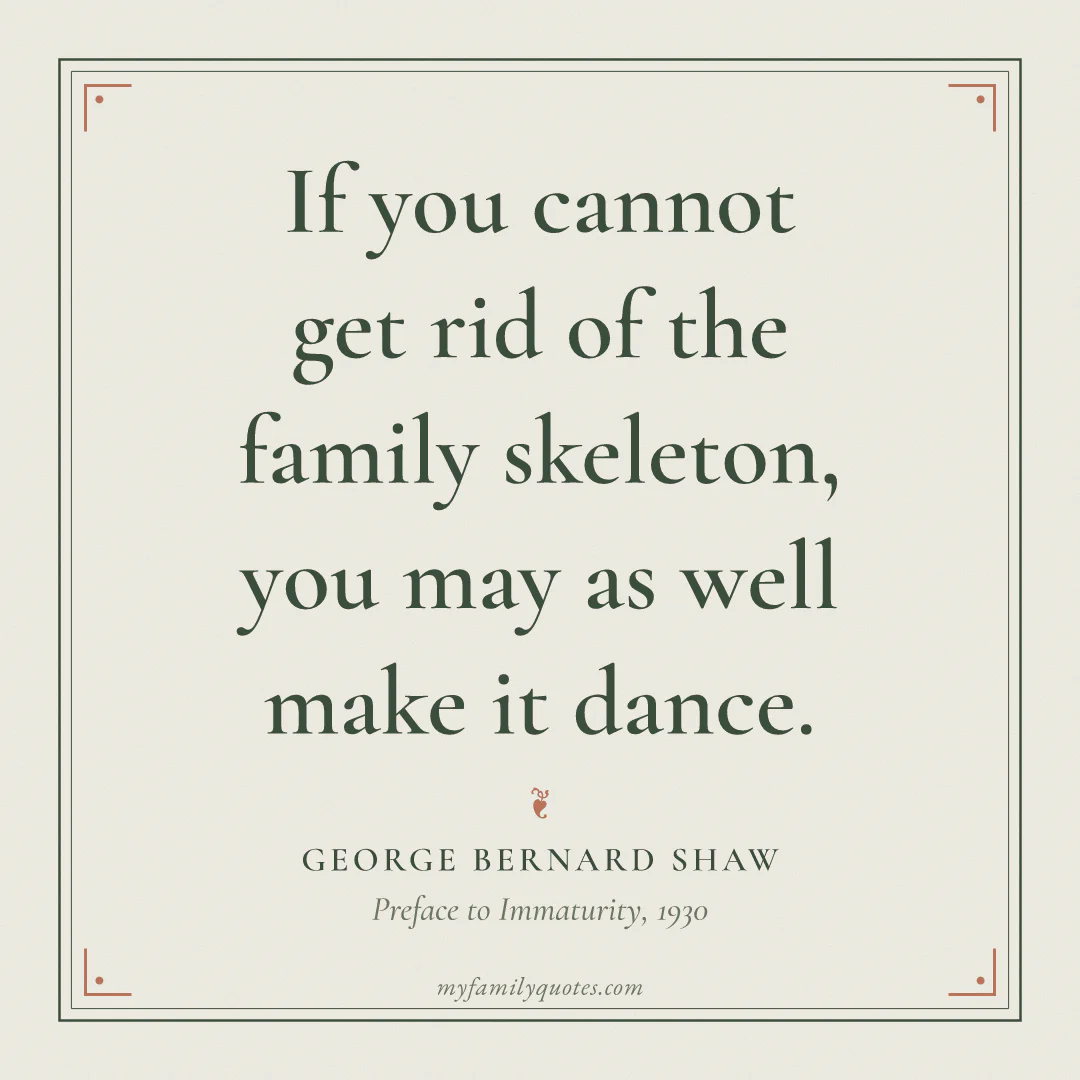
"If you cannot get rid of the family skeleton, you may as well make it dance." — George Bernard Shaw, preface to Immaturity (written 1921, published 1930)
This is the line that circulates on its own, usually without its source. In context it follows Shaw's remark that a boy who laughed at that scene "is clearly not a boy who will make tragedies of trifles instead of making trifles of tragedies." It makes a good caption for a photo of the relatives who sit at the edge of the group, or a toast at a reunion where everyone knows the stories. The family skeleton is a cousin of the black sheep: the thing a family hides instead of the person it sidelines.
Did Bert Hellinger say black sheep are "seekers of liberation"?
The most shared "black sheep" passage online says, in various wordings, that the so-called black sheep of a family are really seekers of liberation for the whole family tree, the ones who break patterns that hurt earlier generations. It is credited to Bert Hellinger, the German founder of "family constellations" therapy, and a Reddit thread sharing it as "a quote by Bert Hellinger" sits on the first page of Google for this search. We could not find it in any of Hellinger's books or in a dated interview. The versions in circulation differ from one another, and none we found gives a book title or page. Until someone finds a primary source, treat it as commonly attributed to Hellinger (no primary source found), and do not print it on anything permanent with his name under it. Our page of misattributed family quotes tracks other famous family lines with the same problem.
How to use a black sheep quote without starting a fight
- For yourself, a caption: Thoreau's drummer line or Emerson's nonconformist line. Both are about you, not about them, so nobody can read them as an attack.
- For a sibling or cousin who is the black sheep: a card with Mark 6:4 or the drummer line says "I see what they don't" without criticising the rest of the family.
- To a relative who has drifted away: Luke 15:4, or simply "the ninety and nine can wait." Pair it with a real invitation (a date, a meal), not only a verse.
- For a reunion or holiday toast: Shaw's skeleton line, but only if the black sheep in question is in on the joke. If they are not, it lands as mockery.
- When you want to name the hurt: the Jane Eyre or Great Expectations line, in a journal or a private message to a friend, rather than a public post your family will read.
If you would rather write your own line, three that our editors wrote for this page (not quotations) show the pattern: name the difference, refuse the shame, keep the door open. "Different flock, same field." "I didn't leave the family; I left the script." "Black sheep, still at the table."
Questions people ask about being the black sheep
What does it mean when you're the black sheep of the family?
It means the family sees you as the one who does not fit its expectations, because of your choices, beliefs or personality, and often treats that difference as a fault. The phrase comes from the dark sheep in a white flock, whose wool was worth less, and was used for a bad character by 1640.
What is another way to say "black sheep of the family"?
The odd one out, the outsider, the maverick or the nonconformist. In family-therapy writing the "scapegoat" is a related but different role: the person blamed for the family's problems, not just the one who is different.
Is there a Bible verse about the black sheep?
No verse uses the phrase. The closest in spirit are Mark 6:4 ("A prophet is not without honour, but in his own country, and among his own kin") and the parable of the lost sheep in Luke 15:4.
What is a short positive quote for the black sheep?
Thoreau's "he hears a different drummer" (Walden, 1854) or Emerson's "Whoso would be a man, must be a nonconformist" ("Self-Reliance", 1841). Both are short enough for a caption and are traced here to their sources.