Toxic Mother-in-Law Quotes, From a Roman Comedy to D. H. Lawrence
Words My Family Quotes Editors

In 165 BC a Roman audience walked out of a comedy called Hecyra, "The Mother-in-Law." It wasn't the subject: a rumour had spread that a tightrope walker and some boxers were about to perform. Terence had to stage the play twice more before an audience sat through it. When they finally did, they heard a father complain that every mother-in-law in Rome hated her son's wife. Over two thousand years later, people are still searching for words that say the same thing more neatly.
This page collects toxic mother-in-law quotes that come from real books, plays and scriptures, with the speaker, the work and the year for each. Under every line you'll find what it meant in context and the kind of situation it fits. After the quotes there's a short cut for captions, a check to run before you post anything, and five calm sentences to say to her face. Most of the "mother-in-law quotes" circulating on image boards have no source at all, and a few carry a famous name they never belonged to. We've flagged one of those too.
A grievance as old as Roman comedy
Two of the sharpest lines on the subject are Latin. Both were written by men, for laughs, about women, so take them as satire rather than as evidence. But they show that the friction is not a modern invention.
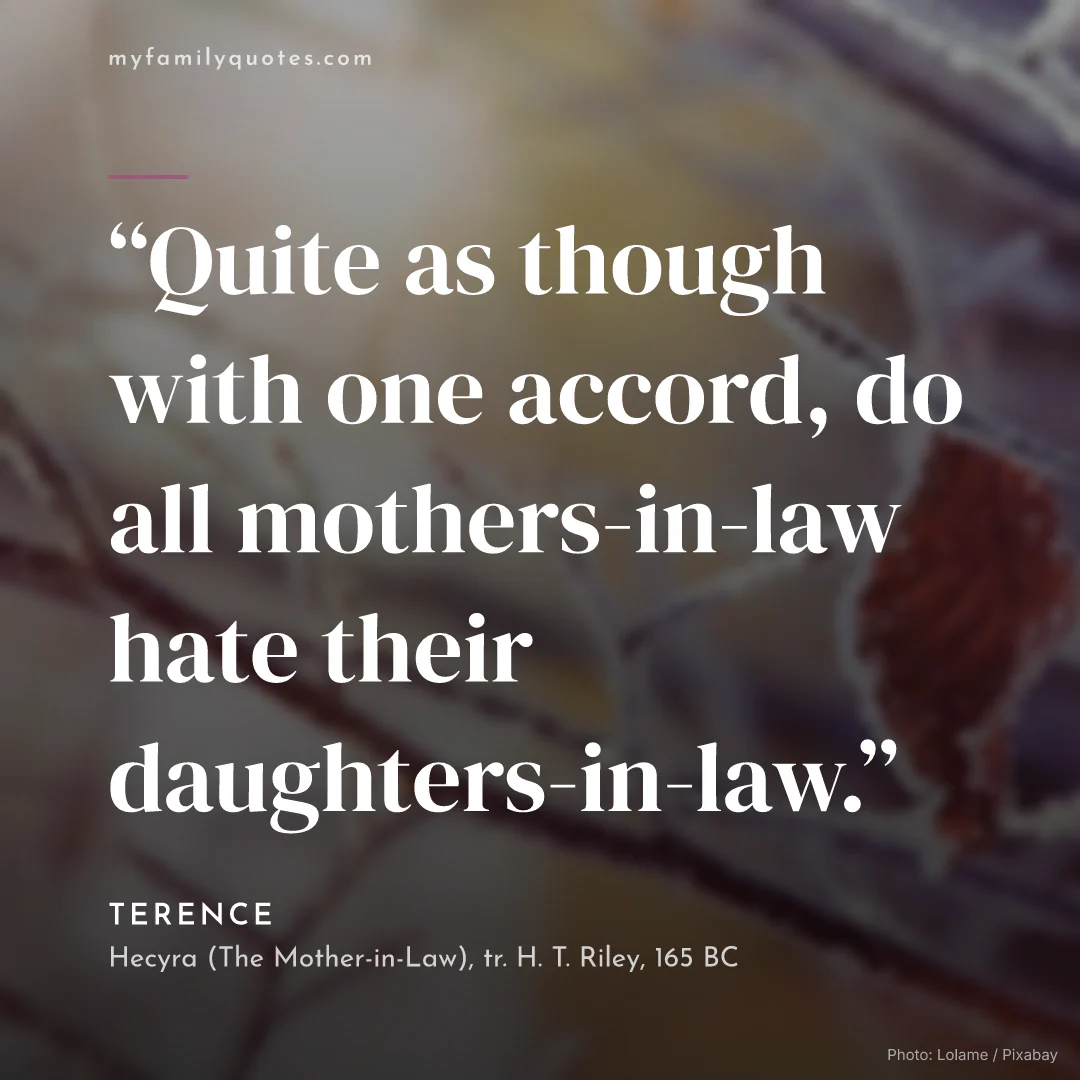
"For instance, quite as though with one accord, do all mothers-in-law hate their daughters-in-law." — Laches in Terence, Hecyra (The Mother-in-Law), Act II, Scene 1; first staged 165 BC (H. T. Riley's prose translation, 1853)
Laches is shouting at his own wife, Sostrata, because he assumes she drove their son's bride back to her parents. The twist of the play is that Sostrata is innocent. She even offers to move to the country so that her presence won't stand in the young couple's way, and the real cause of the quarrel lies elsewhere. That makes the line more useful than it looks. Use it when you want to name the stereotype with a wink, and keep in mind that Terence wrote it to show the stereotype being wrong. The Latin is uno animo omnes socrus oderunt nurus.
"Give up all hope of peace so long as your mother-in-law is alive." — Juvenal, Satire VI, line 231; early 2nd century AD (G. G. Ramsay's translation, Loeb Classical Library, 1918)
Juvenal's sixth satire is a long and often nasty rant against marriage, and the mother-in-law appears as the woman who coaches her daughter in ways to fleece her husband. The Latin is five words: desperanda tibi salva concordia socru. It suits a dark-humoured caption on a bad week. It does not belong in anything she will read.
When she treats your marriage like a rivalry
Many of the most painful situations aren't open insults. They're about loyalty: who comes first, whose house is "home," whose side the husband or wife takes. The Bible names this conflict outright.
"For the son dishonoureth the father, the daughter riseth up against her mother, the daughter in law against her mother in law; a man's enemies are the men of his own house." — Micah 7:6 (King James Version, 1611)
The prophet Micah lists the collapse of family loyalty as a sign of how far his society has fallen, and Jesus repeats the image in Matthew 10:35. It is a lament, not a recommendation. Its value for a reader in a hard spot is the last clause: the people who hurt you most are often inside the house. If you share it, quote it whole. Cutting it down to "the daughter in law against her mother in law" turns a prophet's lament into a taunt.
"Which were a grief of mind unto Isaac and to Rebekah." — Genesis 26:35 (King James Version, 1611)
The verse is about Esau's two Hittite wives, Judith and Bashemath. It is one of the Bible's earliest cases of parents openly unhappy with whom their son married. It is a useful reminder that the strain often runs in both directions. If you're the daughter-in-law, the line describes how she may see you. If you're the mother-in-law reading this, it may describe how you feel.
"The mother-in-law is unwilling to give up the possession of her daughter; she distrusts the stranger to whom her daughter has been delivered, and shows a tendency to maintain the dominating position, to which she became accustomed at home." — Sigmund Freud, Totem and Taboo, chapter 1 (1913; A. A. Brill's translation, 1918)
Freud was writing about husbands and their wives' mothers. He had been reading anthropologists' accounts of societies where a man was forbidden to speak to his mother-in-law at all, and he remarked that many Europeans might see "high wisdom" in such a rule. Leave his theory aside. His description of the mother who won't give up her place still matches what many people mean when they say "toxic": distrust of the newcomer, and a refusal to step back from running things.
When she wants to run his life, and yours
Fiction is where the controlling mother-in-law gets her best lines, because novelists let us hear what she thinks and doesn't say.
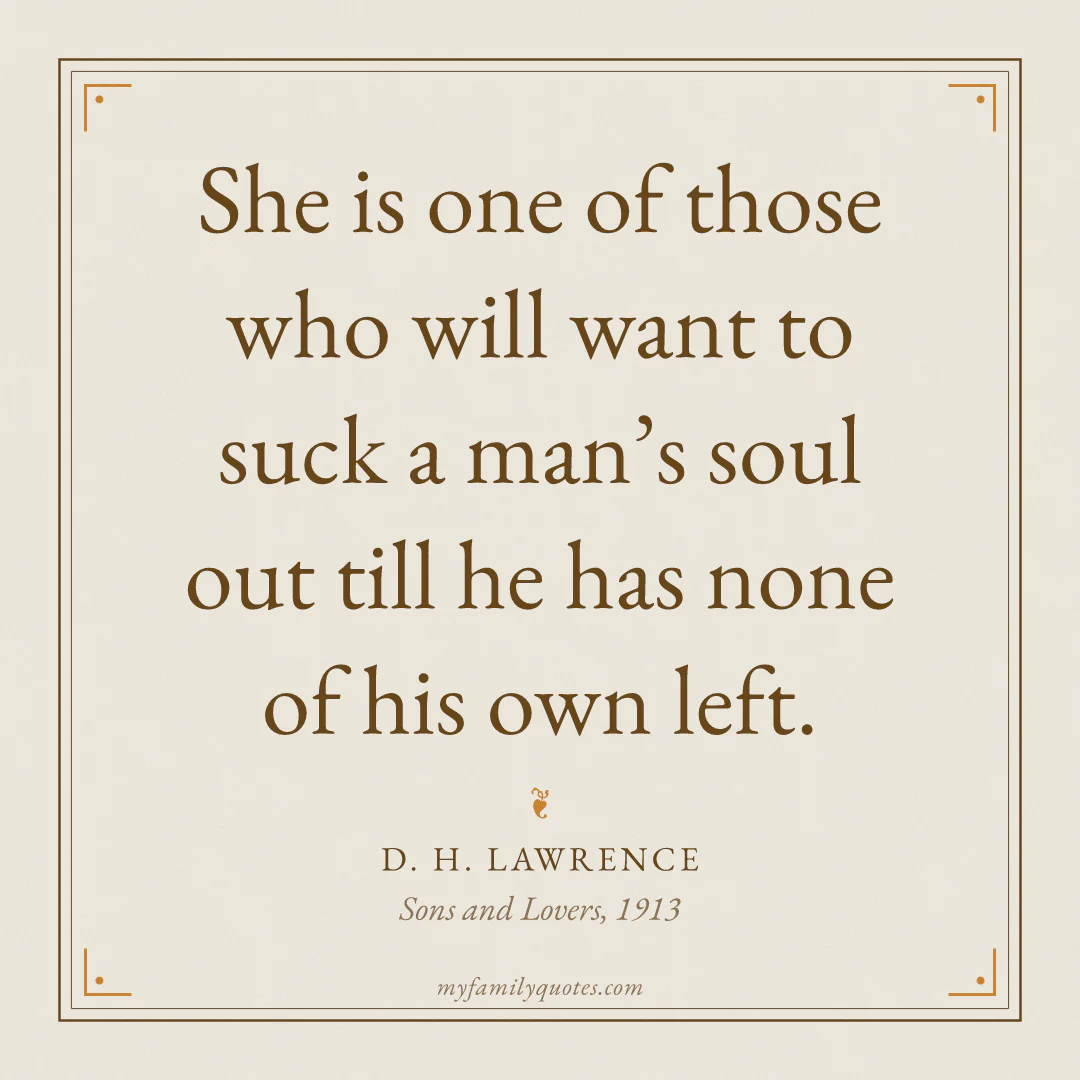
"She is one of those who will want to suck a man's soul out till he has none of his own left." — Mrs. Morel, in D. H. Lawrence, Sons and Lovers, chapter 7, "Lad-and-Girl Love" (1913)
The irony is the point. Gertrude Morel says this to herself about Miriam, the girl her son Paul loves, while she is the one holding on to Paul's soul. Lawrence based the story closely on his own mother. The line describes possessiveness perfectly, and it also shows the trap of possessiveness: it always believes the other woman is the possessive one. Use it in a private journal or a conversation with a friend who has read the book. In public, it is likely to read as an accusation.
"Heaven and earth!—of what are you thinking? Are the shades of Pemberley to be thus polluted?" — Lady Catherine de Bourgh, in Jane Austen, Pride and Prejudice, chapter 56 (1813)
Lady Catherine is Darcy's aunt, not his mother, but she plays the in-law from hell to perfection. She drives to the Bennets' house to forbid Elizabeth to marry him, and this outburst comes after she lists Elizabeth's family's failings. If her in-laws make you feel your own family isn't good enough, this is the line. The joke is on Lady Catherine: Elizabeth refuses to promise anything, and the visit pushes the couple together. Readers who know the book will smile. Readers who don't will still hear the snobbery.
Lines to laugh it off
Sometimes the healthiest response to a difficult mother-in-law is a joke, ideally one she would recognize herself in only after a few drinks.
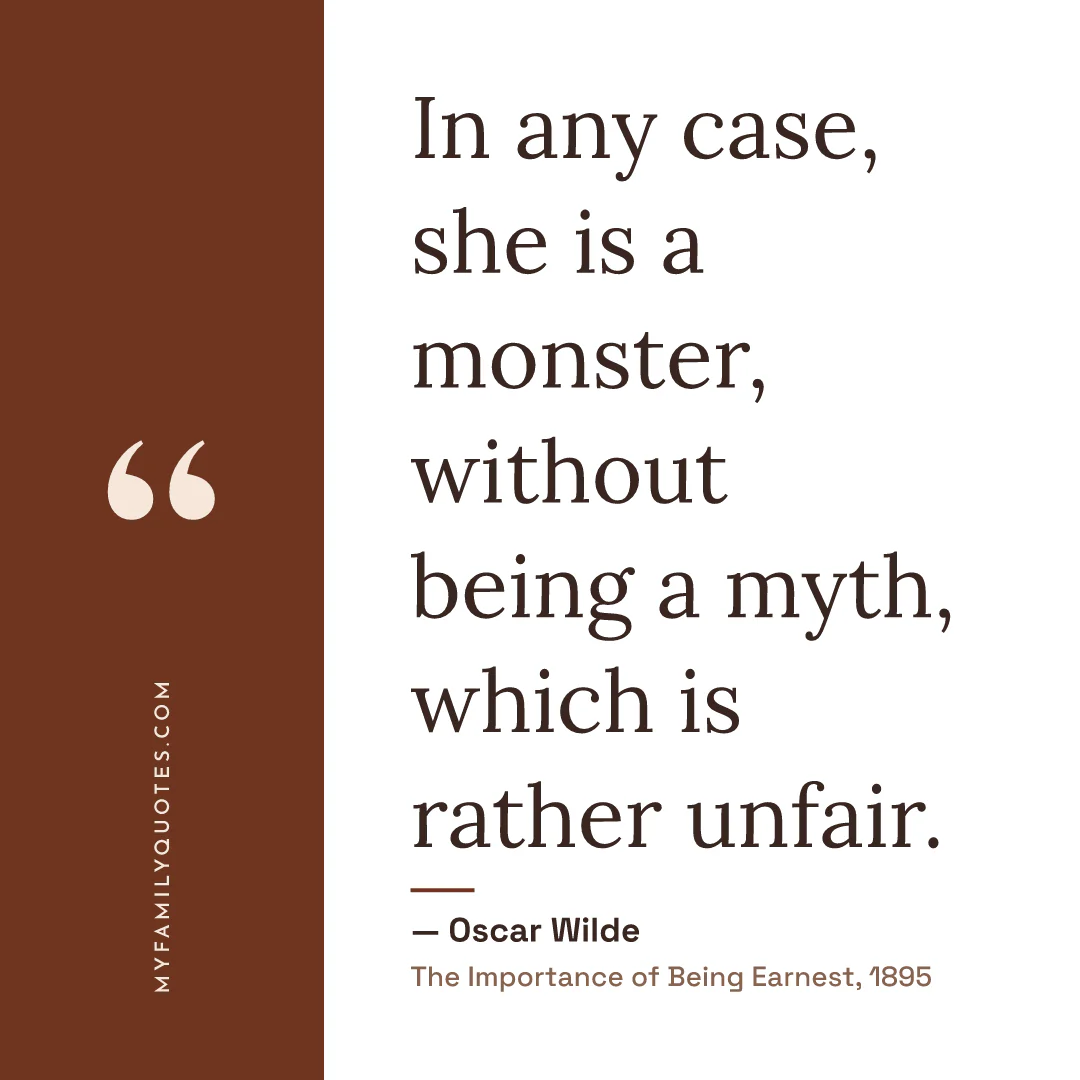
"Her mother is perfectly unbearable. Never met such a Gorgon . . . I don't really know what a Gorgon is like, but I am quite sure that Lady Bracknell is one. In any case, she is a monster, without being a myth, which is rather unfair." — Jack Worthing, in Oscar Wilde, The Importance of Being Earnest, Act I (1895)
Jack has just been interviewed by Lady Bracknell, the mother of the woman he wants to marry, and failed because he was found as a baby in a handbag at Victoria Station. Lady Bracknell is his future mother-in-law, and the scene is still the best comic portrait of one. "A monster, without being a myth" works on its own as a caption, and it's funny enough that most people will laugh rather than ask whom you mean. Jack then apologizes to Algernon, because Lady Bracknell is Algernon's aunt. In-law insults have a way of landing on a relative.
A joke with the wrong name on it. A joke about Adam being the luckiest man because he had no mother-in-law is very often credited to Mark Twain. Twain did write a comic Extracts from Adam's Diary, but the joke isn't in it. We searched the full text and found no mother-in-law at all, and we found no other Twain source for the line. If you use it, leave the name off. Our page on misattributed family quotes tracks more lines like this.
The same complaint in Latin, Italian and Hindi
Folk sayings about the mother-in-law and the son's wife exist in many languages. The lines below are documented in standard sources (Italian Wiktionary for the proverbs, the published Latin texts for the Roman lines). Translations are ours and literal.
| Original | Language and source | Literal translation |
|---|---|---|
| Uno animo omnes socrus oderunt nurus. | Latin; Terence, Hecyra, 165 BC | With one mind, all mothers-in-law hate their daughters-in-law. |
| Desperanda tibi salva concordia socru. | Latin; Juvenal, Satire VI, line 231 | While your mother-in-law is alive, you must despair of harmony. |
| Tra suocera e nuora, tempesta e gragnuola. | Italian proverb | Between mother-in-law and daughter-in-law: storm and hail. |
| Neve marzarola, dura quanto la pace tra suocera e nuora. | Italian proverb | March snow lasts as long as peace between mother-in-law and daughter-in-law (that is, it melts at once). |
| La suocera signora, ricordi che fu nuora. | Italian proverb | Let the lady mother-in-law remember that she was once a daughter-in-law. |
| Kyunki Saas Bhi Kabhi Bahu Thi | Hindi; title of the Star Plus serial, 2000–2008 (1,833 episodes) | Because even a mother-in-law was once a daughter-in-law. |
The last two say the same thing in two languages, and that is the most useful idea in the table. A mother-in-law was once the newcomer in someone else's family. That works as a gentle reminder in a family conversation, and as a promise to yourself if you'll be a mother-in-law one day.
Before you post one: a quick check
Quotes about a toxic mother-in-law tend to travel further than intended. Screenshots reach group chats, and group chats reach her. Before sharing any line above, run through these questions:
- Would your spouse be comfortable seeing it? He or she is the person caught in the middle. A post that humiliates their mother usually costs you more with your partner than it costs her.
- Is it about a pattern or about one bad day? Funny lines (Wilde, the Italian proverbs) suit a bad day. Heavy ones (Micah, Lawrence) suggest a pattern, and people will read them that way.
- Is the source right? A line with the wrong author makes you look careless in an argument where you want to look reasonable. Copy the credit exactly as given here.
- Would you say it to her face? If not, a private note to a friend may do more good than a public post.
You are not unusual if you need this list. In research for her 2009 book What Do You Want from Me?, Cambridge psychologist Terri Apter interviewed 163 people. More than 60% of the women said friction with their husband's mother had caused them long-term stress, compared with 15% of the men about their wife's mother (as reported by TIME, 4 December 2008). The most common flash points were childcare and housework.
For a caption, a shorter cut is often better than the whole quotation. These are exact excerpts, so you can still credit the author:
| Short cut (exact words) | Credit | Tone |
|---|---|---|
| "A monster, without being a myth." | Oscar Wilde, The Importance of Being Earnest | Light, safe-ish |
| "Storm and hail." | Italian proverb (suocera e nuora) | Wry |
| "A man's enemies are the men of his own house." | Micah 7:6, KJV | Serious |
| "Are the shades of Pemberley to be thus polluted?" | Lady Catherine, Pride and Prejudice | Ironic |
| "Give up all hope of peace." | Juvenal, Satire VI | Dark humour |
Five calm sentences to say to her face
Quotes help you vent. They don't solve anything. If the problem is real, the words that matter are the ones you say to her directly, ideally with your partner beside you. These are our own suggested wordings, not quotations. Adjust them to sound like you.
- When she drops in unannounced: "We love seeing you. Please text before you come over, so we can actually be here for you."
- When she overrides your parenting: "I know you did it differently, and your kids turned out well. In our house, we're doing it this way."
- When she criticizes you to your spouse: (said by your spouse) "If you have a problem with [name], please talk to both of us. I'm not going to discuss her behind her back."
- When holidays become a tug of war: "We're splitting the holidays between both families this year. We'll be with you on [day], and we're looking forward to it."
- When a comment crosses a line: "That hurt. I'd like us to get along, and comments like that make it hard."
Short, specific and repeatable works better than a speech. If the relationship has gone beyond what a calm sentence can fix, our guide to quotes for cutting ties with family covers the harder choice of stepping back. For the wider family, see these toxic family quotes about relationships, each with its source.
The other story: Ruth and Naomi
The best-known mother-in-law in literature isn't toxic at all. In the Book of Ruth, Naomi loses her husband and both sons and tells her two widowed daughters-in-law to go back to their own mothers. One does. Ruth refuses:
"Intreat me not to leave thee, or to return from following after thee: for whither thou goest, I will go; and where thou lodgest, I will lodge: thy people shall be my people, and thy God my God." — Ruth 1:16 (King James Version, 1611)
Many couples now read it at weddings, but it was spoken by a daughter-in-law to her husband's mother. Keep it in mind if things ever improve. It is the line to put in her birthday card the year you've made peace. Relationships with the other in-laws need their own words: see our page on sister-in-law quotes and messages.
Quick answers
What is a short quote about a toxic mother-in-law?
"A monster, without being a myth" (Oscar Wilde, The Importance of Being Earnest, 1895) is the shortest well-sourced line, and it's funny rather than cruel. For something darker, use Juvenal's "Give up all hope of peace so long as your mother-in-law is alive" (Satire VI).
Did Mark Twain joke that Adam was lucky because he had no mother-in-law?
Not as far as anyone can show. The joke is often credited to him, but it does not appear in his Extracts from Adam's Diary, and we found no other Twain source. Share it without a name.
Is the mother-in-law joke really that old?
Yes. Terence's comedy Hecyra (The Mother-in-Law) was first staged in 165 BC and includes the line "all mothers-in-law hate their daughters-in-law." Juvenal mocked mothers-in-law again in the early 2nd century AD.