Sister-in-Law Quotes and Messages: How to Write One That Fits Her
Words My Family Quotes Editors

"Sister-in-law" is one word for at least three different people: your husband's or wife's sister, your brother's wife, and, in everyday use, your spouse's brother's wife. The first one you inherited when you married. The second arrived when your sibling married, and she may now spend more holidays with your parents than you do. The third is related to you only through two marriages, yet you may share every Christmas table with her for forty years.
That is why a message to a sister-in-law is harder to write than one to a sister or a friend. The usual sister lines ("we shared a bedroom", "you know all my secrets") are not true, and the usual friendship lines leave out the family part. This guide walks through how to write something that fits your sister-in-law in particular. It covers the few classic lines that are really about sisters-in-law, editor-written drafts for birthdays, weddings and hard weeks, and what to say when the relationship is strained. Every quotation below comes with the poem, novel or book it appears in.
First, work out which sister-in-law you are writing to
The relationship shapes the tone more than the occasion does. A birthday text to your brother's wife of two months should not sound like one to your husband's sister, who has known you since you were nineteen.
| Who she is | What she usually needs to hear | Tone that tends to work | What to avoid |
|---|---|---|---|
| Your spouse's sister | That you see her as family in her own right, not only as your partner's sibling | Warm, a little teasing once you know each other well | Jokes about her childhood that only your spouse is allowed to make |
| Your brother's or sister's wife (or husband's sister's partner) | That she is welcome, and that your parents' house is hers too | Generous and specific; thank her for something real | Comparisons with your sibling's earlier partners, and "taking care of my brother" lines that sound like supervision |
| Your spouse's brother's wife | That the two of you are allies at family gatherings | Light, conspiratorial, practical | Over-sentimental lines she may find odd from someone she sees twice a year |
| A sister-in-law after a divorce or a death | That the bond did not end with the marriage | Plain and steady | Taking sides in the message itself |
Step 1: Start with one true detail
The single thing that turns a generic card into one she keeps is a detail only you could have written. Before you look at any quote, write down three facts: something she does for the family (she is the one who remembers every birthday, the one who hosts, the one who calms your mother down), something the two of you share (a running joke, a recipe, a dislike of the same relative's casserole), and one thing she has done for you personally. You will rarely need all three. One is enough to anchor the message.
A useful test: if the sentence would make sense in a card to any woman you know, it is not specific yet. "You're such an amazing person" fails the test. "Thank you for driving four hours to sit with Dad in the hospital when I couldn't get there" passes it.
Step 2: Borrow a classic line only if it really fits
Very few famous quotations are about sisters-in-law, and most of the "sister-in-law quotes" shared online have no author at all. The handful below are real, and each one suits a particular kind of message.
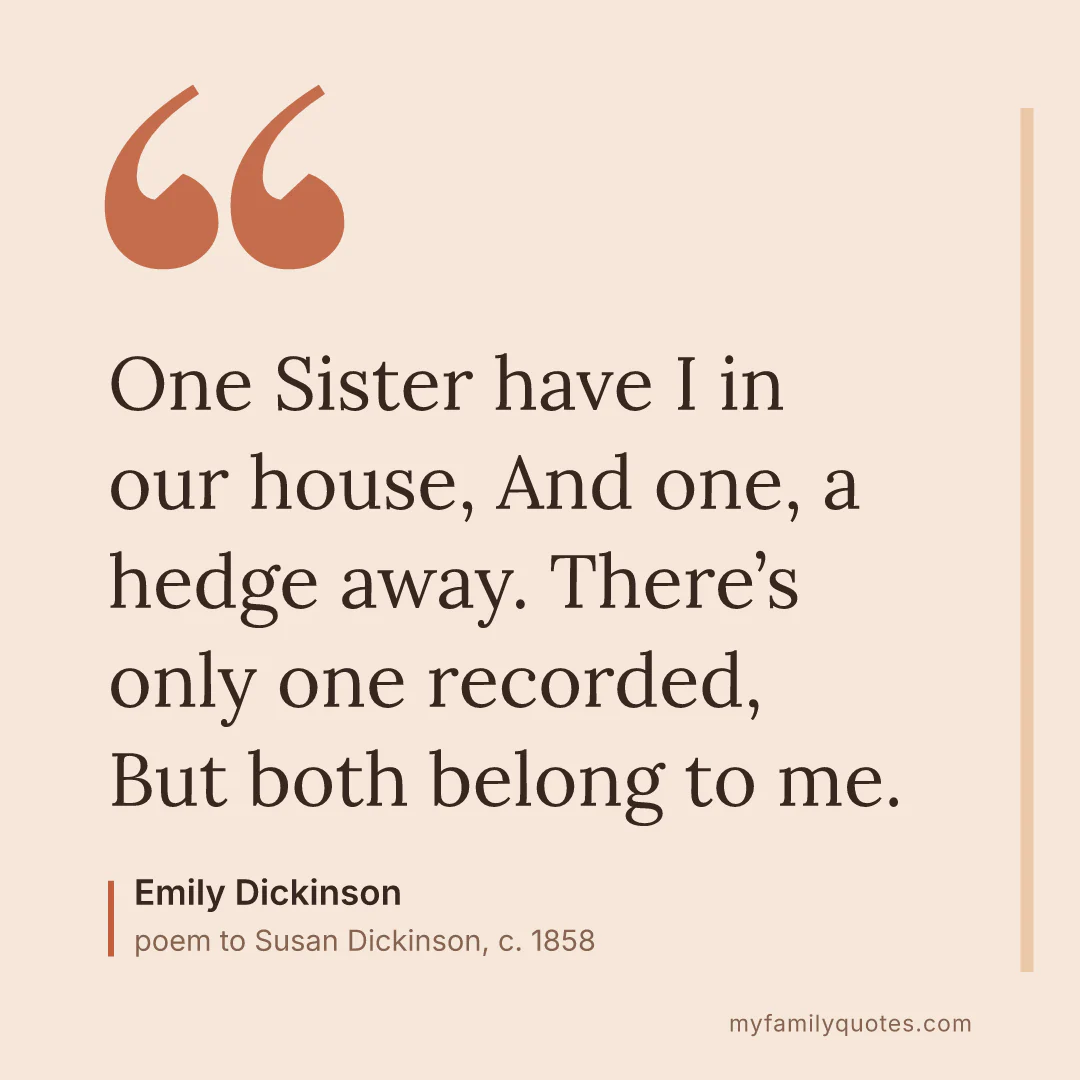
"One Sister have I in our house, / And one, a hedge away. / There's only one recorded, / But both belong to me." — Emily Dickinson, poem to Susan Dickinson, c. 1858
Susan Gilbert married Emily Dickinson's brother Austin on 1 July 1856, and the couple moved into the Evergreens, the house built on the lot next door to the Dickinson Homestead in Amherst. The "Sister in our house" is Emily's sister Lavinia; the one "a hedge away" is Susan, the new sister-in-law next door. "Only one recorded" means only Lavinia is her sister on paper. The copy Dickinson sent ends with "Sue forevermore!" and is signed "Emilie". Susan went on to receive more of Dickinson's poems than anyone else. These four lines are the most natural quotation there is for a sister-in-law card, especially if she lives nearby or you count her as a real sister.
"The other as a bird her nest, / Builded our hearts among." — Emily Dickinson, same poem, c. 1858
The second stanza contrasts the two sisters. Lavinia "came the road that I came, / And wore my last year's gown", while Susan arrived from outside and made a home among them, the way a bird builds a nest. It is a good line for a sister-in-law who married into the family and changed it for the better. It reads well on its own under a wedding or anniversary photo.
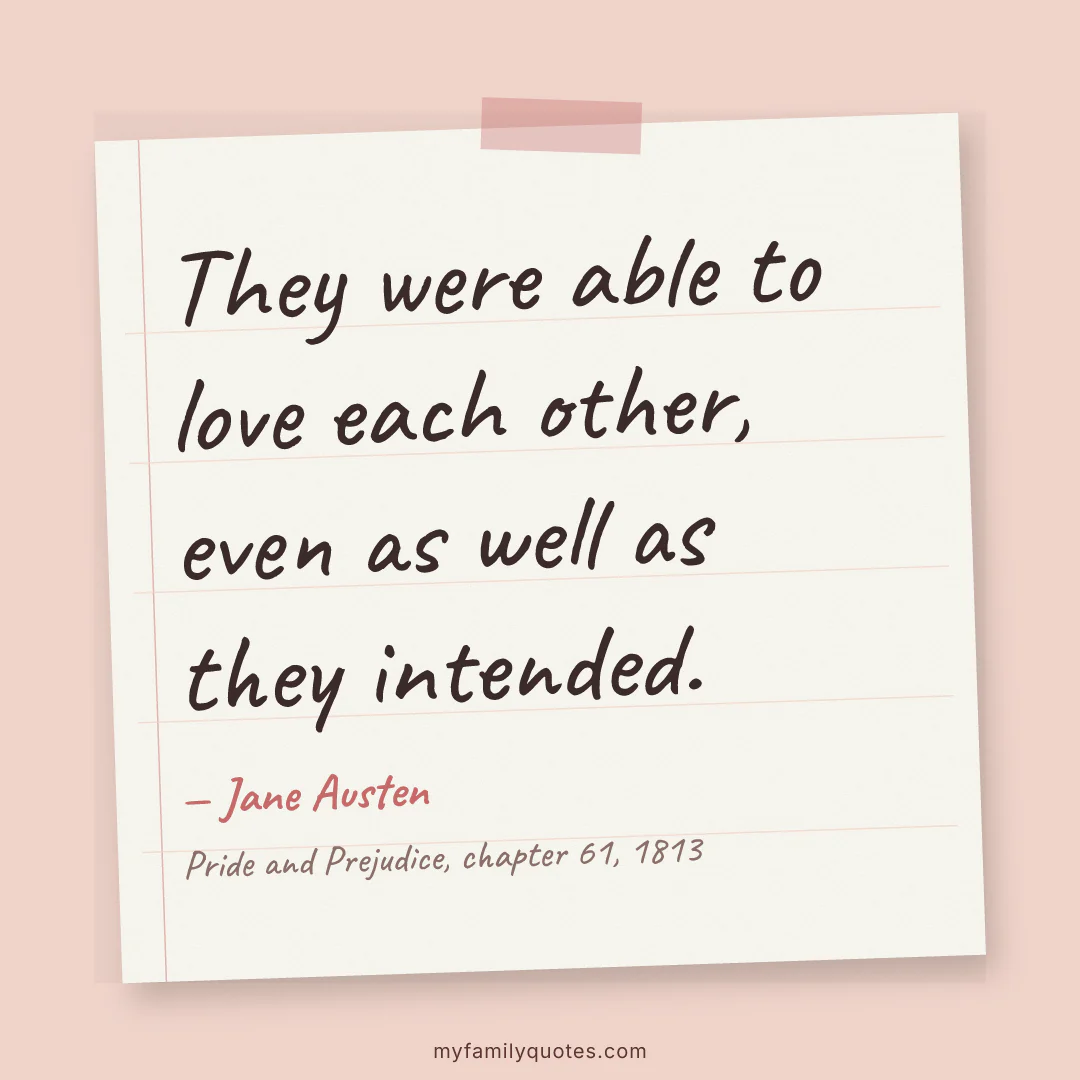
"Pemberley was now Georgiana's home; and the attachment of the sisters was exactly what Darcy had hoped to see. They were able to love each other, even as well as they intended." — Jane Austen, Pride and Prejudice, chapter 61, 1813
In the last chapter of the novel, Elizabeth Bennet has married Mr. Darcy and his shy younger sister Georgiana comes to live with them. Austen calls the two women "the sisters", although they are sisters-in-law. The phrase "even as well as they intended" is typical Austen: warm, but aware that families often mean to love each other more than they manage to. Use the second sentence for a new sister-in-law you are determined to get on with, or as a quietly funny line for one you already adore.
Austen adds a detail worth knowing before you write: Georgiana was at first astonished by Elizabeth's "lively, sportive manner of talking to her brother". Many sisters-in-law will recognize the moment when someone new starts teasing the brother everybody else treated with respect. If that is your story, a card can say so.
Step 3: Match the length to the occasion
| Occasion | Length | Shape that works |
|---|---|---|
| Birthday text or social post | 1–2 sentences | One true detail + birthday wish |
| Birthday card | 3–5 sentences | Detail, what she means to the family, wish for the year; a short quote is optional |
| Wedding card (welcoming a new sister-in-law) | 3–4 sentences | Welcome, one thing you already like about her, a promise (holidays, help, a standing coffee) |
| Speech or toast at the wedding | About one minute | Short story about how you met her, one quotation at most, toast to both of them |
| New baby, new house, new job | 2–3 sentences | Congratulations + a practical offer |
| Grief, illness or a divorce | 2–4 sentences, plain words | Acknowledge it, say you are still family, offer one concrete thing |
Drafts you can adapt
The messages below were written by our editors as starting points. They are not quotations, so change the details to your own and sign them yourself.
Birthday
- Happy birthday to the sister I got by marriage and would have picked anyway.
- Happy birthday! Thank you for being the person at every family dinner who catches my eye at exactly the right moment.
- Another year of you making my brother more bearable. The whole family is grateful. Happy birthday.
- Happy birthday to the one who remembers everyone else's birthdays. Today it's your turn to be remembered.
Welcoming a new sister-in-law
- Welcome to the family. You already know what you're getting into, and you came anyway, which tells us everything.
- Our family just got bigger and better. There's always a chair for you at Mum's table and a spare key at our house.
- I always wanted a sister. I didn't expect my brother to be the one who'd find her.
For a wedding reading or a card in a religious family, many couples turn to the Book of Ruth. The story begins with two sisters-in-law, and the King James Version uses the word itself.
"And they lifted up their voice, and wept again: and Orpah kissed her mother in law; but Ruth clave unto her. And she said, Behold, thy sister in law is gone back unto her people, and unto her gods: return thou after thy sister in law." — Ruth 1:14–15, King James Version, 1611
Naomi has lost her husband and both sons, and she urges her two widowed daughters-in-law, Orpah and Ruth, to go home to their own families. Orpah goes, Ruth stays, and Naomi points to her "sister in law" as an example to follow. Ruth's answer in the next verse, "whither thou goest, I will go... thy people shall be my people, and thy God my God", is the famous one. It is spoken to a mother-in-law, not a spouse, which is why it suits a card about joining a family better than a love note. Orpah is not the villain here: the text treats her choice as reasonable. That is worth remembering if you quote the passage to a sister-in-law who stayed close after a death or a divorce.

Thank you, new baby or a hard week
- Thank you for everything you did for Mum this year. I know how much of it fell on you, and I noticed.
- Congratulations to you both. I'm bringing dinner on Thursday, and I'm not taking no for an answer.
- Whatever happens between you and my brother, you are still my sister-in-law, and my door is still open.
- No need to reply. I'm thinking of you and I'm here, today and after.
If the message is for a cousin's wife or an aunt by marriage instead, the same steps work. Our guides to cousin messages and aunt quotes from literature cover those relationships.
When the relationship is strained
Not every sister-in-law is a Susan Dickinson. Fiction has always known this, and literature's best-known difficult sister-in-law opens one of Austen's novels. In Sense and Sensibility, Fanny Dashwood talks her husband out of the money he promised his dying father he would give to his half-sisters.
"And what possible claim could the Miss Dashwoods, who were related to him only by half blood, which she considered as no relationship at all, have on his generosity to so large an amount." — Jane Austen, Sense and Sensibility, chapter 2, 1811
Over the course of the chapter, the promised three thousand pounds shrinks to occasional presents of fish and game. Readers with an in-law who draws the family's boundaries a little too tightly tend to recognize the voice. Quote it to a sympathetic sibling, not to the sister-in-law herself.
Austen also shows the opposite strategy, the cool truce. When Darcy marries Elizabeth, Caroline Bingley, who had hoped to marry him herself, makes a practical calculation:
"Miss Bingley was very deeply mortified by Darcy's marriage; but as she thought it advisable to retain the right of visiting at Pemberley, she dropped all her resentment." — Jane Austen, Pride and Prejudice, chapter 61, 1813
It is a funny sentence, but it also describes how many in-law relationships actually survive: through civility kept up for the sake of the people you both love. If you are in that position, the card you write does not have to pretend to closeness. It only has to be kind and true.
Shakespeare gave in-law tension its most compact line. Hamlet's mother has married his uncle Claudius, and when Claudius greets him as "my cousin Hamlet, and my son", Hamlet mutters:
"A little more than kin, and less than kind." — William Shakespeare, Hamlet, Act 1, Scene 2, c. 1600
"Kin" and "kind" are a pun: Claudius is now more than a relative (a stepfather as well as an uncle), but not "kind" in either sense, neither natural family nor kindly. It is a line for venting to a friend, not for a card.
For a strained relationship, a civil message usually has three parts: a greeting, one honest positive (even a small one, such as "the kids loved the presents"), and a good wish that asks nothing back. For example: "Happy birthday, Claire. The kids are still talking about the picnic. I hope the year treats you well." It is short, true and safe. If you need something sharper to read on your own, our page of sarcastic quotes about bad relatives is the place for it, not the card.
About "sister by law, friend by choice" and other unsigned sayings
Many of the most shared sister-in-law lines, such as "sister-in-law by law, friend by choice", "a sister-in-law is a sister by heart", or "my brother found someone who could put up with him, so I got a sister", have no traceable author. They appear on mugs, printables and image sites without a name or with "Unknown". There is nothing wrong with using one in a card or on a gift, as long as you do not attach a famous name to it. If a website credits one of these to a well-known writer without naming a book or a speech, treat the credit as doubtful.
Questions readers ask
What is a good short quote for a sister-in-law?
Emily Dickinson's "One Sister have I in our house, / And one, a hedge away" (about 1858) is the best-known line actually written about a sister-in-law, Susan Dickinson. For a lighter card, Jane Austen's "They were able to love each other, even as well as they intended" from Pride and Prejudice works well.
What should I write in a birthday card for my sister-in-law?
Start with one specific thing she does for the family or for you, add what she means to you in a sentence, and finish with a wish for her year. Two to five sentences are enough. A quotation is optional; a true detail is not.
How do I welcome a new sister-in-law into the family?
Say she is welcome, name one thing you already like about her, and make one concrete promise, such as a standing invitation, a holiday tradition you want to share, or a practical offer of help. Keep comparisons with past partners out of it.
What do I write if we don't get along?
Keep it short and true: a greeting, one honest positive and a good wish that asks for nothing. Save sarcastic lines for friends, never for the card itself.
If you only remember one thing from this guide, make it this: a sister-in-law already knows the family's story. What she rarely hears is that someone in it noticed her part. One sentence that says so is worth more than any quotation. For more lines about the siblings you grew up with, see our collection of sibling love quotes, and if the in-law you are writing to is a brother, see our sourced brother-in-law quotes.