Daughter Quotes From Dad: 10 Lines Real Fathers Wrote to Their Girls
Words My Family Quotes Editors

The best daughter quotes from dad were never written for a poster. They were written by real fathers to one particular girl: a note to a daughter at boarding school, a birthday letter from a prison cell, a list scribbled to an 11-year-old at summer camp. That is why they still work. They sound like a father talking, not like a slogan.
This page collects 10 of those lines, each checked against the letter it comes from: W. E. B. Du Bois, F. Scott Fitzgerald, Thomas Jefferson, Jawaharlal Nehru and Theodore Roosevelt. They are grouped by what a dad usually wants to say (I believe in you, be yourself, I love you, happy birthday, you're getting married), followed by a short guide to writing your own note and an answer to the old "like father, like daughter" question. If you need one line right now, take Du Bois's: "Above all remember: your father loves you and believes in you."
Find the right line in ten seconds
| What you want to tell her | Line | From |
|---|---|---|
| I believe in you | "… your father loves you and believes in you …" | Du Bois to Yolande, 1914 |
| You can do hard things | "We are always equal to what we undertake with resolution." | Jefferson to Martha, 1787 |
| Be brave | "Be brave, and all the rest follows." | Nehru to Indira, 1930 |
| Who you are matters more than looks | "The main thing is the YOU beneath the clothes and skin …" | Du Bois to Yolande, 1914 |
| Stop worrying so much | "Don't worry about failure unless it comes through your own fault" | Fitzgerald to Scottie, 1933 |
| I love you, plainly | "… all the world will love you, and I more than all the world." | Jefferson to Maria, 1790 |
| You're my favourite person to talk to | "… the very nicest of all nice daughters …" | Roosevelt to Ethel, 1909 |
| Happy birthday, from far away | "Good-bye, little one, and may you grow up …" | Nehru to Indira, 1930 |
| A funny thank-you | "I think you are a little trump …" | Roosevelt to Ethel, 1904 |
| On her wedding | "… continue to love me as you have done …" | Jefferson to Martha, 1790 |
"I believe in you": lines for a daughter facing something hard
The most useful thing a father can put in writing is a vote of confidence that she can reread later. Three of the strongest examples were all written to daughters who were far from home and a little scared.
In the autumn of 1914, W. E. B. Du Bois sent his 14-year-old daughter Yolande to Bedales, a boarding school in England. He waited until she had settled in, then wrote a letter that starts with homesickness and ends with this:
"Above all remember: your father loves you and believes in you and expects you to be a wonderful woman."
— W. E. B. Du Bois, letter to Yolande Du Bois, 29 October 1914 (W. E. B. Du Bois Papers, MS 312, University of Massachusetts Amherst)
Notice the order: love first, then belief, then expectation. Many fathers skip straight to the expectation. Du Bois puts it last, after she already knows she is loved, which is why it reads as encouragement and not as pressure. The line fits a first-day-of-college card, a note in a suitcase, or a text before a big exam. You can sign it yourself and leave the quotation marks off, as long as you know where it comes from.
Thomas Jefferson's daughter Martha, called Patsy, was 14 and studying at a convent school in Paris when she complained that she could not read her Latin Livy without her teacher's help. Jefferson, travelling through the south of France, answered from Aix-en-Provence:
"We are always equal to what we undertake with resolution."
— Thomas Jefferson, letter to Martha Jefferson, Aix-en-Provence, 28 March 1787 (in Sarah N. Randolph, The Domestic Life of Thomas Jefferson, 1871)
The rest of the letter is less quotable (he warns that a girl who cannot solve her own problems will be "thought a very helpless animal"), but this sentence has outlived its context. It is short, it does not depend on talent, and it suits a daughter learning to drive, starting a hard course, or training for something she is not sure she can finish.
The third line came from a prison. On 26 October 1930, Jawaharlal Nehru wrote to his daughter Indira from Naini Central Prison for her 13th birthday. (Her birthday falls on 19 November by the Western calendar; the family marked it on 26 October that year by the Hindu Samvat calendar, as a footnote in the published book explains.) He apologised for having no present and offered advice instead, with a simple test for when she was in doubt:
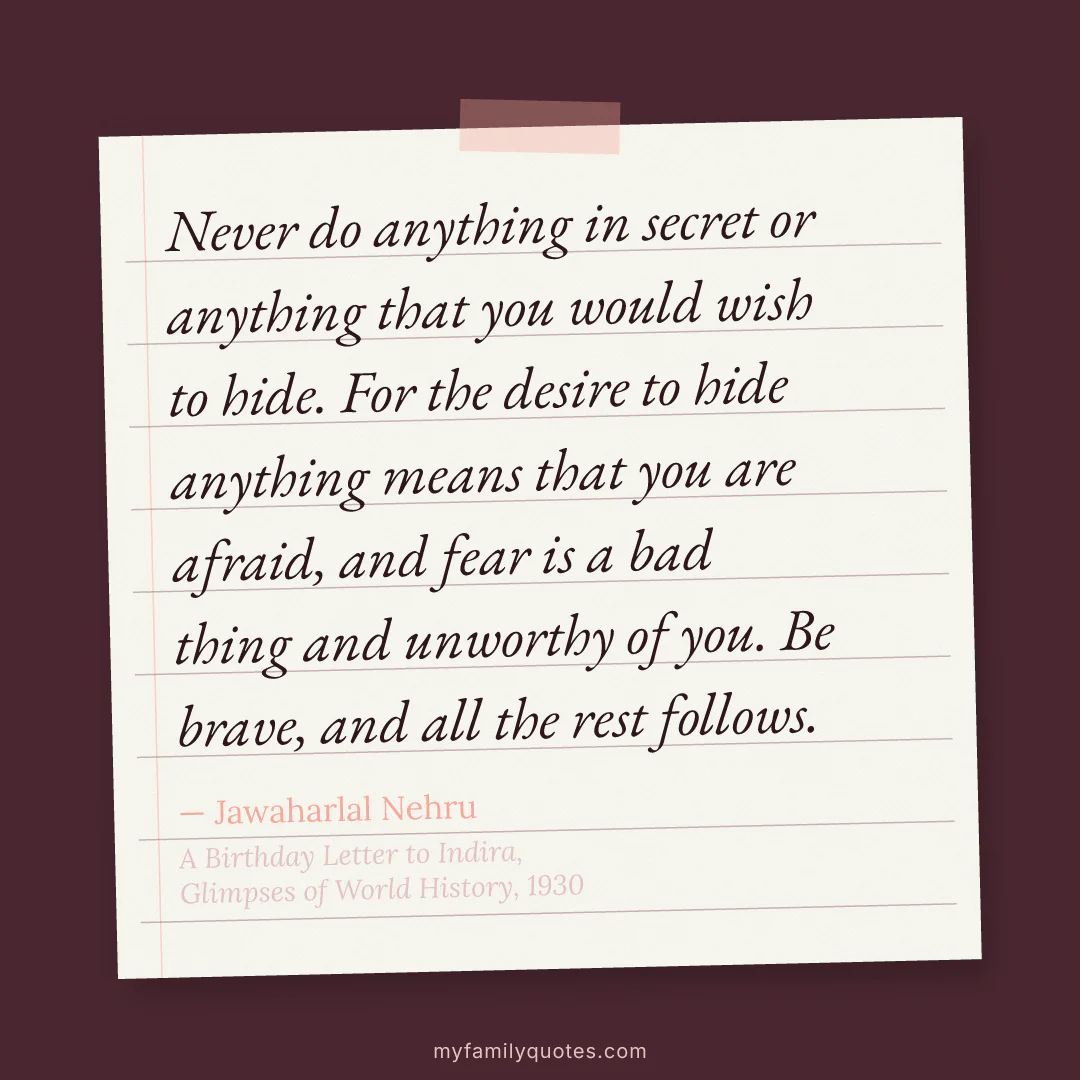
"Never do anything in secret or anything that you would wish to hide. For the desire to hide anything means that you are afraid, and fear is a bad thing and unworthy of you. Be brave, and all the rest follows."
— Jawaharlal Nehru, "A Birthday Letter", 26 October 1930, opening letter of Glimpses of World History (1934)
"Be brave, and all the rest follows" is one of the few father-to-daughter lines short enough for a bracelet engraving or a phone lock screen. The longer version works better in a letter, because it explains why courage matters: secrecy is a form of fear.
"Be yourself": what fathers say about who she is
Du Bois's 1914 letter has a second passage that is even more personal. He warned Yolande, a Black American girl arriving at an English school, that other children would stare at "your dear brown and the sweet crinkley hair". Then he told her what actually counted:
"The main thing is the YOU beneath the clothes and skin – the ability to do, the will to conquer, the determination to understand and know this great, wonderful, curious world."
— W. E. B. Du Bois, letter to Yolande Du Bois, 29 October 1914
The capital letters are his. For a daughter who is being judged on her looks, at school or online, this is a stronger answer than "you're beautiful", because it moves the compliment to things she can do. It works in a card for a teenager, or as a caption under a photo of her doing something rather than posing.
F. Scott Fitzgerald took a lighter route. On 8 August 1933, writing from La Paix, the house near Towson, Maryland, where the family was living, he sent his 11-year-old daughter Scottie at summer camp a letter that ends in three lists: things to worry about (courage, cleanliness, efficiency, horsemanship), things not to worry about, and things to think about. The middle list is the one people frame:
"Don't worry about popular opinion / Don't worry about dolls / Don't worry about the past / Don't worry about the future / Don't worry about growing up / Don't worry about anybody getting ahead of you / Don't worry about triumph / Don't worry about failure unless it comes through your own fault"
— F. Scott Fitzgerald, letter to Frances "Scottie" Fitzgerald, 8 August 1933 (transcribed by Open Culture)
The list goes on to mosquitoes, flies, parents, boys, disappointments, pleasures and satisfactions, which is part of the joke. Read in full, it is a father teaching a child to sort her worries into the few that are hers and the many that are not. A teenager who overthinks everything will understand it at once. Pick three or four items rather than all of them for a card, and keep "unless it comes through your own fault": that clause is what stops it from being a pat on the head.

Love daughter quotes from dad, short enough for a card
Most fathers find "I love you" harder to write than advice. These two letters say it without sounding like a greeting card, which is why they read well in a dad's handwriting.
Jefferson's younger daughter Mary, called Maria or Polly, was not quite 12 in April 1790 and living with her aunt and uncle in Virginia while he worked in New York as Secretary of State. His letter is full of questions (does she see the sun rise, how far has she got in Don Quixote, can she make a pudding yet?) and then turns tender:
"Be good, my dear, as I have always found you; never be angry with any body, nor speak harm of them; try to let every body's faults be forgotten, as you would wish yours to be; take more pleasure in giving what is best to another than in having it yourself, and then all the world will love you, and I more than all the world."
— Thomas Jefferson, letter to Mary Jefferson, New York, 11 April 1790 (in Randolph, The Domestic Life of Thomas Jefferson)
The last clause, "all the world will love you, and I more than all the world", is the part to borrow. It is old-fashioned enough to feel special and plain enough to mean exactly what it says.
Theodore Roosevelt wrote to his children constantly, and his letters to his daughter Ethel are the warmest in the collection. In December 1909 he was finishing a long African expedition with her brother Kermit and wrote to her from Kampala that he was eager to get home to "darling, pretty Mother" and:
"… the very nicest of all nice daughters—you blessed girlie. … It is a great comfort to have a daughter to whom I can write about all kinds of intimate things!"
— Theodore Roosevelt, letter to Ethel Roosevelt, Kampala, 23 December 1909 (Theodore Roosevelt's Letters to His Children, ed. Joseph Bucklin Bishop, 1919)
Ethel was 18. The second sentence is the rarer compliment: it tells a grown daughter that she is her father's confidant, not just his child. It suits a birthday card for a daughter in her late teens or twenties, or a message on the day she moves out.
Funny daughter quotes from dad
Real fathers' letters are funnier than most "funny dad quotes" lists, because the jokes are aimed at one person. Roosevelt wrote this from the White House on 21 June 1904 to 12-year-old Ethel, after a letter from her about how things were going at home:
"I think you are a little trump and I love your letter, and the way you take care of the children and keep down the expenses and cook bread and are just your own blessed busy cunning self."
— Theodore Roosevelt, letter to Ethel Roosevelt, 21 June 1904 (Letters to His Children)
Two words need a note. A "trump" was a reliable, generous person (as in a trump card), and "cunning" meant cute or charming in American English of the time, not sly. The image of a president thanking his daughter for keeping the grocery bill down is the joke, and it still works as a thank-you to a daughter who has been organising everyone. Fitzgerald's 1933 letter has its own deadpan moments too: he threatens to take "the White Cat" out and beat his bottom hard, "six times for every time you are impertinent", and closes one paragraph with "Half-wit, I will conclude."
Daughter birthday quotes from dad
Nehru's letter above is the model for a birthday note from a father who cannot be there. It opens with an admission that he has no present to send ("My presents cannot be very material or solid. They can only be of the air and of the mind and spirit"), gives one piece of advice, and closes with a blessing:
"Good-bye, little one, and may you grow up into a brave soldier in India's service."
— Jawaharlal Nehru, "A Birthday Letter" to Indira, Naini Central Prison, 26 October 1930 (Glimpses of World History)
You do not need to copy the politics to copy the shape: say what you wish you could give her, give her one idea instead, end with a wish for who she will become. "Good-bye, little one, and may you grow up into a brave woman" is an easy adaptation for a father who is travelling, deployed or living apart on her birthday.
For a younger daughter, Roosevelt's "your own blessed busy cunning self" makes a playful birthday line. For a daughter turning 18 or 21, his "nicest of all nice daughters" is warmer than anything on a shop card.
On her wedding day: a father's letter after the marriage
Martha Jefferson married Thomas Mann Randolph in February 1790. Six weeks later her father, alone in New York, wrote to her about what marriage would change. Parts of it are very much of 1790 (he tells her that her happiness now depends on pleasing her husband), but the end is a father letting go gracefully:
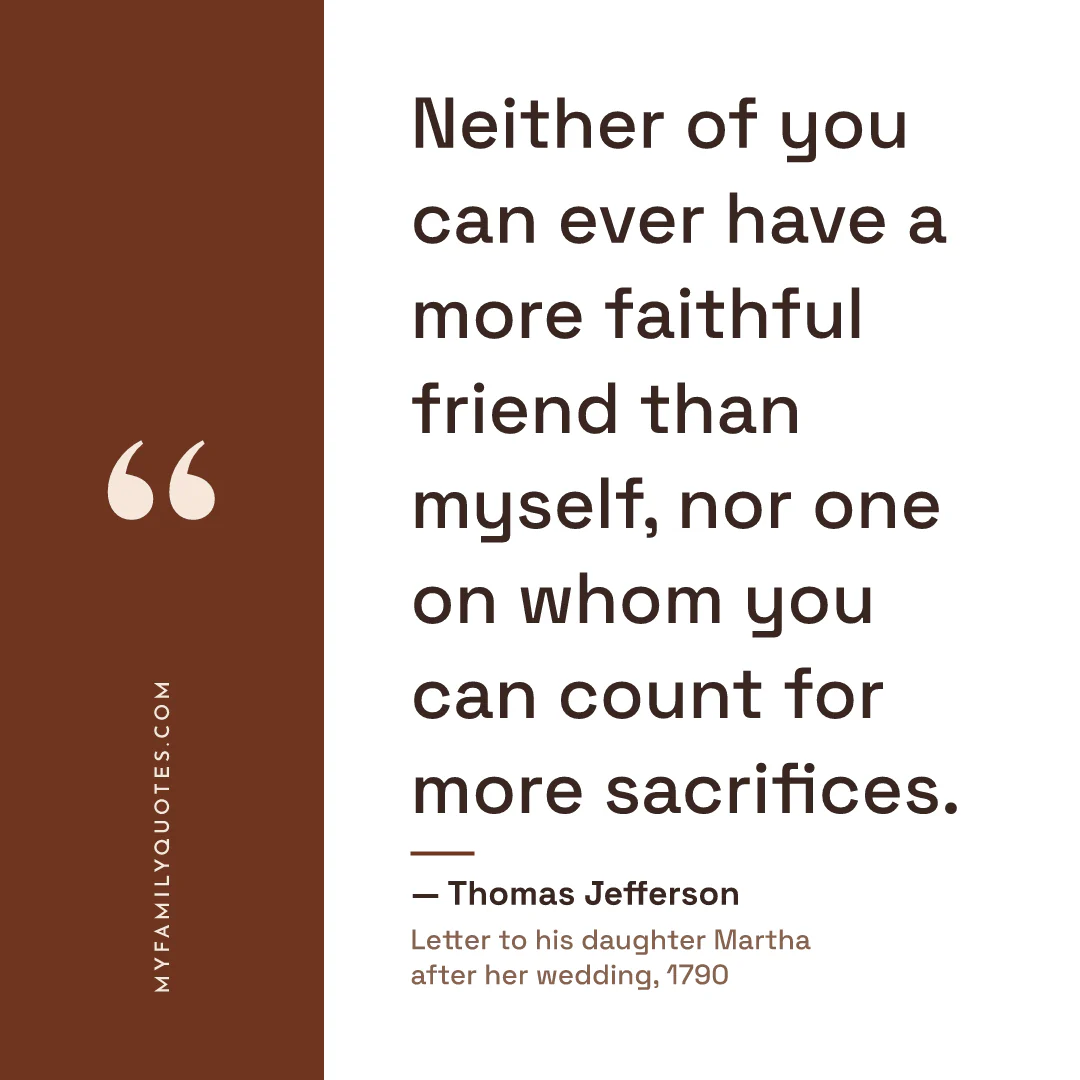
"Neither of you can ever have a more faithful friend than myself, nor one on whom you can count for more sacrifices. My own is become a secondary object to the happiness of you both. Cherish, then, for me, my dear child, the affection of your husband, and continue to love me as you have done …"
— Thomas Jefferson, letter to Martha Jefferson Randolph, New York, 4 April 1790 (extract in Randolph, The Domestic Life of Thomas Jefferson)
"Neither of you" is the generous part: he addresses the couple, not just his daughter. For a father-of-the-bride speech, that sentence and "continue to love me as you have done" can be read aloud with a short credit ("as Thomas Jefferson wrote to his daughter after her wedding"), and it lands better than a line nobody can trace. We would leave out the "please a single person" passage.
How to write your own note to your daughter
Read side by side, these letters follow the same pattern, and it is one any father can use for a card, a graduation note or a text:
- Start with something specific about her right now. Roosevelt mentions the bread and the household budget; Du Bois mentions her new bedroom and the cold baths. A detail proves you are paying attention.
- Say the love part plainly, once. "Your father loves you and believes in you" is eight words. Don't bury it.
- Give one piece of advice, not ten. Nehru's whole letter turns on one test: would you want to hide it?
- Let her off the hook for something. Fitzgerald's "don't worry" list is the most loved part of his letter because it removes pressure instead of adding it.
- End by looking forward. "Expects you to be a wonderful woman", "may you grow up into a brave soldier": the last line is about who she will become.
Three short examples written by our editors on that pattern (they are ours, not historical quotations):
- For a first day at college: "You packed the whole car yourself and didn't let me carry a thing. I love you and I believe in you. Don't worry about being the best in the room. Worry about being kind in it." (our example)
- For a 16th birthday: "Sixteen years of you, and you still laugh at my jokes. Be brave, and all the rest follows. Happy birthday from your biggest fan." (our example, borrowing Nehru's line)
- For a hard week: "We are always equal to what we undertake with resolution. Jefferson wrote that to his daughter; I'm writing it to mine. Call me after the exam." (our example)
If you would rather give her a verse, our collection of Bible verses for a daughter has the same kind of source notes, and for a brand-new baby girl see newborn daughter quotes. Lines she might write back, about what a father means to her, are in father daughter quotes.
Is it "like father, like daughter" or "like daughter, like father"?
"Like father, like daughter" is the usual form, because it adapts the old proverb "like father, like son", which puts the parent first. The Bible's version of the idea is actually about mothers: "As is the mother, so is her daughter" (Ezekiel 16:44, King James Version), where it is a reproach rather than a compliment. "Like daughter, like father" is a playful reversal, best used when the daughter is the one setting the example, for instance on a photo where she is teaching her dad something.
A famous "letter to his daughter" that isn't real
The most shared father-to-daughter letter online is one Albert Einstein supposedly wrote to his daughter Lieserl, about love as the "universal force". It did not happen. Snopes found no such letter in the Albert Einstein Archives at the Hebrew University of Jerusalem or in The Collected Papers of Albert Einstein, and Lieserl herself was born in 1902 and is not mentioned again after 1903, so there was no adult daughter to receive it (Snopes). If you see it on a card or in a speech, it is worth gently replacing with one of the real letters above. More corrections like this are in our guide to misattributed family quotes.
Questions fathers ask
What is a good quote from a dad to his daughter?
"Above all remember: your father loves you and believes in you and expects you to be a wonderful woman," from W. E. B. Du Bois's 1914 letter to his daughter Yolande, is one of the best because it says love, belief and hope in one sentence. For something shorter, Nehru's "Be brave, and all the rest follows" (1930) fits almost anywhere.
What should a father write in a card to his daughter?
One specific detail about her right now, a plain sentence of love, one piece of advice, and a closing line about who she is becoming. Real fathers' letters from Roosevelt, Du Bois and Nehru all follow that pattern, and it keeps a card short and personal.
Is the Einstein letter to his daughter about love real?
No. The "universal force" letter attributed to Einstein and his daughter Lieserl is not in the Einstein archives or his collected papers, and Lieserl is not recorded after 1903. It is a modern invention.
Is it "like father, like daughter" or "like daughter, like father"?
"Like father, like daughter" is standard, following the proverb "like father, like son". The Bible's version is "As is the mother, so is her daughter" (Ezekiel 16:44). "Like daughter, like father" is a playful reversal.
Sources: Du Bois letter, W. E. B. Du Bois Papers (MS 312), Special Collections and University Archives, UMass Amherst Libraries (credo.library.umass.edu, mums312-b007-i220); Fitzgerald letter of 8 August 1933 as transcribed by Open Culture; Jefferson letters from Sarah N. Randolph, The Domestic Life of Thomas Jefferson (1871, Project Gutenberg #43331); Nehru, Glimpses of World History (Internet Archive scan, dli.bengal.10689.20895); Roosevelt, Letters to His Children, ed. J. B. Bishop (1919, Project Gutenberg #6467); Ezekiel 16:44, King James Version.