Newborn Daughter Quotes: 11 Sourced Lines for Her First Card, Caption and Nursery Wall
Words My Family Quotes Editors
What do you write under the first photo of a baby girl, when every line you remember suddenly sounds like a shop-window card? Our answer: borrow from people who wrote while a real newborn daughter was in the room. Sylvia Plath's "Love set you going like a fat gold watch" was written in the first year of her daughter Frieda's life; W. B. Yeats wrote "A Prayer for My Daughter" beside a cradle; Shakespeare gave a father five lines to greet a daughter born in a storm at sea. Below are 11 newborn daughter quotes with sources, grouped by the moment you need them for (the first hours, a card from her mother, a card from her father, something short and funny, a long-awaited girl), each checked against the original text, with who wrote it, what was happening, and where the line works best.
Every line was compared word for word with a full text we could open: Project Gutenberg editions, the Corpus of Electronic Texts at University College Cork, and the King James Bible. Where a famous line is usually trimmed, we say what was cut.
The first hours: three lines about the day she arrived
These suit a birth announcement or the first message to the family group chat. None of them is sugary; all three were written by people describing a real arrival.
"Love set you going like a fat gold watch." — Sylvia Plath, "Morning Song", written in February 1961, collected in Ariel (1965)
Plath wrote "Morning Song" in February 1961, in the first year of Frieda's life, and the first line is the most quoted part for a reason: it says a baby has been wound up and started by love, like a watch that will now tick on its own. The rest of the poem is stranger and more honest than most birth poems: the midwife slaps the baby's feet, the new mother feels "no more your mother" than a cloud, and she stumbles out of bed "cow-heavy" at the first cry. The poem ends with the baby trying "Your handful of notes; / The clear vowels rise like balloons." Both the first and the last line work under a photo. The poem is still in copyright, so quote a line, not the whole thing.
"Now, mild may be thy life! / For a more blustrous birth had never babe: / Quiet and gentle thy conditions! for / Thou art the rudeliest welcome to this world / That ever was prince's child." — William Shakespeare, Pericles, Prince of Tyre, Act 3, Scene 1
Pericles speaks these lines on a ship in a storm, holding the daughter, Marina, who has just been born while her mother appeared to die. He wishes her a quiet life precisely because her first minutes were so rough. That makes it the line for a hard birth: an emergency delivery, weeks in the NICU, a baby who came early or in the middle of chaos. "A more blustrous birth had never babe" says "that was frightening" without saying it, and "mild may be thy life" is the wish that follows. ("Blustrous" is the old spelling of blusterous; we keep it as printed.)
"For thou hast possessed my reins: thou hast covered me in my mother's womb." — Psalm 139:13 (King James Version)
The verse just before the famous "I am fearfully and wonderfully made" (Psalm 139:14). "Reins" is the old English word for the kidneys, used in the Bible for the inmost self, so the verse says: you knew me from the inside before anyone saw me. For a baptism card or a church announcement, the second half alone ("thou hast covered me in my mother's womb") is the clearest. If you want more verses for a daughter, for each age from birth to her wedding, our guide to Bible verses for a daughter lists them by occasion.
From her mother: two lines for the first card
The best lines written by mothers about a baby daughter are not the cheerful ones. They mix love with worry, which is closer to what the first weeks actually feel like.
"You know that, as a female, I am particularly attached to her; I feel more than a mother's fondness and anxiety when I reflect on the dependent and oppressed state of her sex." — Mary Wollstonecraft, Letters Written During a Short Residence in Sweden, Norway, and Denmark, Letter VI (1796)
Wollstonecraft was travelling through Scandinavia in 1795 and had just left her little daughter, Fanny, for the first time. In the same paragraph she writes that she dreads "lest she should be forced to sacrifice her heart to her principles, or principles to her heart." It is not a card line in the usual sense, but for a mother who wants to say "I will raise you to be free" it is hard to beat, and it comes from the author of A Vindication of the Rights of Woman. A short way to use it: "More than a mother's fondness and anxiety" as a caption, with the full sentence inside the card.
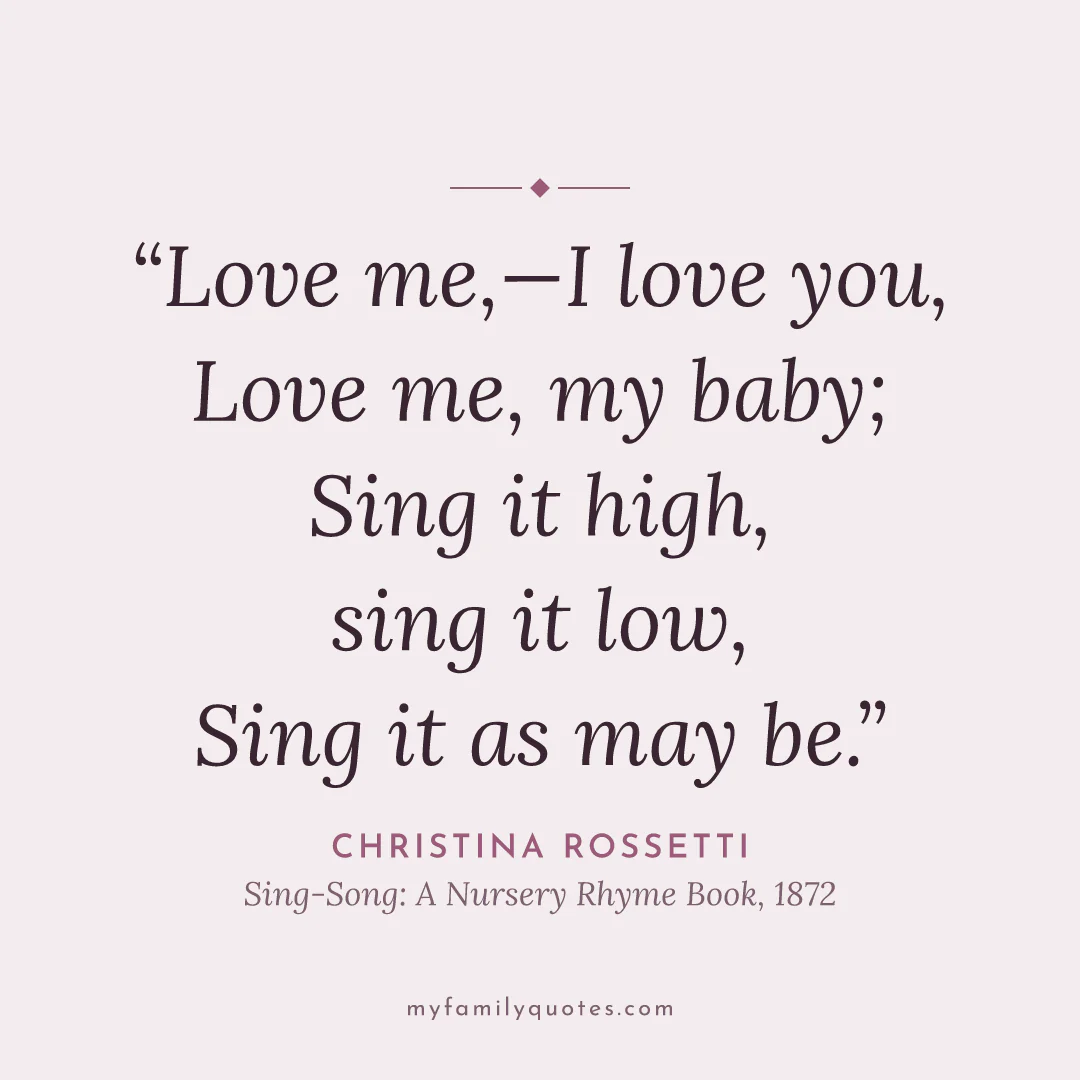
"Love me,—I love you, / Love me, my baby; / Sing it high, sing it low, / Sing it as may be." — Christina Rossetti, Sing-Song: A Nursery Rhyme Book (first published 1872; quoted from the 1893 Macmillan edition illustrated by Arthur Hughes)
Rossetti's book of nursery rhymes is full of babies, and this little lullaby is the most usable piece in it. The second verse goes "Mother's arms under you, / Her eyes above you", which is exactly what the first weeks look like. It is short enough for the nursery wall, a sleep-sack embroidery or the inside of a baby book, and it has the rhythm of something you can sing at 3 a.m. Rossetti never had children of her own, which makes how closely she watched other people's babies all the more striking.
From her father: lines written beside a cradle
For a dad's first message, a hospital photo of father and daughter, or a card from a grandfather. Both of these were written by men looking at a sleeping girl.
"May she be granted beauty and yet not / Beauty to make a stranger's eye distraught, / Or hers before a looking-glass." — W. B. Yeats, "A Prayer for My Daughter", in Michael Robartes and the Dancer (1921)
Anne Butler Yeats was born on 26 February 1919. Her father began this poem two days later at Thoor Ballylee, the tower he had bought in County Galway, with a storm "howling" outside and "My child sleeps on" under the "cradle-hood and coverlid." It was first printed in the magazine Poetry in November 1919. What he prays for is unusual and worth quoting: not too much beauty, because beauty that is "a sufficient end" can cost a girl "natural kindness" and the ability to "find a friend." Later in the poem he hopes "her bridegroom" brings her to a peaceful house; most people leave that stanza out of a birth card. The opening stanza, about the storm and the sleeping child, also works on its own.
"O, a cherubin / Thou wast that did preserve me. Thou didst smile, / Infused with a fortitude from heaven." — William Shakespeare, The Tempest, Act 1, Scene 2
Prospero tells his daughter Miranda how they were cast out to sea when she was not yet three, and how her smile kept him going while he wept into the waves. Miranda has just asked "what trouble / Was I then to you!", and this is his answer: she was no trouble, she was the reason he survived. It is a beautiful line for a father who has had a hard year and finds that a baby girl has changed the weather. "Thou didst smile, infused with a fortitude from heaven" fits under a photo of her first smile.
If you are looking for words for a dad before the birth, our page of new father to be quotes covers the waiting months; for the long bond that comes after, see father daughter quotes with sources.
Short and funny newborn daughter quotes
Two lines with a smile in them, both about the thing every visitor says in the first week: who does she look like, and look at those creases.
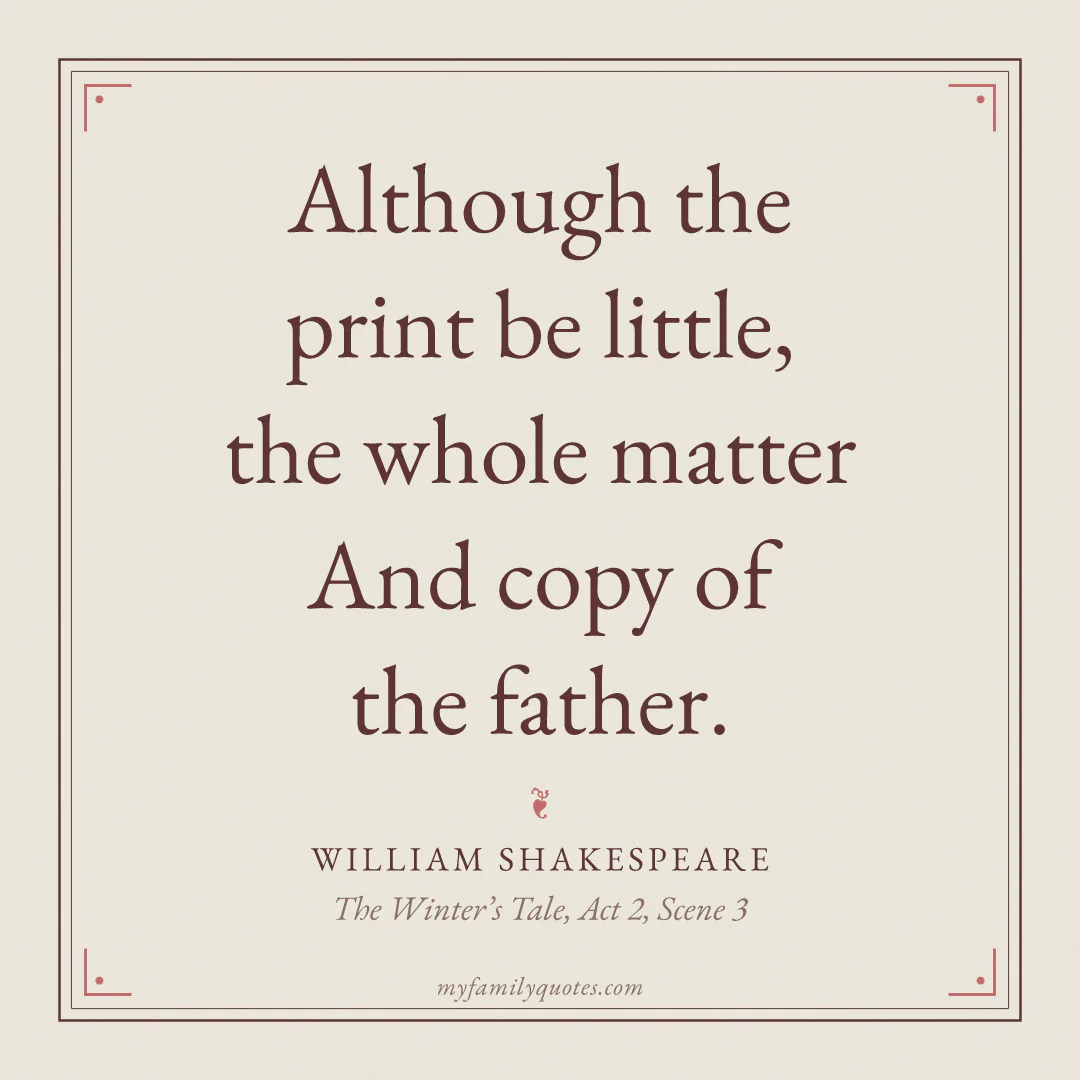
"Behold, my lords, / Although the print be little, the whole matter / And copy of the father: eye, nose, lip, / The trick of 's frown, his forehead." — William Shakespeare, The Winter's Tale, Act 2, Scene 3
Paulina carries the newborn princess Perdita to King Leontes, who refuses to believe the baby is his, and lists her features to prove she is his "copy": eye, nose, lip, even his frown and "the pretty dimples of his chin and cheek." In the play the scene is tense (the king orders the child taken away), but out of context "although the print be little, the whole matter and copy of the father" is a perfect, slightly cheeky caption for a photo of dad and daughter wearing the same expression. "Print" here means a small printed copy, like a small edition of a book.
"My baby has a mottled fist, / My baby has a neck in creases; / My baby kisses and is kissed, / For he's the very thing for kisses." — Christina Rossetti, Sing-Song: A Nursery Rhyme Book (first published 1872)
Rossetti's baby here is a boy, so for a daughter change one word: "For she's the very thing for kisses." Say that you adapted it if you print it. The first two lines are the best description of a newborn's red fists and folded neck we know, and they make people laugh because they are so exact.
For a first-born, long-awaited or late-arriving girl
Two very different lines from Victorian novels: one about how little a newborn girl used to be valued, one about how much a child can change a life.
"But what was a girl to Dombey and Son! In the capital of the House's name and dignity, such a child was merely a piece of base coin that couldn't be invested—a bad Boy—nothing more." — Charles Dickens, Dombey and Son, Chapter 1 (1846–48)
Not a card line. We include it because it is the background to the whole idea of celebrating a daughter. Dickens opens the novel with Mr. Dombey thrilled at the birth of a son, while his six-year-old daughter Florence crouches in a corner, unnoticed. The novel then spends hundreds of pages showing that Florence was the real treasure of the family. If you are writing a toast for a baby shower or a speech for a first-born daughter, this line, followed by "Dickens spent the rest of the novel proving him wrong", gets a laugh and a point across.
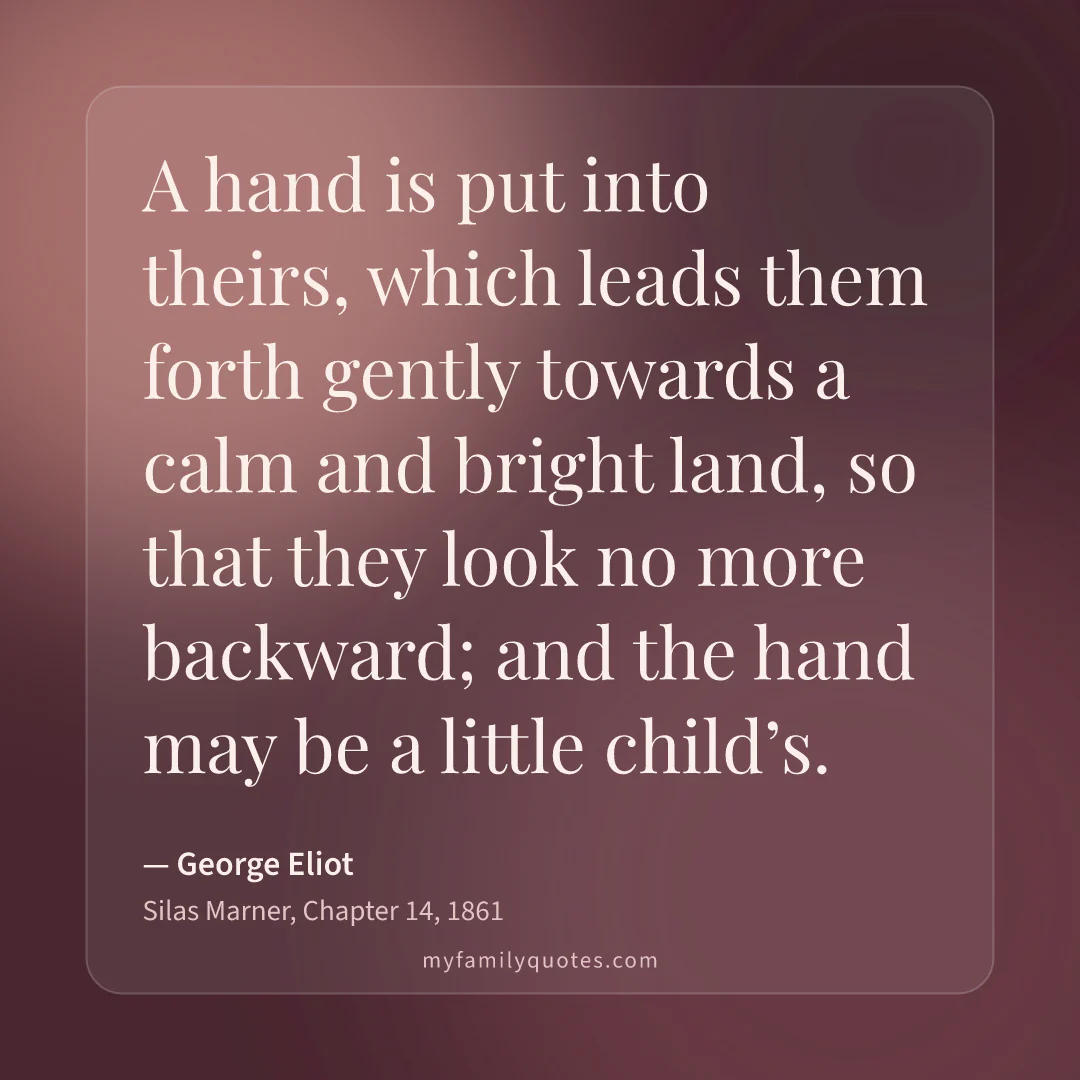
"In old days there were angels who came and took men by the hand and led them away from the city of destruction. We see no white-winged angels now. But yet men are led away from threatening destruction: a hand is put into theirs, which leads them forth gently towards a calm and bright land, so that they look no more backward; and the hand may be a little child's." — George Eliot, Silas Marner, end of Chapter 14 (1861)
Silas, a lonely miser whose gold has been stolen, finds a toddler girl asleep on his hearth one winter night and raises her as his own daughter, Eppie. This paragraph closes the chapter about her first years with him. Eppie is not a newborn when she arrives, but the line is the best we know for a baby who came late, after loss, through adoption or after years of hoping: "the hand may be a little child's." For a grandparent's card it works especially well.
Which line for which use
Word counts are of the quoted text as given above; shorter versions are the trims we suggest.
| Line | Words | Best for | Short version |
|---|---|---|---|
| Plath, "Morning Song" | 9 | Birth announcement, first photo caption | Love set you going like a fat gold watch. |
| Shakespeare, Pericles | 33 | A hard or early birth, NICU homecoming | Now, mild may be thy life! |
| Psalm 139:13 | 14 | Baptism, dedication, church card | Thou hast covered me in my mother's womb. |
| Wollstonecraft, Letter VI | 33 | Card from her mother | More than a mother's fondness and anxiety. |
| Rossetti, lullaby | 20 | Nursery wall, baby book | Love me, I love you, love me, my baby. |
| Yeats, "A Prayer for My Daughter" | 20 | Card from her father or grandfather | May she be granted beauty and yet not beauty to make a stranger's eye distraught. |
| Shakespeare, The Tempest | 18 | Dad's caption under her first smile | Thou didst smile, infused with a fortitude from heaven. |
| Shakespeare, The Winter's Tale | 26 | Funny dad-and-daughter photo | Although the print be little, the whole matter and copy of the father. |
| Rossetti, "mottled fist" | 26 | Funny caption, baby book | My baby has a mottled fist, my baby has a neck in creases. |
| Dickens, Dombey and Son | 37 | Baby-shower toast (as a joke) | But what was a girl to Dombey and Son! |
| Eliot, Silas Marner | 70 | Adoption, rainbow baby, grandparent's card | The hand may be a little child's. |
What is a good caption for a newborn daughter?
A good caption is short, true to the picture and doesn't need explaining. For a first photo, "Love set you going like a fat gold watch" (Plath, nine words) is our first choice. For a photo where she looks like her dad, "Although the print be little" (Shakespeare) is funnier than any pun. For her first smile, "Thou didst smile" is enough. Add the author's name after a dash; people will look it up, and it is fair to the writer.
What to write in a new baby daughter card
A card for a new baby girl usually goes to the parents, not to the baby, so the line should speak to them. A simple pattern that works:
- Congratulate them by name and name the baby if you know it: "Dear Sam and Priya, welcome to the world, Mira."
- Add one quoted line that fits how the birth went. Easy and joyful: Plath or the Rossetti lullaby. Long or hard: "Now, mild may be thy life!" from Pericles. After a long wait or an adoption: "the hand may be a little child's."
- Say where it comes from in a few words ("Shakespeare wrote this for a baby born in a storm"); one sentence of context turns a quote into a message.
- Offer something concrete: a meal, a walk with the pram, a night shift. New parents remember that more than the quote.
- Keep it to four or five lines. They will read it at 4 a.m.
For a mother who has just had a daughter, our short mother daughter quotes are useful for the years that follow.
Lines we left out
Many of the most shared "baby girl quotes" have no author at all, which is fine for a caption but means there is nothing to check. We left out lines such as "A daughter is a little girl who grows up to be a friend" and "She is a pocketful of sunshine" because we could not find who wrote them or where they first appeared. If you love one of them, use it without a name rather than with a made-up one. We also did not use Robert Burns's poem welcoming his first daughter or Victor Hugo's cradle poem here, because they are already quoted on our father to be page.
Quick answers
What are some short quotes about a first-born daughter?
"Love set you going like a fat gold watch" (Sylvia Plath, written in the first year of her first-born Frieda's life) and "Now, mild may be thy life!" (Shakespeare, Pericles). For a joke about how first-born girls were once overlooked, Dickens's "But what was a girl to Dombey and Son!"
Is there a Bible verse about a newborn daughter?
We know of no verse written about a newborn daughter as such. Psalm 139:13 ("thou hast covered me in my mother's womb") and 139:14 ("I am fearfully and wonderfully made") fit any baby, girl or boy, and are the two we would pick for a dedication card.
Who wrote "A Prayer for My Daughter"?
The Irish poet W. B. Yeats, after the birth of his daughter Anne. He started it in February 1919, two days after she was born, and published it in Poetry that November.