Encouraging Quotes for Family: 10 Sourced Lines for Hard Times
Words My Family Quotes Editors

On 23 December 1862, Abraham Lincoln took time out of the second winter of the Civil War, ten days after the Union defeat at Fredericksburg, to write to a girl in Bloomington, Illinois. Fanny McCullough's father, Lieutenant Colonel William McCullough of the Fourth Illinois Cavalry, an old friend of Lincoln's, had been killed in a night charge near Coffeeville, Mississippi, earlier that month. Lincoln did not tell her to be strong. He told her the truth about time, and then he told her she would be happy again. That letter is still one of the best models for what encouraging quotes for family are supposed to do: tell people in a hard season that it will not always feel like this, without pretending it does not hurt now.
This page gathers 10 encouraging quotes for family going through hard times, each checked against the full text it comes from: Lincoln's letter, Little Women, The Grapes of Wrath, Anne of Green Gables, The Swiss Family Robinson and four verses from the King James Bible. It is arranged by situation (illness, money trouble, a death, a sudden change, a family that needs to pull together, a bad day), with a short guide on how to send a line without making things worse. If you need one line right now, take Marmee's from Little Women: "Hope and keep busy."
Pick a line by what your family is facing
| Situation | Line | Source |
|---|---|---|
| Someone is seriously ill | "Hope and keep busy …" | Alcott, Little Women, ch. 16 |
| Waiting for news | "Rejoicing in hope; patient in tribulation …" | Romans 12:12 (KJV) |
| Money is gone, work is gone | "… we're the people—we go on." | Steinbeck, The Grapes of Wrath, ch. 20 |
| Everything is going wrong at once | "… cast down, but not destroyed …" | 2 Corinthians 4:8-9 (KJV) |
| After a death in the family | "You are sure to be happy again." | Lincoln to Fanny McCullough, 1862 |
| A family of faith in shock | "… a very present help in trouble." | Psalm 46:1 (KJV) |
| A sudden emergency | "Courage, my darlings …" | Wyss, The Swiss Family Robinson, ch. 1 |
| A new start, a new home | "… I'm learning how to sail my ship." | Alcott, Little Women, ch. 44 |
| Relatives who need to pull together | "Two are better than one …" | Ecclesiastes 4:9-10 (KJV) |
| A child (or you) after a bad day | "… tomorrow is a new day with no mistakes in it yet?" | Montgomery, Anne of Green Gables, ch. 21 |
When someone in the family is seriously ill
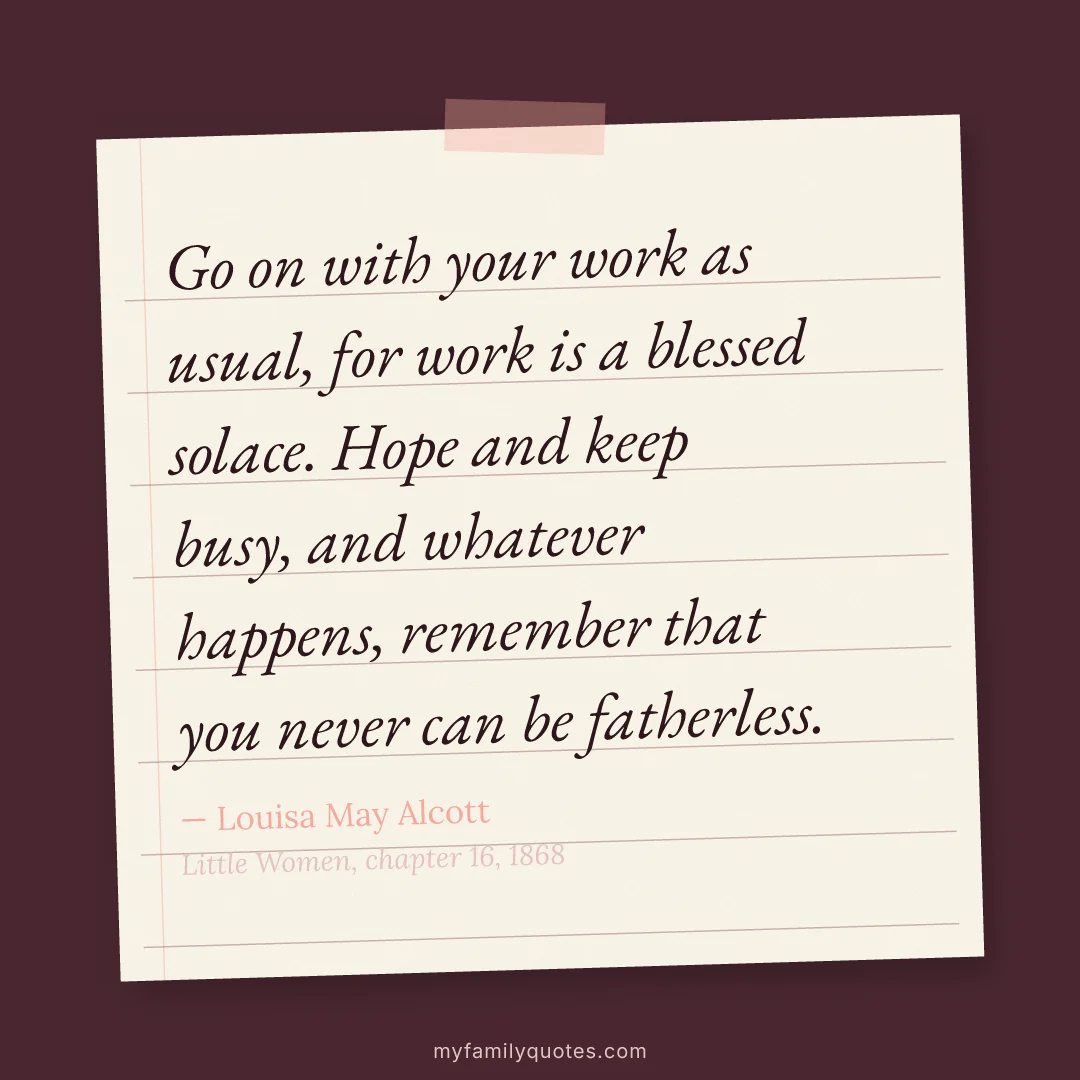
Illness is the hard time that most often lands without warning, and it splits a family into the people at the bedside and the people at home trying to keep ordinary life going. Louisa May Alcott wrote exactly that split. In Little Women (1868) a telegram tells Mrs. March that her husband is very ill in a Washington hospital, and she has to leave her four daughters at dawn. Her parting advice, at the start of chapter 16, is the most practical encouragement in the book:
"Go on with your work as usual, for work is a blessed solace. Hope and keep busy, and whatever happens, remember that you never can be fatherless."
— Louisa May Alcott, Little Women, chapter 16, "Letters" (1868)
Marmee does not promise that Father will live. She gives the girls something to do with their fear, and the second half of the sentence tells them that the family's bond does not depend on the outcome. A few pages later Jo turns it into a slogan at the breakfast table ("'Hope and keep busy', that's the motto for us"), which is how lines like this really work in families: one person says it, and the others repeat it to each other. It suits a text to siblings sharing hospital shifts, or a note left for teenagers while a parent is away with a sick grandparent.
For a family that prays, Paul's three-part instruction to the church in Rome covers the long middle stretch of an illness, when there is no news yet:
"Rejoicing in hope; patient in tribulation; continuing instant in prayer;"
— Romans 12:12 (King James Version)
"Instant" here means persistent, not quick: keep at prayer. The verse is short enough for a card that goes into a hospital bag, and it asks for patience rather than for a miracle, which makes it easier to send when the prognosis is uncertain.
When money runs out or a job is lost
Financial trouble carries a particular shame, and encouragement that sounds like a greeting card can feel like an insult to a parent who cannot pay rent. The most honest family voice on the subject belongs to Ma Joad. In chapter 20 of John Steinbeck's The Grapes of Wrath (1939), the family has had to leave a squatters' camp in a hurry, Tom is close to losing his temper with the men who keep pushing them around, and Ma talks to him in the truck at night:
"Why, Tom, we're the people that live. They ain't gonna wipe us out. Why, we're the people—we go on."
— John Steinbeck, The Grapes of Wrath, chapter 20 (1939)
Ma's encouragement is not about money coming back; it is about who the family is while it is gone. Tom answers that they take a beating all the time, and she agrees, then says maybe that makes them tough. That is why the line works for a household after a layoff or a failed business: it admits the beating and refuses the conclusion that the family is finished. Use it in a message to a brother or sister who is carrying the family through a bad year, or on the inside of a card with a practical offer underneath.

When the trouble comes from several directions at once, Paul's list in his second letter to the Corinthians names each blow and answers it:
"We are troubled on every side, yet not distressed; we are perplexed, but not in despair; Persecuted, but not forsaken; cast down, but not destroyed;"
— 2 Corinthians 4:8-9 (King James Version)
The pattern of "yes, this, but not that" is what makes it encouraging rather than cheerful. It gives a struggling family permission to say they are troubled and perplexed, and holds the line at despair. It is a good verse to read aloud at a family meal during a long season of bad news.
After a death in the family
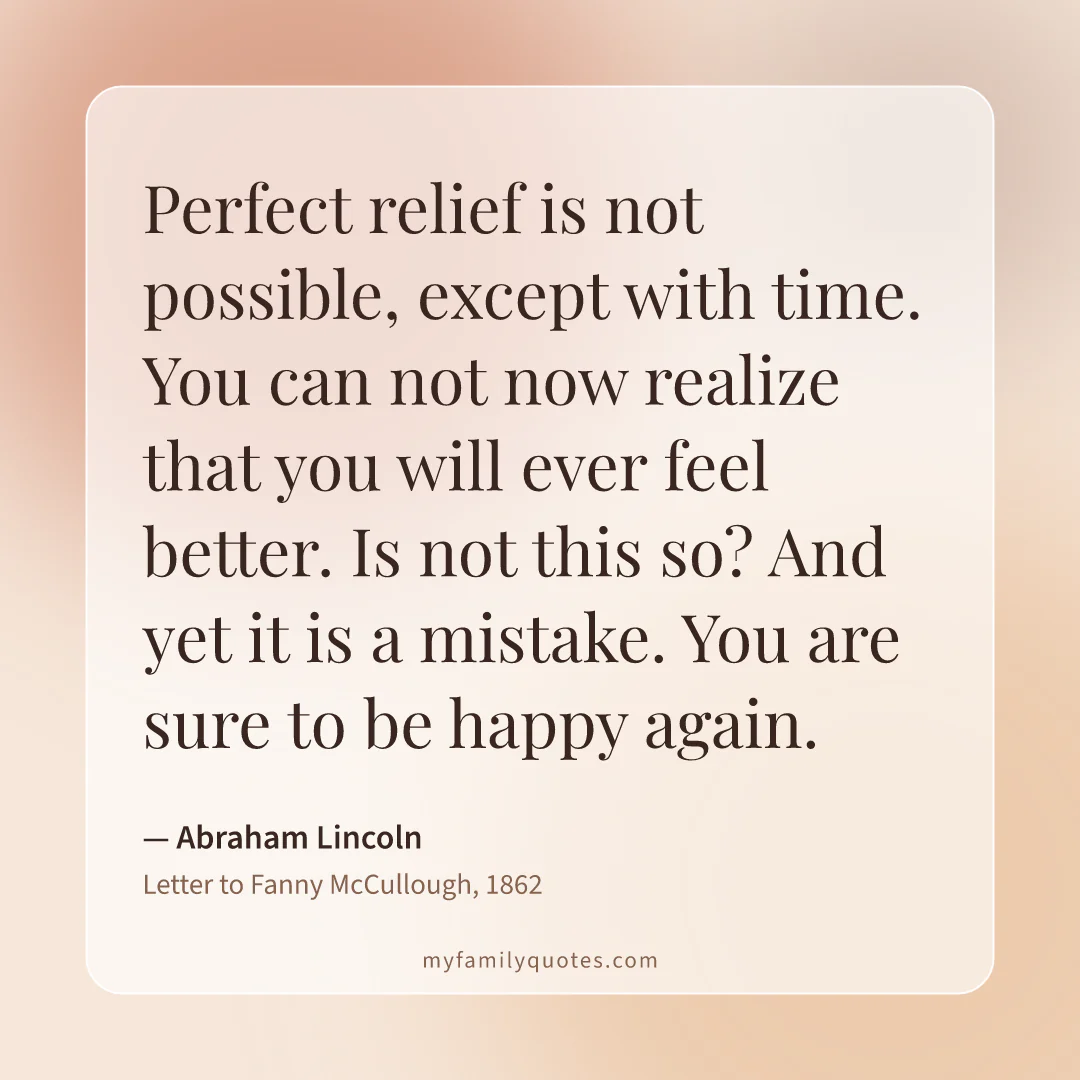
Lincoln's letter to Fanny McCullough, written from the Executive Mansion, is short, about a dozen sentences, and the part most often reprinted is its middle:
"Perfect relief is not possible, except with time. You can not now realize that you will ever feel better. Is not this so? And yet it is a mistake. You are sure to be happy again."
— Abraham Lincoln, letter to Fanny McCullough, 23 December 1862
Notice the order. He starts by agreeing with her ("Is not this so?"), and only then contradicts her. He also had standing to say it: Lincoln had buried his mother when he was nine and his son Willie earlier that same year, and the letter says plainly, "I have had experience enough to know what I say." Quote the whole passage rather than only the last sentence; on its own, "You are sure to be happy again" can sound like a brush-off. For more lines for this situation, our page of sympathy quotes for the loss of a mother goes deeper into what to write in the first weeks.
Psalm 46 opens with the verse many families choose for a funeral order of service, because it promises presence rather than explanation:
"God is our refuge and strength, a very present help in trouble."
— Psalm 46:1 (King James Version)
The next verse continues "Therefore will not we fear, though the earth be removed," which is how a sudden death feels. If the family is religious, this is one of the safest verses to send: it makes no claim that the loss was meant to be.
When everything changes at once
Some hard times are not slow; they are one terrible night. Johann David Wyss told the story of The Swiss Family Robinson (first published in German in 1812) to his own sons, and it opens with a family of six on a ship breaking up in a storm. The father's first words to his frightened boys are, in the English edition illustrated by John Gilbert (Project Gutenberg #11703):
"Courage, my darlings, we are still, above water, and the land is near. God helps those who trust in him."
— Johann David Wyss, The Swiss Family Robinson, chapter 1 (English translation)
English translations differ here, and the difference is worth knowing. Another widely read version (Project Gutenberg #3836) has the father say "You know God helps those that help themselves!", a proverb many people believe is in the Bible. It is not: we searched the full King James text and the phrase does not appear. The older translation's "trust in him" version is the one to use if you want a line that is both encouraging and accurate. It fits a family after a house fire, a flood, an accident or a diagnosis that changes everything overnight: the danger is real, and the first job is to reach the next solid ground.
Change is not always a disaster, though. Sometimes the hard part is starting again: a new marriage, a move across the country, a household put back together after a divorce. In chapter 44 of Little Women, the newly married Amy answers a joke about the "weather" of her marriage with:
"Lovely weather so far. I don't know how long it will last, but I'm not afraid of storms, for I'm learning how to sail my ship."
— Louisa May Alcott, Little Women, chapter 44, "My Lord and Lady" (Part Second, 1869)
Amy says it lightly, which is the point: she does not expect calm forever, only to get better at handling rough water. It is a good line for a couple or a blended family going through a hard first year, because it promises growth rather than ease.
When the family needs to pull together
Many hard times are made worse by relatives drifting apart just when they most need each other: siblings who stop talking during a parent's illness, cousins who each assume someone else is helping. The Teacher in Ecclesiastes made the case for staying together in plain economic terms:
"Two are better than one; because they have a good reward for their labour. For if they fall, the one will lift up his fellow: but woe to him that is alone when he falleth; for he hath not another to help him up."
— Ecclesiastes 4:9-10 (King James Version)
It is usually read at weddings, but its picture is of someone falling, which makes it just as fitting for a family group chat when one member is struggling. Two verses later comes the image of "a threefold cord" that "is not quickly broken," useful if three siblings are sharing the care of a parent. For a calmer verse to read together once the crisis has passed, see our Bible quotes on family time.
For a child (or yourself) after a bad day
Not every hard time is a crisis. Children have terrible days too, and so do the adults raising them. In chapter 21 of L. M. Montgomery's Anne of Green Gables (1908), Anne has just served the new minister's wife a layer cake she accidentally flavoured with liniment instead of vanilla. That night she sighs to Marilla, the woman who took her in:
"Marilla, isn't it nice to think that tomorrow is a new day with no mistakes in it yet?"
— L. M. Montgomery, Anne of Green Gables, chapter 21 (1908)
Marilla's dry reply ("I'll warrant you'll make plenty in it") is part of the charm: the line is encouraging because nobody in the scene pretends Anne will stop making mistakes. You will often see it online as "Tomorrow is always fresh, with no mistakes in it." That wording is not in the novel (we searched the full text); quote Anne's question as she asks it. It belongs on a lunchbox note, a bedtime chat or a message to a grown child after a rough week at a new job.
How to send encouragement without making it worse
The quote matters less than the way it arrives. A relentlessly cheerful message can feel like pressure to someone who is barely coping. A few habits make a line land as support:
- Name what is happening. "I know this month has been brutal" before the quote shows you are not skipping over the hard part. Lincoln did this ("Is not this so?") before he offered hope.
- Pick a line that admits the pain. Ma Joad, Paul's "troubled on every side" and Lincoln all acknowledge the trouble first. Avoid lines that promise a reason ("everything happens for a reason") or a deadline.
- Match the family's beliefs. Send a Bible verse to relatives who pray, a novel line to those who do not. If you are not sure, Marmee and Ma Joad work for almost everyone.
- Add one concrete offer. A quote plus "I'll do the school run on Thursday" is worth more than three quotes.
- Keep it short in a crisis. In the first days, one line and one sentence is enough. Save the longer passages for later, when people have room to read.
Two examples, written by our editors, to show the shape:
Example for a sibling caring for a sick parent (ours): "Marmee's rule from Little Women keeps coming back to me: 'Hope and keep busy.' You've done both for weeks. I'm taking Saturday so you can sleep."
Example for a cousin after a layoff (ours): "Ma Joad had it right: 'we're the people—we go on.' This is a bad year, not a bad family. Dinner's at ours on Sunday, no need to bring anything."
Encouraging lines we could not trace
Several "encouraging family quotes" circulate without a source. We checked the most common ones so you know what you are sending:
- "Tough times never last, but tough people do." This one is real, but it is a book title, not a family proverb: Tough Times Never Last, but Tough People Do! by the American pastor Robert H. Schuller, first published in 1983. Credit him if you use it.
- "God helps those who help themselves." Not a Bible verse (see the Swiss Family Robinson note above). It is an old English proverb; if you want scripture, use Psalm 46:1 instead.
- "Tomorrow is always fresh, with no mistakes in it." A paraphrase of Anne Shirley's question in chapter 21; the novel's words are given above.
For more lines that are often credited to the wrong person, see our research page on misattributed family quotes.
Questions about encouraging quotes for family
What is a good encouraging quote for family?
Marmee's "Hope and keep busy" from chapter 16 of Little Women (1868) is one of the best because it gives a worried family something to do. For a family facing money trouble, Ma Joad's "we're the people—we go on" from The Grapes of Wrath (1939) is honest about the struggle and still hopeful.
What do you say to a family going through hard times?
Name the situation first, keep the message short, choose a line that admits the pain, and add one concrete offer of help. Lincoln's 1862 letter to Fanny McCullough is a good model: he agrees that she cannot imagine feeling better, then tells her she will.
What is a short Bible verse for family strength?
Psalm 46:1, "God is our refuge and strength, a very present help in trouble," is the most widely used. Romans 12:12 ("Rejoicing in hope; patient in tribulation") suits a long wait, and Ecclesiastes 4:9-10 suits relatives who need to pull together.
Is "God helps those who help themselves" in the Bible?
No. The phrase does not appear anywhere in the King James Bible. It is an old proverb that turns up in some translations of The Swiss Family Robinson, which may be one reason people think it is scripture.