Brother-in-Law Quotes: 12 Lines From Dickens, Austen, Shakespeare and the Bible
Words My Family Quotes Editors

English literature's best-loved brother-in-law is a blacksmith. Joe Gargery in Great Expectations marries Pip's much older sister, and with her he takes on the orphan she is raising, a boy who is legally nothing to him. Dickens gives Joe the warmest lines in the book, and most of them are spoken to his wife's little brother. That is the useful thing about brother-in-law quotes: the relationship is chosen on one side and inherited on the other, so the best lines are about two men (or a man and a woman) deciding to act like family anyway.
Below are 12 brother-in-law quotes, each checked word for word in its original text: three from Joe, four from Jane Austen (two kind, two very funny), two from Shakespeare's Antony and Cleopatra, where a marriage is arranged to turn rivals into brothers, two from the Bible, and one from Tennyson for a brother-in-law who died. Because "brother-in-law" covers three different people, the first table matches each line to the kind you are writing to. For in-law lines in general, browse our family quotes collection.
Which brother-in-law are you writing to?
A brother-in-law can be your sister's husband, your spouse's brother, or your spouse's sister's husband. The same quote does not suit all three, so start here and jump to the section that fits.
| Kind of brother-in-law | Lines that fit | Where it comes from |
|---|---|---|
| Your sister's husband, who became a real brother | "Ever the best of friends"; the steam-hammer; "ever so many partings" | Dickens, Great Expectations (1861) |
| Your sister's husband, when you had doubts | "we are brother and sister, you know" | Austen, Pride and Prejudice (1813) |
| Your sister's husband who is a bit grumpy | "not an ill-tempered man"; "Nothing wrong in him escaped her" | Austen, Emma (1815) |
| The quiet, dependable one | "a calmly kind brother and friend" | Austen, Emma (1815) |
| Your spouse's brother, at the wedding | "To make you brothers"; "a great part of myself" | Shakespeare, Antony and Cleopatra |
| Your spouse's brother, the guide or best friend | "instead of eyes"; "knit with the soul of David" | Numbers 10:31; 1 Samuel 18:1 (KJV) |
| A brother-in-law who has died | "boys of thine / Had babbled 'Uncle' on my knee" | Tennyson, In Memoriam (1850) |
Joe Gargery: the sister's husband who chose the little brother
Joe marries Pip's sister, the formidable "Mrs. Joe," while she is bringing the orphaned Pip up "by hand." In chapter 7 Pip, still a small boy, learns that Joe agreed to take him on as part of the bargain. Joe tells the story of his proposal, Pip breaks down crying, and Joe drops the poker to hug him.
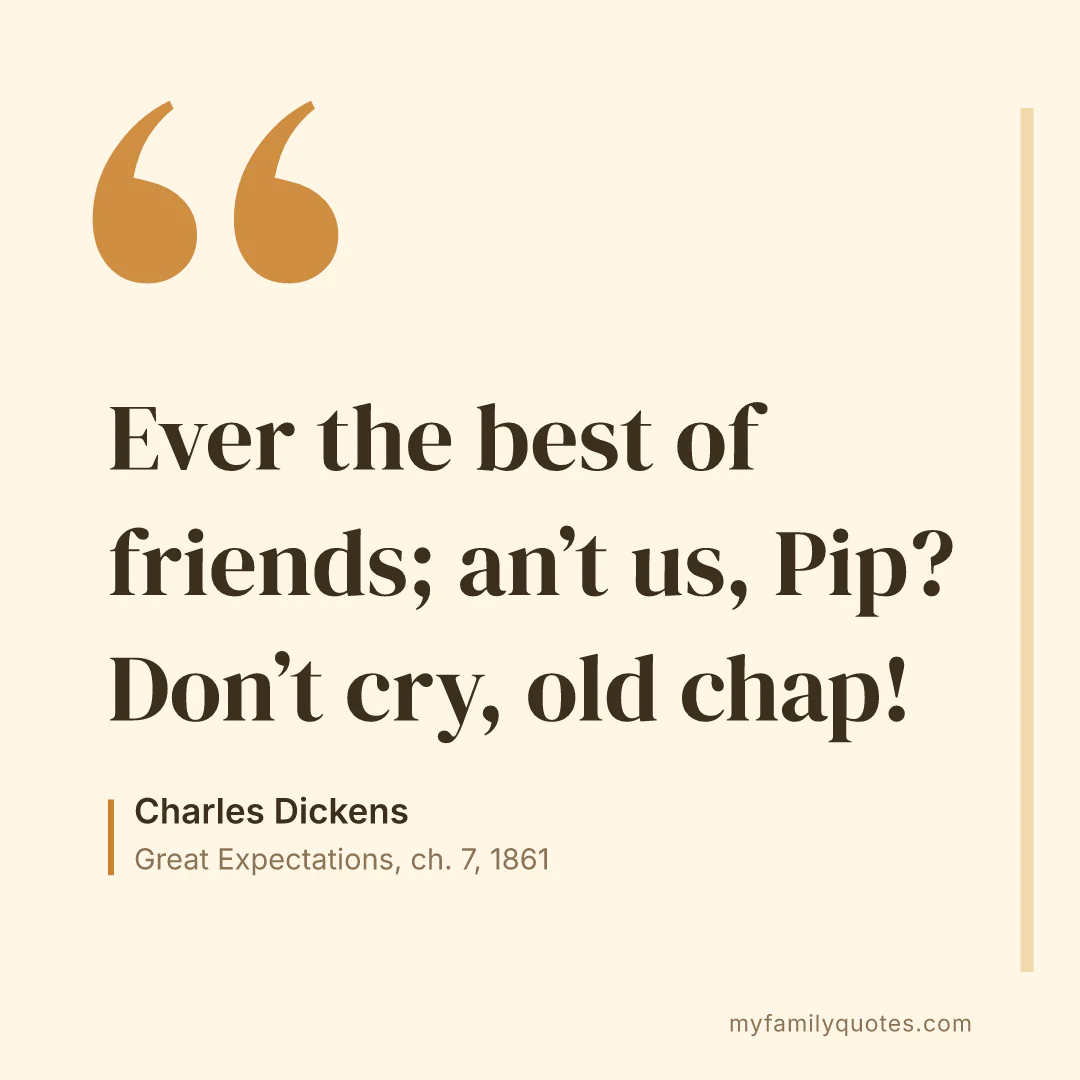
"Ever the best of friends; an't us, Pip? Don't cry, old chap!"
— Joe Gargery, Charles Dickens, Great Expectations, chapter 7 (1861)
The phrase "ever the best of friends" comes back like a refrain through the whole novel, including at Pip's sickbed in chapter 57 when Joe nurses him and refuses to talk about the past. It is the best short line on this page for a sister's husband who has been there since childhood: a birthday card, a toast at his fiftieth, or a caption under an old photo of the two of you.
In chapter 18 the lawyer Jaggers arrives to announce Pip's "great expectations" and offers Joe money for the loss of his apprentice. Joe refuses it, and the grown Pip, narrating years later, describes him in one of the most quoted images in Dickens.
"Joe laid his hand upon my shoulder with the touch of a woman. I have often thought him since, like the steam-hammer that can crush a man or pat an egg-shell, in his combination of strength with gentleness."
— Pip on Joe, Charles Dickens, Great Expectations, chapter 18 (1861)
"Strength with gentleness" is a fine thing to say about a big, quiet brother-in-law who is good with your kids. The steam-hammer was new technology when Dickens wrote, so the comparison was as modern then as a power tool would be now.
Joe's third great line comes when he visits Pip in London in chapter 27. Pip, now a would-be gentleman, is embarrassed by him, and Joe leaves early with more dignity than anyone in the room.
"Pip, dear old chap, life is made of ever so many partings welded together, as I may say, and one man's a blacksmith, and one's a whitesmith, and one's a goldsmith, and one's a coppersmith. Diwisions among such must come, and must be met as they come."
— Joe Gargery, Charles Dickens, Great Expectations, chapter 27 (1861)
This one suits a brother-in-law moving away, or a reconciliation after the two of you drifted apart. Joe's point is that different lives are not a betrayal of the bond, and the blacksmith's word "welded" makes the partings part of what holds it together.
Funny brother-in-law quotes, courtesy of Jane Austen
Austen's novels are full of the small comedy of in-laws, people who did not pick each other and have to sit at the same table anyway. The funniest line is Elizabeth Bennet's. Her youngest sister Lydia has eloped with George Wickham, the man who lied about Darcy, and the marriage has been patched up. In chapter 52 Wickham tries to fish for what Elizabeth knows; she has had enough, and closes the subject with a smile.
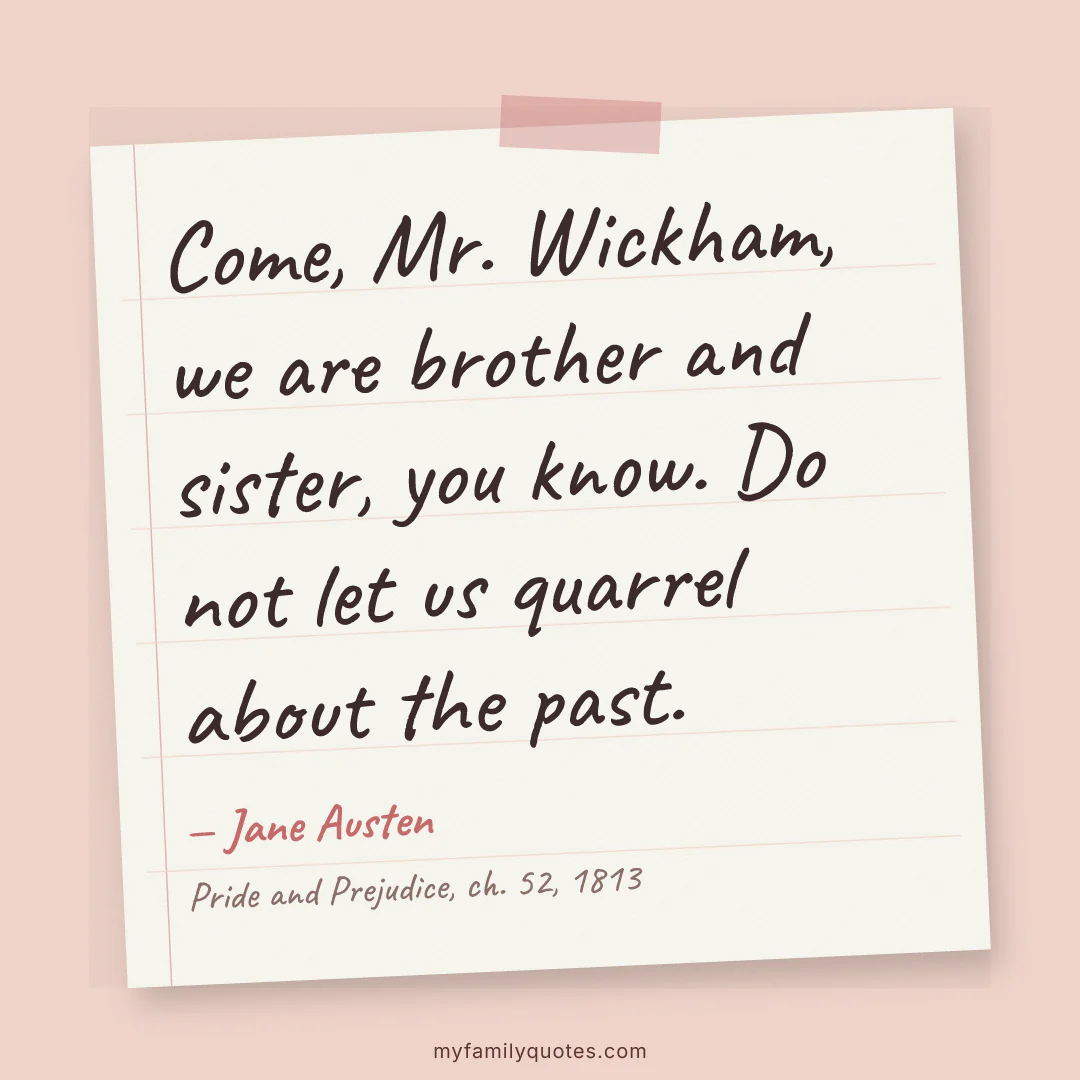
"Come, Mr. Wickham, we are brother and sister, you know. Do not let us quarrel about the past. In future, I hope we shall be always of one mind."
— Elizabeth Bennet, Jane Austen, Pride and Prejudice, chapter 52 (1813)
Austen adds that Wickham kissed her hand "though he hardly knew how to look." Use it, with a wink, for a sister's husband you were not sure about at first, or after a family argument that is finally over. Among people who know the novel it reads as both a peace offering and a gentle warning.
In Emma (published December 1815), Emma's older sister Isabella is married to John Knightley, a London lawyer who loves his family and cannot stand dinner parties. Chapter 11 introduces him with a sentence that every family has a use for.
"He was not an ill-tempered man, not so often unreasonably cross as to deserve such a reproach; but his temper was not his great perfection."
— Jane Austen on John Knightley, Emma, chapter 11 (1815)
The comedy is in the hedging: Austen defends him and convicts him in the same breath. Two sentences later she turns to Emma's side of the relationship.
"He was not a great favourite with his fair sister-in-law. Nothing wrong in him escaped her."
— Jane Austen, Emma, chapter 11 (1815)
This is the line for a sister-in-law to send her brother-in-law when they both know they keep score, or for a group chat after the holidays. Keep it affectionate: the same chapter makes clear that Emma notices every small slight to her sister, and that John is, underneath, a good husband.
Austen's fairest description of him comes in the same paragraph, about his manners toward Emma, and it is the best definition of a good brother-in-law we found anywhere.
"…they were only those of a calmly kind brother and friend, without praise and without blindness…"
— Jane Austen, Emma, chapter 11 (1815)
"Without praise and without blindness" fits the brother-in-law who never flatters you and never pretends not to see your faults, and who turns up anyway. It works in a thank-you card, especially for the kind of help that is never mentioned again.
Wedding quotes: the marriage that was meant to make two men brothers
Shakespeare's Antony and Cleopatra (written around 1606–07) dramatizes a real political marriage. In 40 BC Mark Antony married Octavia, the sister of his rival Octavius Caesar, to hold the Roman world together. In Act 2, Scene 2 Caesar's friend Agrippa proposes the match, and he says out loud what every wedding hopes for between the groom and the bride's brother.
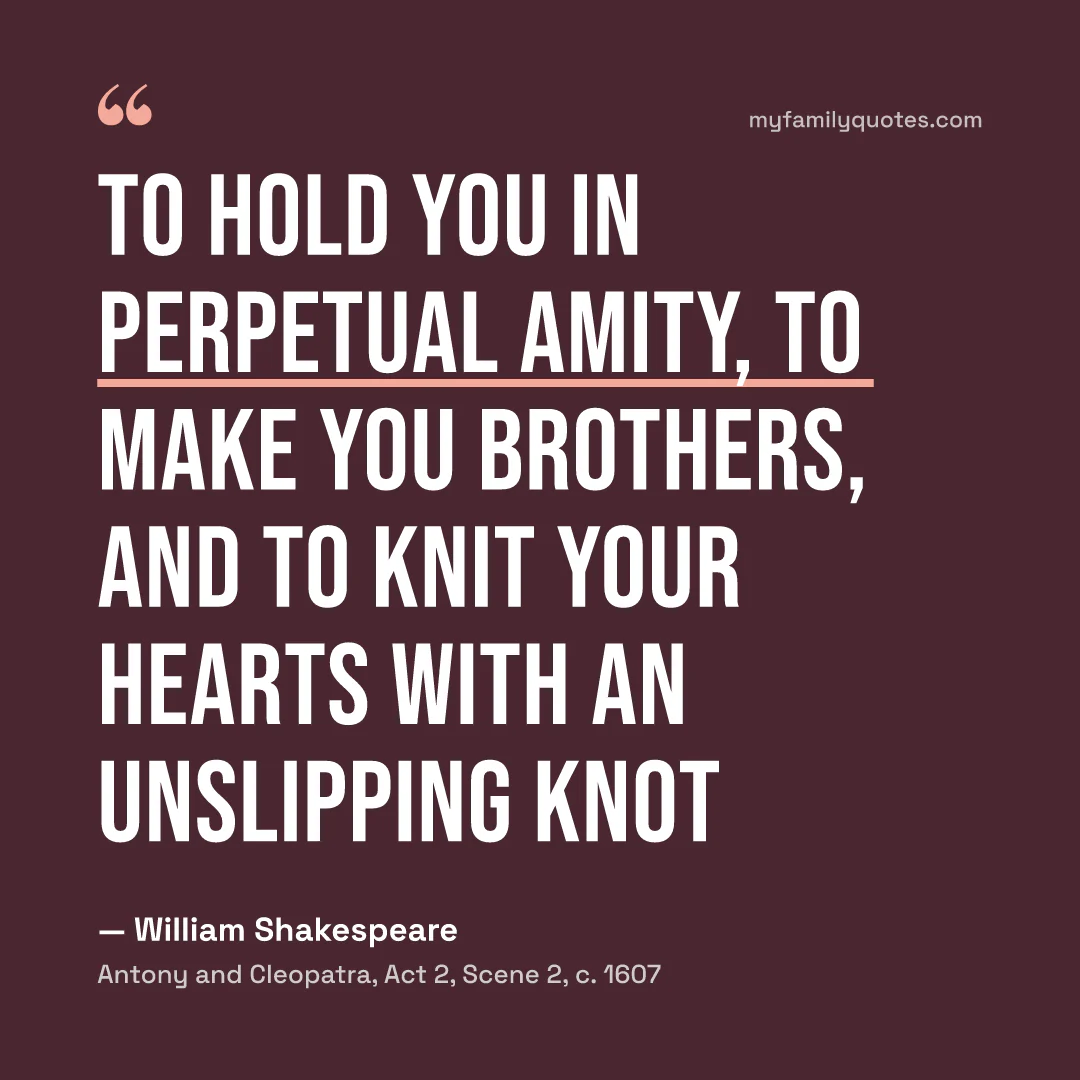
"To hold you in perpetual amity, / To make you brothers, and to knit your hearts / With an unslipping knot, take Antony / Octavia to his wife"
— Agrippa, William Shakespeare, Antony and Cleopatra, Act 2, Scene 2
"To make you brothers, and to knit your hearts with an unslipping knot" is a strong opening for a best man or a bride's brother at the reception, as long as nobody in the room knows how the play ends: Antony goes back to Cleopatra, and the brothers-in-law go to war. For a toast, the line is about the hope, not the history.
In Act 3, Scene 2 the newlyweds leave Rome, and Octavius hands his sister over with the most honest thing a bride's brother can say.
"You take from me a great part of myself. / Use me well in't."
— Octavius Caesar to Antony, William Shakespeare, Antony and Cleopatra, Act 3, Scene 2
Short, half tender and half a warning: it fits a speech by the bride's brother, or a card from him to the groom. "Use me well in't" means "treat me well in her," because she is part of him.
Bible verses about a brother-in-law
The Bible has no verse that names a "brother-in-law" in the modern sense, but two famous friendships are between men related by marriage. The first is Moses and Hobab. Numbers 10:29 calls Hobab "the son of Raguel the Midianite, Moses' father in law," which makes him Moses' wife's brother (Judges 4:11 uses the in-law word for Hobab himself, and translators still discuss the exact relationship). When Hobab wants to go home, Moses asks him to stay with the people in the wilderness.
"Leave us not, I pray thee; forasmuch as thou knowest how we are to encamp in the wilderness, and thou mayest be to us instead of eyes."
— Numbers 10:31 (KJV)
"Thou mayest be to us instead of eyes" is a lovely line for a brother-in-law who knows the way: the one who helped you move, found you a job, or knew the hospital corridors when you did not.
The second is David and Jonathan. David later married Michal, Saul's daughter and Jonathan's sister (1 Samuel 18:27), so the most famous friendship in the Bible was also a brother-in-law bond. It starts the day they meet.
"…the soul of Jonathan was knit with the soul of David, and Jonathan loved him as his own soul."
— 1 Samuel 18:1 (KJV)
Notice that Shakespeare's "knit your hearts" and the King James "knit with the soul" use the same verb for this kind of bond. Either works on a wedding card for a groom and the bride's brother who were friends first.
Brother-in-law in heaven: Tennyson's lines for the one who never got to be
Arthur Hallam, Tennyson's closest friend, was engaged to the poet's sister Emily when he died suddenly in Vienna in September 1833, aged 22. In Memoriam, published in 1850, is Tennyson's long elegy for him. In one section he imagines the brother-in-law Hallam would have become, and the nephews who were never born.
"For now the day was drawing on, / When thou should'st link thy life with one / Of mine own house, and boys of thine / Had babbled 'Uncle' on my knee"
— Alfred Tennyson, In Memoriam A.H.H., section LXXXIV (LXXXII in the first edition, 1850)
This is for a sister's husband or fiancé who died young, and for a sympathy card to a sister who lost him: it says what the family lost along with him, the future gatherings, the children, the place at the table. For more lines about grief between brothers, see our page of losing a brother quotes.
Borrowed line or your own words? A quick comparison
A quote is not always the best choice. Here is how the two compare for the most common occasions.
| Occasion | When a quote works best | When your own words work best |
|---|---|---|
| Birthday card | He likes books or old films; use Joe or Austen | You share a running joke; one line about it beats any classic |
| Wedding toast | As an opener: Agrippa's "To make you brothers" | For the middle: one true story about how you met |
| Thank-you note | "Without praise and without blindness" for quiet help | Always name the exact thing he did |
| After a falling-out | Elizabeth's "Do not let us quarrel about the past" | If the hurt was serious, skip the wit and apologize plainly |
| Sympathy card | Tennyson, for a young death | One memory of him, in a single sentence |
A simple method that works for most cards: one quote, one specific detail, one wish. Here are three short examples written by our editors (these are not quotations, so adapt them freely):
- Birthday: "Ever the best of friends, as Joe Gargery says. Thanks for twenty years of fixing things and pretending it was no trouble. Happy birthday."
- Thank you: "You were our eyes in that hospital last spring. We will not forget it. Thank you."
- New brother-in-law: "To make you brothers and to knit your hearts with an unslipping knot: welcome to the family, and good luck at Thanksgiving."
If the relationship is hard rather than just funny, our page of toxic in-laws quotes deals with that honestly. For the other in-laws in the family, see sister-in-law quotes and messages and father-in-law quotes.
Popular brother-in-law sayings with no known author
Several lines circulate on cards and image sites with no name attached. We searched for an author or first appearance and found none, so we did not count them among the 12 above. They are fine to use, but don't credit them to anyone:
- "A brother-in-law is a brother by law and a friend by choice."
- "Brothers by marriage, friends by choice."
- "My sister gave me the best brother-in-law," usually printed on mugs and T-shirts.
The first two follow the pattern of the older, equally unsigned "sister by law, friend by choice," which our sister-in-law page discusses.
Questions people ask about brother-in-law quotes
What is a good quote for a brother-in-law?
For a sister's husband who has been like a brother, Joe Gargery's "Ever the best of friends; an't us, Pip?" from Great Expectations (1861) is the warmest short line. For a wedding, Agrippa's "To make you brothers, and to knit your hearts with an unslipping knot" from Antony and Cleopatra fits a toast.
What is a good message to thank a brother-in-law?
Name exactly what he did, then add one line. Austen's description of a good brother-in-law in Emma, "a calmly kind brother and friend, without praise and without blindness," suits quiet, practical help; Moses' "thou mayest be to us instead of eyes" (Numbers 10:31) suits a brother-in-law who guided you through something.
What does the Bible say about a brother-in-law?
No verse uses the modern word, but two bonds in the Bible are between brothers-in-law: Moses asking his wife's brother Hobab to stay, "thou mayest be to us instead of eyes" (Numbers 10:31), and David and Jonathan, whose sister Michal married David; "the soul of Jonathan was knit with the soul of David" (1 Samuel 18:1).
What can I say when a brother-in-law dies?
Tennyson's lines for Arthur Hallam, who was engaged to his sister when he died, name what the family loses: "boys of thine / Had babbled 'Uncle' on my knee" (In Memoriam, 1850). In a card, add one short memory of him and offer one concrete kind of help.