Losing a Brother Quotes: 12 Lines From Poets, Letters and Scripture, With Their Stories
Words My Family Quotes Editors

Ave atque vale is Latin for "hail and farewell". The three words close a short poem the Roman poet Catullus wrote at his brother's grave, more than two thousand years ago, and they are still the most famous goodbye anyone has written to a brother. Most losing a brother quotes online come without a name or a source. The best ones were written by people who had just lost theirs, in poems and letters we can still read today.
This page gathers 12 of those lines, each checked against the text it comes from: Catullus, Alfred Tennyson (who answered Catullus after his own brother died), Charles Lamb, William Wordsworth, Mark Twain, John Keats, and two passages from the Bible, one spoken by a grieving sister. Each one comes with its story and a note on when it fits. Near the end you will find a table that matches a line to a moment, and a short guide to writing a sympathy card for someone who has lost a brother. If you need one line right now, take Tennyson's: "True brother, only to be known / By those who love thee best."
"Hail and farewell": the poem Catullus wrote at his brother's grave
Catullus's brother died far from home, near Troy, in what is now Turkey. We know this from another of his poems (number 68), where he calls Troy "the common grave of Asia and of Europe" and says it took his brother. Poem 101 is the visit to that grave. It is ten lines long in Latin, and every translation since has tried to keep its plainness. The version below is the 1894 prose translation by Leonard C. Smithers, printed alongside Sir Richard Burton's verse.
"Through many a folk and through many waters borne, I am come, brother, to thy sad grave, that I may give the last gifts to the dead, and may vainly speak to thy mute ashes, since fortune hath borne from me thyself."
— Catullus, Poem 101, prose translation by Leonard C. Smithers (The Carmina of Caius Valerius Catullus, London, 1894)
The key word is "vainly". Catullus knows that talking to ashes changes nothing, and he talks anyway. That is the honest center of grief for a brother: the long journey, the ritual, and the knowledge that the person you came for cannot hear you. This line suits a eulogy that starts with a confession ("I know he can't hear this"), or a card for someone who travelled a long way to a funeral.
"But now these gifts, which of yore, in manner ancestral handed down, are the sad gifts to the grave, accept thou, drenched with a brother's tears, and for ever, brother, hail! for ever, adieu!"
— Catullus, Poem 101, closing lines, prose translation by Leonard C. Smithers (1894); Latin: atque in perpetuum, frater, ave atque vale
The ending turns a Roman funeral formula into something personal. "Ave" was a greeting and "vale" a goodbye, and Catullus says both to his brother in one breath, "for ever". That is why the Latin phrase still appears on headstones and in memorial notices. If you want a very short line for an engraving, a tattoo or a remembrance post, the Latin frater, ave atque vale ("brother, hail and farewell") is about as old and as true as a brother's goodbye gets.
How Tennyson answered Catullus after his own brother died
Charles Tennyson Turner, Alfred Tennyson's elder brother and a poet himself, died on 25 April 1879. Alfred wrote a poem to stand at the front of his brother's sonnets and dated it "Midnight, June 30, 1879": a wet, cold June, a cuckoo calling outside, and the poet awake. Both poems below are printed in Tennyson's Tiresias and Other Poems (London, Macmillan, 1885), one directly after the other.
"And thou hast vanish'd from thine own
To that which looks like rest,
True brother, only to be known
By those who love thee best."
— Alfred Tennyson, "Prefatory Poem to My Brother's Sonnets", dated Midnight, June 30, 1879 (Tiresias and Other Poems, 1885)
"Only to be known by those who love thee best" says something every family in mourning learns at the funeral: the public picture of a man is never the whole of him. Charles was a quiet country clergyman whose poems were far less famous than his brother's, and Alfred is saying that the real Charles belonged to the family. It is a good line for a brother who was private, shy or overlooked, and for anyone who feels the eulogies missed who he really was.

"When all my griefs were shared with thee,
As all my hopes were thine—
As all thou wert was one with me,
May all thou art be mine!"
— Alfred Tennyson, closing stanza of "Prefatory Poem to My Brother's Sonnets", 1879 (Tiresias and Other Poems, 1885)
The poem ends by remembering "the light of days when life begun", sixty years back, when the two boys shared everything. The last line is a wish, not a statement: may whatever you are now still be part of me. For a brother who was also a best friend, it is one of the warmest goodbyes in English. Use the whole stanza in a memorial booklet, or only the last line for an engraving.
"Came that 'Ave atque Vale' of the Poet's hopeless woe,
Tenderest of Roman poets nineteen-hundred years ago,
'Frater Ave atque Vale'—as we wander'd to and fro
Gazing at the Lydian laughter of the Garda Lake below"
— Alfred Tennyson, "Frater Ave atque Vale" (Tiresias and Other Poems, 1885)
Here Tennyson is rowed across Lake Garda to Sirmione, where Catullus had a villa, and the Roman's goodbye to his brother comes back to him among the olive groves and ruins. Placed right after the poem for Charles, it reads as one grieving brother recognizing another across nineteen centuries. That is the quiet comfort in this page's oldest line: people have felt exactly this before, and found words for it.
"I missed his crossness": grief that arrives late
Charles Lamb's elder brother John died on 26 October 1821. A few months later, in January 1822, the London Magazine printed Lamb's essay "Dream-Children; A Reverie", in which he tells two imaginary children about their "uncle, John L——". The facts come from E. V. Lucas's notes to the Elia essays, which also quote Lamb writing to Wordsworth in March 1822: "Deaths over-set one, and put one out long after the recent grief."
"...and how when he died, though he had not been dead an hour, it seemed as if he had died a great while ago, such a distance there is betwixt life and death; and how I bore his death as I thought pretty well at first, but afterwards it haunted and haunted me..."
— Charles Lamb, "Dream-Children; A Reverie" (London Magazine, January 1822; collected in Essays of Elia)
Many people who lose a brother say the same thing, and feel guilty about it: at first they coped "pretty well", and only later did the loss start to haunt them. Lamb gives that delay a name and a place. This is a good line to send to someone a few months after the funeral, when the cards have stopped and the grief has just started.
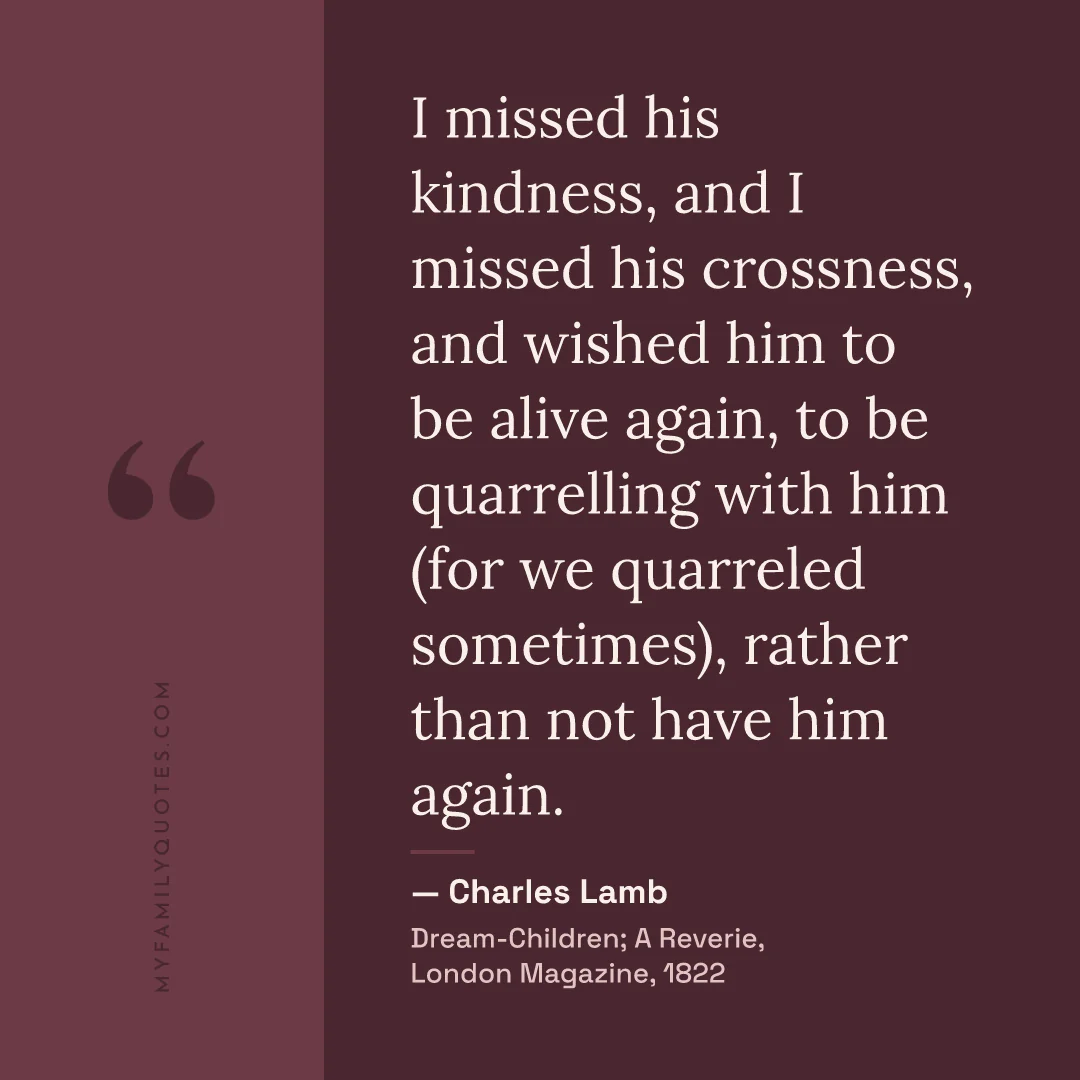
"I missed his kindness, and I missed his crossness, and wished him to be alive again, to be quarrelling with him (for we quarreled sometimes), rather than not have him again."
— Charles Lamb, "Dream-Children; A Reverie" (1822)
This may be the most honest sentence ever written about a brother. Lamb doesn't pretend John was a saint; Lucas's notes say he could be loud enough that he once knocked the critic William Hazlitt down in an argument about painting. What Lamb misses is the whole person, crossness included. Use it for a brother you fought with, or when someone feels they can't grieve properly because the relationship was complicated.
When a brother dies suddenly
Some losses come without warning. On 5 February 1805 the East Indiaman Earl of Abergavenny was wrecked in Weymouth Bay, and its captain, John Wordsworth, went down with his ship. He was the poet William Wordsworth's younger brother. Later Wordsworth looked at a painting of Peele Castle in a storm by his friend Sir George Beaumont, and wrote about how the loss had changed the way he saw the sea.
"So once it would have been,—'tis so no more;
I have submitted to a new controul:
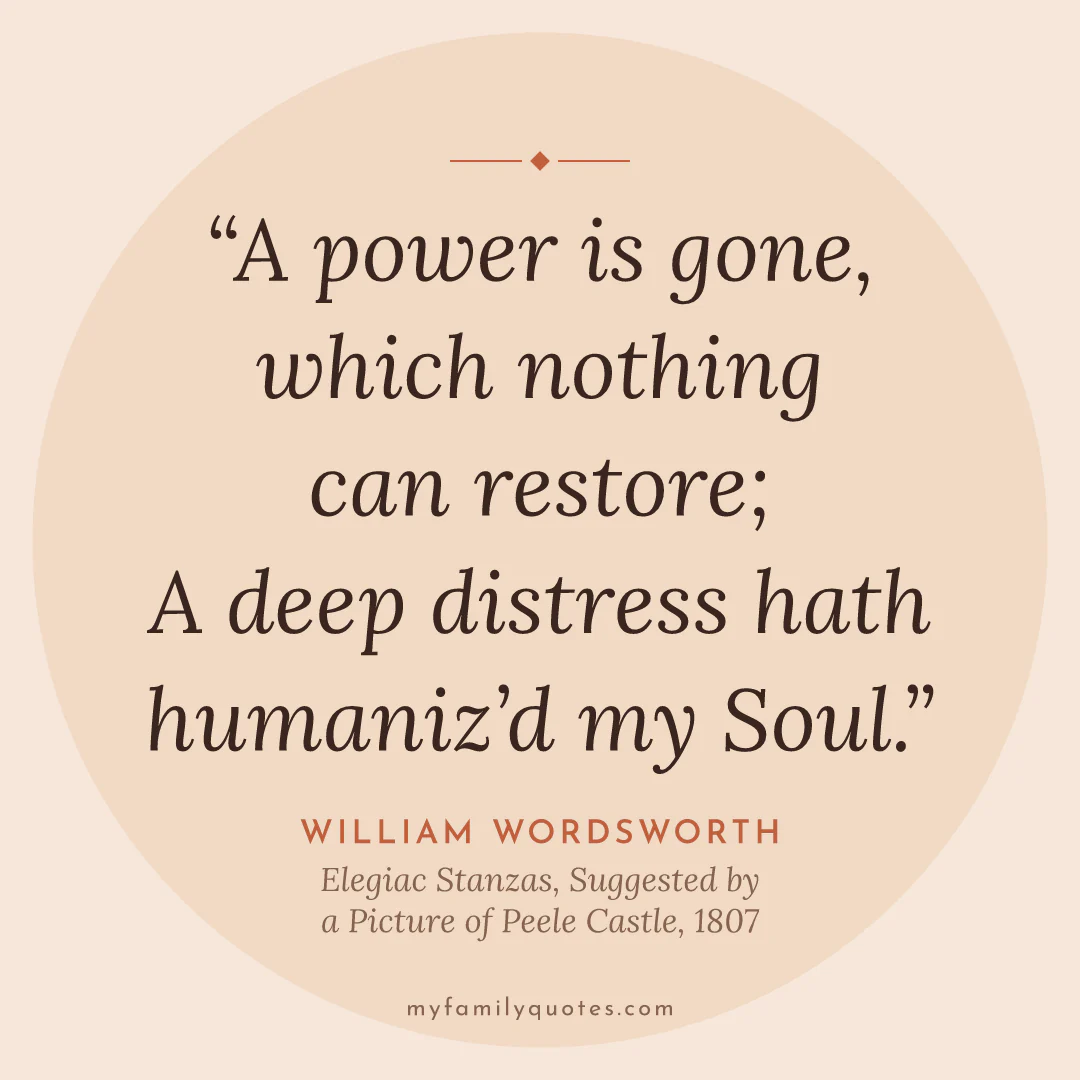
A power is gone, which nothing can restore;
A deep distress hath humaniz'd my Soul."
— William Wordsworth, "Elegiac Stanzas, Suggested by a Picture of Peele Castle, in a Storm, painted by Sir George Beaumont" (Poems, in Two Volumes, 1807)
Before, Wordsworth says, he would have painted the castle on a calm sea. Now he can't, and a few lines later he adds: "The feeling of my loss will ne'er be old." What makes the stanza useful is the word "humaniz'd": the grief did not only break something, it made him gentler with other people's pain. That is a line for someone who wants to say that a brother's death changed them for good, without pretending it got better.
Mark Twain lost his younger brother Henry in the same sudden way. Henry worked on the Mississippi steamboat Pennsylvania, and in June 1858 its boilers exploded below Memphis. Sam Clemens, who had left the boat after a fight with its pilot, reached Memphis on another steamer and sat by his brother's bed for two days. Before Henry died, he wrote to his sister-in-law Mollie:
"Long before this reaches you, my poor Henry my darling, my pride, my glory, my all, will have finished his blameless career, and the light of my life will have gone out in utter darkness. (O, God! this is hard to bear.)"
— Mark Twain (Samuel Clemens), letter to Mrs. Orion Clemens, Memphis, Tenn., Friday, June 18th, 1858 (Mark Twain's Letters, vol. 1, ed. Albert Bigelow Paine, 1917)
Paine, who edited the letters, writes that Clemens "had idolized the boy, and regarded himself responsible for his death". The letter is raw and it is not polished prose; the parenthesis is a cry, not a figure of speech. That is its value. For someone who lost a younger brother in an accident, it shows that even the most famous humorist in America had no clever words at that moment. Quote the first sentence on a memorial page, and leave the rest of the grief to the reader.
After a long illness
John Keats nursed his younger brother Tom through tuberculosis in the autumn of 1818. Tom died on 1 December. Keats then had to write the news to their brother George, who had emigrated to America with his new wife Georgiana.
"The last days of poor Tom were of the most distressing nature; but his last moments were not so painful, and his very last was without a pang. I will not enter into any parsonic comments on death—yet the common observations of the commonest people on death are as true as their proverbs. I have scarce a doubt of immortality of some nature or other—neither had Tom."
— John Keats, letter to George and Georgiana Keats, Hampstead, December 1818 (Letters of John Keats to His Family and Friends, ed. Sidney Colvin, 1891, dated there "about Dec. 18, 1818")
This is what a brother writes to another brother: the practical facts first (the end was peaceful), then a refusal to preach, then a small, firm hope. "Neither had Tom" is the most touching part, because Keats ends a sentence about faith with what his brother believed. If your brother died after a long illness, this is a line to share with the siblings who could not be there, and it works in a funeral programme as well.
Losing a brother in the Bible, from a friend and from a sister
Two Bible passages are quoted at funerals for brothers more than any others. The first is David's lament for Jonathan. Jonathan was not David's brother by birth (he was the son of King Saul, and David married Saul's daughter Michal, so they were brothers-in-law), but David calls him "my brother", and the lament has been read for brothers ever since.
"I am distressed for thee, my brother Jonathan: very pleasant hast thou been unto me: thy love to me was wonderful, passing the love of women."
— 2 Samuel 1:26 (King James Version)
"Very pleasant hast thou been unto me" is a simple, generous thing to say about a brother, and it fits a memorial card for anyone who was a brother in all but blood: a best friend, a brother-in-law, a comrade. Some families stop before "passing the love of women"; that is a matter of taste, and the first two clauses stand on their own.
"Then said Martha unto Jesus, Lord, if thou hadst been here, my brother had not died."
— John 11:21 (King James Version)
This is the line for losing a brother from a sister's side. Martha and Mary's brother Lazarus has been in the grave four days, and both sisters say these exact words when Jesus arrives (Mary repeats them in verse 32). It is not a polite line; it is a complaint, the "if only" that every sister and brother feels after a death. A few verses later comes the shortest verse in the Bible, "Jesus wept" (John 11:35), and many people pair the two in a sympathy card: grief is allowed, even here. For more lines written by sisters about their brothers while they were alive, see our page of brother quotes from a sister.
Which line for which moment
| Moment | Line | From |
|---|---|---|
| Engraving, tattoo or headstone | "Frater, ave atque vale" (brother, hail and farewell) | Catullus, Poem 101 |
| Opening a eulogy | "… and may vainly speak to thy mute ashes …" | Catullus, Poem 101 |
| A private or overlooked brother | "True brother, only to be known / By those who love thee best." | Tennyson, 1879 |
| A brother who was a best friend | "As all thou wert was one with me, / May all thou art be mine!" | Tennyson, 1879 |
| A complicated relationship | "I missed his kindness, and I missed his crossness …" | Lamb, 1822 |
| Months after the funeral | "… afterwards it haunted and haunted me …" | Lamb, 1822 |
| A sudden death that changed you | "A deep distress hath humaniz'd my Soul." | Wordsworth, 1807 |
| A younger brother lost in an accident | "… the light of my life will have gone out …" | Twain, 1858 |
| After a long illness | "I have scarce a doubt of immortality … neither had Tom." | Keats, 1818 |
| A brother-in-law or brother in all but blood | "Very pleasant hast thou been unto me" | 2 Samuel 1:26 |
| A sister's grief | "Lord, if thou hadst been here …" | John 11:21 |
What to write in a sympathy card for someone who lost a brother
The hardest card to write is not to your own family but to a friend whose brother has died. A quote helps, but it should not do all the work. Three short parts are enough:
- Say his name. "I'm so sorry about Danny" is warmer than "I'm sorry for your loss". People who have lost a brother often say the worst part is that others stop using his name.
- Add one true detail, if you have one. A memory of him, something your friend told you about him, or simply what you know of the two of them together. If you never met him, say so and ask to hear about him later.
- Offer the line, then something practical. Put one quote from the table above, with the name under it, and close with an offer you will keep: a meal, a walk, a call next month when the cards stop. Lamb's essay is the reason to make that later call.
Three examples built that way, written by our editors for this page (not quotations, so use and change them freely):
- For a friend: "I'm so sorry about Danny. You always lit up when you talked about your big brother and his terrible jokes. Tennyson wrote of his own brother that he was 'only to be known by those who love thee best'. I'd love to hear more about him whenever you're ready."
- For a coworker: "Thinking of you and your family as you say goodbye to your brother. There is an old Latin goodbye, 'ave atque vale', hail and farewell. I hope the days ahead hold more of the first word than the second."
- From a sibling to a sibling: "We lost the one who knew every version of us. I miss his kindness and I even miss his crossness, like Lamb said. Let's keep telling his stories, the good ones and the ridiculous ones."
Avoid "he's in a better place" unless you know the family shares that belief, and avoid comparing losses ("I know exactly how you feel"). If the death was sudden or by suicide, a short card with his name and your offer of help is better than any quote. For lines to send on the hard dates later, our death anniversary quotes page explains how to mark the first year, and the same advice works for a brother.
The brother quote that is really about Cain and Abel
The most shared line on brother pages is "A brother is a friend given by nature." It is usually printed without a source. It is a translation of a French verse, Un frère est un ami donné par la nature, which the Larousse dictionary attributes to the poet Gabriel-Marie Legouvé (1764–1812). The Larousse entry adds a twist: Legouvé is said to have borrowed the line from a contemporary named Beaudoin. And the play it comes from, La Mort d'Abel, is about Cain killing his brother. The line is fine to use, but it is not the comforting proverb it looks like, and it has no place on a page about grief unless you mean the irony.
Other popular lines, such as "Those we love don't go away, they walk beside us every day", have no author we could find at all. They are fine as captions, but don't put a famous name under them. Our list of misattributed family quotes tracks more lines like these.
Questions people ask about losing a brother
What is a heartfelt quote about losing a brother?
Charles Lamb's line about his elder brother John is one of the most heartfelt because it is so honest: "I missed his kindness, and I missed his crossness, and wished him to be alive again." For something shorter, Tennyson's "True brother, only to be known / By those who love thee best" was written in the weeks after his own brother died.
What can I say about my brother who passed away?
Say something only you could say: one habit, one story, one thing he taught you. Then, if you want a classic line, add Catullus's goodbye, "brother, hail and farewell", or Tennyson's "May all thou art be mine!" Both were written by men speaking to their own brothers.
What is a short quote for a brother who died?
The shortest is the Latin frater, ave atque vale, "brother, hail and farewell", from Catullus's Poem 101. In English, Wordsworth's "A deep distress hath humaniz'd my Soul" and David's "very pleasant hast thou been unto me" both fit on a card or a headstone.
What does the Bible say about losing a brother?
Two passages are read most often. In 2 Samuel 1:26 David mourns Jonathan: "I am distressed for thee, my brother Jonathan: very pleasant hast thou been unto me." In John 11:21 Martha tells Jesus, "Lord, if thou hadst been here, my brother had not died", a few verses before "Jesus wept".
Brothers and sisters lose each other at every age, and the lines above can also help after the loss of a sister. Our page of unconditional sibling love quotes has a section on what to say when a sibling has died, including Cassandra Austen's letter about her sister Jane. If your family has lost a parent as well, our sympathy quotes for the loss of a mother are sourced the same way.