Quotes for Niece From Aunt: 12 Real Lines From Austen, Brontë and Woolf, and What to Write Her
Words My Family Quotes Editors
Most of the aunt-and-niece quotes passed around on cards and pins have no author at all. The relationship itself is well documented, though, and some of the best writing about it was never meant for publication: Jane Austen's letters to her niece Fanny Knight, a letter Charlotte Brontë wrote to the aunt who raised her, and Virginia Woolf's account of what an aunt's money did for her. Novelists wrote the other side too, the aunt who gives good advice and the aunt a niece never forgives.
Below are 12 quotes for a niece from an aunt (and a few going the other way), each traced to the letter, book and chapter it comes from and checked against the full text. For each one we explain the situation it was written in and where it fits: a birthday card, a graduation note, a wedding, or a caption. If you need one line right now, take Austen's to her 24-year-old niece: "You are worth your weight in gold, or even in the new silver coinage."
The 12 aunt and niece quotes at a glance
| Line (short form) | Who wrote it, to whom | Use it for |
|---|---|---|
| "… worth your weight in gold" | Jane Austen to her niece Fanny Knight, February 1817 | Birthday card, any age |
| "… too agreeable as a niece" | Austen to Fanny, February 1817 | Engagement or wedding card, with a wink |
| "Do not be in a hurry, the right man will come at last" | Austen to Fanny, March 1817 | A niece after a breakup |
| "Anything is to be preferred or endured rather than marrying without affection" | Austen to Fanny, November 1814 | Advice you mean seriously |
| "… wisdom is better than wit" | Austen to Fanny, November 1814 | Graduation, a first job |
| "… Aunt Cassandras are quite as scarce as Miss Beverleys" | Austen to her sister Cassandra, January 1809 | Funny line from aunt to aunt |
| "You are too sensible a girl, Lizzy …" | Mrs. Gardiner, Pride and Prejudice, ch. 26 | Gentle advice before a big decision |
| "I am the happiest creature in the world" | Elizabeth to her aunt, Pride and Prejudice, ch. 60 | A niece's news to her aunt |
| "… who ever rose in the world without ambition?" | Charlotte Brontë to her aunt Elizabeth Branwell, 1841 | Thanking an aunt who backed your plans |
| "… my aunt's legacy unveiled the sky to me" | Virginia Woolf, A Room of One's Own, 1929 | Graduation gift, a niece starting out |
| "I will never call you aunt again" | Jane to Mrs. Reed, Jane Eyre, ch. 4 | Understanding a broken aunt-niece bond |
| "… you have my full and free forgiveness" | Jane to Mrs. Reed, Jane Eyre, ch. 21 | Making peace late |
"Do not be in a hurry": Jane Austen's letters to her niece Fanny
Jane Austen never married and had no children, but she was an aunt many times over, and the niece she wrote to most frankly was Fanny Knight, the eldest of her brother Edward's eleven children. In November 1814 Fanny, then 21, wrote to her aunt for advice about a suitor, John Plumptre, whom she had encouraged and then cooled on. Austen's reply, written from Chawton on 18 November, argues his case at length: steady character, good principles, a fine scholar. Then it turns.
"Anything is to be preferred or endured rather than marrying without affection." — Jane Austen, letter to Fanny Knight, 18 November 1814, in The Letters of Jane Austen (Brabourne edition, selected by Susan Coolidge, 1892)
This is the line people remember, and it is the honest centre of the letter: she has spent pages making the case for the man, and she still tells her niece not to accept him unless she really loves him. It suits a niece who is being pushed toward a decision by everyone else. Write it in a card only if you are ready to stand behind it; it reads as real advice, not a pleasantry.
Earlier in the same letter there is a lighter line. Austen expected Fanny to measure the earnest suitor against her quick-witted brothers ("your agreeable, idle brothers", she calls them), and she answered that worry in advance:
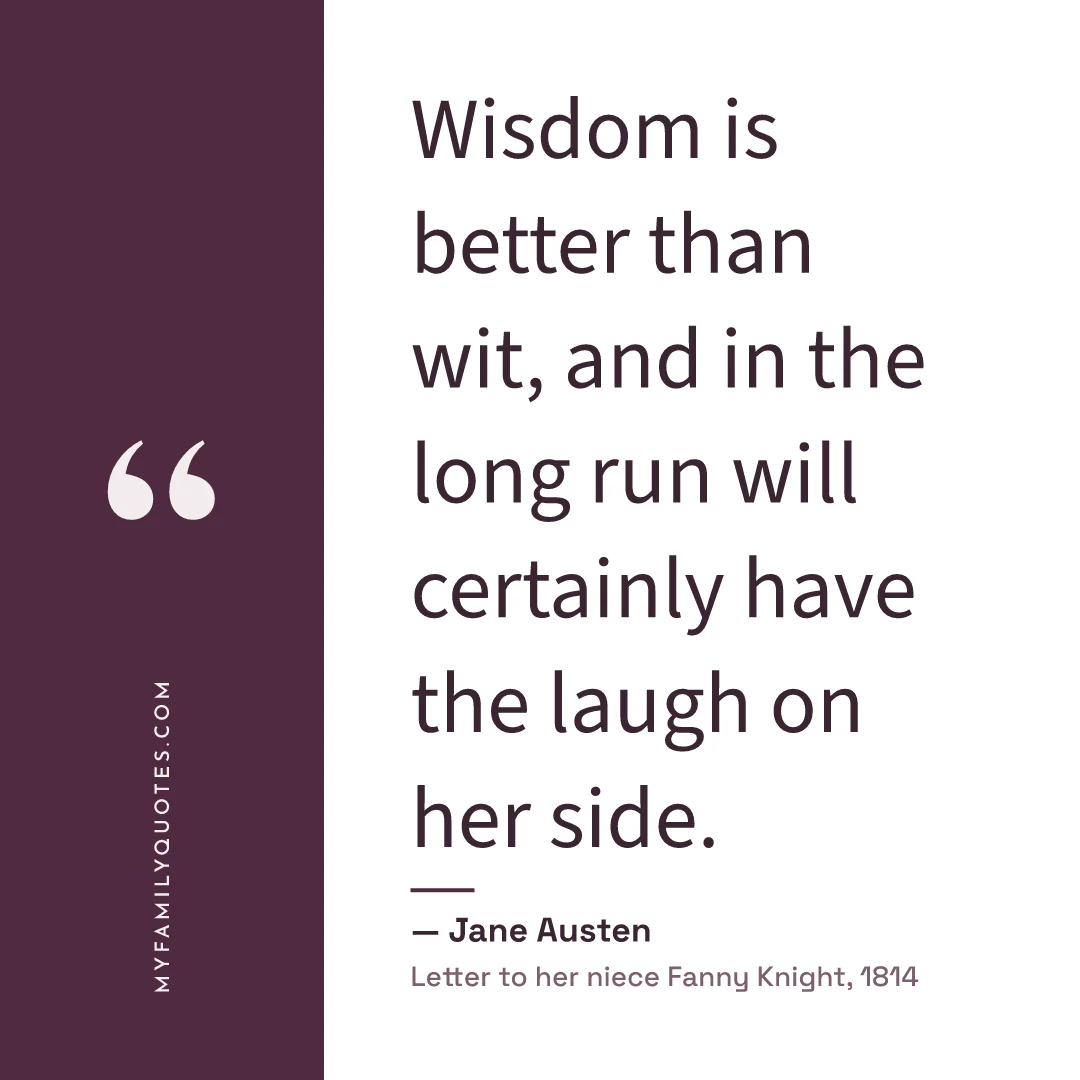
"… wisdom is better than wit, and in the long run will certainly have the laugh on her side." — Jane Austen, letter to Fanny Knight, 18 November 1814
From the writer of Pride and Prejudice, of all people, the preference for wisdom over wit carries weight. It works for a niece's graduation or first job, when the people who sparkle in the room are not always the ones who do well over time.
Two years later Fanny was still single and still writing her aunt long letters about her heart. Austen, by now ill, answered on 20 February 1817 with one of the most affectionate letters she ever wrote to a niece. (The 1892 selection prints the date as 1816; Deirdre Le Faye's Oxford edition of the letters dates it 20–21 February 1817.)
"You are too agreeable in your single state,—too agreeable as a niece. I shall hate you when your delicious play of mind is all settled down into conjugal and maternal affections." — Jane Austen, letter to Fanny Knight, 20 February 1817
It is a joke with real feeling in it: an aunt admitting she will miss the niece she has now once marriage takes her. It makes a lovely, slightly mischievous line for an engagement card or a bridal shower from an aunt, as long as the bride knows you are teasing.
The last letter in this group was written on 13 March 1817, four months before Austen died. Fanny was afraid she would never meet the right person. Her aunt's answer is the one to send after a breakup:
"To you I shall say, as I have often said before, Do not be in a hurry, the right man will come at last …" — Jane Austen, letter to Fanny Knight, 13 March 1817
She was right, as it happens: Fanny married Sir Edward Knatchbull in 1820. "As I have often said before" is the part that makes the line an aunt's line. It is advice repeated patiently, the way only someone outside the parent-child argument can repeat it.
Funny aunt and niece quotes, from the same letters
Austen's affection usually came with a joke attached. The February 1817 letter opens with a burst of praise for Fanny's "entertaining letters", and then this:
"You are worth your weight in gold, or even in the new silver coinage." — Jane Austen, letter to Fanny Knight, 20 February 1817
Britain was replacing its worn silver coins at the time, and the joke is that she raises the price in mid-sentence. It is our favourite birthday line for a niece because it is warm without being sugary, works at 8 or 48, and fits on a gift tag. Try "worth your weight in gold, or even in the new silver coinage, as Jane Austen told her niece" under a photo of the two of you.
Austen was also on the other side of the aunt bond: her sister Cassandra was aunt to the same nieces and nephews and often stayed with them. In January 1809 Jane, writing from Southampton to Cassandra at Edward's house in Kent, signed off one paragraph like this:
"Take care of your precious self; do not work too hard. Remember that Aunt Cassandras are quite as scarce as Miss Beverleys." — Jane Austen, letter to Cassandra Austen, 24 January 1809
Miss Beverley is the heroine of Fanny Burney's novel Cecilia, a rich and admired young woman; the edition's footnote explains the reference. Swap in any name and you have a funny card for a sister who has just become an aunt, or for the aunt everyone in the family relies on.
The aunt who gives the best advice: Mrs. Gardiner and Elizabeth Bennet
In Pride and Prejudice (1813), Elizabeth's mother is no help at all, and the adult she confides in is her aunt, Mrs. Gardiner, Mrs. Bennet's sister-in-law. When Mrs. Gardiner sees Elizabeth drawn to the charming, penniless Wickham, she takes her aside in chapter 26.
"You are too sensible a girl, Lizzy, to fall in love merely because you are warned against it; and, therefore, I am not afraid of speaking openly." — Mrs. Gardiner, Pride and Prejudice, ch. 26 (1813)
This is how good aunt advice works: it starts by trusting the niece. Mrs. Gardiner does not forbid anything; she tells Elizabeth she is clever enough to hear the truth. It is a useful opening line for a note before a big decision (a move, a job offer, a relationship you have doubts about), followed by what you actually think.
The reward comes at the end of the novel. When Elizabeth is engaged to Darcy, the person she writes to first, at length, is her aunt.
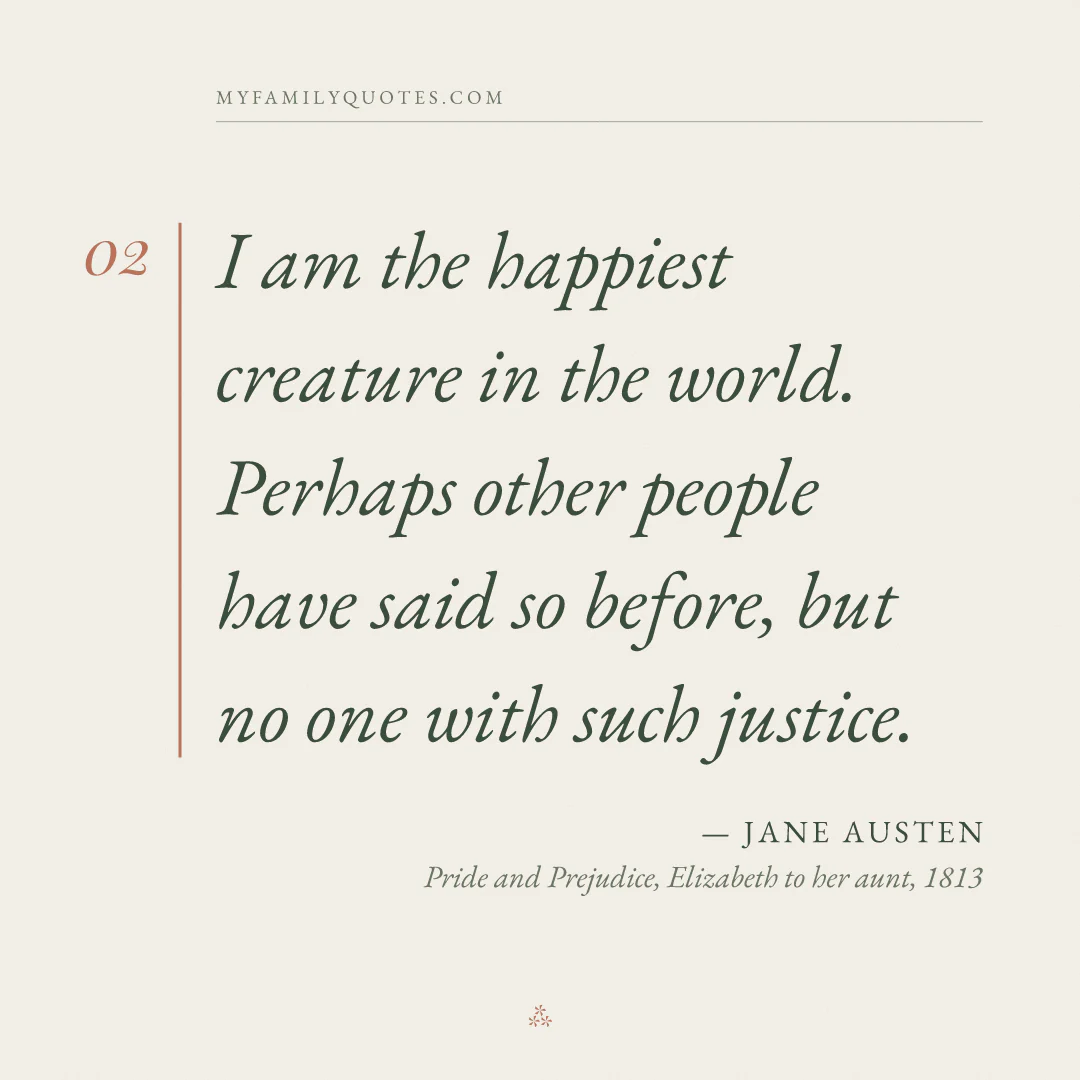
"I am the happiest creature in the world. Perhaps other people have said so before, but no one with such justice. I am happier even than Jane; she only smiles, I laugh." — Elizabeth Bennet, letter to Mrs. Gardiner, Pride and Prejudice, ch. 60
"She only smiles, I laugh" is a perfect caption for a niece announcing an engagement to the aunt who saw it coming. The aunt can quote it back, too, in the wedding card: Elizabeth's letter also invites the Gardiners to Pemberley for Christmas, which is the point. The aunt who gave the hard advice is the one who gets the happy letter.
From a niece to the aunt who raised her: Charlotte Brontë's 1841 letter
After the Brontë children lost their mother, her sister Elizabeth Branwell came to Haworth and ran the household. In September 1841 Charlotte, then 25 and working as a governess, wanted to borrow money from her aunt to study in Brussels with Emily, so that the sisters could open their own school. Elizabeth Gaskell printed the letter in full in The Life of Charlotte Brontë (1857), describing it as written with "a suppressed eagerness". It ends:
"Papa will, perhaps, think it a wild and ambitious scheme; but who ever rose in the world without ambition? When he left Ireland to go to Cambridge University, he was as ambitious as I am now. I want us all to get on. I know we have talents, and I want them to be turned to account. I look to you, aunt, to help us." — Charlotte Brontë, letter to Elizabeth Branwell, 29 September 1841, in Elizabeth Gaskell, The Life of Charlotte Brontë, ch. 10 (1857)
Aunt Branwell said yes, and the sisters went to Brussels in 1842. She died that autumn while they were away; Gaskell writes that she "had done her part well in their household for nearly twenty years". The letter is the best answer we know to "how do I thank the aunt who believed in me": be specific about what she made possible. "I look to you, aunt, to help us" works as a heading for a thank-you note, a toast, or a graduation speech that mentions her.
Quotes for a niece's graduation: Virginia Woolf on an aunt's gift
In A Room of One's Own (1929), Woolf's narrator explains that she can afford to think because an aunt left her five hundred pounds a year. The aunt in the book, "Mary Beton", is invented, but the idea had a source in Woolf's life: her real aunt, the Quaker writer Caroline Emelia Stephen, died in 1909 and left her niece £2,500.
"Indeed my aunt's legacy unveiled the sky to me, and substituted for the large and imposing figure of a gentleman, which Milton recommended for my perpetual adoration, a view of the open sky." — Virginia Woolf, A Room of One's Own, ch. 2 (1929)
A few paragraphs earlier the narrator puts it more bluntly: the news of the legacy reached her at about the time women won the vote, and "the money, I own, seemed infinitely the more important." Both lines suit a graduation card from an aunt who is giving money or paying toward a first flat. The message underneath is Woolf's whole argument: independence is what lets a young woman think for herself. Keep the first sentence, "my aunt's legacy unveiled the sky to me", if you need it short.

When the aunt was the problem: Jane Eyre and Mrs. Reed
Not every aunt is a Mrs. Gardiner. Charlotte Brontë's Jane Eyre (1847) opens with an orphan raised, badly, by her aunt by marriage, Mrs. Reed. At ten, about to be sent off to school, Jane finally answers back.
"I am glad you are no relation of mine: I will never call you aunt again as long as I live." — Jane Eyre to Mrs. Reed, Jane Eyre, ch. 4 (1847)
Readers who grew up with a cold or cruel aunt often find this scene oddly comforting: a child refusing a family title that was never earned. It is a line to understand, not to send. If you are dealing with a relative like this now, our guide to quotes for toxic in-laws and the relatives who married in covers the practical side.
Years later Jane goes back when Mrs. Reed is dying, and the novel does not pretend the aunt changes. Jane forgives her anyway.
"Love me, then, or hate me, as you will," I said at last, "you have my full and free forgiveness: ask now for God's, and be at peace." — Jane Eyre, Jane Eyre, ch. 21
This is the line for a niece making peace late with an aunt who hurt her, perhaps at a hospital bedside or in a letter that may not get an answer. Forgiveness here does not depend on the other person's response, which is what makes it bearable to give.
Birthday quotes for a niece from an aunt: picking the line and writing the card
Birthday cards are where most people need a niece quote, so here is a short way to use the lines above.
- Match the line to her age. For a child, use something you can explain in one sentence ("worth your weight in gold"). For a teenager or young adult, the advice lines land better: "wisdom is better than wit" or "Do not be in a hurry".
- Say who said it and to whom. "Jane Austen wrote this to her niece in 1817" turns a nice line into a small story, and she may look it up.
- Add one memory of your own. A trip, a joke, the first time she beat you at a game. One real detail does more than three adjectives.
- End with a promise, not a compliment. Aunts are good at being available: "Call me before you call your mother if you need to" says more than "you're amazing."
Three short messages our editors wrote to show the pattern (adapt the details):
- "Happy 10th birthday! Jane Austen once told her niece she was 'worth your weight in gold, or even in the new silver coinage.' Same goes for you, and you're getting heavier. Love, Auntie."
- "Happy 18th. Here's the best advice one aunt ever gave a niece: 'Do not be in a hurry, the right man will come at last.' Swap 'man' for whatever you're waiting for. I'll be here either way."
- "Congratulations, graduate. Virginia Woolf said her aunt's gift 'unveiled the sky' to her. I hope this small one does a bit of the same."
Uncles, nephews and the rest of the family
This page is about nieces and their aunts. For the other relationships, see our sourced uncle quotes, the aunt quotes from Austen, Dickens and Wodehouse (including more of Austen's letters to her nieces and nephews), and aunt to be quotes for when the niece hasn't arrived yet. For a line that works for both a niece and a nephew, Austen's "worth your weight in gold" needs no change at all.
Niece sayings we did not include
Several popular lines, such as "A niece is a little bit of childhood that never goes away", circulate on gift sites and pins without any author or source. We searched for an original and found none, so they are not on this list. They are fine to use as your own words; just don't credit them to anyone. Our page on misattributed family quotes explains how these anonymous sayings pick up famous names.
Questions readers ask about aunt and niece quotes
What are some cute quotes about nieces?
Jane Austen's "You are worth your weight in gold, or even in the new silver coinage", from a letter to her niece Fanny Knight in February 1817, is short, sourced and playful. Her line from the same letter, "too agreeable as a niece", is a good second choice.
Why are aunts important to nieces?
An aunt is close enough to know a niece well but outside the parent-child argument, so her advice is often easier to hear. Austen's letters to Fanny, Mrs. Gardiner in Pride and Prejudice and Elizabeth Branwell's support for Charlotte Brontë all show the same thing: an aunt can back a niece's plans when her parents are worried.
What should I write to my niece on her birthday?
Pick one sourced line that fits her age, say who wrote it and to whom, add one real memory, and end with a promise to be there. The three sample messages above show the pattern.
Is there a quote that works for both a niece and a nephew?
Yes. "You are worth your weight in gold, or even in the new silver coinage" has nothing in it tied to a girl, and Austen's "wisdom is better than wit" works for anyone starting school or work.