Quotes for Son From Mother: 12 Lines Real Mothers Wrote, From His Birth to His Wedding
Words My Family Quotes Editors

In June 1778 Abigail Adams sat down at home in Massachusetts to write to her ten-year-old son. John Quincy had sailed for France with his father almost four months earlier, across an ocean at war, and she had not yet written to him. When she did, she managed to be tender and stern in the same letter: she told him how hard it was to let him go, and then told him exactly what kind of man she expected him to become. Most quotes for a son from his mother try to do one of those two things. The best ones, like hers, were written by mothers who were actually saying goodbye, worrying, or watching a boy turn into a man.
This page collects 12 of those lines, each checked against the letter, poem or book it comes from, and arranges them in the order a son's life arrives: his birth, his birthdays, the first time he scares you, the day he leaves home, the empty house, his graduation, a deployment and his wedding. Each line comes with its story and a note on when it fits. Near the end there is a simple way to write your own note, and the true origin of the saying "a son is a son till he takes a wife". If you only need one line today, Anne Bradstreet's prayer for her grown son is hard to beat: "Thou heard'st me then and gave'st him me; Hear me again, I give him Thee."
Which line for which milestone
Use this as a shortcut. Each line is explained in its own section below, with the full source.
| The moment | The line (short form) | Who wrote or said it |
|---|---|---|
| A new baby boy, a baptism or dedication | "I have lent him to the LORD" | Hannah, 1 Samuel 1:28 |
| Any birthday | "Increased in wisdom and stature" | Luke 2:52 |
| When he forgot to call (said with a smile) | "Son, why hast thou thus dealt with us?" | Mary, Luke 2:48 |
| First trip or move far away | "A very difficult task ... to part with a child" | Abigail Adams, letter to her son |
| Leaving home, a prayer for him | "Hear me again, I give him Thee" | Anne Bradstreet, poem for Samuel |
| The empty nest | "Chief of the Brood then took his flight" | Anne Bradstreet, poem on her children |
| Graduation or a first job | "An ornament to society ... a blessing to your parents" | Abigail Adams, same letter |
| A proud moment he earned | "He had proved himself a man" | Volumnia, Shakespeare |
| Advice he will roll his eyes at now | "The prophecy that his mother taught him" | King Lemuel's mother, Proverbs 31 |
| His wedding day | "Her price is far above rubies" | Proverbs 31:10 |
| A deployment (read the warning first) | "Either this or upon this" | A Spartan mother, in Plutarch |
| When someone quotes it at you | "A son is a son till he takes a wife" | Old English proverb, printed by John Ray |
When he is born: Hannah's word "lent"
The Bible's first long story about a mother and son begins with a woman who could not have a child. Hannah prays at the shrine in Shiloh so intensely that the priest Eli thinks she is drunk. She promises that if she has a son, she will give him back to God. Samuel is born, and when he is weaned she brings him to Eli and keeps her promise.
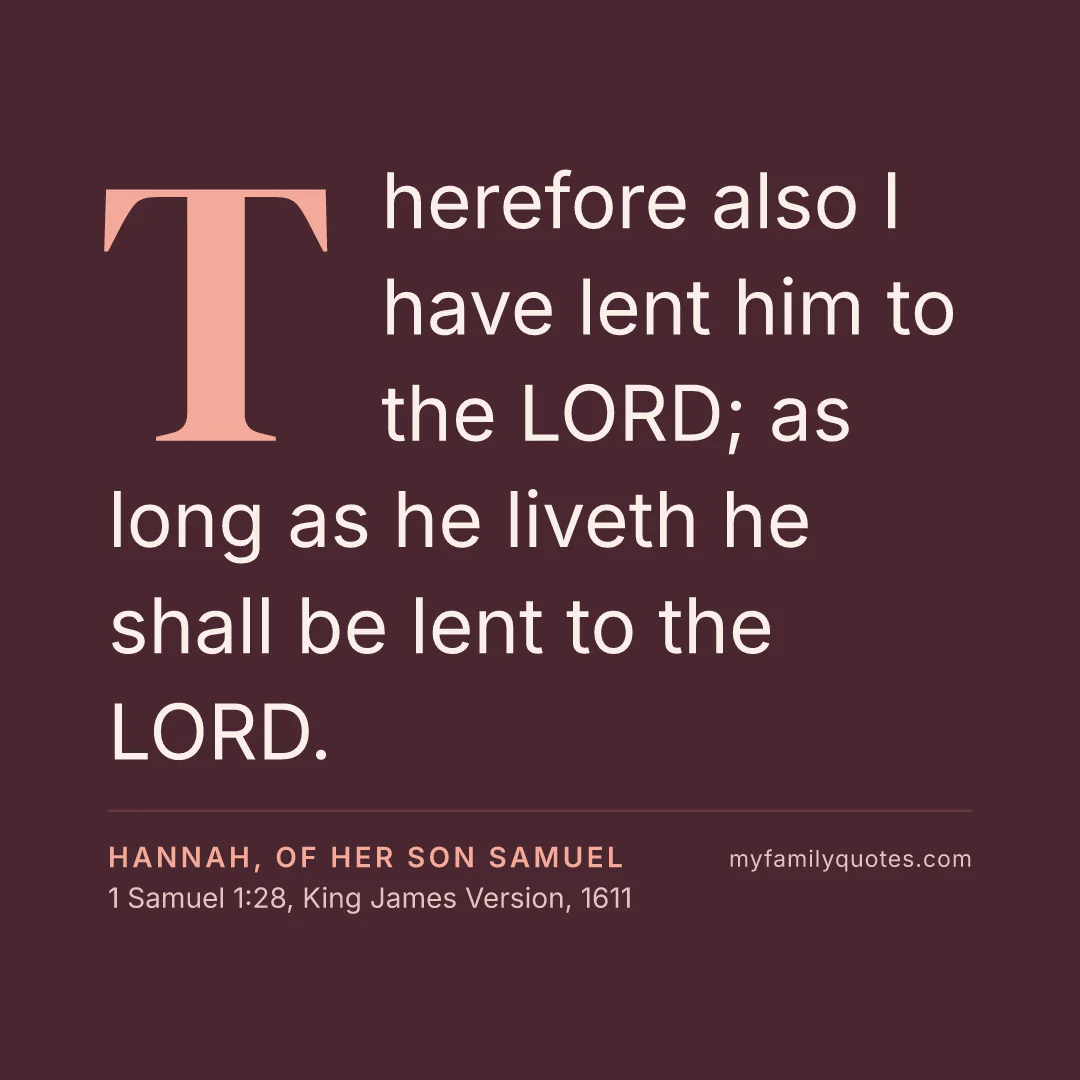
"Therefore also I have lent him to the LORD; as long as he liveth he shall be lent to the LORD."
— Hannah, of her son Samuel, 1 Samuel 1:28 (King James Version, 1611)
The verse just before it, "For this child I prayed", is the one people usually put on nursery walls, and we use it on our page of Bible verses for a daughter. Verse 28 is the better line for a son, and the more honest one for any parent. "Lent" admits what every mother of a boy learns sooner or later: he was never hers to keep. It suits a baptism or baby dedication card, the first page of a baby book, or a note tucked into a christening gift. Hannah's story also has a detail mothers recognize: the next chapter says she made Samuel "a little coat" and brought it to him every year (1 Samuel 2:19).
Birthday quotes for a son from his mother
Most birthday quotes for a son are written as if he were still five. One verse grows with him. Luke's Gospel tells only one story about Jesus between his infancy and his adult life, and it ends with a single sentence that sums up the years in between.
"And Jesus increased in wisdom and stature, and in favour with God and man."
— Luke 2:52 (King James Version, 1611)
Wisdom, stature and favour are three different kinds of growth: what he knows, how tall he is, and how people treat him. That makes the verse useful at any age. On a tenth birthday you can point to the stature ("you grew three inches this year"); on an eighteenth, to the wisdom; on a thirtieth, to the favour, meaning the friends and respect he has earned. For a Christian family it works as the whole card. For anyone else, the plain-English version still works: "Taller, wiser, and loved by more people than last year."
The first time he scares you
The story that ends with that verse is the one where Mary and Joseph lose their twelve-year-old in Jerusalem. They travel a full day home before noticing he is missing, go back, and search for three days. They find him in the temple, calmly talking with the teachers. Mary's first words are the oldest recorded worried-mother sentence in the Bible.
"Son, why hast thou thus dealt with us? behold, thy father and I have sought thee sorrowing."
— Mary, to her twelve-year-old son, Luke 2:48 (King James Version, 1611)
Every mother of a teenage boy has said some version of this to a phone that went unanswered. That is why it works as a gently funny line: on a card for a son who just got his driver's license, in a text when he finally calls back, or as a caption under a photo of him asleep after a night you spent waiting up. Luke adds that his mother "kept all these sayings in her heart" (2:51), a line we trace with other mother and son quotes. Keep the tone light; the point of the story is that he was safe all along.
When he leaves home: Abigail Adams's hardest letter
Back to Abigail Adams. Her son John Quincy, later the sixth president of the United States, had left Massachusetts in February 1778 at ten years old. Her June letter to him opens by admitting that she had not written since he sailed, and then says this:
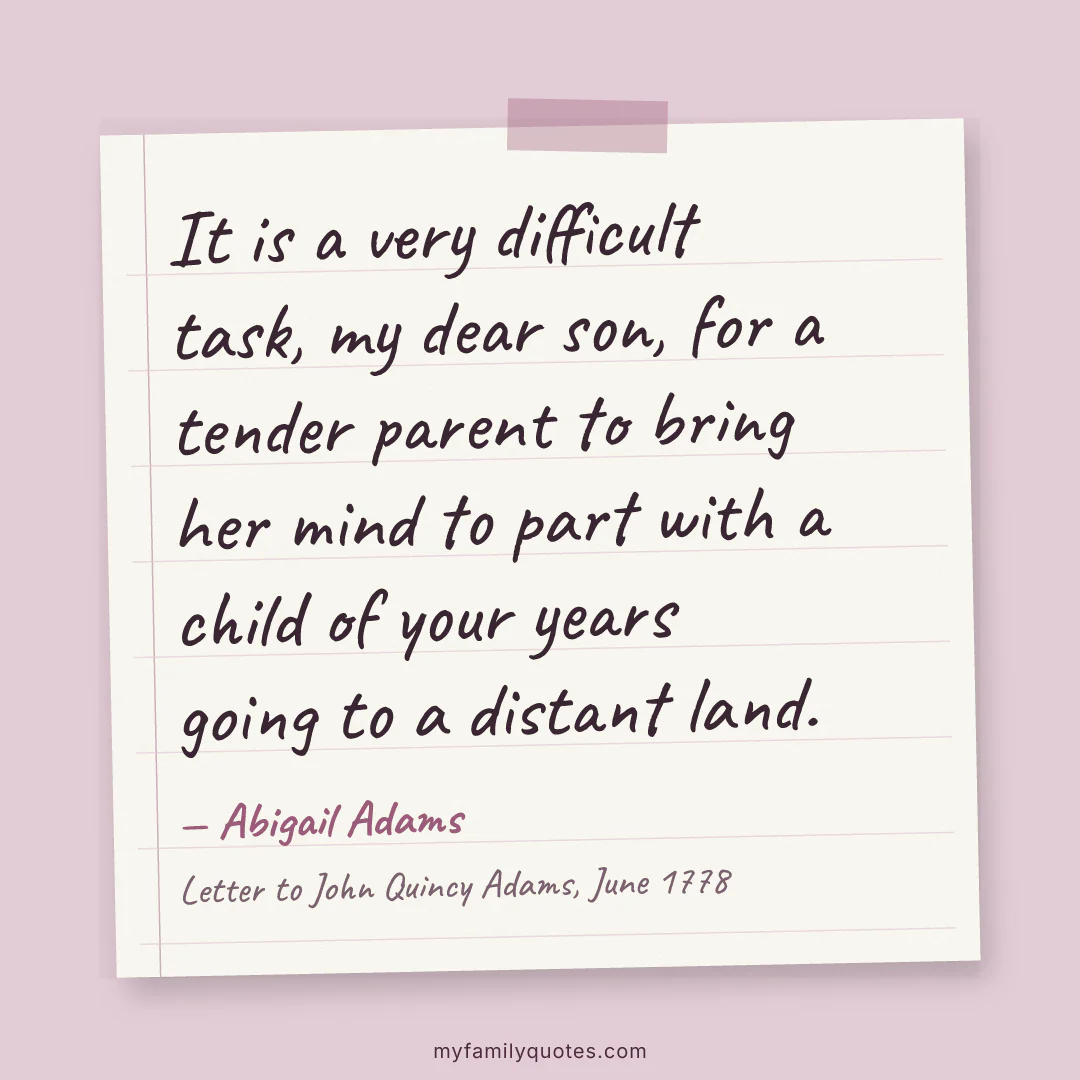
"It is a very difficult task, my dear son, for a tender parent to bring her mind to part with a child of your years going to a distant land; nor could I have acquiesced in such a separation under any other care than that of the most excellent parent and guardian who accompanied you."
— Abigail Adams, letter to John Quincy Adams, June 1778 (Letters of Mrs. Adams, ed. Charles Francis Adams, 4th edition, Boston, 1848, p. 95)
The first half is the part to quote. It says the true thing without asking him to stay: letting him go is hard for her, and she is doing it anyway. That balance is exactly what a son heading to college, a job in another city or a year abroad needs to hear. Write the first sentence in his card, then add one practical sentence of your own, such as when you will call or what you put in his suitcase. (The 1848 edition, edited by her grandson, regularized her spelling and a few words; the manuscript text published in the modern Adams Papers differs slightly in places, but not in meaning.)
A prayer as he sails: Anne Bradstreet, 1657
Anne Bradstreet, the first published poet of the American colonies, wrote the other great leaving-home piece. Her eldest son Samuel, a Harvard graduate of 1653, sailed for England in November 1657 and did not come back until 1661. She had waited years for him: in the short spiritual memoir she left her children, printed as "Religious Experiences", she wrote that God kept her "a long time without a child, which was a great greif to me". The poem she wrote the day he left is a prayer, and it says out loud what Hannah did.
"Thou mighty God of Sea and Land,
I here resigne into thy hand
The Son of prayers, of vowes, of teares,
The child I stayed for many yeares.
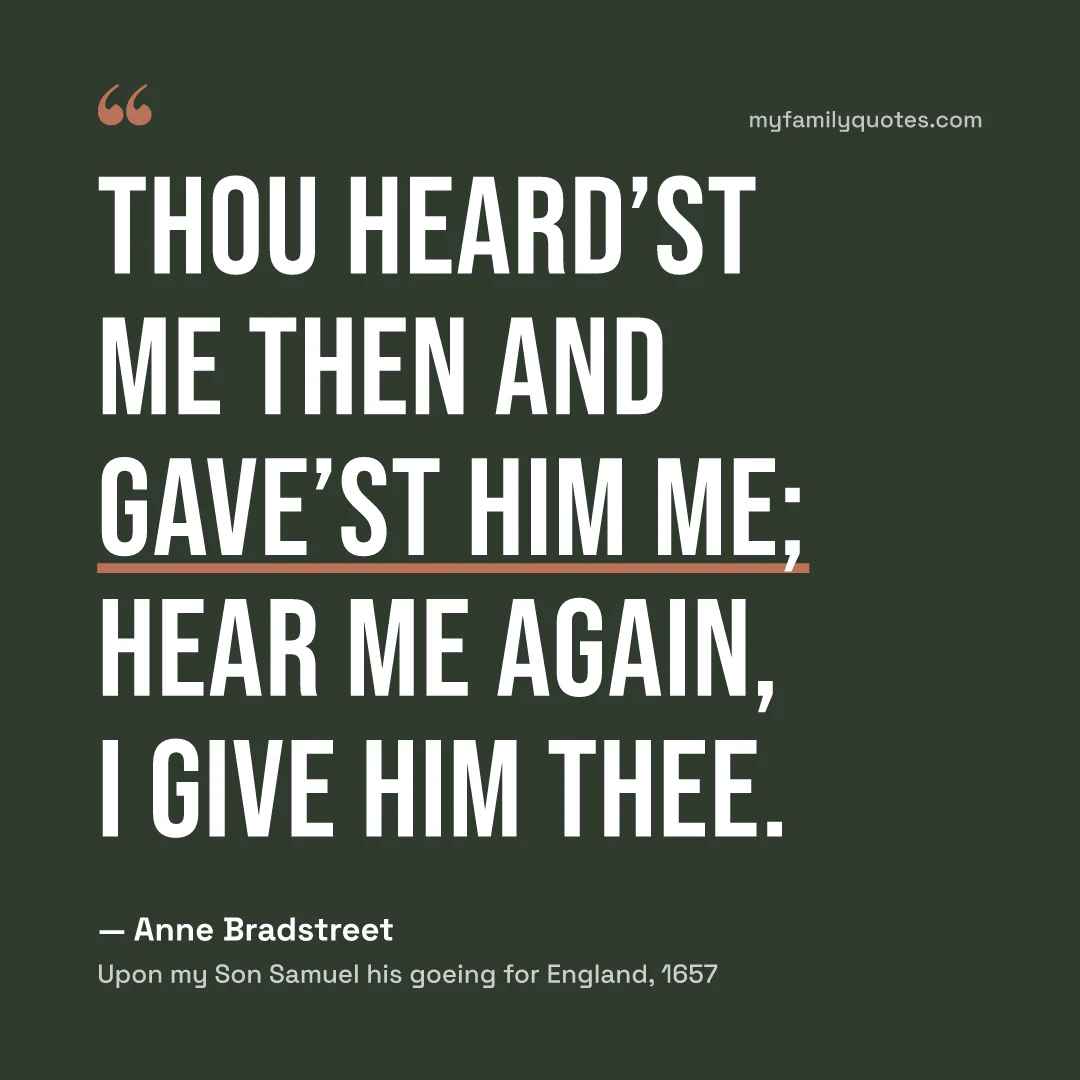
Thou heard'st me then and gave'st him me;
Hear me again, I give him Thee."
— Anne Bradstreet, "Upon my Son Samuel his goeing for England, Novem. 6, 1657" (text as printed in Helen Campbell, Anne Bradstreet and Her Time, Boston, 1891, ch. XV)
"The Son of prayers, of vowes, of teares" is the line most mothers will recognize: it describes every son who was hard to have or hard to raise. The last two lines are short enough for a card and work for any departure, including enlistment or a move overseas. Later in the same poem she asks God to "Protect him there and bring him back", which is a good closing line on its own. The old spellings ("resigne", "yeares") are hers; keep them if you frame the poem, and modernize them if you write it in a card.
The empty nest: Bradstreet's eight birds
Two years later Bradstreet wrote a longer poem about all eight of her children, "In Reference to her Children, 23 June 1659". It opens "I had eight birds hatcht in one nest, / Four Cocks there were, and Hens the rest", and gives each child a few lines in the order they left. Samuel, still in England, comes first.
"Chief of the Brood then took his flight
To Regions far, and left me quite;
My mournful chirps I after send,
Till he return, or I do end;
Leave not thy nest, thy Dam and Sire,
Fly back and sing amidst this Quire."
— Anne Bradstreet, "In Reference to her Children, 23 June 1659" (text as printed in Campbell, 1891, ch. X)
"My mournful chirps I after send" is the funniest and most accurate description of a mother's texts to a son who has moved away. The poem is affectionate rather than sad, and that makes it good for an empty-nest card or a caption under the last family photo before he leaves. "Fly back and sing amidst this Quire" is a lovely way to say "come home for the holidays" without guilt. (Campbell's biography dates the poem to 1656; the title in the 1678 edition gives 23 June 1659, which fits Samuel's absence.)
Graduation and first-job quotes from mom
The same 1778 letter from Abigail Adams turns, a paragraph later, from feeling to instruction. This is the part a mother can give a son at a graduation, because it tells him what his education is for.
"Improve your understanding by acquiring useful knowledge and virtue, such as will render you an ornament to society, an honor to your country, and a blessing to your parents. Great learning and superior abilities, should you ever possess them, will be of little value and small estimation, unless virtue, honor, truth, and integrity are added to them."
— Abigail Adams, letter to John Quincy Adams, June 1778 (Letters of Mrs. Adams, 1848, p. 95)
The second sentence is the strong one for a diploma card: talent is worth little without honesty. Be aware that the letter becomes very severe a few lines later, where she tells him she would rather he had drowned crossing the ocean than grow up "an immoral, profligate, or graceless child". That was ordinary moral language in 1778; it is not something to copy into a card today. Quote the first two sentences and stop.
Shakespeare gives the proud-mother moment its most famous speech, though the mother is a difficult one. In Coriolanus (about 1608), Volumnia tells her daughter-in-law how she sent her only son to war as a boy and how he came home crowned with oak leaves, the Roman prize for bravery.
"I tell thee, daughter, I sprang not more in joy at first hearing he was a man-child than now in first seeing he had proved himself a man."
— Volumnia, of her son, in William Shakespeare, Coriolanus, Act 1, Scene 3
Taken alone, this is a beautiful sentence for a graduation, a promotion, a first house or anything else he earned with effort: the day he was born was a joy, and the day he proved himself was a bigger one. Taken in context, Volumnia is a warrior's mother who says in the next speech she would rather lose eleven sons nobly than see one live idly, and the play ends badly for her son. Use the line, not the character.
A mother's advice in the Bible: the chapter written for a son
Many people know Proverbs 31 as the chapter about the "virtuous woman". Fewer notice how it begins. The chapter is presented as advice given to a king by his mother.
"The words of king Lemuel, the prophecy that his mother taught him. What, my son? and what, the son of my womb? and what, the son of my vows?"
— Proverbs 31:1-2 (King James Version, 1611)
Nobody knows who Lemuel was, and the Bible never names his mother. What survives is her voice: three exasperated questions, the way a mother starts a lecture she has given before. "The son of my vows" echoes Hannah, and Bradstreet's "Son of prayers, of vowes" echoes both. Her advice that follows is practical: do not waste your strength, stay away from drink when you have responsibility, and "Open thy mouth, judge righteously, and plead the cause of the poor and needy" (31:9). For a son starting out, verses 8-9 are a better graduation verse than most of the ones sold on plaques.
His wedding: the virtuous-woman poem as a mother's advice
The famous description of a good wife starts at verse 10 of the same chapter. Many readers take it as the rest of the mother's teaching, which would make it a mother's advice to her son about whom to marry; others read it as a separate poem (in Hebrew it is an alphabet acrostic). Either way, it sits under her heading.
"Who can find a virtuous woman? for her price is far above rubies."
— Proverbs 31:10 (King James Version, 1611)
That reading makes this verse one of the most fitting lines a mother of the groom can use. On a wedding card to the couple, a note to her son on the morning of the wedding, or in a short toast at the rehearsal dinner, it says: you found her, and you understand what she is worth. It also gives the mother of the groom a graceful way to welcome a daughter-in-law without making the toast about herself. For more lines for that relationship, see our page of daughter-in-law quotes.
A deployment: the Spartan line, and a gentler one
The most famous thing a mother ever said to a son going to war comes from Sparta. Plutarch, writing in the first or second century, collected sayings of Spartan women in his Moralia, and this is the shortest of them.
"Another, as she handed her son his shield, exhorted him, saying, 'Either this or upon this.'"
— Plutarch, Moralia, Sayings of Spartan Women, "Other Spartan women", no. 16 (translated by Frank Cole Babbitt, Loeb Classical Library, 1931)
It means: come back carrying your shield, or carried on it. A soldier who ran dropped his shield, and the dead were carried home on theirs. So the mother is saying "win or die, but do not run". Military families sometimes quote it as "come back with your shield or on it". It is a hard line, and it should not go in a card to a frightened nineteen-year-old. If you want an old mother's words for a deployment, Bradstreet's "Protect him there and bring him back" from her 1657 poem is the one to write.
How to write your own note to your son
The lines above share a pattern, and you can borrow it. Abigail Adams, Bradstreet and Lemuel's mother all do four things in a few sentences.
- Name the moment. "You leave on Saturday." "You are thirty today." Bradstreet put the date in her title.
- Say the hard part honestly, once. Adams wrote that parting was "a very difficult task" and did not repeat it. One sentence of feeling is enough; more starts to sound like a burden.
- Give one piece of advice, not five. Pick the thing you most want him to remember. Lemuel's mother chose fairness; Adams chose integrity.
- End with a blessing or a door left open. "Bring him back." "Fly back and sing." "Call me when you land."
Three short examples, written by our editors to show the pattern (adapt the details to your son):
Example for a college send-off (written by our editors): "You leave on Saturday, and I will not pretend this is easy for me. Work hard, but be kind first; people remember that longer than grades. Call me when you find the laundry room."
Example for a 30th birthday (written by our editors): "Thirty years ago you made me a mother. I have watched you grow taller, then wiser, then into someone other people rely on. Keep being honest when it costs you something. Come home for dinner soon."
Example for his wedding morning (written by our editors): "Today you marry someone worth far more than rubies, and you know it, which is the best thing about you. Love her the way you were loved. The door at home stays open for both of you."
"A son is a son till he takes a wife": where the saying comes from
Almost every mother of a son has heard this one, usually at the wrong moment. Online it is usually left unsigned, and modern novels repeat it in newer wording. It is an old English rhyming proverb, and the naturalist John Ray printed it in his Collection of English Proverbs, first published in 1670, in a group of proverbs about love and marriage.
"My son's my son 'till he hath got him a wife; But my daughter's my daughter all the days of her life."
— English proverb, in John Ray's Collection of English Proverbs (as reprinted in Henry G. Bohn, A Hand-Book of Proverbs, London, 1855, p. 47)
It is a proverb about who traditionally cared for aging parents, not a rule about love. If someone quotes it to you at his wedding, two answers from this page work well. One is Proverbs 31, where a mother's advice about a good wife is written down for a son, which assumes the son keeps listening. The other is Hannah's word "lent": a mother of a son knew from the start that he would make his own home, and that is what she raised him for. For more lines that are commonly misquoted or misattributed, see our guide to misattributed family quotes.
Questions mothers ask
What is a short quote for my son from his mother?
Anne Bradstreet's "Hear me again, I give him Thee" (1657) is one of the shortest lines a mother ever wrote about her son, and it works for any departure. For a birthday, "increased in wisdom and stature" (Luke 2:52) fits on any card. Both are explained above with their sources.
What should a mother write to her son on his birthday?
Name his age, mention one way he grew this year (taller, wiser, kinder, or better loved by the people around him), and end with an open door, like dinner or a call. Luke 2:52 gives you that structure in one verse: wisdom, stature and favour.
What is a good Bible verse for a son from his mother?
Proverbs 31:1-2 is the only passage in the Bible presented as a mother's teaching to her son. For a new baby, Hannah's "I have lent him to the LORD" (1 Samuel 1:28) is the classic choice; for his wedding, Proverbs 31:10.
Who said "a son is a son till he takes a wife"?
No single person said it. It is an old English proverb printed by John Ray in his Collection of English Proverbs (first edition 1670) in the form "My son's my son till he hath got him a wife, but my daughter's my daughter all the days of her life."
Looking for the other side of the bond? Our collection of daughter quotes from dad takes the same approach for fathers, and what is a mother quotes collects definitions of motherhood from writers who knew.