Best Son-in-Law Quotes: 12 Sourced Lines for His Wedding, Birthday and Thank-You Card
Words My Family Quotes Editors

What do you say to the man who married your daughter? Most son-in-law quotes online are unsigned card verses about "gaining a son," and almost none say where they come from. Yet older books have plenty to say about sons-in-law: the Bible has a father-in-law teaching Moses to delegate, Jane Austen gave Mr. Bennet three sons-in-law to joke about, and Thomas More's son-in-law wrote a life of More after sixteen years in his house.
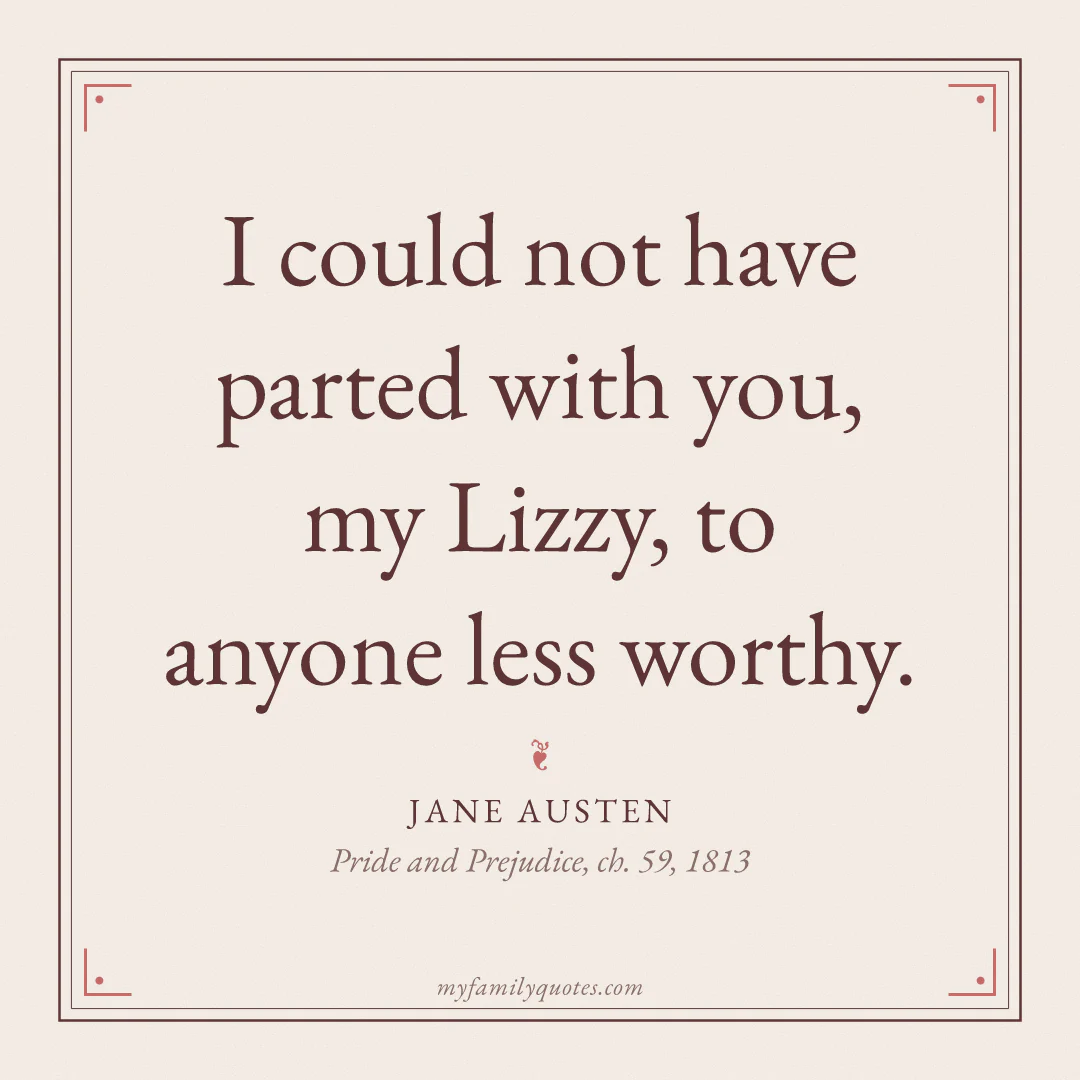
Below are the 12 best son-in-law quotes we could trace, each checked against the book, play or verse it comes from, with notes on when each one fits: his wedding day, a thank-you card, his birthday, Father's Day once he becomes a dad, or a move far away. If you need one line right now, use Mr. Bennet's verdict from Pride and Prejudice: "I could not have parted with you, my Lizzy, to anyone less worthy." It praises him and reassures her in the same breath.
The 12 lines and where each one fits
| Line (short form) | Source | Best for |
|---|---|---|
| "I could not have parted with you … to anyone less worthy." | Austen, Pride and Prejudice, ch. 59 (1813) | Father-of-the-bride speech |
| "Moses went out to meet his father in law … and kissed him" | Exodus 18:7 | Welcome-to-the-family card |
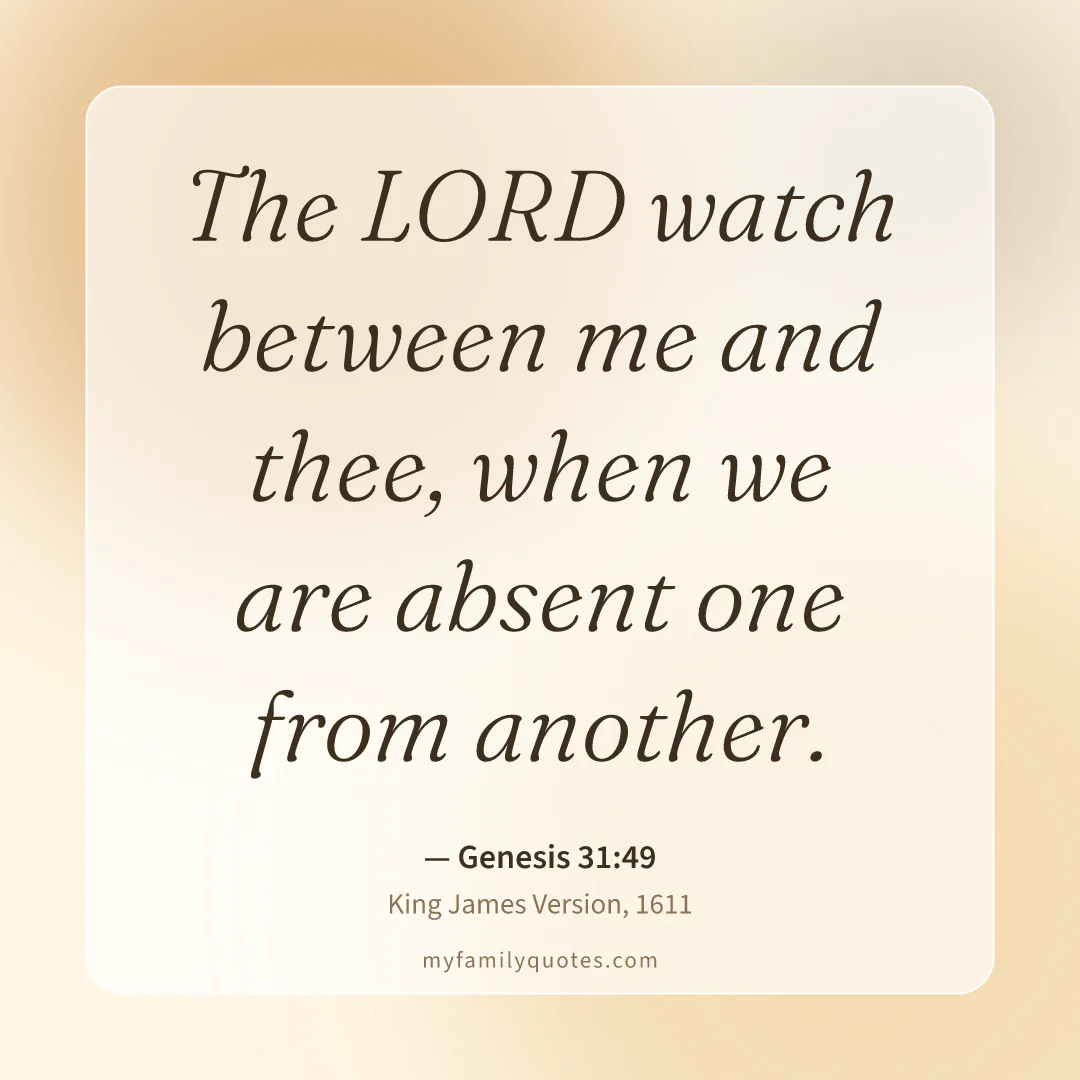
| "The LORD watch between me and thee" | Genesis 31:49 | When they move far away |
| "… his son-in-law's protection" | Austen, Emma, vol. III, ch. 19 (1815) | Thank-you note for help |
| "So Moses hearkened to the voice of his father in law" | Exodus 18:24 | Light tease in a birthday card |
| "… thou art not able to perform it thyself alone." | Exodus 18:17–18 | New dad, new job, busy season |
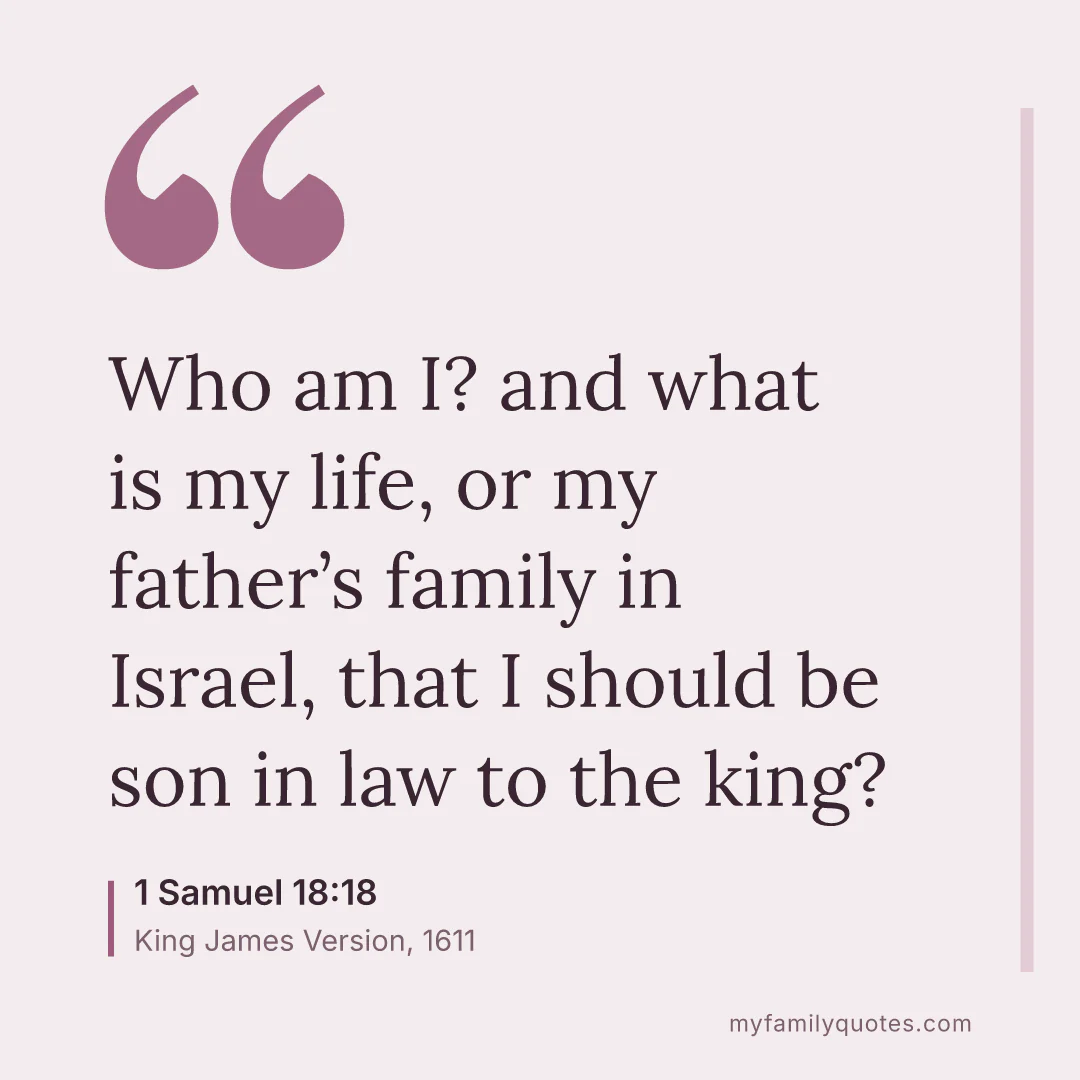
| "… that I should be son in law to the king?" | 1 Samuel 18:18 | From him: a humble toast |
| "… his most unworthy son in law …" | William Roper, Life of Sir Thomas More (printed 1626) | From him: a tribute to her father |
| "Son Roper, I thank our Lord God, the field is won." | Roper, Life of Sir Thomas More | Calling him "son" |
| "I admire all my three sons-in-law highly" | Austen, Pride and Prejudice, ch. 59 | Funny, for families with several |
| "I defy even Sir William Lucas … a more valuable son-in-law." | Austen, Pride and Prejudice, ch. 53 | Only as an obvious joke |
| "Your son-in-law is far more fair than black." | Shakespeare, Othello, 1.3 | Don't use on a card (see why below) |
For the wedding day: welcoming him into the family
The best wedding-day line for a son-in-law is one that praises him through her. That is what a father-of-the-bride speech is for, and Jane Austen wrote the model for it two hundred years ago.
"Well, my dear, I have no more to say. If this be the case, he deserves you. I could not have parted with you, my Lizzy, to anyone less worthy." — Mr. Bennet, in Jane Austen, Pride and Prejudice, chapter 59 (1813)
Mr. Bennet has just learned that Elizabeth is engaged to Mr. Darcy, a man he believed she disliked. He calls her into his library, worried she is marrying for money, and she talks until he is convinced Darcy's affection "had stood the test of many months' suspense." Only then does he give this blessing. That order is what makes it work in a speech: the father doubted, listened, and was won over. Swap in your daughter's name and you have a closing line for a toast that sounds like you, not like a greeting card.
"And Moses went out to meet his father in law, and did obeisance, and kissed him; and they asked each other of their welfare; and they came into the tent." — Exodus 18:7 (King James Version)
The Bible's warmest in-law greeting runs the other way from what people expect: here the son-in-law goes out to meet the father-in-law. Jethro, a priest of Midian, has travelled into the wilderness to bring Moses his wife and two sons. Moses walks out, bows, kisses him, and the two men ask after each other before going inside. For a welcome card the last clause is enough: "they asked each other of their welfare; and they came into the tent." It says, gently, that the door is open and that the relationship goes both ways.
Mizpah: the famous verse a father-in-law said to his son-in-law
Genesis 31:49 is printed on rings, lockets and coin pendants as a promise between people who love each other. Few people who wear it know that it was first spoken by a father-in-law to his son-in-law, and that the two men did not trust each other at all.
"And Mizpah; for he said, The LORD watch between me and thee, when we are absent one from another." — Genesis 31:49 (King James Version)
Laban says it to Jacob, who had worked for him for twenty years, married both of his daughters, and has just slipped away with them, their children and his flocks. Laban chases him down; the two men pile up stones as a boundary marker, and the very next verse is a warning: "If thou shalt afflict my daughters … God is witness betwixt me and thee." So the original meaning is closer to "God is watching you" than "God keep us close." Victorian jewellers turned it into a sentimental keepsake for people separated by travel, emigration or war (Art of Mourning has examples of "Mizpah" brooches). Used today, it is a fitting line when a daughter and her husband move to another city or country. Knowing the backstory, you can even add a wink: "Laban meant it as a warning; we mean it as a blessing."
Thanking a son-in-law who shows up
Appreciation lines work best when they name a specific kind of help. Austen's Emma ends with exactly that: an anxious old father who sleeps better because of a son-in-law.
"He was very uneasy; and but for the sense of his son-in-law's protection, would have been under wretched alarm every night of his life." — Jane Austen, Emma, volume III, chapter 19 (1815)
Mr. Woodhouse, Emma's nervous father, hears that a neighbour's turkeys have been stolen and is convinced burglars are next. He is calm only while his son-in-law John Knightley and John's brother are close by; when John has to go back to London, Mr. Woodhouse finally agrees to Emma's marriage so that the brother, Mr. Knightley, can move in. It is a comic scene, but the point is sincere: a good son-in-law is a person the whole household relies on. In a thank-you note you might write, "Like Mr. Woodhouse, we sleep better knowing you're around," then name the thing he did: the move he organised, the hospital runs, the boiler he fixed.
"So Moses hearkened to the voice of his father in law, and did all that he had said." — Exodus 18:24 (King James Version)
This verse is a gift to any father-in-law with a sense of humour. Put it in a birthday card with the note "Scripture's model son-in-law" and he will know exactly what you are doing. It also has a serious side: Moses was leading a whole people and still took his father-in-law's advice, which is a nice thing to say to a son-in-law who asks your opinion and actually listens.
Advice from the Bible's best-known father-in-law
If you want one sourced line of advice to give a son-in-law, the obvious choice is the one that made him listen.
"The thing that thou doest is not good. Thou wilt surely wear away, both thou, and this people that is with thee: for this thing is too heavy for thee; thou art not able to perform it thyself alone." — Jethro to Moses, Exodus 18:17–18 (King James Version)
Jethro watches Moses sit from morning to evening hearing every dispute in the camp by himself. He tells him to appoint "able men" over thousands, hundreds, fifties and tens, and to keep only the hard cases, and Moses does exactly that. For a son-in-law who has just become a father, started a business or taken on a demanding job, the last clause, "thou art not able to perform it thyself alone," is a kind way of saying "let us help." It reads as care, not criticism, because it comes after Jethro has seen how hard he works.
From his side: what a son-in-law can say
Searches for son-in-law quotes are not only from parents. Grooms look for a line to thank their new in-laws, and the two lines below come from sons-in-law themselves.
"And David said unto Saul, Who am I? and what is my life, or my father's family in Israel, that I should be son in law to the king?" — 1 Samuel 18:18 (King James Version)
David, still a shepherd's son famous for one victory, is offered King Saul's daughter. His reply is pure humility, and it makes a disarming opening for a groom's toast: "Who am I … that I should be son in law to" and then the name of the family. Read the chapter, though, before you lean on it too hard. Saul made the offer hoping the Philistines would kill David on the way to earning the bride, so keep the comparison to David and away from Saul.
"I William Roper, his most unworthy son in law (by marriage of his eldest daughter) knowing no man living to this day, able to speak more of his life and conversation, than myself, who was continually resident in his house for the space of sixteen years and more" — William Roper, The Life of Sir Thomas More (written in the 1550s, printed in Paris in 1626; spelling modernised)
William Roper married Margaret, Thomas More's eldest daughter, in 1521 and lived in More's household until More was executed in 1535. Some twenty years later, in the reign of Mary I, he wrote down what he remembered, as a member of the household who had seen it all (the facts here are from Wikipedia's Roper article; the text is the University of Oregon transcription of the 1626 edition). "His most unworthy son in law" is the formal modesty of the time, but "sixteen years and more" is the heart of it: the son-in-law as the person who knew the family best. A husband giving a eulogy for his father-in-law could do worse than borrow that structure.
"Son Roper, I thank our Lord God, the field is won." — Thomas More, as recorded by William Roper, The Life of Sir Thomas More (1626 edition; spelling modernised)
Roper records More's words in a boat on the Thames, as the two men were rowed to Lambeth. That was in April 1534, when More was summoned to swear to the Act of Succession, and he refused. More sat silent for a while, then whispered this in his son-in-law's ear. Roper admits he did not understand it and said "Sir, I am very glad thereof" so as not to look ignorant; only later did the family take it to mean More had settled his conscience. The line is not one for a birthday card. What it gives a parent-in-law is the form of address: a former Lord Chancellor of England calls his daughter's husband "Son Roper" again and again in the book. Starting a card with "Son" plus his name says more than any verse.
Funny son-in-law quotes from a dry father-in-law
Our favourite funny son-in-law lines belong to one fictional father, and both of them need a little context so the joke lands.
"I admire all my three sons-in-law highly," said he. "Wickham, perhaps, is my favourite; but I think I shall like your husband quite as well as Jane's." — Mr. Bennet, in Jane Austen, Pride and Prejudice, chapter 59 (1813)
Wickham is the novel's scoundrel: he ran off with the youngest Bennet daughter and had to be paid to marry her. So "Wickham, perhaps, is my favourite" is Mr. Bennet's dry way of saying he likes Darcy and Bingley very much. It is the perfect line for a family with several sons-in-law who all know each other well enough to laugh, ideally printed in a group birthday card or said in a toast where everyone has read the book or seen the film.
"He is as fine a fellow," said Mr. Bennet, as soon as they were out of the house, "as ever I saw. He simpers, and smirks, and makes love to us all. I am prodigiously proud of him. I defy even Sir William Lucas himself to produce a more valuable son-in-law." — Jane Austen, Pride and Prejudice, chapter 53 (1813)
This is said of Wickham after the newly married couple leave for the north, and every word is sarcasm. Use it only for a son-in-law who is so plainly lovely that nobody could miss the joke, and only if he has a sense of humour. In chapter 57 Mr. Bennet goes further and says he values "the impudence and hypocrisy of my son-in-law," which tells you how he really sees Wickham. If your relationship with a son-in-law is actually strained, our page of toxic in-laws quotes is a better place to look than a joke that might be read literally.
Lines to handle with care
Shakespeare wrote two famous sons-in-law, and neither line belongs on a card.
"If virtue no delighted beauty lack, / Your son-in-law is far more fair than black." — The Duke of Venice to Brabantio, in William Shakespeare, Othello, act 1, scene 3
The Duke means it as praise: Othello's virtue makes him "fair," that is, beautiful. But the compliment only works by treating "black" as the opposite of beautiful, and it is spoken to a father who has just accused Othello of witchcraft for marrying his daughter. Brabantio's reply a few lines later is a curse on the marriage: "Look to her, Moor, if thou hast eyes to see: / She has deceiv'd her father, and may thee." The scene is worth knowing because it shows how a father-in-law's prejudice can poison a family, but it is not a quote to send. The same goes for Capulet's "Death is my son-in-law, death is my heir" in Romeo and Juliet (4.5), spoken when he believes Juliet has died on her wedding morning: a striking line that keeps turning up in search results and has no place in a celebration.
How to write his birthday or Father's Day card
Most people searching for son-in-law quotes need a few sentences for a card, not a famous line. A simple order works for almost every occasion:
- Call him what you call him. If you'd say "son" out loud, write "son"; More's "Son Roper" shows how natural it can sound. If you use his first name, keep it. A sudden "Son" in writing can feel staged.
- Name one thing he did. Not "you're amazing," but "you drove six hours to fix our roof" or "you make her laugh at breakfast."
- Connect it to her or the grandchildren. Parents-in-law are really thanking him for how he loves their family; say so.
- Add one line only if it fits. Use the table above to pick one quote, and shorten it rather than add a second.
Three short drafts to adapt (our own wording, not quotes):
- Birthday: "Happy birthday, Daniel. Thank you for every Sunday you spend at our table and for the way you look after Anna. We got the son-in-law we would have chosen."
- Father's Day, first year as a dad: "Watching you with the baby has been the best part of this year. Remember Jethro's advice: you are not meant to do it all alone. Call us."
- Thank-you note: "You turned a moving day we were dreading into a good memory. Like old Mr. Woodhouse in Emma, we sleep better knowing you're nearby."
For the women on the other side of the family, see our mother-in-law quotes and daughter-in-law quotes, which use the same approach.
Son-in-law sayings we could not source
A few lines show up on every Pinterest board and gift shop. Here is what we found when we tried to trace them.
- "Son-in-love." A modern play on "son-in-law" used on mugs and signs. Nobody seems to have coined it in print; use it freely as a nickname, but there is no author to credit.
- "A son is a son till he takes him a wife, a daughter's a daughter all of her life." A traditional English proverb, often quoted to sons-in-law at weddings. We did not find a fetched copy of its earliest printing, so we credit it simply as a proverb. It is also a backhanded line for a son-in-law, since it suggests he took a son away from someone, so read it before you use it.
- "I didn't gain a son-in-law, I gained a son." Unsigned card verse. Fine to write in your own voice, but don't put a famous name after it.
- Quotes from the film Son in Law (1993). Many searches for "son in law quotes" are about the Pauly Shore comedy, not family cards. Lines from it are best checked against the film itself; we don't list them here.
For more popular family quotes that turned out to have the wrong name attached, see our page on misattributed family quotes.
Questions people ask
How do I thank my son-in-law?
Name one specific thing he did and say what it meant to your family. A short line can frame it, such as Austen's note in Emma that an anxious father felt safe because of "his son-in-law's protection," but the specific detail is what he will remember.
What are some encouraging words for a son-in-law?
Jethro's words to Moses in Exodus 18:18, "thou art not able to perform it thyself alone," are the classic choice for a son-in-law under pressure, whether he has a new baby, a new job or a hard season. Follow it with a concrete offer of help.
What is a short quote for a son-in-law?
For a card, "he deserves you" (Mr. Bennet in Pride and Prejudice, chapter 59) is short and warm. For a son-in-law moving away, use the Mizpah verse, Genesis 31:49: "The LORD watch between me and thee, when we are absent one from another."
Is "son-in-love" a real word?
It is an affectionate modern nickname, not a dictionary term, and we could not trace who first used it. It is fine on a card as long as you don't attribute it to anyone.