Grandma Quotes From Granddaughter: 6 Sourced Lines From Books, and How to Write Your Own Note
Words My Family Quotes Editors

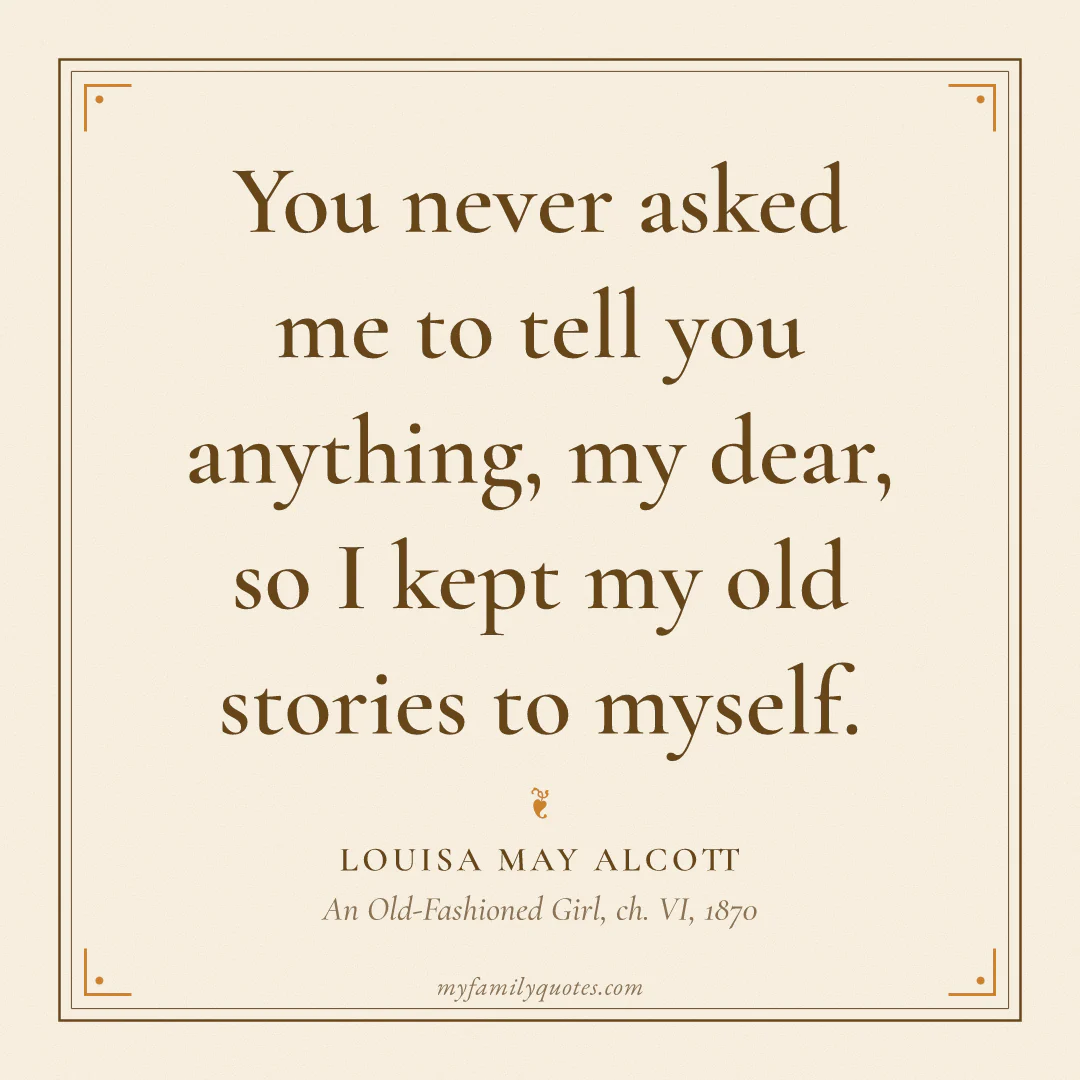
"You never asked me to tell you anything, my dear, so I kept my old stories to myself." In Louisa May Alcott's An Old-Fashioned Girl, a grandmother says this to her granddaughter Fan, who has just walked in on her telling stories to a houseguest. It is a gentle rebuke, and it is the most useful sentence on this page: many grandmothers are waiting to be asked.
Below are six grandma quotes for a granddaughter to borrow, each taken from a book we could open and read: three are a granddaughter writing about her grandmother, three are a grandmother speaking. Every line comes with who wrote it, where it sits in the book, and what it suits: a birthday card, a toast, a caption or a letter. After the lines there is a short guide to writing your own note, because a sentence of yours will mean more to her than any quotation.
A granddaughter writes about her grandmother
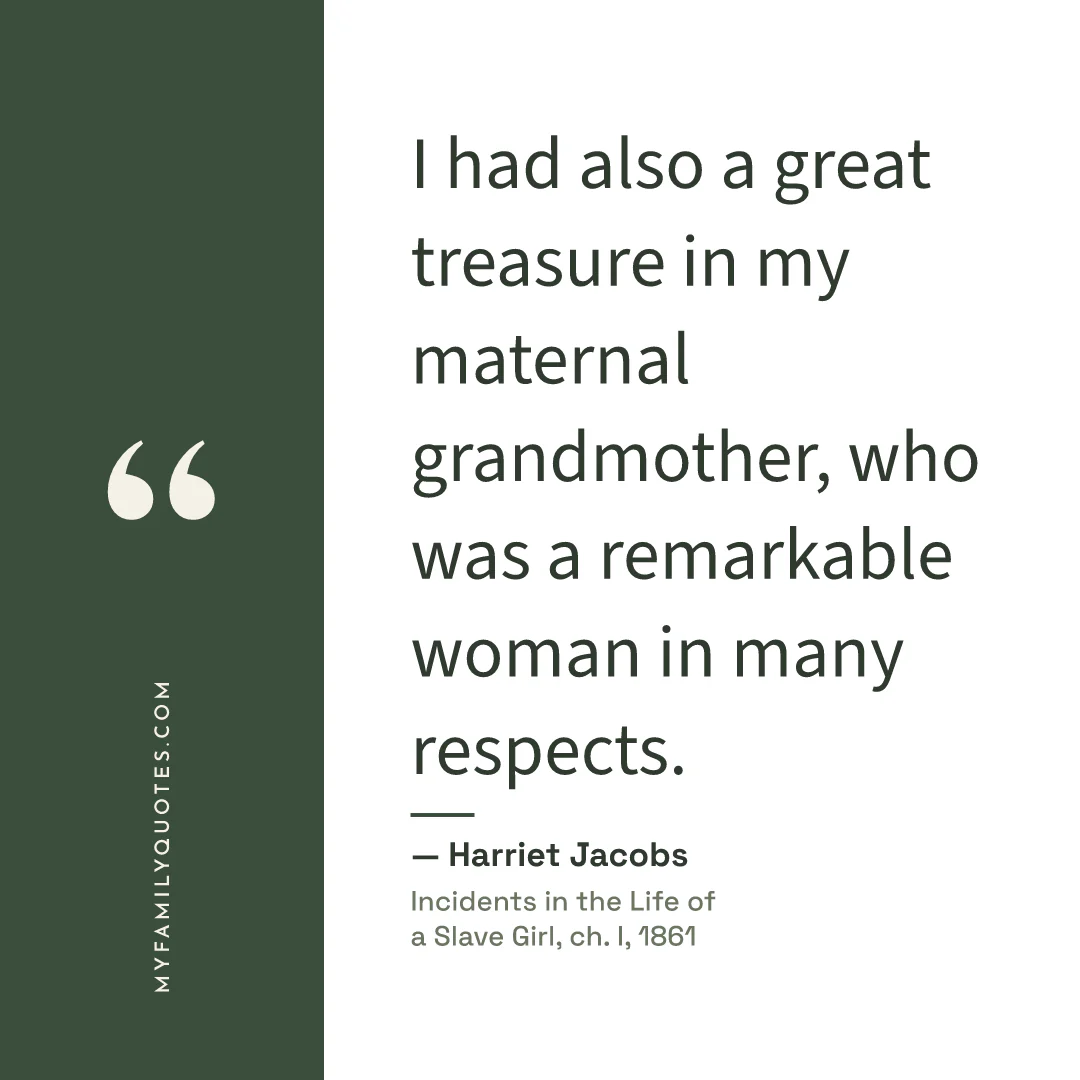
The first writer is Harriet Jacobs, whose Incidents in the Life of a Slave Girl was published in 1861 under the name Linda Brent, with Lydia Maria Child as editor. Her grandmother is the steadiest person in the book. The line comes in the first chapter, where Jacobs describes the six happy years before she learned she was enslaved.
"I had also a great treasure in my maternal grandmother, who was a remarkable woman in many respects." — Harriet Jacobs, Incidents in the Life of a Slave Girl, ch. I (1861)
Jacobs goes on to tell how her grandmother baked crackers, cakes and preserves to sell, and how she shared them with her grandchildren. "A great treasure" is the phrase to keep: it is warm and specific without being sugary. It works well as the opening line of a birthday card or a toast, followed by one thing she actually did for you.
A little later in the book, the young Linda is sent on errands past her grandmother's house, and her grandmother, to avoid detaining her, stands at the gate with food for her. Jacobs sums it up like this:
"I was indebted to her for all my comforts, spiritual or temporal. It was her labor that supplied my scanty wardrobe." — Harriet Jacobs, Incidents in the Life of a Slave Girl, ch. II (1861)
This is the line for a thank-you rather than a greeting. It names what a grandmother's love often looks like in practice: food, clothes, a place to stop. Use it in a letter, or as the thought behind a caption on a photo of her hands at work. The context is heavier than a card needs, so quote it briefly and let the sentence stand on its own.
The third writer is L. M. Montgomery, who describes her childhood in The Alpine Path, a six-part memoir serialised in the Canadian magazine Everywoman's World in 1917. She was raised by her mother's parents on Prince Edward Island, and the Cavendish she describes is the village that inspired the setting of Anne of Green Gables (1908).
"I was brought up by my grandparents in the old Macneill Homestead in Cavendish." — L. M. Montgomery, The Alpine Path (1917)
It is a plain sentence, but it is a good one for a granddaughter who was close to both grandparents, or who grew up in their house. It suits a short caption with a photo of the old home, or the first line of a family-history note. Montgomery also writes about the Macneill family's tales and traditions in the same memoir, which makes it a good companion read for a grandmother who likes stories.
A grandmother speaks
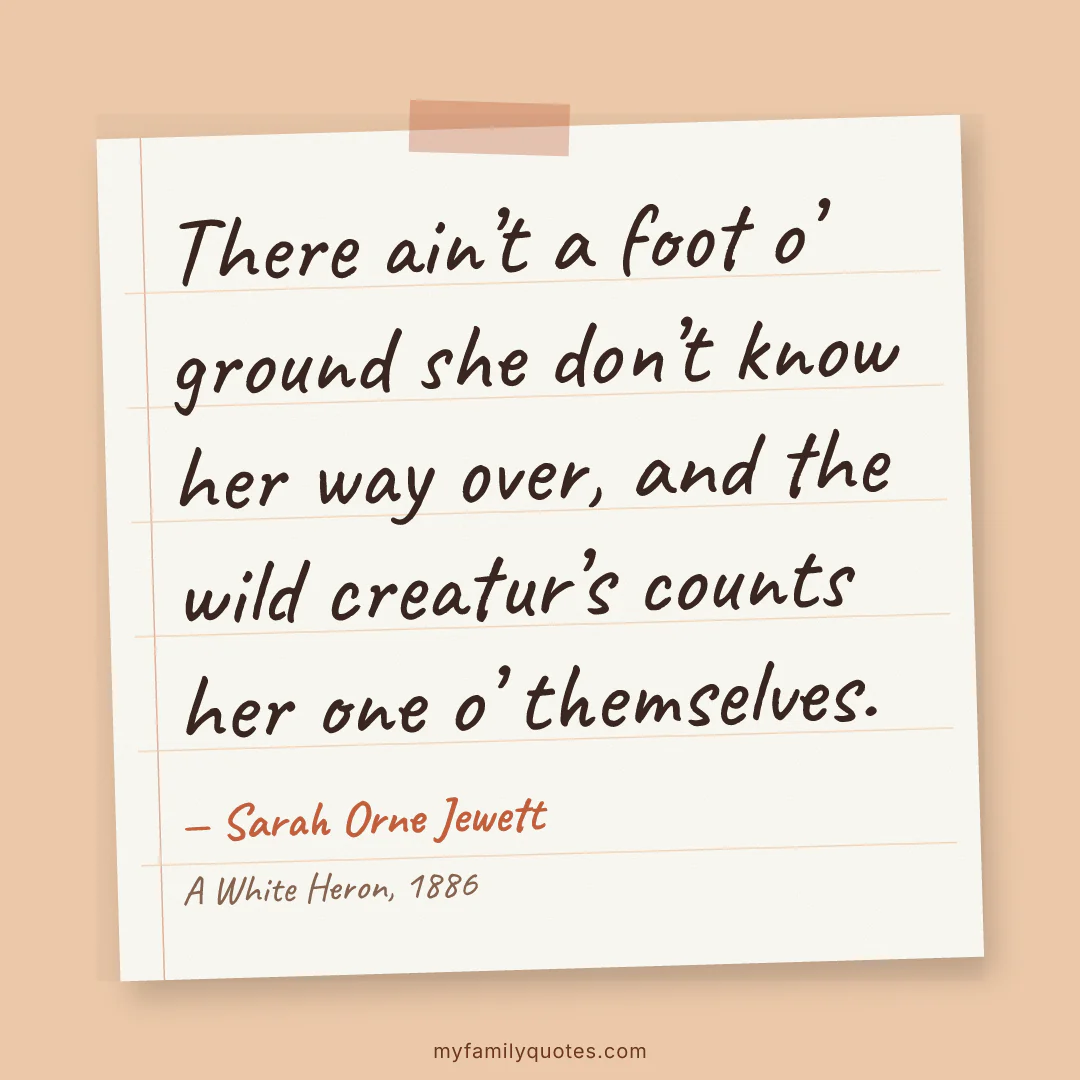
Fiction gives us the other half of the conversation: what grandmothers say about their granddaughters. In Sarah Orne Jewett's A White Heron (1886), the grandmother, Mrs. Tilley, has taken in her nine-year-old granddaughter Sylvia from a manufacturing town. When a young hunter stays the night, she tells him about the girl in the evening:
"There ain't a foot o' ground she don't know her way over, and the wild creatur's counts her one o' themselves." — Sarah Orne Jewett, A White Heron (1886)
The dialect spelling is Jewett's. If you use the line in a card, you can keep it as written for the flavour or give it as a paraphrase, but don't modernise it inside quotation marks. It suits a granddaughter who loves the outdoors, or a grandmother who is proud of her. It is also the line to pick if you want a grandmother's pride to sound like her own voice rather than a greeting-card voice.
Alcott's Madam Shaw is a quiet old lady in a wealthy household, and the one visitor who sits with her, Polly, asks about the keepsakes in her cabinet and gets a story for each. When her granddaughter Fan walks in and says she has never heard them, the grandmother answers:
"You never asked me to tell you anything, my dear, so I kept my old stories to myself." — Louisa May Alcott, An Old-Fashioned Girl, ch. VI (1870)
This is the best line here for a practical purpose: write it in a card and add "so I'm asking". It tells her that you want her stories, and it does so with a sentence from a book she may well know. It also fits a family-history project or a recorded interview.
The last grandmother is the one in Johanna Spyri's Heidi (1880–81), in Marion Edwards's English translation. She is Clara Sesemann's grandmother, who arrives in Frankfurt and meets the child her granddaughter has befriended. Heidi, trying to be polite, addresses her as "Mrs. Madam". The grandmother laughs and sets her straight:
"Never mind! when I am with the children I am always grandmamma; you won't forget that name, will you?" — Johanna Spyri, Heidi, ch. X, "Another Grandmother" (1880–81, trans. Marion Edwards)
Heidi answers that she often used to say the word at home, and the grandmother nods. It is a nice line for a granddaughter who is thanking her grandmother for treating her friends like her own, or for a grandmother's birthday message from the whole family. Note that this grandmother belongs to Clara, not to Heidi, so use it for what it says about a welcome, not as Heidi's own grandmother.
Which line for which message
| Line | Best for | Add after it |
|---|---|---|
| Jacobs, "a great treasure" | Birthday card, toast | One thing she did for you |
| Jacobs, "indebted to her for all my comforts" | Thank-you letter | The comfort you remember most |
| Montgomery, "brought up by my grandparents" | Photo caption, family-history note | The name of the house or town |
| Jewett, "a foot o' ground" | A grandmother proud of you; an outdoor photo | Where she taught you to look |
| Alcott, "kept my old stories to myself" | Asking for her stories | "Tell me about..." and a date to meet |
| Spyri, "always grandmamma" | Family birthday message | Everyone's signature |
How to write your own note to your grandma
- Start with one concrete thing. A food, a phrase she says, a room in her house. Specific beats grand.
- Say what it taught you or gave you. One sentence, in your own words.
- Add a line from a book only if it fits. One of the six above, with the author's name, makes a good opening or closing. Never put a made-up name next to a quote.
- Ask her something. Alcott's grandmother kept her stories until someone asked, so end with a question she can answer: "What was your first job?" "Where did you grow up?"
- Sign it by hand. A short handwritten note is worth more than a long printed one.
A simple structure for a card is: the line, then "I think of this when..." and one sentence of your own, then your question. For example: "'A great treasure' is how Harriet Jacobs described her grandmother, and it is how I think of you. I'd love to hear how you spent your Saturdays when you were my age." That is an editor-written sample, not a quotation; swap in your own details.
Popular grandma quotes we could not trace
Three lines are on almost every grandparent quote list. We could not find a primary source for any of them, so we did not use them as sourced quotations:
- "Grandparents, like heroes, are as necessary to a child's growth as vitamins." Usually credited to Joyce Allston; the lists we found name no book.
- "A child needs a grandparent, anybody's grandparent, to grow a little more securely into an unfamiliar world." Usually credited to Charles and Ann Morse; again, no work we could check.
- "It is as grandmothers that our mothers come into the fullness of their grace." Usually credited to Christopher Morley; a longer passage circulates, but we did not find the book it comes from.
They are fine to use if you write "commonly attributed to" and skip the book title. If you want lines about the grandparent bond more widely, our grandparents love quotes cover cards, Grandparents Day and a new baby, and the thankful for grandparents quotes are written for a grandparent who is still here. For a goodbye, see losing grandma quotes, and to check a line before you print it, our misattributed family quotes page lists the ones to avoid.
Frequently asked questions
What is a nice quote for grandma from her granddaughter?
Harriet Jacobs's "I had also a great treasure in my maternal grandmother" (Incidents in the Life of a Slave Girl, 1861) is short, warm and sourced. Follow it with one specific memory of your own.
What can a grandmother say to her granddaughter?
In An Old-Fashioned Girl (1870), Madam Shaw tells her granddaughter Fan that she kept her stories to herself because nobody had asked. It is a good model: she says what she has been keeping back and invites the girl to ask.
What is a heartfelt message for grandma?
Say what she did, what it meant, and ask her one question. Try: "Thank you for [one thing she did]. What was the first thing you taught yourself to make?" Keep it to a few sentences and write it by hand.