15 Mother Daughter Love Quotes Highlighting Lifelong Bonds

The relationship between a mother and her female child shifts constantly under the weight of time, moving from total dependence to a complex parity. Watching my mother in a backyard garden in Richmond, Virginia, 1982, I realized that affection often lives in the quietest domestic routines. She worked the soil with bare hands while I handed her the pruning shears. It was a silent transaction of trust. Writers have spent centuries trying to capture this specific gravitational pull, producing literature that strips away the sentimentality to reveal the absolute durability of the connection.
Documenting these shifts requires language that acknowledges both the intense closeness and the inevitable separations that happen as children mature. When you are writing notes for family scrapbooks, leaning on the exact words of novelists and poets provides a clarity that our own immediate emotions sometimes obscure. Historical texts show us that the mechanics of maternal devotion remain surprisingly stable across different eras. These fifteen observations map the territory of that enduring attachment.
The Formative Early Years
Early childhood establishes a baseline of physical and emotional security that dictates how a daughter will eventually interact with the wider world. The physical presence of a mother anchors the child's reality during these initial stages of development.
"A mother's arms are made of tenderness and children sleep soundly in them." — Victor Hugo, Les Misérables, 1862
Hugo embedded this observation in his sprawling epic to emphasize how foundational maternal comfort is amidst severe societal poverty.
"All that I am, or hope to be, I owe to my angel mother." — Abraham Lincoln, Personal Correspondence, 1865
Though historians sometimes debate the exact original wording of this tribute, it remains a famous acknowledgment of Nancy Hanks Lincoln's early influence on the president.
"The mother's heart is the child's schoolroom." — Henry Ward Beecher, Life Thoughts, 1858
Beecher recognized that a child absorbs their first lessons in empathy and emotional regulation directly from their primary caregiver's temperament.
"There is no velvet so soft as a mother's lap, no rose as lovely as her smile." — Eugene Field, Poems of Childhood, 1896
Field utilized heavy sensory metaphors to capture the intense, almost overwhelming comfort a young child derives from physical proximity.
"A mother is a mother still, the holiest thing alive." — Samuel Taylor Coleridge, The Three Graves, 1797
Coleridge elevated the maternal role to a sacred status, reflecting the Romantic era's intense reverence for natural human connections.
Navigating Independence and Growth

As a daughter ages, the dynamic shifts from protection to guidance, demanding that mothers eventually step back. This transition frequently requires setting firm emotional boundaries to allow the younger woman space to forge her own identity.
"A mother is not a person to lean on, but a person to make leaning unnecessary." — Dorothy Canfield Fisher, Her Son's Wife, 1926
Fisher articulated a progressive view of parenting, suggesting that the ultimate goal of maternal love is to cultivate complete self-sufficiency.
"The bearing and the training of a child is woman's wisdom." — Alfred Lord Tennyson, The Princess, 1847
Tennyson framed the arduous process of raising a child as a distinct intellectual and philosophical achievement rather than mere instinct.
"A mother's love is patient and forgiving when all others are forsaking." — Inspired by Louisa May Alcott, Little Women, 1868
Alcott's narrative consistently demonstrated that familial grace provides a safety net when external societal judgments become unbearable.
"We are born of love; love is our mother." — Rumi, The Masnavi, 1258
The Persian poet stripped the concept down to its absolute metaphysical core, equating the origin of human existence directly with maternal affection.
"A mother is the truest friend we have." — Washington Irving, The Sketch Book, 1819
Irving highlighted the transition of the mother figure from an authority figure to a reliable confidante as the child enters adulthood.
The Quiet Endurance of Maternal Affection

Decades of shared history eventually distill the relationship into a profound, unspoken mutual understanding. For those exploring expressions of beautiful maternal bonds, literature proves that this later stage relies less on instruction and more on pure presence.
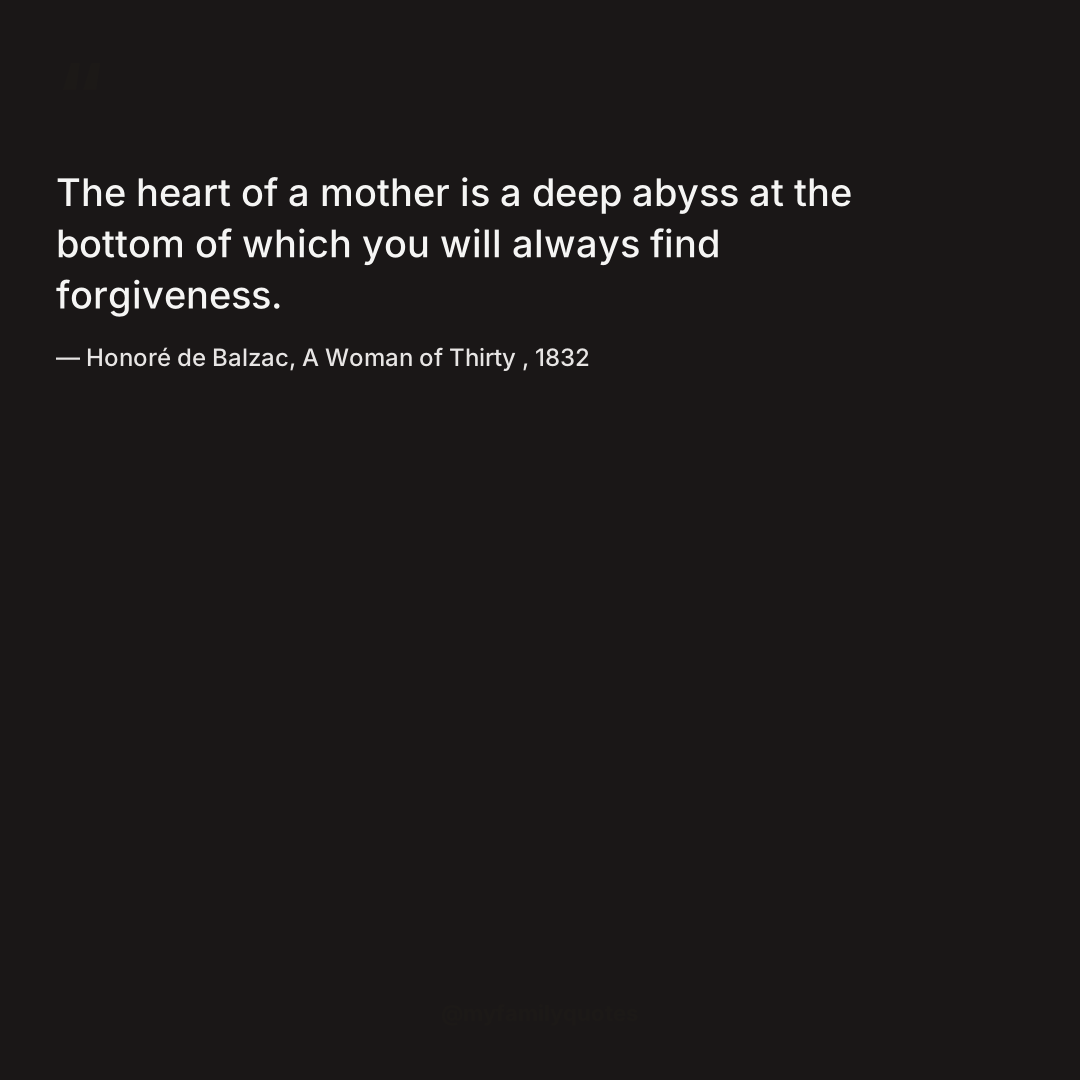
"The heart of a mother is a deep abyss at the bottom of which you will always find forgiveness." — Honoré de Balzac, A Woman of Thirty, 1832
Balzac examined the seemingly limitless capacity of a mother to absorb and pardon the deeply flawed decisions of her adult children.
"Youth fades; love droops; the leaves of friendship fall; A mother's secret hope outlives them all." — Oliver Wendell Holmes Sr., The Mother's Secret, 1870
Holmes contrasted the fragility of romantic and platonic relationships with the stubborn, quiet persistence of a parent's optimism.
"A mother's love for her child is like nothing else in the world. It knows no law, no pity." — Agatha Christie, The Last Séance, 1926
Christie captured the fierce, almost dangerous intensity of a mother's protective instincts when threatened by external forces.
"Men are what their mothers made them." — Ralph Waldo Emerson, The Conduct of Life, 1860
While phrased about men, Emerson's essay underscored the inescapable imprint a mother leaves on the psychological architecture of any child.
"There is nothing so pure and so profound as the love a mother has for her child." — Inspired by Harriet Beecher Stowe, Uncle Tom's Cabin, 1852
Stowe utilized the absolute sanctity of the mother-child bond to argue fiercely against the familial separations forced by nineteenth-century institutions.
What People Usually Get Wrong

Popular reading: The bond is entirely devoid of conflict
On closer look: Many assume that a celebrated maternal connection means an absence of friction or disagreement. In reality, the most resilient relationships rely on surviving intense arguments, which ultimately deepens mutual respect rather than fracturing the foundation.
Popular reading: True love requires constant proximity
On closer look: Readers often interpret devotion as the need to be physically near one another at all times. Literature actually shows that understanding unconditional affection between generations involves trusting the connection even when separated by oceans or decades.
Popular reading: A mother's role never changes
On closer look: There is a widespread belief that the mother must always act as the primary caregiver and emotional shield. The healthiest dynamics documented in historical letters show a distinct pivot where the daughter eventually assumes the role of caretaker as the mother ages.
The literature of maternal devotion proves that the relationship survives precisely because it is capable of radical transformation. By refusing to remain static, the connection between a mother and daughter adapts to the changing demands of age, circumstance, and individual identity.