24 Happy Family Time Quotes for Sunday Dinners
Words My Family Quotes Editors

Sunday has been an official day off for a long time: on 7 March 321 the Roman emperor Constantine ordered magistrates, townspeople and workshops to rest on "the venerable day of the sun," and the habit of keeping one day for home, church, a long lunch and the people you live with has outlasted his empire. This page collects 24 lines about that kind of time, grouped by where Sunday usually happens: at the table, in the living room, and on the road. Every quote has its author, the work it comes from and the year, and each one comes with a note on where it fits. The famous opener, "A happy family is but an earlier heaven," is here too, with its real author.
The Chaos of the Dinner Table
A shared meal is the one fixed point of many family weekends: the time everyone is expected to turn up, put the phone down and talk over each other. Writers have noticed this for centuries, and the best lines about the family table are less about the food than about who is sitting around it.
"A happy family / Is but an earlier heaven." — John Bowring, "Home Joys," in A Collection of Hymns for Public and Private Worship, 1837
This is the line most quote sites give to George Bernard Shaw. It was written by Sir John Bowring, a British politician, linguist and hymn writer, and printed as hymn 517 in an 1837 Unitarian hymnal; the full stanza begins "A glance of heaven to see, / To none on earth is given." Quote Investigator traced the Shaw credit to newspaper filler items from the 1890s onward. It suits a place card or the top of a printed Sunday menu.
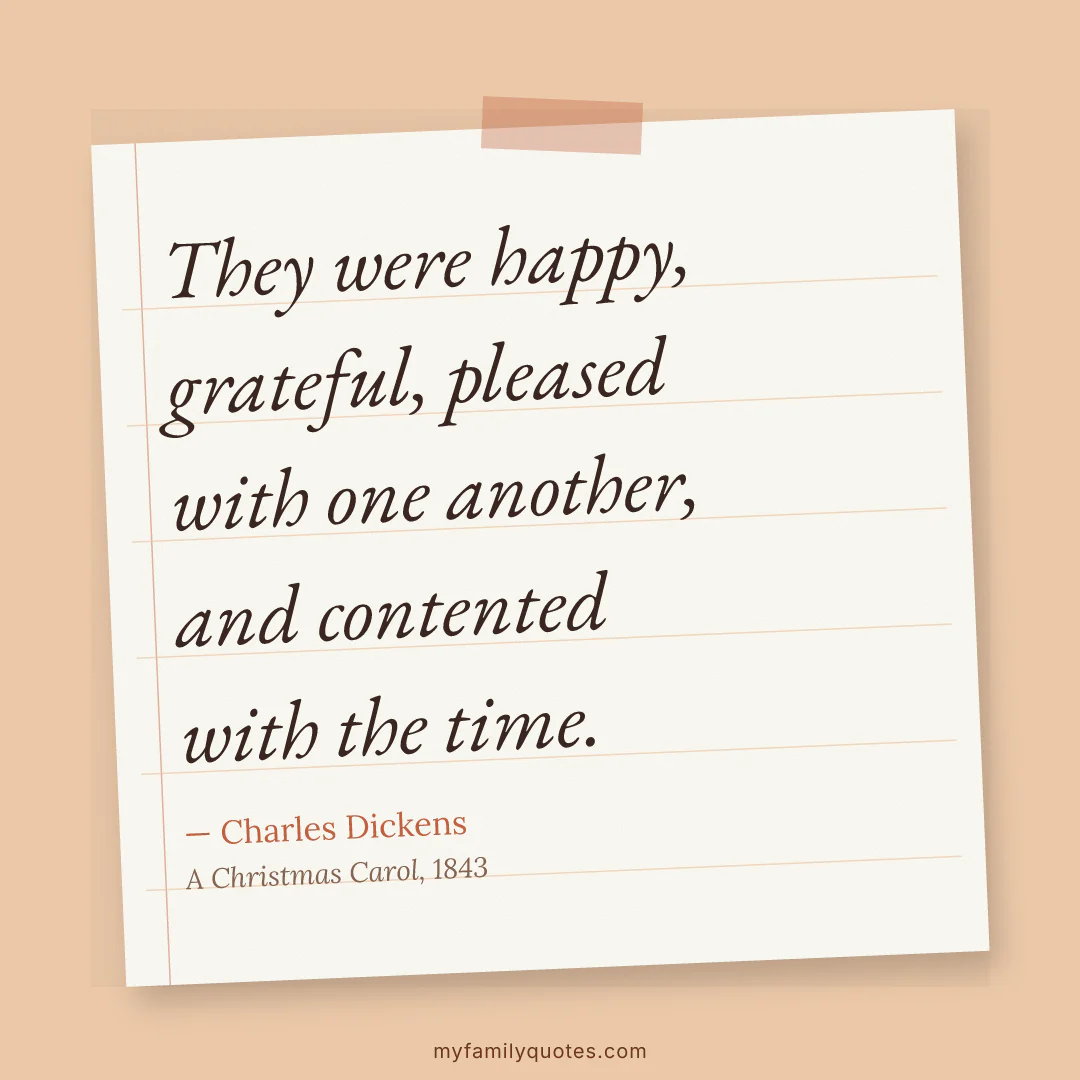
"They were not a handsome family; they were not well dressed; their shoes were far from being water-proof; their clothes were scanty... But, they were happy, grateful, pleased with one another, and contented with the time." — Charles Dickens, A Christmas Carol, Stave Three, 1843
The Ghost of Christmas Present shows Scrooge the Cratchits finishing a small goose, a pudding and a jug of hot drink, with Tiny Tim singing at the end. Dickens deliberately lists everything the family lacks before naming what they have. The last clause, "contented with the time," is about as good a description of an ordinary good Sunday as exists in English.
"Go thy way, eat thy bread with joy, and drink thy wine with a merry heart." — Ecclesiastes 9:7, King James Version, 1611
Ecclesiastes is usually read as the Bible's gloomiest book ("vanity of vanities"), which is what gives this verse its force: since life is short and uncertain, the writer says, enjoy your food and the people you share it with. It works well as a dinner invitation or a short grace for families who want something scriptural but not solemn.
"It was the policy of the good old gentleman to make his children feel that home was the happiest place in the world; and I value this delicious home-feeling as one of the choicest gifts a parent could bestow." — Washington Irving, "Christmas Eve," The Sketch-Book of Geoffrey Crayon, 1820
Frank Bracebridge says this about his father, the old Squire, who insisted on traditional games and feasts at the family hall. Irving's Christmas sketches shaped how many Americans pictured an old-fashioned Christmas, but the point carries to any weekly ritual: the tradition matters because of how it makes the children feel about home. A good line for a parent's or grandparent's birthday card.
"One cannot think well, love well, sleep well, if one has not dined well." — Virginia Woolf, A Room of One's Own, chapter 1, 1929
Woolf wrote this after comparing a lavish lunch at a men's college with a thin dinner of gravy soup and prunes at a women's college. Her real subject was money and opportunity, but the sentence has escaped its context and become a cook's motto. It is a fair defence of taking Sunday dinner seriously.
"If more of us valued food and cheer and song above hoarded gold, it would be a merrier world." — Thorin Oakenshield, in J. R. R. Tolkien, The Hobbit, chapter 18, 1937
Thorin says it to Bilbo on his deathbed, after a quarrel over treasure nearly ended in war. He is praising the hobbit way of life, which is built around meals, comfortable chairs and company. Families who read Tolkien together will recognise it, and it suits a caption for a long, unhurried lunch.
"It seems to me that our three basic needs, for food and security and love, are so mixed and mingled and entwined that we cannot straightly think of one without the others." — M. F. K. Fisher, foreword to The Gastronomical Me, 1943
Fisher was answering readers who asked why she wrote about eating instead of "bigger" subjects. Her answer is that the table is where hunger, safety and affection meet, which is why a family meal can feel like more than a meal. It works on a recipe card handed down with a family dish.
"The family is one of nature's masterpieces." — George Santayana, The Life of Reason: Reason in Society, chapter 2, 1905
Santayana was a philosopher, not a greeting-card writer, and the next sentence is drier: he admires how well the family's "system of instincts" is "adjusted." Quoted alone, the short line is one of the few genuine one-liners about family from a major thinker, which makes it a safe choice for a toast.
Quiet Evenings and Living Room Conversations
After the dishes, a family Sunday usually slows down: someone falls asleep, someone reads, a game comes out. The best writing about these hours treats rest as something worth protecting, not as wasted time.
"Happy families are all alike; every unhappy family is unhappy in its own way." — Leo Tolstoy, Anna Karenina, part 1, chapter 1, 1878 (translated by Constance Garnett, 1901)
The most famous first line about family in any language opens a novel that is mostly about unhappy ones. Readers still argue whether Tolstoy meant it straight: happy families may be alike only in that their contentment is quiet and hard to dramatise. That is exactly what a calm Sunday evening is, and why it rarely makes a good story.
"The sabbath was made for man, and not man for the sabbath." — Mark 2:27, King James Version, 1611
Jesus says this when critics complain that his disciples picked grain on the day of rest. The point is that the day exists to serve people, not to burden them with rules. Many families use it, half-jokingly, to defend a slow Sunday morning or a late lunch.
"The Sabbath is not for the sake of the weekdays; the weekdays are for the sake of Sabbath." — Abraham Joshua Heschel, The Sabbath: Its Meaning for Modern Man, 1951
Heschel, a rabbi and philosopher who escaped Nazi-occupied Europe in 1940, argued that the weekly day of rest is the goal of the week rather than a break from it. In the same book he calls the Sabbath "a palace in time." Whatever day a family keeps, the idea that the time together is the point, and the working week serves it, makes a strong opening line for a weekend message.
"Ah! there is nothing like staying at home for real comfort." — Mrs. Elton, in Jane Austen, Emma, volume 2, chapter 14, 1815
A small joke for Austen readers: Mrs. Elton says this and, in the same conversation, starts planning excursions in her brother-in-law's barouche-landau, so she hardly means it. Out of context, the sentence is sincere and useful, and it makes a cheerful caption for a pyjama day. If you want to keep the joke, add her name.

"But it was good to think he had this to come back to; this place which was all his own, these things which were so glad to see him again and could always be counted upon for the same simple welcome." — Kenneth Grahame, The Wind in the Willows, chapter 5, "Dulce Domum," 1908
Mole has spent months on the river with Rat, then catches the scent of his old home on a winter night and insists on going back. The chapter title is Latin for "sweet home." The line is about returning, which makes it a good fit for adult children coming home for a weekend lunch.
"Have regular hours for work and play, make each day both useful and pleasant, and prove that you understand the worth of time by employing it well." — Marmee, in Louisa May Alcott, Little Women, chapter 11, "Experiments," 1868
The March girls have tried a week of doing nothing, which ends with a ruined dinner and a dead canary, and Marmee draws the lesson. It is a parent's line, a little earnest, but it describes the rhythm most families aim for: work in the week, real play at the weekend.
"The bond that links your true family is not one of blood, but of respect and joy in each other's life." — Richard Bach, Illusions: The Adventures of a Reluctant Messiah, 1977
In Bach's novel the line continues: "Rarely do members of one family grow up under the same roof." It is a good choice when the people around the Sunday table include friends, partners, stepfamily or neighbours who have become family.
"'Ohana' means 'family'. 'Family' means nobody gets left behind, or forgotten." — Lilo, in Lilo & Stitch (Walt Disney Pictures), 2002
Quote sites often credit this to David Ogden Stiers, who voiced the scientist Jumba; it is Lilo's line, written for the film by Chris Sanders and Dean DeBlois. Later Stitch repeats it to himself and Nani finishes it. It is the most-quoted family line of its generation, which makes it easy to use with children: everyone already knows it.
Vacations and Shared Excursions
Day trips and holidays put a family in a small space with a lot of decisions to make. They produce most of the stories a family tells later, good and bad. These lines cover the excitement before the trip, the trip itself, and what it shows about the people on it.
"What are men to rocks and mountains? Oh, what hours of transport we shall spend!" — Elizabeth Bennet, in Jane Austen, Pride and Prejudice, chapter 27, 1813
Elizabeth says this when her aunt and uncle Gardiner invite her on a summer tour to the Lakes, after a dull, disappointing winter. The trip changes the plot: it takes her to Derbyshire and Pemberley. It is a happy, slightly dramatic line for the night before a family holiday.
"Believe me, my young friend, there is nothing—absolute nothing—half so much worth doing as simply messing about in boats." — the Water Rat, in Kenneth Grahame, The Wind in the Willows, chapter 1, 1908
Rat says it to Mole on Mole's first day on the river, shortly before he steers the boat into the bank. Grahame first told the story to his son Alastair as bedtime tales. Swap "boats" for whatever your family does on a free Sunday and the sentence still works.
"Here to-day, up and off to somewhere else to-morrow! Travel, change, interest, excitement!" — Toad, in Kenneth Grahame, The Wind in the Willows, chapter 2, "The Open Road," 1908
Toad is showing off his new gipsy caravan; within a few pages a motor car runs it into a ditch. It is a fond portrait of the relative who plans the over-ambitious road trip, and a good caption for the first photo of the drive.
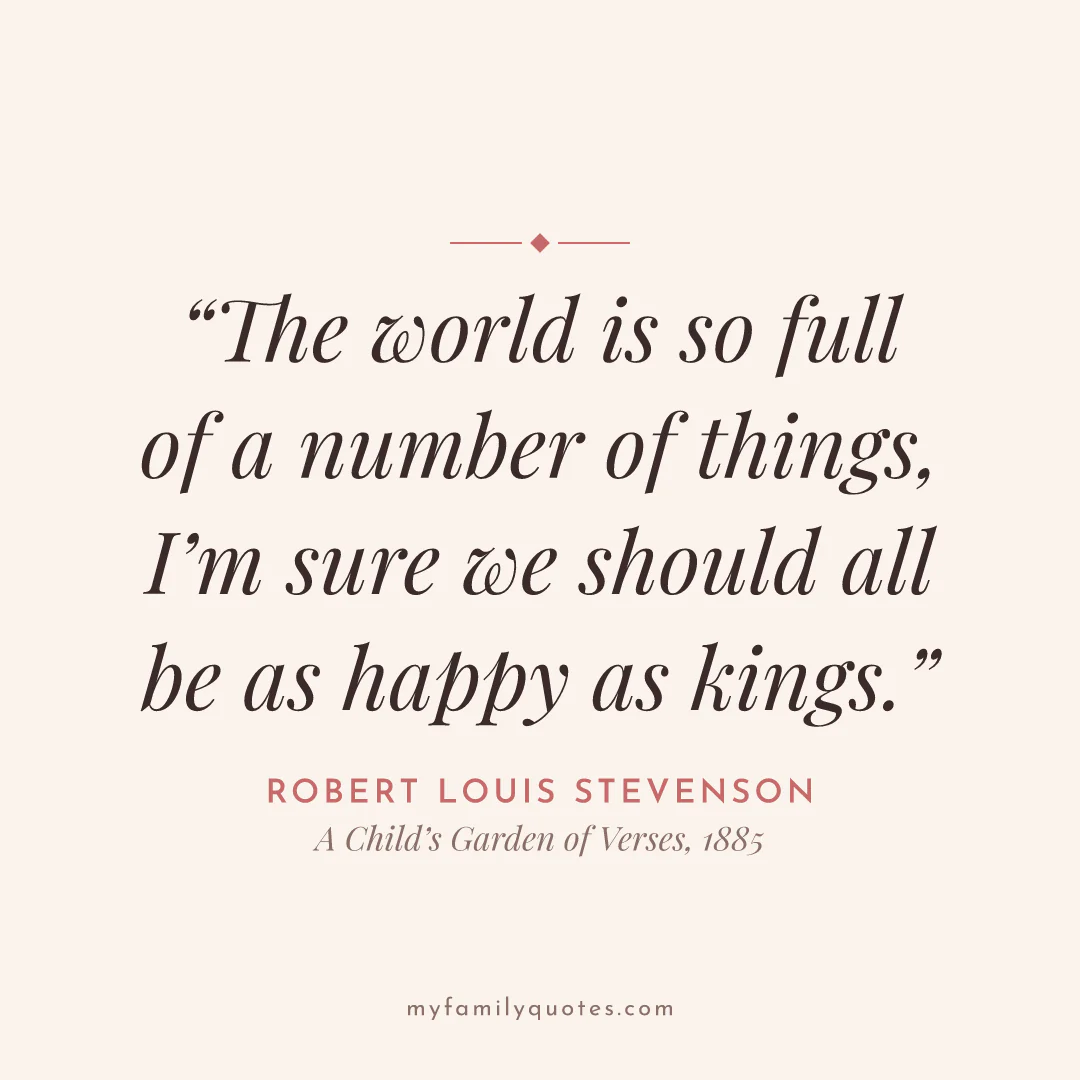
"The world is so full of a number of things, / I'm sure we should all be as happy as kings." — Robert Louis Stevenson, "Happy Thought," A Child's Garden of Verses, 1885
The whole poem is these two lines. Stevenson, often ill as a child, wrote the collection from a child's point of view, and this one became a nursery favourite. It is ideal for photos of children at the beach, the zoo or the park.
"Travel is fatal to prejudice, bigotry and narrow-mindedness, and many of our people need it sorely on these accounts." — Mark Twain, The Innocents Abroad, conclusion, 1869
Twain wrote it at the end of his account of an 1867 pleasure cruise to Europe and the Holy Land, after 60 chapters of poking fun at his fellow passengers. The first half of the sentence is the famous part. It suits a family that is taking the children abroad for the first time.
"I looked at the boy, who was silently watching his fly, and it was my hands that held his rod, my eyes watching." — E. B. White, "Once More to the Lake," Harper's Magazine, 1941
White took his son to the Maine lake where his own father had taken him around 1904, and kept feeling that he had become his father and the boy had become him. The essay is one of the most anthologised in American schools. The line is for parents who bring their children back to the places of their own childhood holidays.
"You don't choose your family. They are God's gift to you, as you are to them." — Desmond Tutu, address at his enthronement as Archbishop of Cape Town, 7 September 1986
Tutu said it in Cape Town during apartheid, at the service that made him the first Black Archbishop of Cape Town. Read at the level of one household, it is the right attitude for a long car journey: the people in the car were not chosen, and that is part of the gift.
"When everything goes to hell, the people who stand by you without flinching—they are your family." — Harry Dresden, in Jim Butcher, Proven Guilty (The Dresden Files, book 8), chapter 24, 2006
Harry says it just after "I don't care about whose DNA has recombined with whose." It fits the trip where the car breaks down, the rain sets in or the hotel loses the booking, and the family copes anyway. Good for a wry caption once everyone is home and laughing about it.
The hours spent with relatives rarely follow a script. Someone drops a glass, forgets a punchline or brings up an old argument. The value of a family Sunday lies not in getting it perfect but in doing it again next week. For lines to say out loud at a holiday table, see our sourced quotes for Thanksgiving toasts and cards; for the grandparents at the end of the table, there are 22 funny grandparent quotes with their sources.
Picking a Line for the Group Chat, a Place Card or a Photo Caption
Most people looking for a Sunday family quote need it for something small: a message to the family group chat on Saturday night, a line on a place card, or a caption under a photo of everyone around the table. The format decides more than the sentiment does. The table below matches each job to a length and a line from this page.
| Where it goes | Good length | Line that fits | Why it works |
|---|---|---|---|
| Saturday-night invite in the group chat | One short sentence | "Go thy way, eat thy bread with joy" (Ecclesiastes 9:7) | Reads as an invitation, and the old wording keeps it light rather than preachy. |
| Place card or printed menu | Under ten words | "A happy family / Is but an earlier heaven" (Bowring) | Short enough for a small card, and it fits a formal table. |
| Photo of the whole table | One line, plus names or a date | "They were happy, grateful, pleased with one another, and contented with the time" (Dickens) | Describes a real scene, not a slogan, so it suits a candid photo. |
| Lazy Sunday at home, couch or garden | One line | "There is nothing like staying at home for real comfort" (Austen) | Funny if you know the speaker, warm if you don't. |
| Day trip, beach or park | Two short lines | "The world is so full of a number of things, / I'm sure we should all be as happy as kings" (Stevenson) | A child's rhyme, so it suits photos with kids. |
| A trip that went wrong but ended well | One line | "When everything goes to hell, the people who stand by you without flinching—they are your family" (Jim Butcher) | Admits the mess with affection; best posted once everyone is home. |
Writing your own Sunday message
A quote works best as the second line, not the whole message. Start with the plan or the moment, add the quote, and stop. Three examples written by our editors:
- "Roast at Mom's, 1 p.m., kids bring dessert. 'Go thy way, eat thy bread with joy.' See you all there."
- "Grandpa carved, the twins argued, nobody burned anything. 'Happy, grateful, pleased with one another, and contented with the time.' Same again next week?"
- "No plans today, and nobody leaving the sofa. As Mrs. Elton put it, 'there is nothing like staying at home for real comfort.'"
Two habits keep these from sounding like a greeting card: name one real detail (the dish, the place, the person who did the washing up), and keep the attribution if you print the quote anywhere it will last, such as a menu, a framed print or a photo book.
Lines we took off this page, and why
An earlier version of this page listed 24 lines without sources. When we checked them, most could not be traced to anything their supposed authors wrote or said. We removed them rather than guess:
- "A happy family is but an earlier heaven" was credited to George Bernard Shaw. It is John Bowring's (1837), and it stays on the page under his name.
- "Family means no one gets left behind or forgotten" was credited to David Ogden Stiers. It is Lilo's line in Lilo & Stitch (2002), and it stays under the film's name.
- "Rejoice with your family in the beautiful land of life" (Albert Einstein): no letter, speech or book we could find; it appears only on quote sites.
- "There is no such thing as fun for the whole family" (Jerry Seinfeld), "Happiness is having a large, loving, caring, close-knit family in another city" (George Burns), "Family faces are magic mirrors" (Gail Lumet Buckley) and "Other things may change us, but we start and end with the family" (Anthony Brandt): plausibly theirs, but we could not find the original book, show or article, so we left them out until we can.
- Lines credited to Marge Kennedy, Les Dawson, Eva Burrows, John Wooden, Donna Hedges, Wanda Hope Carter, Brad Pitt, Maya Angelou, Barbara Bush, Candace Cameron Bure, Jenna Morasca and Michael Imperioli: no primary source located.
We keep a longer, sourced list of family lines that are regularly credited to the wrong person in our guide to misattributed family quotes.
Questions Readers Send In
What are some short quotes about family time?
The shortest real ones on this page are John Bowring's "A happy family / Is but an earlier heaven" (1837), Mark 2:27's "The sabbath was made for man, and not man for the sabbath," and Robert Louis Stevenson's two-line "Happy Thought" (1885). All three fit a card, a caption or a place card, and all three have a source you can check.
Who said "A happy family is but an earlier heaven"?
Sir John Bowring, in his hymn "Home Joys," published in 1837. It is widely credited to George Bernard Shaw, but there is no evidence that Shaw wrote it; the Shaw credit spread through newspaper filler items from the 1890s onward.
How do I caption a photo of a family Sunday?
Lead with one real detail (who cooked, where you went, what went wrong), then add one short quoted line with its author. A caption that describes the actual day, like the Dickens line about the Cratchits being "contented with the time," usually reads warmer than a generic slogan.