What Does a Mother See in Their Bond? 15 Father-Son Quotes From Mom
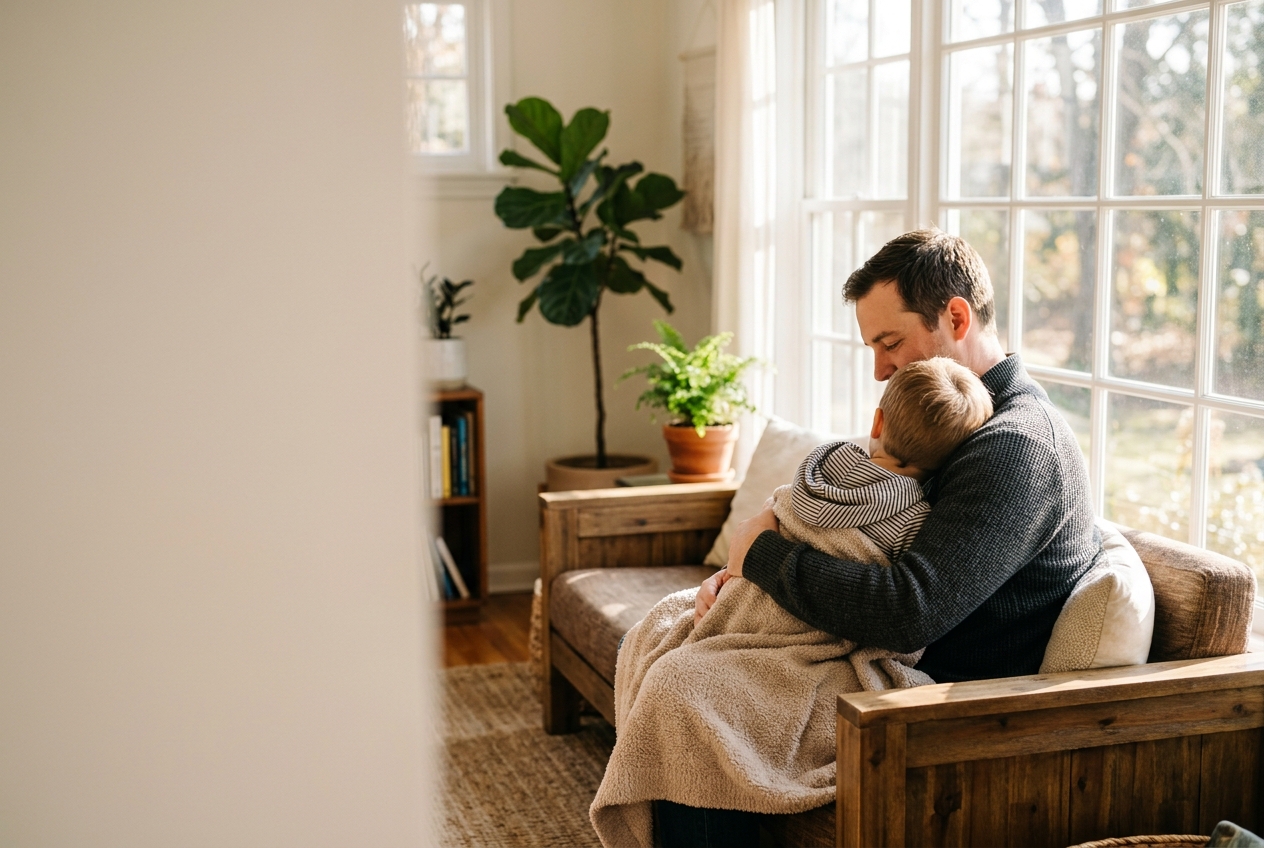
To the mother watching from the kitchen doorway. How do you capture the exact moment a boy decides he wants to walk, talk, and stand just like his dad? When does that shift happen, moving from maternal dependence to paternal mimicry?
It usually arrives without warning. I remember watching my older brother in a cramped apartment in Chicago, 1986, suddenly lowering his voice an octave just to match our father's timber when answering the landline. You are likely witnessing this exact kind of subtle mirroring right now in your own living room. The dynamic between a father and a son operates on a frequency women can observe but rarely broadcast on. You stand on the periphery of their inside jokes and shared silences, documenting the slow construction of a man.
You will notice the quiet mimicry
When you watch them together, the physical similarities become impossible to ignore. It happens fast. You see the same stubborn set of the jaw and the identical way they fold their arms when challenged.
"A man's desire for a son is usually nothing but the wish to duplicate himself in order that such a remarkable pattern may not be lost to the world." — Helen Rowland, A Guide to Men, 1922
Rowland captures the humorous but undeniable truth of paternal ego passing down through generations.
"Every son quotes his father, in words and in deeds." — Terri Guillemets, Anthology of Observations, 2007
You will hear your husband's exact phrasing come out of a seven-year-old's mouth at the dinner table.
A longer take on this lives in how women document paternal bonds.
"Boys want to grow up to be like their male role models. And boys who grow up in homes with positive male role models are more likely to be positive role models themselves." — Hillary Clinton, It Takes a Village, 1996
The stakes of this mimicry are high, shaping the adults these boys will eventually become.
"A boy’s best friend is his mother, but his father is his anchor." — Inspired by Willa Cather, O Pioneers!, 1913
Keep this one for the mornings you doubt your own role in their rough-and-tumble dynamic.
You will see them build their own language
They do not communicate the way you do. Words are scarce. Where you might ask direct questions about feelings, they communicate through shoulder punches, shared tools, and companionable silence over a car engine.
"No music is so pleasant to my ears as that word—father." — Lydia Maria Child, The Mother's Book, 1831
Child understood that the mere title carries a weight that transforms the man who bears it.
Related — why tired parents rely on humor.
"Dads are most ordinary men turned by love into heroes, adventurers, story-tellers, and singers of song." — Pam Brown, To a Very Special Dad, 1992
You get to witness this transformation firsthand, watching a mundane Tuesday evening turn into an epic backyard expedition.
"A father’s smile has been known to light up a child’s entire day." — Susan Gale, Reflections, 1999
Notice how your son's mood hinges entirely on a single nod of approval from across the yard.
"Fathers just have a way of putting everything together." — Erika Cosby, Quotes on Family, 1995
Even when they assemble the bicycle backward, the shared effort becomes its own kind of perfect logic.
For a broader look at household ties, explore what anchors the broader household together.
You must let them have their separate space
It is tempting to intervene when their play gets too rough or their discipline feels too stern. Resist the urge. You have to step back and let their specific relationship breathe on its own terms.
"It is a wise father that knows his own child." — William Shakespeare, The Merchant of Venice, 1596
This sixteenth-century truth reminds you that fathers possess their own distinct intuition about their boys.
"When my father didn’t have my hand, he had my back." — Linda Poindexter, Collected Verses, 2000
You will realize that a father's distance is often just a tactical retreat to provide better cover.
This gets argued with in scriptural views on fatherly duty.
"The imprint of a father remains forever on the life of the child." — Roy Lessin, Family Devotions, 2002
Every small interaction you observe from the hallway is carving permanent grooves into your son's character.
"There is nothing that moves a loving father's soul quite like his child's cry." — Joni Eareckson Tada, A Step Further, 1978
Despite their stoic exterior, you know exactly how quickly your husband moves when the boy actually falls.
You will realize how much they need each other
As the years pass, the dynamic shifts from teacher and student to something resembling peers. The height difference inverts. You will watch the boy outgrow the man physically, even as he continues to look up to him emotionally.
"A father is neither an anchor to hold us back, nor a sail to take us there, but a guiding light whose love shows us the way." — Unknown, Traditional Proverb, 1900s
This anonymous wisdom perfectly captures the evolving role of a father as his son navigates adolescence.
Another perspective is found in the quietest heartfelt family moments.
"The greatest gift I ever had came from God; I call him Dad." — Reneé Vennard, Poetry Collection, 1990
You will eventually hear your grown son express this exact sentiment, validating decades of quiet observation.
"A father is someone you look up to no matter how tall you grow." — Unknown, Folk Wisdom, 1950s
Watch them stand shoulder to shoulder in the driveway, and you will see that the hierarchy of respect remains firmly intact.
Leave the room quietly tonight while they are arguing over the rules of a board game, and just let them figure it out on their own.
If You Only Remember a Few Things
- Mothers hold a unique vantage point, observing the paternal bond without needing to manage its every detail.
- Boys absorb their fathers' mannerisms and language long before they understand the meaning behind the words.
- A father's distance is often a calculated choice to allow his son room to fail and recover independently.
- The physical environment, from garage workbenches to backyard lawns, serves as the primary classroom for this relationship.