Short Sister Quotes: 13 Lines From Real Sisters, Poems and Fairy Tales, With Sources
Words My Family Quotes Editors
When Cassandra Austen was sent away to school at Reading, her little sister Jane went with her. Jane was too young to learn much there, but, as their nephew James Edward Austen-Leigh wrote in his Memoir of Jane Austen, "she would have been miserable without her sister." Their mother put the whole relationship into one sentence, and it is still one of the best short sister quotes anyone has recorded. It is quoted in full below, with twelve more.
Every line on this page is short enough for a card, a caption or the inside of a gift, and every one was checked against a fetched copy of the original text: a letter, a memoir, a poem, a play or a fairy tale. Under each one you will find who said it, where and when, and the kind of sister or moment it suits. Near the end there is a table that matches each line to the space you have, a few short captions we wrote ourselves (labelled as ours), and the popular sister sayings we could not trace to anyone. For lines about brothers and sisters together, see our sibling quotes section.
Six words or fewer to start with
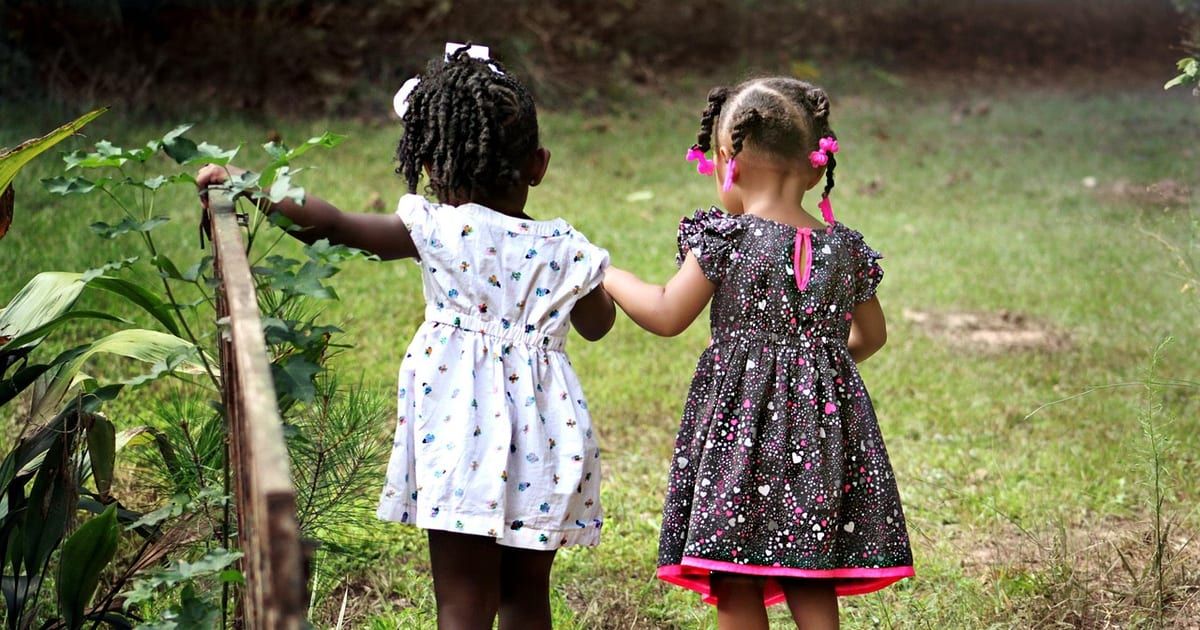
The shortest good sister lines come from a fairy tale. Snow-White and Rose-Red are two sisters, named for the white and the red rose tree in their mother's garden, and the Grimms describe them as so fond of each other that they always held hands when they went out.
When Snow-white said, "We will not leave each other," Rose-red answered, "Never so long as we live."
— Jacob and Wilhelm Grimm, "Snow-White and Rose-Red", Household Tales, translated by Margaret Hunt (1884)
This is the call and the answer, and it works best split between two people: one sister writes the first half, the other the second. It suits matching tattoos, two halves of a friendship necklace, or a caption under a photo of two small girls holding hands. The mother in the story adds a third line, "What one has she must share with the other", which is a fine joke for a card that comes with a shared gift. Note that this is not the Snow White of the seven dwarfs; she is a different girl from a different tale.
The other short classic comes from the closing lines of Christina Rossetti's Goblin Market: "For there is no friend like a sister." We discuss it on our page of brother and sister quotes. People who quote it rarely quote the lines that follow, though those are the ones that say what a sister actually does.
"To cheer one on the tedious way,
To fetch one if one goes astray,
To lift one if one totters down,
To strengthen whilst one stands."
— Christina Rossetti, Goblin Market (1862)
In the poem these words are spoken years later by Laura, who has told her children how her sister Lizzie risked herself to save her from the goblin men's poisoned fruit. Each line is a job: cheer, fetch, lift, strengthen. Any one of them works alone. "To lift one if one totters down" is right for a sister who has just got you through something hard; "To strengthen whilst one stands" is the quieter thanks for someone who keeps you steady when nothing is wrong.
Sister love, said briefly
Rossetti also wrote the most tender picture of two sisters asleep. It comes earlier in the same poem, on the night Laura first eats the goblin fruit, before the harm it does her begins to show.
"Golden head by golden head,
Like two pigeons in one nest
Folded in each other's wings"
— Christina Rossetti, Goblin Market (1862)
Those three lines are made for photographs: two sisters asleep in the back of a car, small girls in matching pajamas, or two grown women on a sofa after a long day. The first line alone, "Golden head by golden head", makes a caption for sisters with fair hair. For anyone else, use the second and third lines.
Emily Dickinson had two sisters in the sense that mattered to her: Lavinia, her younger sister at home, and Susan Gilbert Dickinson, her brother Austin's wife, who lived next door at the Evergreens. She wrote a poem to Susan about them both, signed "Emilie". Her niece Martha Dickinson Bianchi printed it as the dedication of The Single Hound, headed "To Sue".
"One Sister have I in our house,
And one a hedge away
There's only one recorded
But both belong to me."
— Emily Dickinson, "One Sister have I in our house", in The Single Hound (1914)
This is the line for a sister-in-law who has become a real sister, or for a family where a cousin, stepsister or best friend counts as one. "There's only one recorded" admits the paperwork says otherwise; "But both belong to me" settles the matter. The next stanza is the funny one, and it is about Lavinia.
"One came the way that I came,
And wore my last year's gown"
— Emily Dickinson, "One Sister have I in our house", in The Single Hound (1914)
Every younger sister has worn the older one's clothes, and every older sister remembers it. "One came the way that I came" means born to the same parents, and the hand-me-down gown is the proof. It makes a good caption for an old photograph where the little one is clearly wearing the big one's dress, or for a birthday card from an older sister. If you are writing for a sister-in-law, our sister-in-law quotes and messages page has more lines like the first stanza.

Funny lines for big and little sisters
Here is Mrs. Austen's sentence from the opening of this page. Her two daughters lived in the same house and shared the same bedroom for most of their lives, and the mother saw early how it would be.
"If Cassandra were going to have her head cut off, Jane would insist on sharing her fate."
— Mrs. Cassandra Austen, as recorded by James Edward Austen-Leigh, A Memoir of Jane Austen (1870)
It is a joke with real love underneath, which is what makes it so usable. Swap in your own names and it fits any younger sister who follows the older one everywhere: to school, to the same college, to the same city. It also suits a sister who insists on coming along to the hospital, the hard meeting or the dentist. Credit it to the Austens even if you change the names, because the point of the line is that it was said about them.
Most of Jane Austen's surviving letters are to Cassandra, and many of them open with a joke. This one was written from the family home at Steventon on a Wednesday in January 1801, when Cassandra was away and there was very little news.
"Expect a most agreeable letter, for not being overburdened with subject (having nothing at all to say), I shall have no check to my genius from beginning to end."
— Jane Austen, letter to Cassandra Austen, 21 January 1801
This is the perfect opening for a long chatty message to a sister who lives far away, or for the card you write when you have nothing to say and want to say it anyway. Only a sister gets a letter like that. The shorter version, "having nothing at all to say", is a good caption for a phone call screenshot or a voice note that lasted two hours.
Shakespeare gives the little sister the last word. In The Taming of the Shrew, Katherina has tied her younger sister Bianca's hands and is demanding to know which suitor she likes best. Bianca offers to do whatever she is told, and then adds a line with a sting in it.
"Or what you will command me will I do,
So well I know my duty to my elders."
— Bianca to her sister Katherina, William Shakespeare, The Taming of the Shrew, Act 2, Scene 1
"My elders" is the joke: Bianca is being obedient and calling her sister old in the same breath. It is ideal for a younger sister's birthday card to an older one, especially a birthday with a zero in it. A big sister can send it back with the roles reversed, and it still works.
For the sister who is also your best friend
Some of the most quoted sister lines are not about sisters by birth at all. In A Midsummer Night's Dream, Helena reminds her childhood friend Hermia of "the sisters' vows" they made as girls, and of how they sat on one cushion sewing one flower on one sampler.
"So we grew together,
Like to a double cherry, seeming parted,
But yet a union in partition,
Two lovely berries moulded on one stem"
— Helena to Hermia, William Shakespeare, A Midsummer Night's Dream, Act 3, Scene 2
A double cherry is two cherries on one stalk, separate but joined. That makes this the best older line for a soul sister: a friend so close she counts as family, or a real sister who is also your closest friend. Helena says it in the middle of a quarrel, believing Hermia has turned against her, so it also suits a reconciliation after a fight between sisters. Two lines are enough for most uses: "So we grew together, / Like to a double cherry".
The plainest line about a friend becoming a sister was spoken by a dying woman. On her last morning at Scarborough, Anne Brontë asked a blessing on her sister Charlotte and then on Charlotte's friend, who had travelled with them, and turned to the friend with a request.
"Be a sister in my stead. Give Charlotte as much of your company as you can."
— Anne Brontë to Ellen Nussey, 28 May 1849, in Elizabeth Gaskell, The Life of Charlotte Brontë, Volume 2, Chapter 3 (1857)
Gaskell does not print the friend's name; she calls her "Charlotte's beloved friend of more than twenty years", who wrote out the account for the biography, and that friend was Ellen Nussey. The first five words are a whole message on their own. They belong in a card to the friend who stepped in when a sister could not be there, or to a sister-in-law who has become family. Read the full sentence only where the weight of it fits, because it was a goodbye.
When she is going through something hard
Anne Brontë died at Scarborough on 28 May 1849, aged 29, with her sister Charlotte beside her. Elizabeth Gaskell recorded her last words in The Life of Charlotte Brontë, from the account of Charlotte's friend Ellen Nussey, who was also there. Seeing that Charlotte "could hardly restrain her grief", Anne spoke to her.
"Take courage, Charlotte; take courage."
— Anne Brontë, her last words, in Elizabeth Gaskell, The Life of Charlotte Brontë, Volume 2, Chapter 3 (1857)
It is remarkable that the dying sister was the one giving comfort. Put your sister's name where Charlotte's is and it becomes a four-word message for any hard week: an illness, a divorce, a new baby who will not sleep, a first day back at work after a loss. Because it carries the weight of where it was said, send it when things are truly hard, not for a bad hair day.
Anton Chekhov's Three Sisters ends with Olga, Masha and Irina standing pressed against one another after the worst day of the play. Olga, the eldest, puts her arms around the other two and speaks to them.
"Oh dear sisters, our life is not yet at an end. Let us live."
— Olga, Anton Chekhov, Three Sisters, Act 4 (1901), translated by Julius West (1916)
This is the line for sisters getting each other through something together: a parent's illness, clearing out the family home, the first holiday after a death. It is especially good from an oldest sister to the younger ones, because that is who says it in the play. Translations differ in wording; this one is Julius West's English version of 1916.
When a sister has died
Charlotte Brontë lost her brother Branwell and both her sisters, Emily and Anne, in less than nine months. Coming home from Scarborough in the summer of 1849, she wrote to Ellen Nussey about the evening she got back to the parsonage at Haworth.
"I felt that the house was all silent—the rooms were all empty."
— Charlotte Brontë, letter to Ellen Nussey, July 1849, in Elizabeth Gaskell, The Life of Charlotte Brontë (1857)
It is a plain sentence with no comfort in it, and that is why people who have lost a sister recognize it. It suits a private journal, an anniversary post, or a sympathy card to someone who has just lost a sister, where it shows you understand the silence rather than trying to fill it. For more lines about losing a sibling, see our page of losing a brother quotes, many of which fit a sister too.
Which line fits where
Short is relative. A caption can hold a sentence, a cake can hold six words, and a bracelet engraving can hold about three. This table matches each line on this page to the space it fits.
| Where it is going | Room you have | Line that fits |
|---|---|---|
| Bracelet, necklace or tattoo | 2 to 5 words | "We will not leave each other" / "Never so long as we live" |
| Birthday cake or balloon | 4 to 8 words | "So well I know my duty to my elders" |
| Photo of two sisters asleep | One short line | "Like two pigeons in one nest" |
| Old childhood photo | One or two lines | "One came the way that I came, / And wore my last year's gown" |
| Sister-in-law or chosen sister | Two to four lines | "There's only one recorded / But both belong to me" |
| Best friend | Two lines | "So we grew together, / Like to a double cherry" |
| Friend who stepped in as a sister | 5 words | "Be a sister in my stead" |
| Hard week text message | One sentence | "Take courage" with her name |
| Thank-you card | One line | "To lift one if one totters down" |
| Sympathy card or memorial post | One sentence | "The house was all silent—the rooms were all empty" |
When you shorten a line, cut from the ends, not the middle, and keep the author's name with it. If you have to leave out words inside a sentence, mark the gap with an ellipsis (…). And do not mix two sources into one quote: the Rossetti and Dickinson lines are often run together online as if they were one poem.
Short captions we wrote ourselves
Sometimes a quote is too formal and you just want a caption. These were written by our editors for this page. They are not quotations, so use them freely, with no credit needed.
- Same parents, same jokes, separate opinions on the thermostat.
- First friend, longest friend, still borrowing the good sweater.
- She knew the plan before I said it out loud.
- Older by a little, bossier by a lot.
- Two branches, one tree, a lot of shared photos.
- Still the person I call first.
Popular sister sayings we could not trace
Search for short sister quotes and these come up on almost every list. We looked for an original book, article or interview for each and found none, so we have not included them in the count above. Use them as sayings, not as quotations.
- "A sister is a little bit of childhood that can never be lost." Usually credited to Marion C. Garretty. We could not find a book, article or date for this name, and the line appears only in quote collections.
- "Sisters by chance, friends by choice." A modern saying with many variants (cousins, brothers, sisters-in-law). No author.
- "Having a sister is like having a best friend you can't get rid of." Credited to "Amy Li" with no source; we found no publication behind it.
- "There is no friend like a sister." This one is real, but it is Rossetti's, from Goblin Market (above). It is often printed with no name or with the wrong one.
If you would rather have a line from scripture, our Bible verses about sisters page covers Miriam, Martha and Mary and the other sisters in the Bible, and our short sibling quotes page has short lines that cover brothers too.
Short sister quotes: quick answers
What is a good short sister quote?
"We will not leave each other" / "Never so long as we live", from the Grimms' tale "Snow-White and Rose-Red", is the shortest good one, and it splits neatly between two sisters. For a single line with a famous author, use Christina Rossetti's "For there is no friend like a sister" from Goblin Market (1862).
What is a cute caption for a sister?
For a photo of two sisters asleep, Rossetti's "Like two pigeons in one nest" is hard to beat. For a childhood photo, Emily Dickinson's "One came the way that I came, / And wore my last year's gown" works well. If you would rather not quote anyone, use one of the editor-written captions above.
What is a funny short quote about sisters?
Bianca's "So well I know my duty to my elders" from The Taming of the Shrew is the best one for a younger sister teasing an older one. Mrs. Austen's remark that if Cassandra "were going to have her head cut off, Jane would insist on sharing her fate" suits a younger sister who follows the older one everywhere.
What is a short quote for a sister going through a hard time?
Anne Brontë's last words to her sister, "Take courage, Charlotte; take courage", recorded by Elizabeth Gaskell, can be sent with your sister's name in place of Charlotte's. For sisters facing something together, Olga's line from Chekhov's Three Sisters, "Oh dear sisters, our life is not yet at an end. Let us live", is the other strong choice.