Family Memories Captions for Instagram: How to Write One, Plus 13 Sourced Lines
Words My Family Quotes Editors
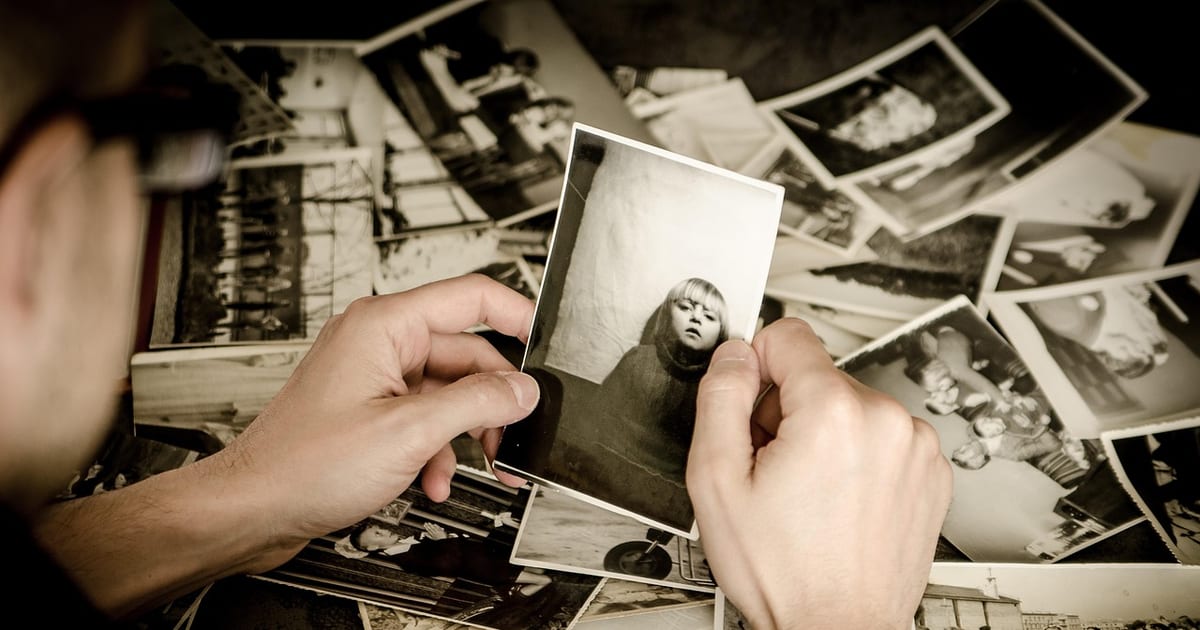
A family memories caption is the one or two lines under an old photo that say what the picture can't: when it was, who is in it, and why you are posting it now. The photo shows faces. The caption gives them a story. Most caption lists online skip this part and hand you fifty interchangeable lines with no source. This page goes the other way. Below you'll find a simple way to write your own caption, then 13 lines from writers who thought hard about memory, each one checked against the original book, play or speech, so you know exactly who you are quoting.
If you only want a quick list for a photo dump, our short family memories quotes are built for that. This guide is for the post you actually want to get right: a throwback for a parent's birthday, a reunion picture, a scan of a print that has been in a shoebox for thirty years.
How to Write a Caption for a Family Memory, in Five Steps
Good memory captions follow the same order the brain does when it sees an old picture: first where am I, then how do I feel, then what does it mean now. You can do it in under a minute.
- Anchor it. Put the year, the place or the occasion first: "Lake Erie, 1997." "Grandma's kitchen, the last Thanksgiving before she moved." Your followers can't know this, and it is the detail that makes cousins comment.
- Name the mood in one word, to yourself. Funny, tender, bittersweet, or in memory of someone. That word decides which section below to use. A memorial photo with a joke caption, or a slapstick vacation photo with a solemn one, is an easy mismatch to make.
- Add one line, borrowed or your own. A borrowed line works when it says something you would struggle to say yourself. Your own line works when it is specific: a nickname, a phrase your dad used, the song that was playing.
- Credit the writer. A dash and a name is enough: "— George Eliot." If the line is spoken by a character, credit the writer, not the character: "— Jane Austen", not "— Elizabeth Bennet".
- Cut it and read it aloud. Instagram shows roughly the first two lines before "more", so the anchor and the quote should fit there. Tag the people in the photo, not the caption.
Put together, a caption looks like this. These are examples our editors wrote to show the pattern; swap in your own details.
- "Outer Banks, 2004. The tent flooded on night one and Dad called it 'character building.' This too sometime we shall haply remember with delight. — Virgil"
- "Mom's 60th, and the photo from her 30th next to it. In memory everything seems to happen to music. — Tennessee Williams"
- "Scanned Grandpa's slides this weekend. Lord, keep my memory green. — Charles Dickens"
The Trip That Went Wrong, and Everyone Laughs About Now
Every family has the vacation: the rain, the breakdown, the motel. These three lines are for photos that were miserable to live through and are now the best story at Christmas.
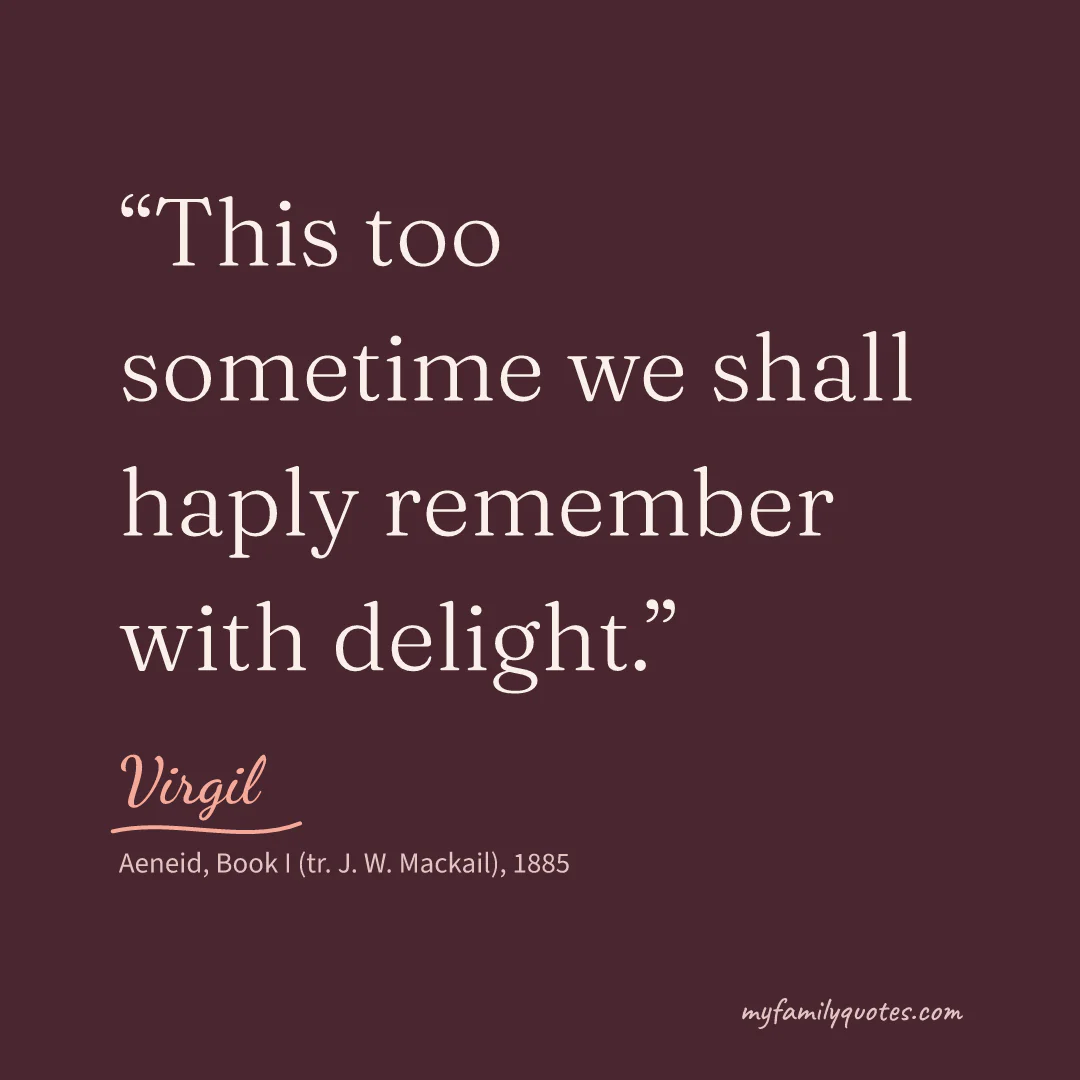
"This too sometime we shall haply remember with delight."
— Virgil, Aeneid, Book I, line 203, written c. 29–19 BC; translation by J. W. Mackail (1885)
Aeneas says this to his crew after a storm has wrecked their fleet on the coast of Libya. He is trying to keep them going, so the line is a mix of comfort and bluff, which is exactly how a parent sounds standing next to a flat tyre. In Latin it is forsan et haec olim meminisse iuvabit, and Mackail's "haply" simply means "perhaps." Use it under any photo of a disaster you've all survived.
"It's a poor sort of memory that only works backwards."
— Lewis Carroll, Through the Looking-Glass, Chapter V, "Wool and Water" (1871)
The White Queen tells Alice that in her country people live backwards, so they can remember things before they happen. Alice says she can't, and the Queen delivers this put-down. It is a nice wink for a "then and now" pair, or for the family member who still insists on their version of what happened at the campsite.
"When I was younger I could remember anything, whether it happened or not; but I am getting old, and soon I shall remember only the latter."
— Mark Twain, as quoted by Albert Bigelow Paine in Mark Twain: A Biography, chapter CCXXXIX (1912)
Paine, who worked alongside Twain while he dictated his autobiography in his last years, calls this Twain's "lovely and whimsical admission" that some of his stories had drifted from the facts. That makes it the honest caption for a family legend that grows a little every time it is told. It is long, so it works best as the whole caption with only a date in front.
For more lines in this spirit, see our funny family memories quotes.
When the Kid in the Photo Is Now Taller Than You
Childhood photos are the most posted family memories of all: first days of school, bath-time pictures that should never leave the album, siblings in matching outfits. These lines are about how childhood stays in us.
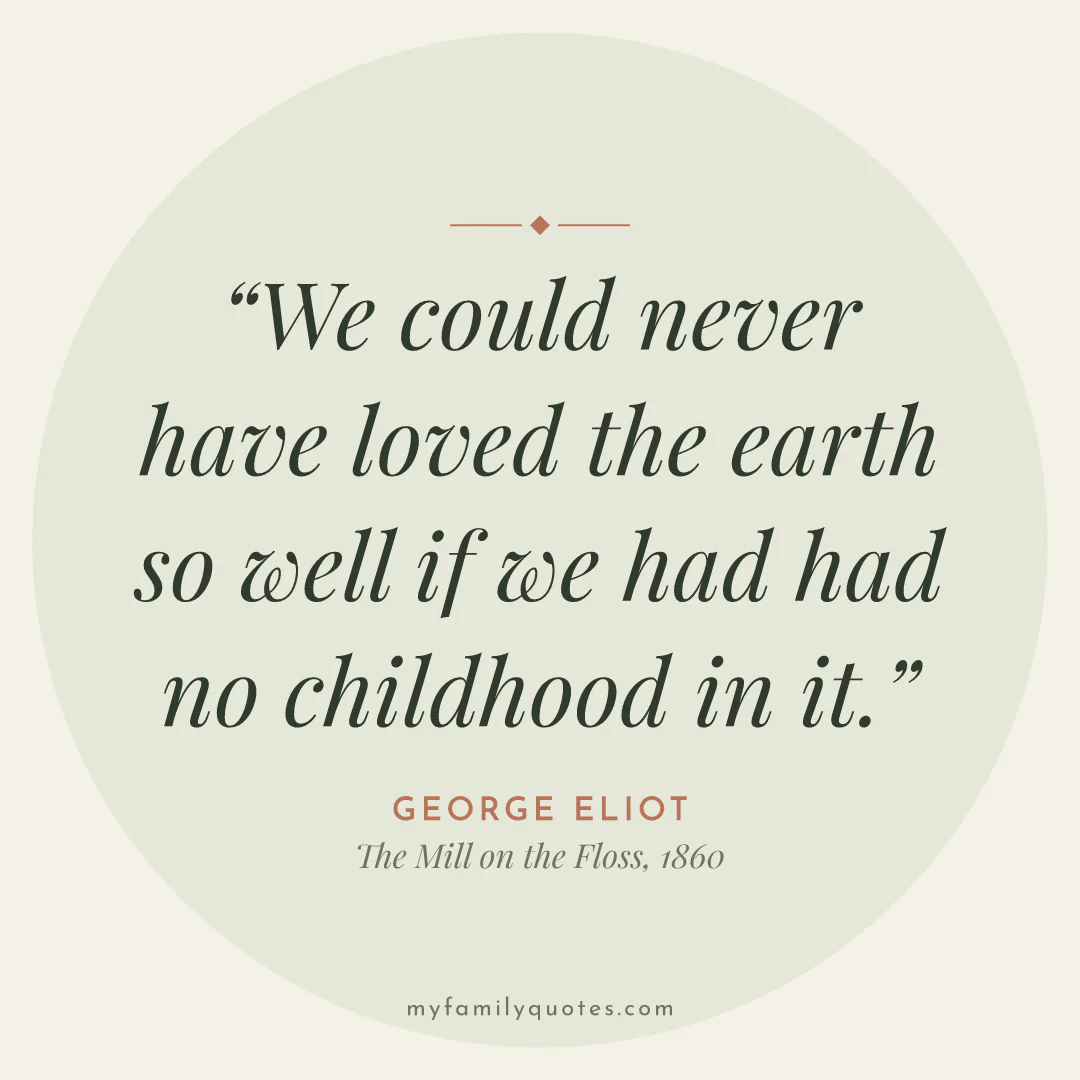
"We could never have loved the earth so well if we had had no childhood in it."
— George Eliot, The Mill on the Floss, Book First, Chapter V, "Tom Comes Home" (1860)
Eliot writes this about the brother and sister Tom and Maggie Tulliver, who believe the places and loves of their first years will always be part of them. She goes on to describe the same flowers coming up every spring "that we used to gather with our tiny fingers." It is a lovely line for a photo taken outdoors: a garden, a farm, a beach you went back to every summer.
"The Child is Father of the Man"
— William Wordsworth, "My Heart Leaps Up," written 1802, published in Poems, in Two Volumes (1807)
The poem is nine lines long: the speaker's heart leaps at a rainbow now just as it did when he was a child, and he hopes it always will. The seven famous words mean that who we were as children shapes who we become. It is ideal for a side-by-side of a baby photo and a graduation, wedding or new-parent photo of the same person.
"Some memories are realities, and are better than anything that can ever happen to one again."
— Willa Cather, My Ántonia, Book V, "Cuzak's Boys" (1918)
The narrator, Jim Burden, admits he put off visiting his childhood friend Ántonia for twenty years because he did not want to lose his early memories of her. The line is bittersweet rather than sad. Use it for a childhood photo with a friend or cousin you've lost touch with, or a picture of a house that has since been sold.
Photos From a Year You'd Rather Not Repeat
Some throwbacks come from a hard stretch: a move, an illness, a divorce, a year money was tight. Posting them can be a way of saying "we got through it." These two lines handle that without pretending it was all fine.
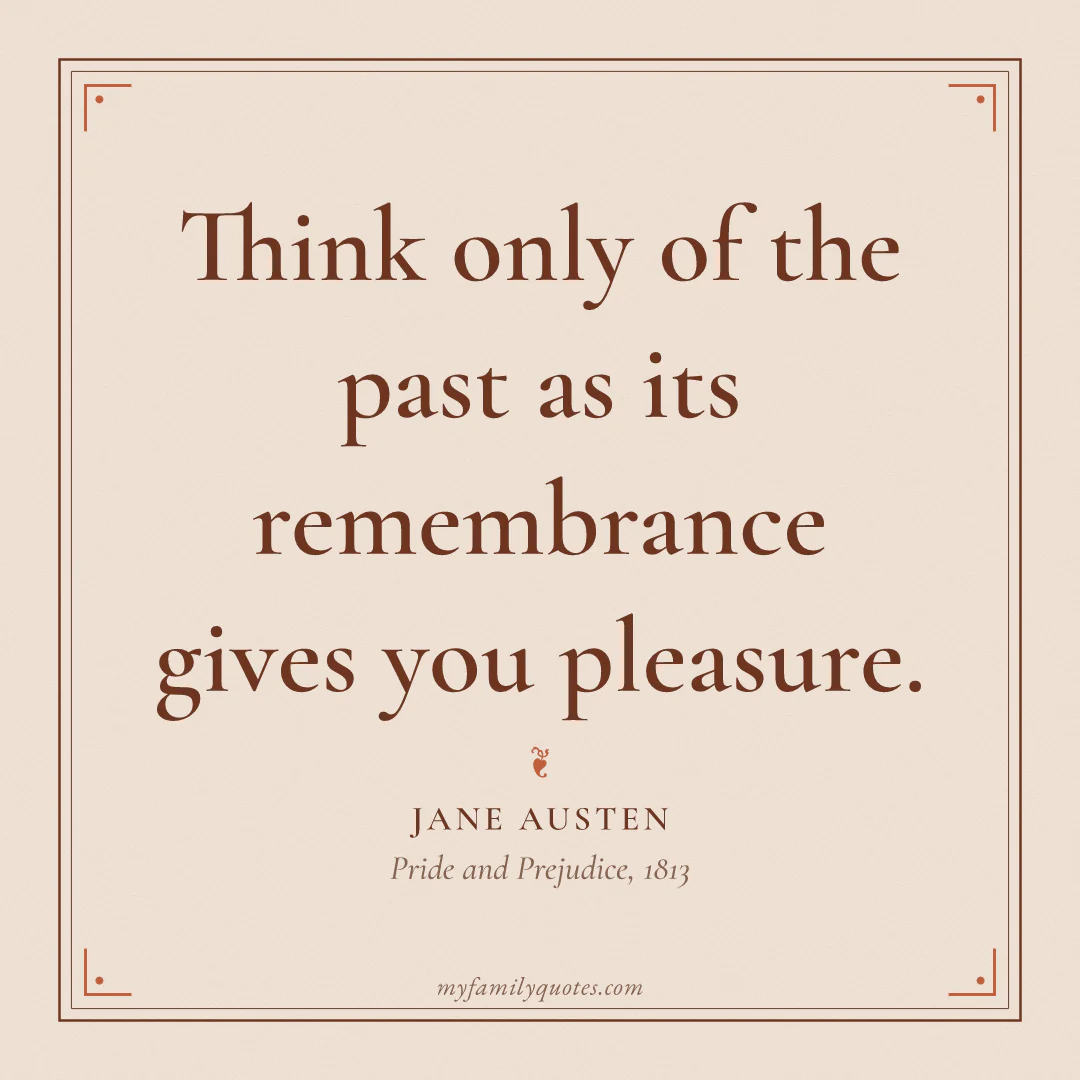
"Think only of the past as its remembrance gives you pleasure."
— Jane Austen, Pride and Prejudice, Chapter 58 (1813)
Elizabeth Bennet says this to Mr Darcy near the end of the novel, when he apologises for the bitter letter he once wrote her. She tells him he "must learn some of my philosophy": keep what is worth keeping and let the rest go. It suits a photo of a family that has made up after a long quarrel, or a picture from a hard time that you can now look at kindly.
"The past is never dead. It's not even past."
— William Faulkner, Requiem for a Nun, Act I, Scene 3 (1951)
Faulkner's lawyer Gavin Stevens says this in a play about a woman whose past catches up with her and her family. It is often misquoted as "The past isn't over." In a caption it reads as serious, even heavy, so save it for photos where that weight is the point: a family home, an immigrant ancestor's portrait, a reunion after years apart.
When the Photo Is Really About the House
Some of the best memory photos have almost nobody in them: the old kitchen, the piano, the porch, the table set for a holiday. These lines are about rooms, songs and the shared private language a family builds.
"In memory everything seems to happen to music."
— Tennessee Williams, The Glass Menagerie, Scene One (1944)
Tom Wingfield says this while narrating the opening of a play about his mother and sister, a family he has left but cannot stop thinking about. It is one of the best short lines ever written about remembering home, and it fits any photo with a record player, a radio, a piano, or a kitchen where someone was always singing.
"Memory, my dear Cecily, is the diary that we all carry about with us."
— Oscar Wilde, The Importance of Being Earnest, Act II (1895)
The governess Miss Prism tells Cecily she doesn't need to keep a diary. Cecily's reply is the better joke: memory, she says, "usually chronicles the things that have never happened, and couldn't possibly have happened." Quote the first line for a sweet post, or both lines for a playful one about the family story nobody agrees on.
"Whatever we had missed, we possessed together the precious, the incommunicable past."
— Willa Cather, My Ántonia, closing paragraph (1918)
These are the last words of the novel, as Jim and Ántonia meet again as adults. "Incommunicable" means it cannot be explained to anyone who wasn't there, which is exactly what a sibling reunion photo or a group shot of cousins feels like. It is a good choice when the comments will fill up with inside jokes.
When Someone in the Photo Is Gone
Posting a photo of someone who has died is different from any other throwback. The caption should be quiet, and short is usually better. Both lines here are about keeping people close through memory.
"Lord, keep my memory green!"
— Charles Dickens, The Haunted Man and the Ghost's Bargain, Chapter I, "The Gift Bestowed" (1848)
In Dickens's Christmas story, 87-year-old Philip Swidger repeats this prayer, which is written under an old portrait in the dining hall of the college his family looks after. The book is about a man who asks to forget his sorrows and learns that losing painful memories means losing the good ones too. Its very last words are this prayer. At five words, it is the shortest line on this page and works for an anniversary post or a scanned photo of a grandparent.
"They are the roses in December; you remember someone said that God gave us memory so that we might have roses in December."
— J. M. Barrie, rectorial address "Courage," University of St Andrews, 3 May 1922
Barrie, the author of Peter Pan, said this to students and went on to call the people he had cared for most "my December roses." Note what he actually says: "someone said." Barrie was quoting an older saying, not coining it, so the accurate caption credit is "— J. M. Barrie, quoting an old saying" or simply "— an old saying." For other ways to write about loss, see C.S. Lewis on mourning.
Pick by Length: All 13 Lines at a Glance
Word counts are for the part you would actually put in the caption.
| Line (caption form) | Writer | Words | Best photo |
|---|---|---|---|
| Lord, keep my memory green | Dickens | 5 | Someone who has died |
| The Child is Father of the Man | Wordsworth | 7 | Baby photo next to grown-up photo |
| In memory everything seems to happen to music | Williams | 8 | A room, a piano, a record player |
| This too sometime we shall haply remember with delight | Virgil (Mackail) | 9 | The vacation that went wrong |
| The past is never dead. It's not even past. | Faulkner | 9 | Ancestors, the family home |
| It's a poor sort of memory that only works backwards | Carroll | 10 | "Then and now" pairs |
| Think only of the past as its remembrance gives you pleasure | Austen | 11 | A hard year, a reconciliation |
| God gave us memory so that we might have roses in December | Barrie, quoting a saying | 12 | An anniversary of a loss |
| Whatever we had missed, we possessed together the precious, the incommunicable past | Cather | 12 | Sibling or cousin reunions |
| Memory, my dear Cecily, is the diary that we all carry about with us | Wilde | 14 | The family story nobody agrees on |
| Some memories are realities, and are better than anything that can ever happen to one again | Cather | 16 | A childhood friend, a sold house |
| We could never have loved the earth so well if we had had no childhood in it | Eliot | 17 | Outdoor childhood photos |
| When I was younger I could remember anything, whether it happened or not… | Twain (via Paine) | 26 | A family legend |
Lines We Removed or Corrected, and Why
An earlier version of this page carried several memory quotes that circulate widely on caption sites. When we checked them, some didn't hold up, so here is what changed.
- "The best thing about memories is making them," usually credited to Patrick Rothfuss: we found no primary source for it, so it is gone.
- "Our memory is a more perfect world than the universe," credited to Guy de Maupassant, and "We are our memories," credited to Jorge Luis Borges: no primary source found in our check, so both are removed rather than guessed at.
- "It isn't so astonishing, the number of things that I can remember, as the number of things I can remember that aren't so" is often posted as pure Twain. Paine, in the same chapter quoted above, says Twain was paraphrasing the humorist Josh Billings.
- "God gave us memory so that we might have roses in December" is posted everywhere as Barrie's own line. His speech shows he introduced it with "someone said."
We keep a longer list of family quotes with the wrong name attached, each traced to its source, in misattributed family quotes: who really said them.
Questions People Ask About Memory Captions
How do you write a caption for memories?
Start with a fact only you know (the year, the place, the occasion), add one line that matches the mood, and credit the writer if the line is borrowed. Keep the first two lines strong, because that is all Instagram shows before "more". The five steps at the top of this page walk through it with examples.
What is a short caption for family memories?
The shortest sourced lines here are Dickens's "Lord, keep my memory green" (5 words), Wordsworth's "The Child is Father of the Man" (7) and Tennessee Williams's "In memory everything seems to happen to music" (8). Pair any of them with a year and a place and you have a complete caption.
Should you credit the author in an Instagram caption?
Yes. A dash and the writer's name is enough, and it stops a line from being passed around with the wrong name. If you are not sure who said something, it is better to leave the credit off and write "author unknown" than to guess; several popular "memories" quotes have no traceable source at all.