40 Short Family Memories Quotes for Photo Albums and Scrapbooks
Words My Family Quotes Editorial Team
Desk: Hannah Ellsworth
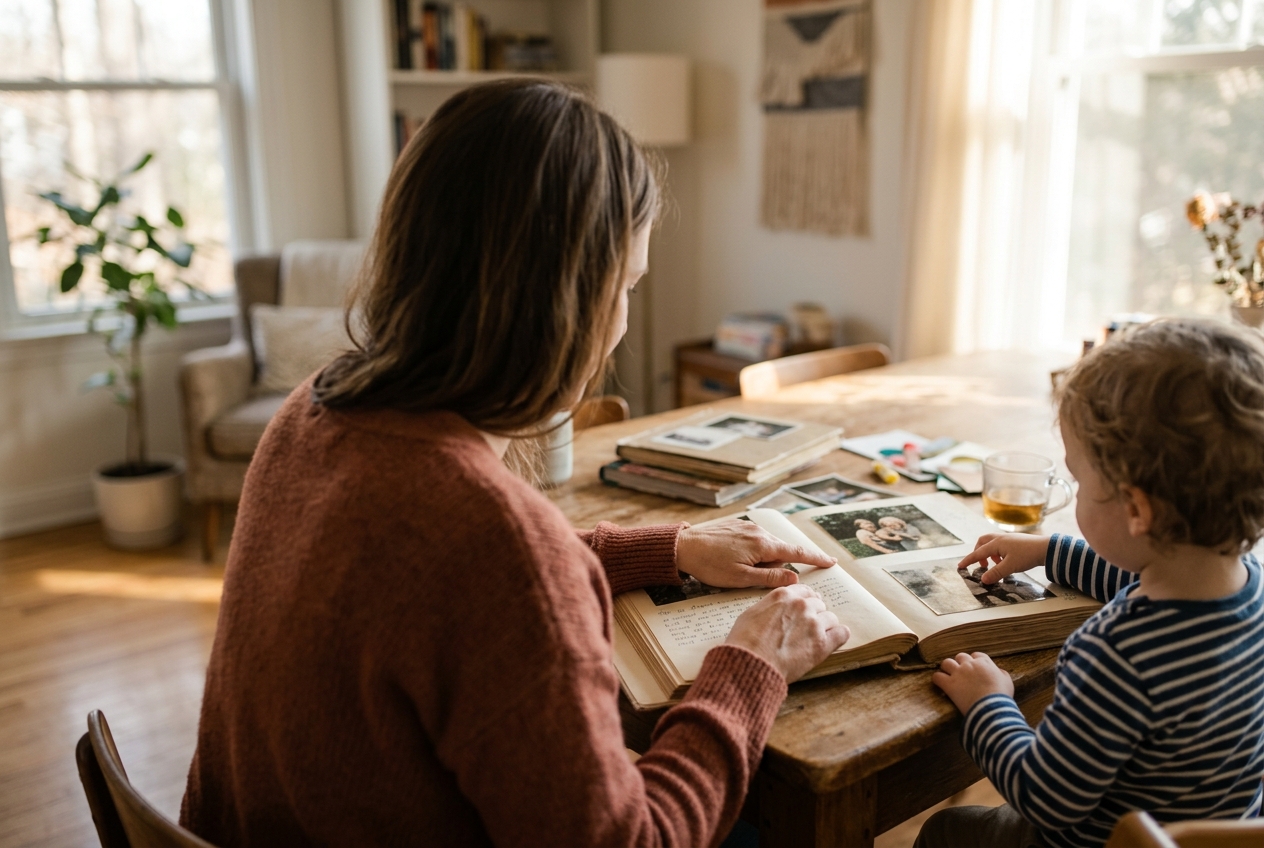
Rain beats against the slanted roof of a Munich apartment on a quiet Tuesday afternoon. An old shoebox sits open on the floor, spilling out black-and-white photographs from the late 1970s. Without dates or names scribbled on the back, the faces stare forward, detached from the laughter that surely followed the camera's flash. A few sparse words penned on a margin change everything. Context transforms a static image into a living record. When we are tasked with preserving shared history, we often find that lengthy paragraphs are unnecessary. A single, sharp sentence can hold the entire atmosphere of a forgotten summer.
Why do short phrases anchor our recollections so effectively?
Brief statements act as cognitive shortcuts for the human brain, bypassing complex narratives to deliver immediate emotional resonance. When we pair a concise sentiment with a visual memory, the combination locks the experience into our long-term recall. A few carefully chosen syllables carry the weight of entire afternoons spent together. Text provides the structural framework for our nostalgia.
- "Family faces are magic mirrors." — Gail Lumet Buckley
Buckley explored her own complex lineage in her 1986 book The Hornes: An American Family. Looking at relatives often reflects our own developing identities back at us. The resemblance is psychological as much as it is physical. We see our own quirks mirrored in a sibling's smile. - "Memories are the architecture of our identity." — Unknown
Though often misattributed to various modern psychologists on social media, this anonymous maxim captures the structural nature of the past. We build our current decisions on the foundation of what we remember from our early homes. A single childhood kitchen can influence a lifetime of meals. - "The heart's memory eliminates the bad and magnifies the good." — Gabriel García Márquez
Writing in his later years, the Colombian novelist understood the editing process of the human mind. Nostalgia acts as a filter, softening the rough edges of past conflicts. We remember the warmth of the hearth, forgetting the smoke that stung our eyes. - "Time endears but cannot fade the memories that friends have made." — Traditional
This old cross-stitch staple speaks to the resilience of early bonds. Kinship often blurs the line between relation and friend during our formative years. The people who shared our first secrets hold a distinct monopoly on our trust. - "What we remember from childhood we remember forever." — Cynthia Ozick
The American essayist points to the permanence of early impressions. A child's brain absorbs atmospheres and tensions with absolute clarity. Those initial sensory details become the baseline against which we measure all future experiences. - "Memory is a way of holding on to the things you love." — Kevin Arnold (The Wonder Years)
Broadcast in the late 1980s, this television narration captured the universal desire to freeze time. We document our gatherings because we know the configuration of people in the room will inevitably change. A photograph is a rebellion against the passage of time. - "Happy memories are the home's invisible foundation." — Unknown
Physical houses settle and shift, but the events that occurred within them remain structurally sound in our minds. The geometry of a childhood living room stays mapped in our brains for decades. We can navigate those old spaces with our eyes closed. - "The best thing about memories is making them." — Unknown
Anticipation plays a crucial role in how we experience family events. The act of planning a reunion often generates as much joy as the event itself. We are conscious architects of the stories we will later tell. - "Nothing is ever really lost to us as long as we remember it." — L.M. Montgomery
The author of Anne of Green Gables understood the sustaining power of recollection. Bereavement is softened slightly by the sudden, vivid recall of a shared joke. The past remains accessible to anyone willing to sit quietly and look backward. - "A moment lasts all of a second, but the memory lives on forever." — Anonymous
The brevity of an event has no correlation to its lasting impact. A five-minute conversation on a porch swing can alter the trajectory of a relationship. We carry these microscopic turning points with us into old age.
How can brief quotes elevate a simple photograph?
Text provides the invisible emotional layer that a camera lens cannot capture, translating atmospheric feelings into readable artifacts. While an image shows who was present at a specific gathering, a written phrase explains why that gathering mattered to the participants. The juxtaposition of visual evidence and linguistic meaning creates a complete historical document. Words give the image a voice.
- "Photography is a way of feeling, of touching, of loving." — Aaron Siskind
The American abstract expressionist photographer viewed the camera as an emotional instrument rather than a mechanical one. Pressing the shutter is an act of preservation born from affection. We only photograph what we are afraid to lose. - "We do not remember days, we remember moments." — Cesare Pavese
The Italian poet recognized the fragmented nature of human recall. We rarely remember an entire Tuesday from beginning to end. Instead, we retain the exact slant of light hitting the dining table at breakfast. - "Sometimes you will never know the value of a moment until it becomes a memory." — Dr. Seuss
Theodor Geisel captured the delayed realization of significance that plagues most adults. We often rush through chaotic family dinners, unaware that we will later yearn for that exact noise. Hindsight assigns proper weight to the mundane. - "A photograph is a pause button on life." — Ty Holland
This modern observation highlights the mechanical intervention required to stop time. Life flows relentlessly forward, dragging us along with it. A printed image offers a rare sanctuary where the clock has stopped ticking entirely. - "Life brings tears, smiles, and memories." — Unknown
This triad of human experience summarizes the arc of any long-term relationship. The tears and smiles are temporary physiological reactions. The memories are the permanent residue left behind after the emotion fades. - "Every picture tells a story." — Rod Stewart
The title track of the 1971 album became a cultural idiom for a reason. Even a poorly framed snapshot contains a narrative about the person holding the camera. The angle reveals what the photographer found most important in the room. - "Memories are the threads that hold together the patchwork of friendship." — Unknown
When considering the broader spectrum of kinship, we see how shared history binds disparate personalities. Relatives often have little in common besides the events they both witnessed. That shared witnessing is strong enough to maintain a lifelong tether. - "The tears dry, the smiles fade, but the memories last forever." — Unknown
Emotional volatility defines our early interactions with siblings and parents. The intense anger over a borrowed sweater evaporates within a week. The memory of the subsequent apology remains intact forty years later. - "A good snapshot keeps a moment from running away." — Eudora Welty
The Southern writer, who was also an accomplished photographer in the 1930s, understood the fugitive nature of time. A moment is always in the process of vanishing. The camera acts as a trap for fleeting light. - "Photos are a return ticket to a moment otherwise gone." — Katie Thurmes
This metaphor treats the past as a physical destination. A scrapbook is essentially a passport filled with stamps from previous eras of our own lives. We flip the pages to travel backward.
What makes childhood memories resonate across generations?
Early experiences form the foundational grammar of our emotional lives, establishing patterns of connection that we unconsciously repeat with our own children. Recognizing these shared beginnings bridges the gap between different eras, proving that fundamental human attachments remain stable despite technological and social shifts. We see our current selves in the past. Generational continuity relies on these echoes.
- "Childhood is the light of our life, we must keep it safe within our hearts." — Marinela Reka
The innocence of our earliest years serves as a psychological refuge during difficult adult periods. Returning to the memory of a secure childhood bedroom offers immediate nervous system regulation. We carry our younger selves inside us like a compass. - "There is no place like home." — L. Frank Baum
First published in the 1900 novel The Wonderful Wizard of Oz, this simple declaration remains the ultimate summary of familial gravity. The physical structure matters less than the psychological safety it represents. Home is the baseline reality we always return to. - "Family is not an important thing. It's everything." — Michael J. Fox
The actor spoke these words while navigating his highly publicized health struggles. Crisis strips away the superficial layers of life, leaving only the essential support structures. Relatives are the people who remain in the hospital waiting room. - "The greatest legacy we can leave our children is happy memories." — Og Mandino
Financial inheritance pales in comparison to the emotional stability provided by a peaceful upbringing. A child raised in a calm environment inherits a resilient nervous system. That resilience is passed down to the next generation. - "Rejoice with your family in the beautiful land of life." — Albert Einstein
The theoretical physicist recognized that intellectual pursuits meant little without a community to share the spoils. Scientific discovery requires isolation, but human satisfaction requires company. The dinner table grounds the wandering mind. - "Family means no one gets left behind or forgotten." — David Ogden Stiers (Lilo & Stitch)
This line from the 2002 animated film entered the cultural lexicon by defining unconditional inclusion. The biological lottery places us in a group where membership cannot be revoked. We are tethered to one another by blood and shared meals. - "In time of test, family is best." — Burmese Proverb
Cultural wisdom often distills complex sociological truths into rhyming couplets. When external systems fail, the internal network of relations absorbs the shock. You learn the true strength of a bond during a crisis. - "The family is one of nature's masterpieces." — George Santayana
The philosopher viewed the family unit as an organic, self-regulating ecosystem. Like any natural system, it contains periods of storm and periods of profound calm. The balance is maintained through constant, micro-adjustments of affection. - "Our most basic instinct is not for survival but for family." — Paul Pearsall
The neuropsychologist argued that human evolution prioritized connection over individual preservation. We will readily risk our own safety to protect a child or sibling. The biological imperative is communal, not solitary. - "A family is a risky venture, because the greater the love, the greater the loss." — Brad Pitt
Attachment inherently carries the risk of grief. To love someone deeply is to accept the eventual pain of their absence. The joy of the present is borrowed against the sorrow of the future.
Where should we record these fleeting moments of connection?
Physical mediums offer a permanence that digital storage lacks, making scrapbooks, photo album margins, and handwritten letters the ideal vessels for preserving brief sentiments. Writing words by hand forces a deliberate slowing of thought, ensuring the chosen phrase matches the gravity of the memory being preserved. Tangible records survive server crashes and forgotten passwords. Ink on paper demands attention.
- "The pale ink is better than the best memory." — Chinese Proverb
Human recall is notoriously unreliable, shifting and degrading with each passing decade. A hastily scribbled note on the back of a receipt serves as hard evidence of a specific afternoon. The physical artifact corrects the drifting mind. - "Memory is the diary that we all carry about with us." — Oscar Wilde
In his 1895 play The Importance of Being Earnest, Wilde touched on the portability of our past. We are constantly referencing this internal ledger to make sense of new situations. The diary is rewritten slightly every time we open it. - "A memory is a photograph taken by the heart." — Unknown
While cameras require light and mechanics, the brain requires only emotional significance to capture a scene. We often remember the exact smell of a grandmother's kitchen without ever having photographed it. The senses act as the film. - "To observe a family is to observe a miniature world." — Unknown
Every household develops its own distinct culture, complete with inside jokes, unspoken rules, and specific vocabularies. When considering how brief expressions capture deep connections, we realize these micro-cultures are entirely self-contained. Outsiders can visit, but they can never fully translate the local language. - "Memories are the key not to the past, but to the future." — Corrie ten Boom
The Dutch watchmaker, who survived the Ravensbrück concentration camp, understood that past survival fuels future endurance. Remembering how a family navigated a previous hardship provides the blueprint for handling the next one. History is a practical tool. - "The best memories are the ones we make together." — Unknown
Solitary experiences, no matter how profound, lack the validation of a shared witness. When two people remember the same ridiculous mishap on a road trip, the memory becomes a physical bridge between them. Shared laughter solidifies the bridge. - "Family memories are the treasures of the heart." — Unknown
We instinctively hoard the good days against the inevitable arrival of the bad ones. A mental vault of peaceful Sunday mornings provides necessary contrast during chaotic periods. The accumulation of these moments constitutes a wealthy life. - "Sometimes the smallest things take up the most room in your heart." — A.A. Milne
The creator of Winnie-the-Pooh captured the disproportionate weight of minor details. A child's mispronunciation of a word can become a fiercely guarded family treasure for decades. The trivial often outlasts the monumental. - "A happy family is but an earlier heaven." — George Bernard Shaw
The Irish playwright suggested that domestic peace is the closest humans come to divine perfection. When a household is operating in absolute harmony, the external world ceases to matter. The kitchen table becomes a sanctuary. - "Memories are timeless treasures of the heart." — Unknown
When reflecting on the legacy passed down through maternal lines, we see how recipes and stories outlive the people who first shared them. The physical body expires, but the instructions for baking the holiday bread remain. The treasure is passed from hand to hand.
Questions Readers Send In
What is the ideal length for a scrapbook caption?
Keep captions between three and ten words for maximum visual impact. A short phrase allows the eye to process the text quickly without distracting from the photograph itself. If the memory requires a longer explanation, consider writing a full paragraph on the opposing page rather than crowding the image margin.
Should I use famous quotes or personal sayings?
A mixture of both creates the most engaging historical record. Famous literary lines provide universal emotional context, while recording a grandfather's specific, repeated catchphrase preserves the unique culture of your household. When recording the inevitable humor of large holiday gatherings, an exact quote from the dinner table is always superior to a generic proverb.
How do I attribute a quote if the author is unknown?
Simply label it as "Traditional" or "Anonymous" beneath the text. Do not guess the attribution based on internet searches, as many popular sentiments are frequently misattributed to figures like Mark Twain or Albert Einstein. The power of the phrase lies in its meaning, not in the fame of its supposed author.
As the weekend approaches and the dining table clears, take a moment to write down one specific detail from the afternoon. A few words scratched onto a notepad today will become the exact anchor your future self needs to remember the warmth of this specific room.