Quotes About Being a Dad: 10 Lines From Real Fathers, Checked at the Source
Words My Family Quotes Editors

In 2016, American fathers reported spending about eight hours a week on child care, roughly triple the time fathers gave in 1965, according to the Pew Research Center. In a 2015 Pew survey, 57% of fathers said parenting was extremely important to who they are. That is the real subject of quotes about being a dad: not the day a man becomes a father, but the years of showing up afterwards, most of which nobody photographs.
This page collects 10 lines on that job, each checked word for word in the speech, letter, book or verse it comes from: Mark Twain's toast to babies at a banquet for General Grant, Theodore Roosevelt on his "household of children", two passages from Barack Obama's 2008 Father's Day speech, Pope Francis on the difference between a present father and a controlling one, Robert Hayden's poem about a father nobody thanked, John Adams writing home from Paris in 1780, Hector with his son in the Iliad, and two Bible verses. The sections follow the moments when dads (and the people who love them) actually go looking for a line. If you are looking for lines for a man who is about to become a father, start with our new father to be quotes instead.
The first months: when the baby takes command
The honest first report on being a dad is usually comic, and the best one was delivered to a room full of Civil War veterans.
"You soldiers all know that when that little fellow arrived at family headquarters you had to hand in your resignation. He took entire command. You became his lackey, his mere body-servant, and you had to stand around too."
— Mark Twain, toast "The Babies", banquet of the Army of the Tennessee for General U. S. Grant, Chicago, November 1879 (in Mark Twain's Speeches)
The banquet's fifteenth toast was to "The Babies", and Twain answered it. He turns a hall of generals into what every new father becomes: an orderly taking commands from someone who cannot talk. Later in the same toast he adds, "one baby is just a house and a front yard full by itself." Either line works as a caption under a photo of a tired dad on the sofa at 3 a.m., or in a card for a friend who has just become a father and has stopped answering texts.
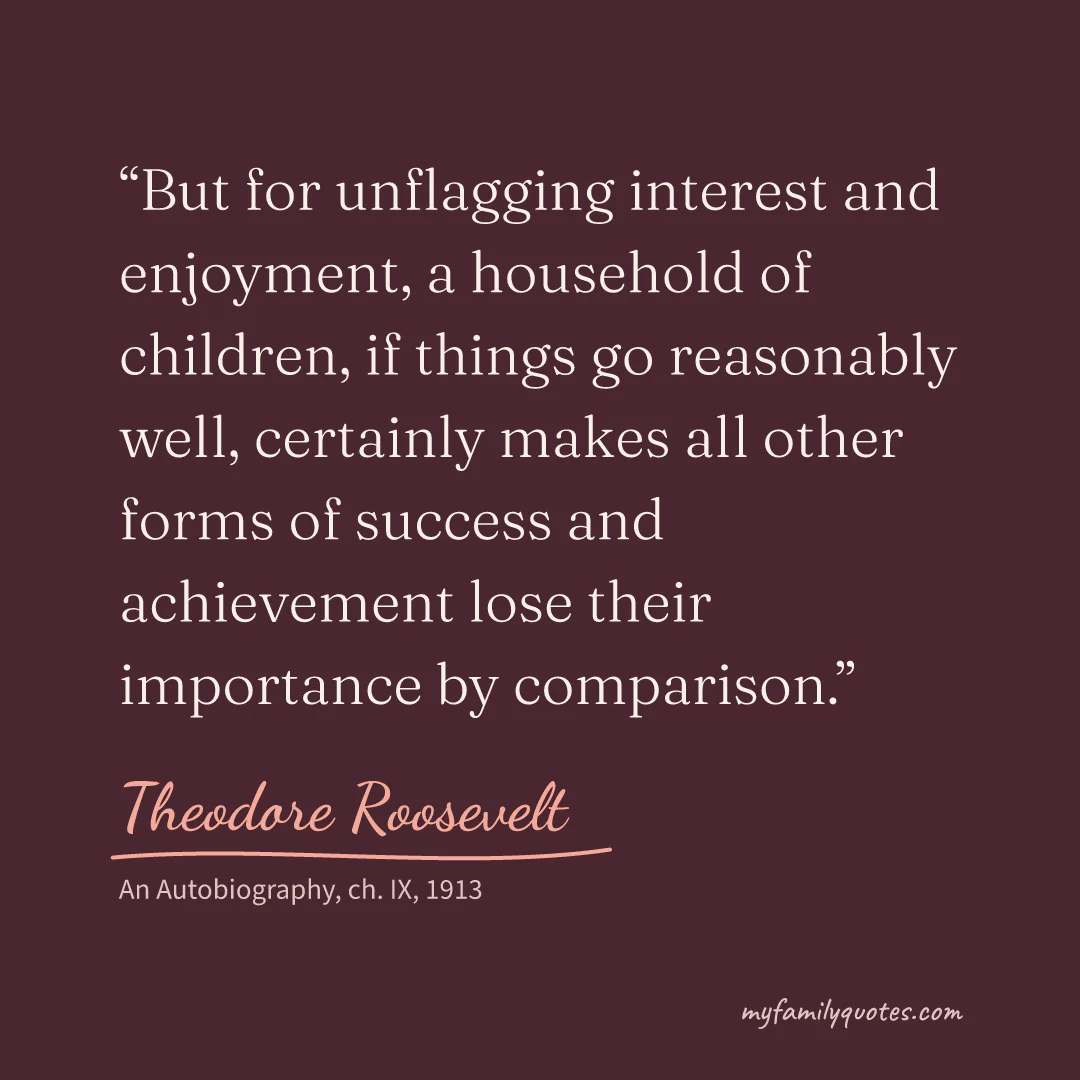
"But for unflagging interest and enjoyment, a household of children, if things go reasonably well, certainly makes all other forms of success and achievement lose their importance by comparison."
— Theodore Roosevelt, An Autobiography, chapter IX "Outdoors and Indoors" (1913)
Roosevelt had been president, a rancher, a colonel and a big-game hunter, and he lists most of those careers in the sentences just before this one. Then he ranks all of them below his six children at Sagamore Hill. The small hedge, "if things go reasonably well", is what makes the line honest rather than sugary: it is a man who knows that parenting can also go badly. It reads well on a first Father's Day card, or under a photo of a crowded kitchen table.
Being a good dad: what "present" actually means
Most quotes about being a good dad say "be there". These two say what being there involves, and what it does not.
"To say 'present' is not to say 'controlling'! Fathers who are too controlling cancel out their children, they don't let them develop."
— Pope Francis, General Audience, Paul VI Audience Hall, 4 February 2015 ("The family - 3. The father")
This comes from a series of Wednesday talks on the family. In the sentences just before it, Francis lists when a father should be close to his children: "when they play and when they strive, when they are carefree and when they are distressed, when they are talkative and when they are silent." Then comes the turn above. Later in the same talk he says, "A good father knows how to wait and knows how to forgive from the depths of his heart." Use the line above for a dad of teenagers, the stage where presence and control are hardest to tell apart.
"We need fathers to realize that responsibility does not end at conception. We need them to realize that what makes you a man is not the ability to have a child – it's the courage to raise one."
— Barack Obama, remarks at the Apostolic Church of God, Chicago, June 15, 2008 (transcript: The American Presidency Project)
Obama gave this speech on Father's Day 2008 as a presidential candidate, and in it he spoke about being raised by a single mother. The famous version you see on posters, "Any fool can have a child. That doesn't make you a father", is not in the transcript; see the note on misquotes below. The real sentence is better anyway, because it puts the weight on "courage". It suits a stepdad, an adoptive dad or a single dad, a man who chose the raising part.
Being a dad is hard, and mostly invisible
The best writing about fathers is often by grown sons who noticed the work too late. If you want one line for a dad who never complains, it is this one.
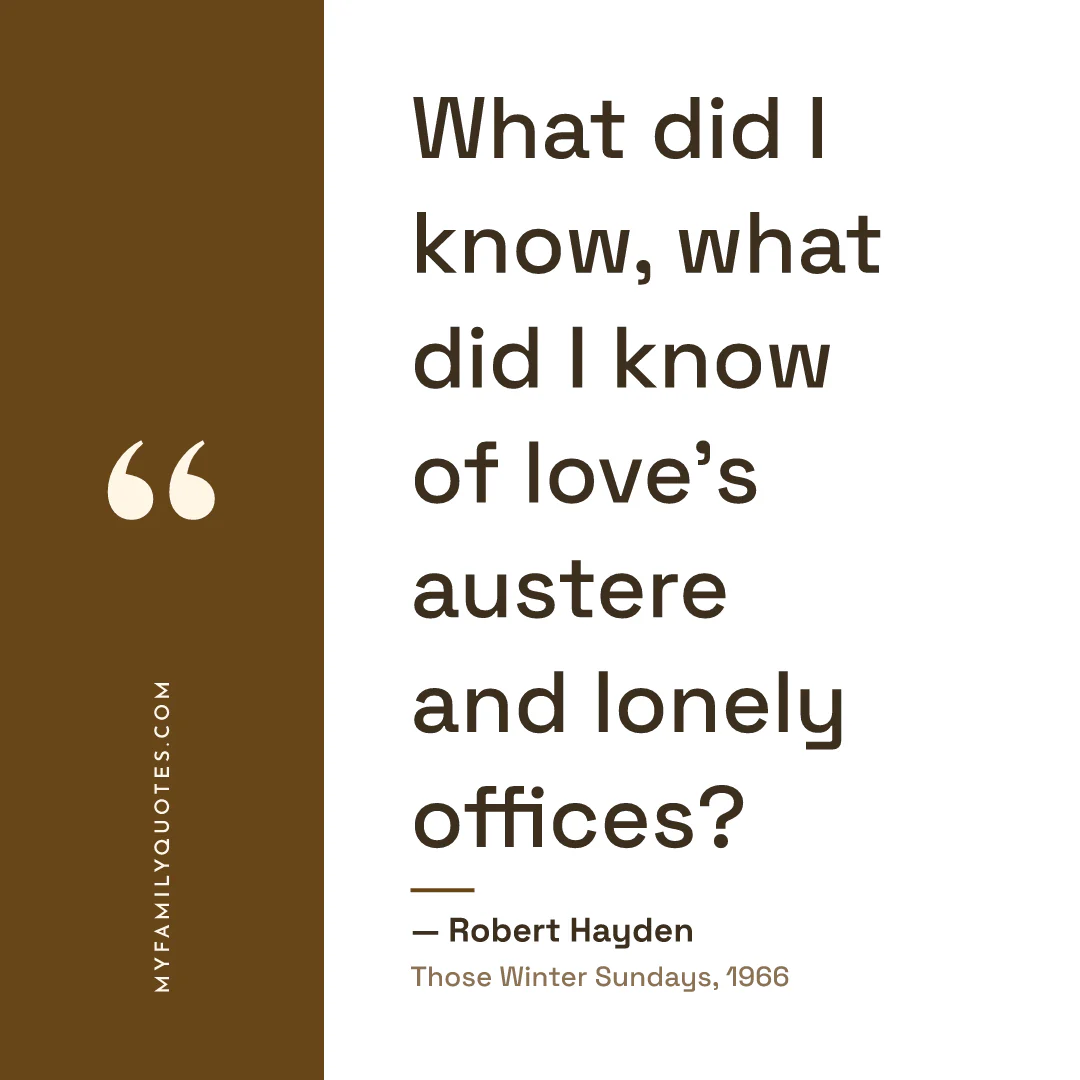
"Sundays too my father got up early / and put his clothes on in the blueblack cold, / then with cracked hands that ached / from labor in the weekday weather made / banked fires blaze. No one ever thanked him. … What did I know, what did I know / of love's austere and lonely offices?"
— Robert Hayden, "Those Winter Sundays" (copyright 1966, Collected Poems of Robert Hayden; text at poets.org)
Hayden grew up in Detroit's Paradise Valley neighborhood, raised by a foster family next door, William Hayden and Sue Ellen Westerfield; he later became the first African American writer to serve as Consultant in Poetry to the Library of Congress. The poem is short (14 lines) and is quoted here only in part. "Love's austere and lonely offices" means the dull duties of love: lighting the stove, polishing a child's shoes, doing it before anyone wakes. It is a strong line for a grown child's Father's Day card, and an even stronger one for a funeral or memorial card, where "No one ever thanked him" turns into a thank-you.
"I say this knowing that I have been an imperfect father – knowing that I have made mistakes and will continue to make more; wishing that I could be home for my girls and my wife more than I am right now."
— Barack Obama, remarks at the Apostolic Church of God, Chicago, June 15, 2008
In the same speech, a few paragraphs earlier, Obama explains that he had resolved to "break the cycle" and be a good father to his daughters. Then he admits this. The line is useful for the dad who feels he is failing at work-life balance, which is most of them: it says mistakes are part of the job, not proof that you are bad at it. Good for a text to a friend after a hard week, or a dad's own caption on a rare family weekend.
What a father hopes for his children
Being a dad also means working for a future you will not see. Two very different men put that hope into words.
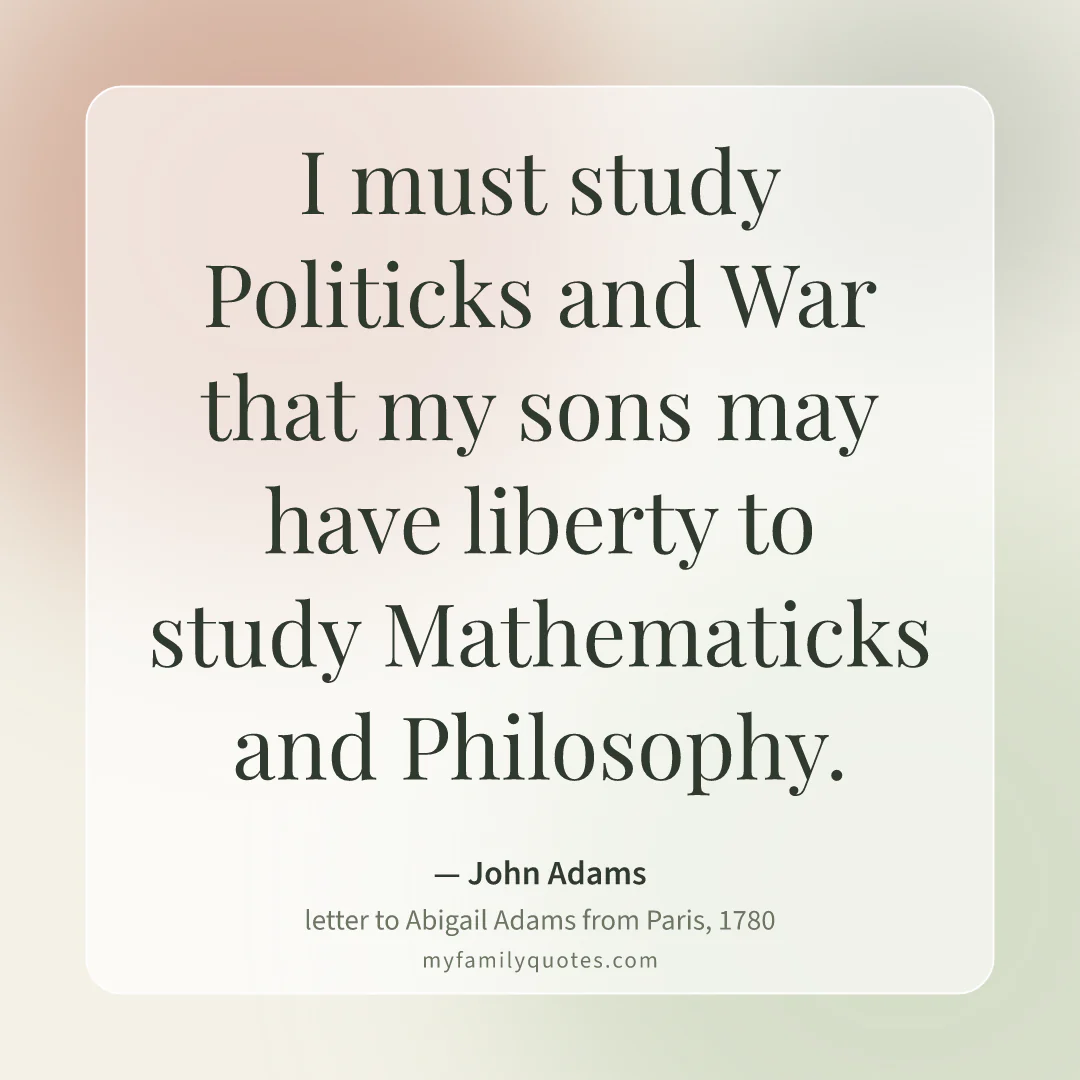
"I must study Politicks and War that my sons may have liberty to study Mathematicks and Philosophy. My sons ought to study Mathematicks and Philosophy, Geography, natural History, Naval Architecture, navigation, Commerce and Agriculture, in order to give their Children a right to study Painting, Poetry, Musick, Architecture, Statuary, Tapestry and Porcelaine."
— John Adams, letter to Abigail Adams from Paris, post 12 May 1780 (Adams Family Papers, Massachusetts Historical Society)
Adams was in Paris as a diplomat during the Revolutionary War, writing to his wife about the palaces, paintings and gardens he said he had no time to describe. One detail is visible in the Massachusetts Historical Society's transcription of the manuscript: Adams first wrote that his sons could study "Painting and Poetry", then struck those words out and moved the arts down a generation, to his grandchildren. That correction is the whole of fatherhood in miniature. It works for a graduation card, or for a father who works a job he does not love so his children can choose theirs. (His son John Quincy Adams did not exactly study porcelain; he became president.)
"Then he took his darling child, kissed him, and dandled him in his arms, praying over him the while to Jove and to all the gods. 'Jove,' he cried, 'grant that this my child may be even as myself, chief among the Trojans; let him be not less excellent in strength, and let him rule Ilius with his might. Then may one say of him as he comes from battle, "The son is far better than the father."'"
— Homer, Iliad, Book VI, translated by Samuel Butler (1898)
A moment earlier, Hector's baby son Astyanax cried and nestled in his nurse's arms, scared by his father's helmet with its nodding horse-hair plume; Hector and his wife Andromache laughed, and he took the helmet off. That small scene, more than 2,500 years old, is one of the oldest pictures we have of a dad making himself less frightening to a child. His prayer is the hope behind every good father: that the child will surpass him. Readers who know the story also know it does not end well for Hector or for his son, so use this for a son's milestone or a dad's toast, not a sympathy card.
Bible verses about being a father
Many Christian dads look for one verse for a Father's Day service, a baptism card or a church bulletin. These two describe a father's character rather than his rules. (For the rules, Proverbs and Ephesians, see our page on the Bible on a father's duty.)
"Like as a father pitieth his children, so the LORD pitieth them that fear him."
— Psalm 103:13 (King James Version)
"Pitieth" here means feels compassion for; modern translations say "has compassion on". The psalm turns the usual comparison around: it explains God by pointing to a good father, which assumes the reader already knows what tender fathering looks like. That makes it a quiet compliment for a dad's card.
"If a son shall ask bread of any of you that is a father, will he give him a stone? or if he ask a fish, will he for a fish give him a serpent?"
— Luke 11:11 (King James Version)
Jesus asks the question as if the answer were obvious, because to a father it is. The verse is about prayer, but it rests on a plain fact about being a dad: you give your children what they actually need, even when you are tired. It fits a provider who rarely hears thanks.
Which line fits which occasion?
| Occasion | Line to use | Why it works |
|---|---|---|
| Card for a brand-new dad | Twain, "you had to hand in your resignation" | Funny, true, no pressure |
| Dad's own Instagram caption | Roosevelt, "a household of children" | Pride without bragging |
| Father's Day card from a grown child | Hayden, "No one ever thanked him" | Thanks for the unseen work |
| Stepdad, adoptive or single dad | Obama, "the courage to raise one" | Honors the choice to stay |
| Dad of teenagers | Pope Francis, "'present' is not … 'controlling'" | Names the hardest balance |
| A dad who feels he is failing | Obama, "an imperfect father" | Mistakes are part of the job |
| Graduation or a first job | John Adams, "Politicks and War" | Sacrifice for the next generation |
| Toast to a son | Hector, "far better than the father" | The father who wants to be surpassed |
| Church card or baptism | Psalm 103:13 | Tender, short, traditional |
How to use a quote about being a dad in a card or caption
A quote does half the work. The other half is one sentence that only you could write. Three habits make the difference:
- Cut to the phrase that lands. On a card, "No one ever thanked him" is stronger than the full stanza. Use quotation marks and the author's name, and do not trim words in the middle without an ellipsis (…).
- Add one specific memory. The quote names the general truth; you name the Saturday, the car ride or the burnt pancakes that proves it.
- Match the tone to the dad. A dad who jokes will enjoy Twain more than Hayden. A quiet dad may be embarrassed by a long tribute and moved by two lines.
Three samples written by our editors (not quotations) to show the pattern:
- For a new dad: "Twain warned that the baby takes entire command. Six weeks in, how is the new boss treating you? Proud of you."
- From a grown child: "Hayden wrote about love's austere and lonely offices. You did all of them, every winter, and I'm saying thank you now."
- For a stepdad: "Obama said what makes a man is the courage to raise a child. You had that courage when nobody asked you to."
Three "being a dad" quotes that are not what they seem
Popular quote sites repeat these three lines with confident attributions. Here is what the record actually shows.
"Any fool can have a child. That doesn't make you a father. It's the courage to raise a child that makes you a father." This is usually credited to Barack Obama. The official transcript of his June 15, 2008 speech, quoted above, says something close but different: "what makes you a man is not the ability to have a child – it's the courage to raise one." The "any fool" wording is a later paraphrase. Quote the transcript.
"It is easier to build strong children than to repair broken men." It appears on countless school posters as Frederick Douglass. Writing in Pacific Standard in February 2018, William Cheng traced the motto in newspapers from 1975 onward with no mention of Douglass, and the earliest Douglass credit he found was a 1994 advertisement. His best guess at a seed is a different sentence in My Bondage and My Freedom (1855), about a slaveholder, not a child: "Once thoroughly broken down, who is he that can repair the damage?" Treat the poster line as unsourced.
"When I was a boy of fourteen, my father was so ignorant I could hardly stand to have the old man around." Credited to Mark Twain. Quote Investigator found it linked to Twain only after his death and no evidence that he said it; Twain's own father died when Twain was eleven. For more corrections like these, see our page on misattributed family quotes.
Questions about being a dad quotes
What is a good short quote about being a dad?
"He took entire command" (Mark Twain, about a new baby, 1879) for a funny card; "No one ever thanked him" (Robert Hayden, "Those Winter Sundays") for a heartfelt one; "the courage to raise one" (Barack Obama, 2008) for a stepdad or single dad.
What is a quote about being a good dad?
Pope Francis put it plainly in his General Audience of 4 February 2015: "To say 'present' is not to say 'controlling'!" Earlier in the same talk he said a father should be close to his children "when they play and when they strive." Psalm 103:13 is the classic Bible verse on the same idea.
Did Obama say "any fool can have a child"?
Not in those words. In his Father's Day speech at the Apostolic Church of God in Chicago on June 15, 2008, he said "what makes you a man is not the ability to have a child – it's the courage to raise one." The "any fool" version is a paraphrase.
For a father's own words to his daughter, from Jefferson to Du Bois, see daughter quotes from dad.