Writers and Creators on Togetherness: 40 Family Time Quotes for Instagram from Literature and Screen
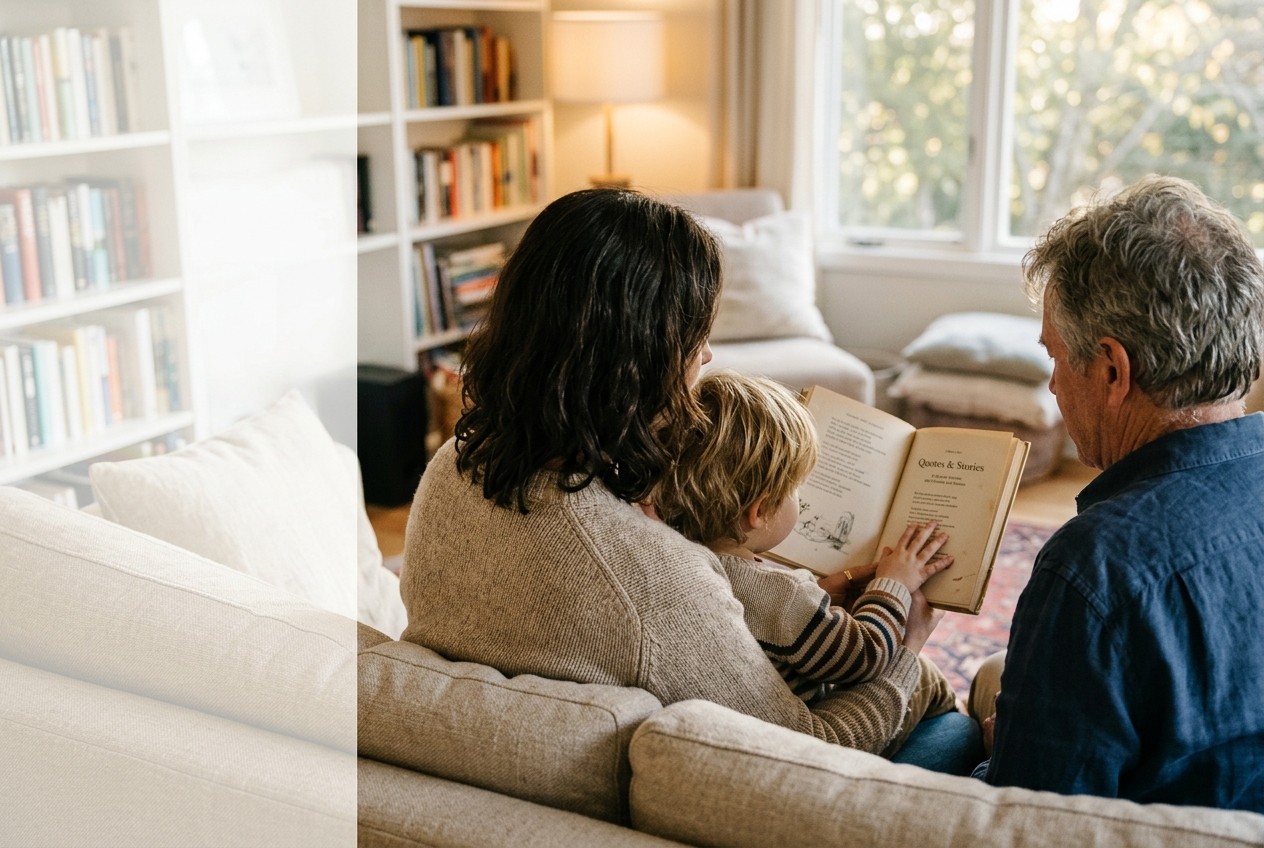
Late on a Tuesday evening in November 2023, snow began to fall steadily over Munich. Inside a small apartment near the Englischer Garten, three generations sat around a scuffed oak table, entirely ignoring the television playing quietly in the background. A grandmother dealt cards with practiced precision, her teenage grandson leaned back balancing his chair on two legs, and a half-eaten plate of pretzels sat abandoned in the center. Someone snapped a quick photograph of the scattered playing cards and intertwined hands. When the time comes to post that image, the visual tells only half the story. The right caption anchors the image in context, providing a specific temporal marker for a fleeting interaction. It adds a layer of emotional resonance to a simple snapshot of a Tuesday night.
Social media often flattens our experiences into polished highlights, stripping away the textured reality of domestic life. Words matter. Yet, when we pair an honest photograph with a thoughtful observation, the platform becomes a meaningful archive rather than a performance space. Selecting a caption requires moving beyond generic hashtags to find language that actually reflects the dynamic in the room. You might be looking at moments spent gathered in the same room, or perhaps you are focused on capturing fleeting childhood milestones before they fade into the broader blur of growing up. Whether you are finding the right words for a digital album or documenting the rhythmic ritual of a weekend meal, literature and cinema offer a vast vocabulary for our shared lives.
The Chaos of Gathering
Kitchen Counters and Dining Tables
We spend a significant portion of our lives hovering near food. Kitchens act as natural magnets for conversation, arguments, and quiet companionship. The clatter of plates provides a steady soundtrack. Writers frequently use the dining table as a stage for character development, revealing exactly how people relate to one another when forced to sit face-to-face over a shared meal. This architectural space forces people to look up from their individual pursuits and acknowledge the presence of the people they live alongside.
"The kitchen is the heart of the home, a place where stories are kneaded into the dough and secrets simmer in the broth." — Alice Hoffman, Practical Magic (1995)
"There is no spectacle on earth more appealing than that of a beautiful woman in the act of cooking dinner for someone she loves." — Thomas Wolfe, The Web and the Rock (1939)
"Cooking is about creating something with your own two hands and offering it to those you care for, a tangible expression of affection." — Julia Child, My Life in France (2006)
"The shared meal elevates eating from a mechanical process of nature to a communion of family and friends, a ritual of connection." — Michael Pollan, In Defense of Food (2008)
"We remember the arguments over the last piece of pie long after we have forgotten the taste of the pie itself." — Nora Ephron, Heartburn (1983)
"A family that eats together might sometimes argue over the salt, but they remain anchored to the same wooden table." — Barbara Kingsolver, Animal, Vegetable, Miracle (2007)
"The dinner table is the center for the teaching and practicing not just of table manners but of conversation, consideration, tolerance, family feeling, and just about all the other accomplishments of polite society." — Judith Martin, Miss Manners' Guide to Excruciatingly Correct Behavior (1982)
"Nothing makes a room feel more like a sanctuary than the smell of garlic sautéing in olive oil while people you love argue in the background." — Stanley Tucci, Taste: My Life Through Food (2021)
Road Trips and Living Rooms
Confined spaces force interaction. A long car ride demands conversation. When a family packs into a station wagon or crowds onto a single sofa, the physical proximity strips away the polite distance we maintain in public spaces, leaving only raw, unfiltered dynamics. Here, you often find humorous observations about eccentric aunts and uncles who dominate the stereo or claim the best seat near the heating vent. These enclosed environments act as pressure cookers for both intense irritation and sudden, unexpected affection.
"A road trip is a way for the whole family to spend time together and annoy each other in interesting new places." — Tom Lichtenheld, Everything I Know About Cars (2005)
"The living room was a landscape of discarded shoes, half-read newspapers, and the sprawling limbs of teenagers pretending not to listen to their parents." — Jonathan Franzen, The Corrections (2001)
"You don't choose your family. They are God's gift to you, as you are to them." — Desmond Tutu, God Has a Dream (2004)
"There is no such thing as fun for the whole family." — Jerry Seinfeld, SeinLanguage (1993)
"Family trips are an exercise in collective endurance, punctuated by moments of unexpected grace when someone spots a hawk or hands over the last fruit snack." — Anne Tyler, Breathing Lessons (1988)
"The greatest moments in life are not concerned with selfish achievements but rather with the things we do for the people we love and esteem." — Walt Disney, spoken during the opening of Disneyland (1955)
"Home is the place where, when you have to go there, they have to take you in." — Robert Frost, The Death of the Hired Man (1914)
"To us, family means putting your arms around each other and being there." — Barbara Bush, spoken at the Republican National Convention (1992)
Quiet Evenings and Shared Silence
Reading and Resting
Not every meaningful interaction requires dialogue. True comfort manifests as shared quiet. When people can sit in the same room for hours, absorbed in their own books or thoughts without feeling the anxious urge to fill the air with chatter, they have achieved a rare level of intimacy. The ambient noise of breathing, shifting pages, and settling floorboards creates a specific kind of domestic music.
"The best time of day is the quiet evening, when the house settles and the only sound is the turning of pages." — Carlos Ruiz Zafón, The Shadow of the Wind (2001)
"Silence is a profound form of communication when it is shared with someone who understands its weight." — Marilynne Robinson, Gilead (2004)
"There is a particular kind of peace that descends on a house when everyone is asleep but you, and you know they are safe under the same roof." — Shirley Jackson, Life Among the Savages (1953)
"We read to know we are not alone, but we read together to prove it." — C.S. Lewis, Shadowlands (1993 film adaptation)
"A house with a library in it has a soul, and a family that reads together shares that soul." — Plato (often misattributed, but popularized in 20th-century library campaigns)
"The most important thing in the world is family and love." — John Wooden, My Personal Best (2004)
"At the end of the day, a loving family should find everything forgivable." — Mark V. Olsen, Big Love (2006)
"In the quiet of the evening, the chaotic noise of the day fades, leaving only the steady rhythm of breathing from those sleeping nearby." — Toni Morrison, Beloved (1987)
Generational Echoes
Elders and Children
Grandparents hold the historical record. They remember the beginning. Observing a grandfather explain the mechanics of a 1978 Polaroid camera to a child who has only ever known digital touchscreens provides a vivid illustration of how knowledge bridges the gap between different eras. You can often hear the specific dialogue between mothers and their girls echoing the exact phrases used decades earlier in entirely different cities.
"If you look deeply into the palm of your hand, you will see your parents and all generations of your ancestors." — Thich Nhat Hanh, No Death, No Fear (2002)
"Children are the anchors that hold a mother to life." — Sophocles, Phaedra (circa 400 BCE)
"What greater thing is there for human souls than to feel that they are joined for life?" — George Eliot, Adam Bede (1859)
"The history of our grandparents is remembered not with rose petals but in the laughter and tears of their children and their children's children." — Charles F. Kettering, Prophet of Progress (1961)
"A grandmother is a little bit parent, a little bit teacher, and a little bit best friend." — Rachel Wyatt, The Day of the Triffids (1951)
"We inherit not just the physical traits of our ancestors, but their unresolved questions and their quietest hopes." — Carl Jung, Memories, Dreams, Reflections (1961)
"The older I get, the more I see the power of that young woman, my mother." — Maya Angelou, Mom & Me & Mom (2013)
"To understand your parents' love, you must raise children yourself." — Chinese Proverb (widely circulated in 20th-century anthologies)
Sibling Bonds
Brothers and sisters serve as our first peers. They witness our earliest mistakes. Siblings share a foundational vocabulary of inside jokes, unspoken resentments, and fierce loyalties that outsiders can rarely penetrate, no matter how closely they observe the dynamic. They function as living mirrors, reflecting back both our best traits and our most frustrating habits.
"Half the time when brothers wrestle, it's just an excuse to hug each other." — James Patterson, I Funny (2012)
"A sister is a gift to the heart, a friend to the spirit, a golden thread to the meaning of life." — Isadora James, Sister to Sister (1995)
"Siblings are the people we practice on, the people who teach us about fairness and cooperation and kindness and caring, quite often the hard way." — Pamela Dugdale, The Sibling Effect (2011)
"You may be as different as the sun and the moon, but the same blood flows through both your hearts." — George R.R. Martin, A Game of Thrones (1996)
"To the outside world, we all grow old. But not to brothers and sisters. We know each other as we always were." — Clara Ortega, The Family Tree (1988)
"Our brothers and sisters are there with us from the dawn of our personal stories to the inevitable dusk." — Susan Scarf Merrell, The Accidental Bond (1995)
"There is no buddy like a brother." — Unknown (popularized in mid-century greeting cards)
"A sibling represents a person's past, present, and future." — John Corey Whaley, Where Things Come Back (2011)
What People Usually Get Wrong
What you hear: Social media captions must be entirely original.
The fuller picture: Borrowing language from established writers often provides a more articulate framing for your photograph than a rushed, original sentence typed on a phone keyboard.
What you hear: Family photos require overly sentimental quotes.
The fuller picture: Humor, dry observation, and even mild cynicism about domestic chaos often resonate more deeply with audiences than saccharine declarations of perfect love.
What you hear: You should only quote famous philosophers or poets.
The fuller picture: Dialogue from contemporary films, stand-up comedy routines, and modern memoirs frequently captures the reality of modern kinship better than classical texts.
Take a moment to scroll through the photographs sitting idle in your phone's camera roll from the past month. Select one image where the lighting is poor but the expression on someone's face is entirely genuine, write down the specific date it was taken, and text it to the person in the frame without any explanation.